chem241 - ketones & aldehydes
 Call Kai
 Learn
 Practice Test
 Spaced Repetition
 Match
 Flashcards
 Knowt Play
1/47

There's no tags or description
Looks like no tags are added yet.
48 Terms
ketone

aldehyde

aldehyde nomenclature
suffix “—al” (-anal)
higher priority > ketone

ketone nomenclature
suffix “—one”

naming priorities
carbox acid > aldehyde > ketone > alcohol > amine > thiols

physical properties
strong dipole
↑ BP
Nu acyl substitution
add Nu & protonate C=O → OH
SNu
Wnu
SNu acyl substitution
reagents
1. SNu
2. dil H+

WNu acyl substitution
reagents
1. H3O+
WNu (H2O, MeOH, EtOH)

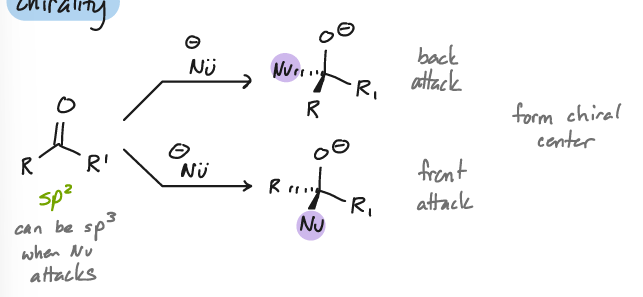
chirality
rxm defined by Nu type
re-face
si-face
mostly attack both sides (racemic)
show both products
distinguish between faces
re-face
R config (CW)

si-face
S config (CCW)

carbon Nu addition
make OH group + other group
grignard
organolithium
alkyne
cyanonuclleophile (cyanohydrin)
corey-seebach
wittig rxn
grignard Nu addition
SN2
reagents: RMgBr, RMgCl, RMgI
limitation → no acidic proton

organolithium Nu addition
violent reaction, prefer grignard
reagents:
1. RLi
H+

alkyne Nu addition
reagents
1. SNu
ketone
dil H+

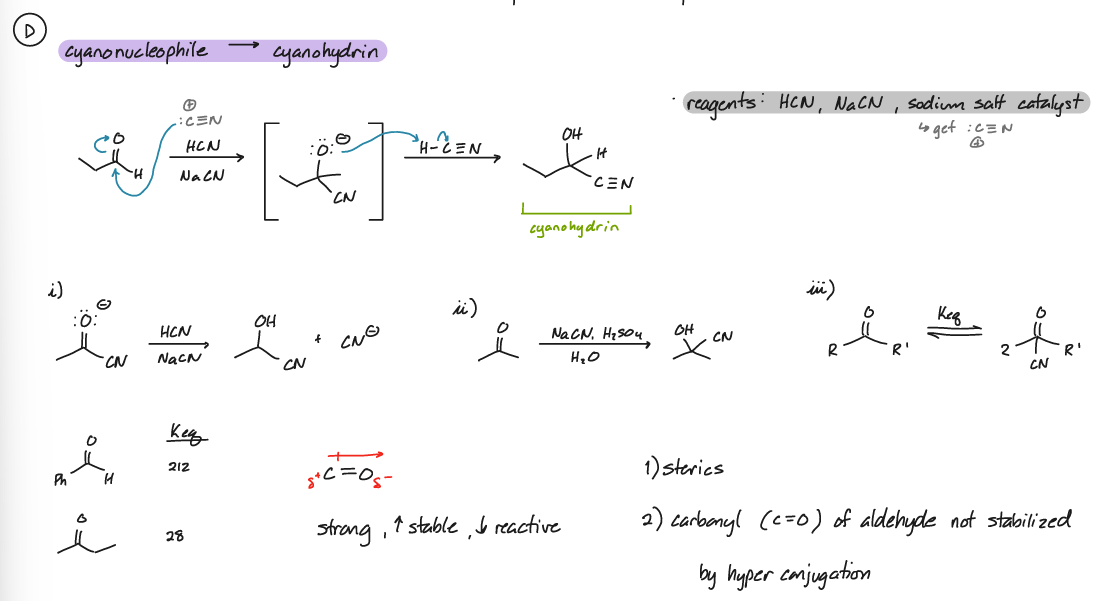
cyanonucleophile addition
cyanohydrin
reagents
HCN, NaCN, sodium salt catalyst (+C≡N)
sterics
cabonyl of aldehye not stabilized by hyperconjugation
corey-seebach
replace “H” in aldehyde only w/ E+
reagents
1. C3H2S2, AlCl3
2. BuLi, THF, 0°C
E+ (RX)
MgO, H2O

wittig reaction
add P(Ph)3 to RX group
reagents:
1. PPh3
BuLi or NaH

wittig mechanism

oxygen Nu addition
react w/ keton to get hydrate geminal diol
reagents: ketone, H2O, acid/base

hydrate geminal diol

hydrate formation
make hydrate geminal diol from ketone
basic
acidic
basic hydrate formation
reagents:
ketone
OH—
H2O

acidic hydrate formation
reagents
ketone
H3O+
excess H2O

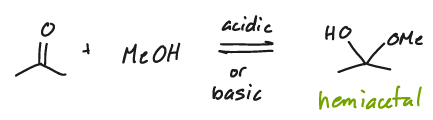
hemiacetal formation
when Nu is ROH → hemiacetal
basic
acidic
basic hemiacetal formation
reagents
ketone
excess EtOH

acidic hemiacetal formation
reagents
ketone
excess EtOH2+

EtOH2 formation
under acidic condition
if excess ROH → rxn go forward → acetal
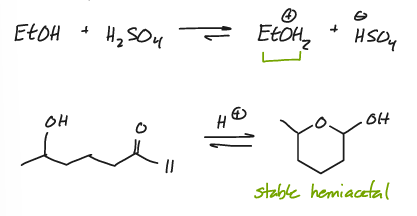
acetal formation
add geminal OMe groups
acetals are protecting groups for ketones & aldehydes

acetal example

nitrogen Nu
react w/ ketones & aldehydes to give imine/enamine
1° amine → imine
2° amine → enamine
imine formation
1° amines
reagents: R-NH2, H+
need alpha-H
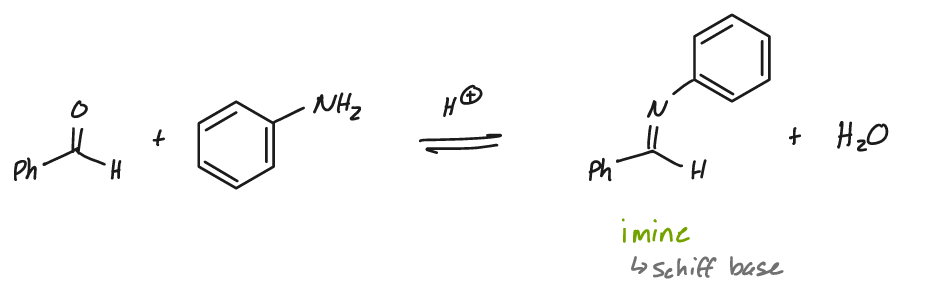
imine mechanism

enamine formation
2° amines
reagents: R-NH, H+
E/Z often reverse this rxn

enamine mechanism

stork enamine reaction
reagents
1. R-NH, RX
2. H2O, H+

redox reactions
reduce C=O → OH
carbonyl reduction
aldehyde & ketone reduction
catalytic reduction
clemmenson reaction
wolf kishen
mozingo rxn
reductive amination
carbonyl reduction
reduce C=O → OH
reagents: NaBH4, EtOH
NaBH4 - reducing agent for ketones & aldehydes

carbonyl aldehyde reduction
reagents:
NaBH4
dil H+

carbonyl ketone reduction
reagents:
LiAlH4
dil H+

carbonyl reagent differences
important for labeling

catalytic reduction
reagents:
H2, Pt or H2, Pd

clemmensan reaction
not benzylic position → reduce to CH2 (ketone/aldehyde) ONLY
under acidic cond.
reagents
Zn(Hg), HCl

wolf kishen
reagents
H2N—NH2, KOH, △

reductive amination
reagents:
R-NH2, H+
H2, Ni
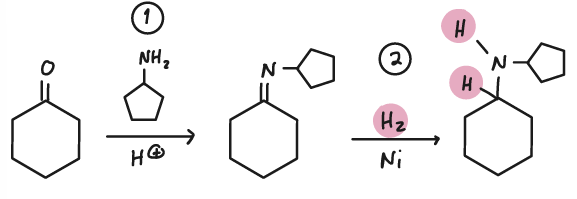
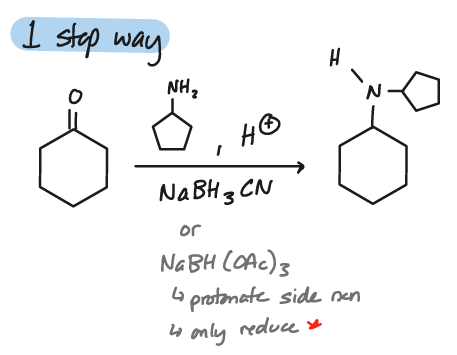
1 step reductive amination
reagents:
R-NH2, H+, NaBH3CN or NaBH(OAc)3