Kines 350 Exam 2
 Call Kai
 Learn
Learn Practice Test
 Spaced Repetition
 Match
Match Flashcards
 Knowt Play
1/66

There's no tags or description
Looks like no tags are added yet.
Name | Mastery | Learn | Test | Matching | Spaced | Call with Kai | Chat |
|---|
No analytics yet
Send a link to your students to track their progress
67 Terms
What is metabolism?
all the chemical reactions that occur in the body of a living organism
What is the difference between anabolic and catabolic reaction?
Anabolic- synthesize molecules and reactions
Catabolic- break down molecules and reactions
What is Bioenergetics?
Process of converting foodstuff (fats, proteins, carbs,) into usuable energy
What consists inside a cell structure?
A cell membrane- a semi-permeable membrane that separates the cell from the extracellular environment
Nucleus- contains genes that regulate protein synthesis
Cytoplasm- fluid portion of the cell, contains enzymes, (in muscle, contractile proteins) contains organelles (mitochondria, vesicles, proteins)
What are the two mitochondria inside in a muscle fiber?
Subsarcolemmal mitochondria
Intermyofibrillar mitochondria
What are the three different types of reactions that use energy?
Endergonic reactions- require energy to be added to reactants
Exergonic reaction- energy is released
Coupled reactions- liberation of energy in an exergonic reaction drives an endergonic reaction
What is the difference between animals and plants metabolism to obtain energy?
Animals- use CO2 and H2O to convert them into energy by cellular respiration
Plants- Plants use O2, Sunlight and H2O to convert them into energy by photosynthesis
What are REDOX reactions?
A chemical reaction by a transfer one electron from a molecule to another one, one is essentially being oxidized and one is being reduced
What does oxidation mean?
removing an electron from an atom or molecule
What does reduction mean?
Addition of an electron to an atom or molecule
What are the roles of NAD and FAD in electron transport?
NAD can become oxidized to form: NAD+
NAD can become reduced to form: NADH
FAD can become oxidized to form: NAD+
FAD can become reduced to form: FADH2
Both of these molecules play an important role in transfer of electrons
What are enzymes? What are some factors that regulate enzyme activity?
Enzymes are cellular proteins that act as catalysts to increase the speed of reactions by lowering the energy activation of reactions
Factors: temperature, pH, certain diseases that damage cells enzymes will show up in blood)
What is the enzyme lock and key hypothesis?
A substrate will “lock” into an active site of an enzyme, they will create an enzyme-substrate complex, water is added, and will then form enzyme-product complex and eventually release the product
Classification of enzymes
Almost all enzymes end in -ase
Kinases- add a phosphate group
Dehydrogenases- remove hydrogen ions
Oxidases- catalyze redox reaction involving oxygen
Isomerases- rearrangement of the structure of molecules
What is a cool fact about measuring enzyme levels in the blood?
In healthy people, enzymes are NOT found in the blood
In people where diseases damage cells, these cells release enzymes into the bloodstream
What are fuels of exercise/ energy?
Carbohydrates- glucose(blood sugar), glycogen( composed of glucose molecules), glycogenolysis (breakdown of glycogen to glucose)
Lipids- fatty acids (primary type of fat used by skeletal muscle), triglycerides (storage of fat in adipose tissue), phospholipids (barrier for cellular membrane), steroids (derived from cholesterol NOT energy source)
Protein- amino acids contribute to convert to energy
What is the molecule that brings energy?
ATP creates energy which is an electrostatic energy between a push and pull of electrons in new arrangements
Food is broken down which is_____ to make ATP which is _____
then ATP is broken down which is_______ to do cellular work which is ______
a. exergonic
b. endergonic
c. exergonic
d. endergonic
What are the 3 metabolic pathways to make energy for muscle contraction?
ATP-PC system (Phosphocreatine system)
Glycolysis
Oxidative Phosphorylation

What are the steps of ATP-PC (Phosphocreatine system)?
Phosphocreatine is already in a muscle and adds ADP with creatine kinase to give ADP phosphorus to ATP and creatine
Happens in muscle cell
Used for short bursts of activity, initial liftings, sprinting, high jump
Anaerobic, so it does not use oxygen
Creatine supplement can improve high intensity exercise

What are the steps of Glycolysis?
Anaerobic and happens inside sarcoplasm/cytoplasm
Glucose- from either the bloodstream or breakdown of glycogen is used
2 ATP is transformed into 2 ADP from hexokinase
When the 2nd ATP is transformed into ADP the rate limiting enzyme Phosphofructokinase (PKF) controls the speed of glycolysis
Then NAD+ is reduced to 2 NADH
Another 2 ADP is then transformed into 2 ATP
Glycolysis has now a net gain of 2 ATP
Pyruvate is the byproduct of glycolysis which w/o the presence of oxygen becomes lactate by accepting 2 H+ and forms NAD+ to recycle to keep the cycle going
Pyruvate Lactate is the primary end-product of glycolysis!

What are the steps of Citric Acid Cycle within Oxidative Phosphorylation?
Aerobic and in the mitochondrial matrix, for each glucose molecule it cycles TWICE
NADH from Glycolysis either donates it’s H+ ion to Pyruvate to make Lactate or sends H+ ions across the inner mitochondrial membrane
Pyruvate from Glycolysis is then transformed into Acetyl-CoA in the presence of oxygen, then enters citric acid cycle which combines with oxaloacetate (4 C)to form citric acid (6 C)
Isocitrate Dehydrogenase (rate limiting enzyme) controls speed of cycle
CO2 is released from the series of reactions and synthesizes 1 ATP
GTP is directly converted into ATP
NAD+ is converted into NADH thrice (in total 6)
FAD+ is converted into FADH2 twice (in total 2)
GTP is converted into ATP twice (in total 2)
CO2 is a byproduct of conversion (in total 4)
True or False Glycogen breaking down from Glycolysis is the only way Acetyl-CoA can be made
False, Acetyl-CoA can be made from glycogen, fatty acids, or amino acids
What is the term for fatty acids converting into Acetyl-CoA
Beta-Oxidation
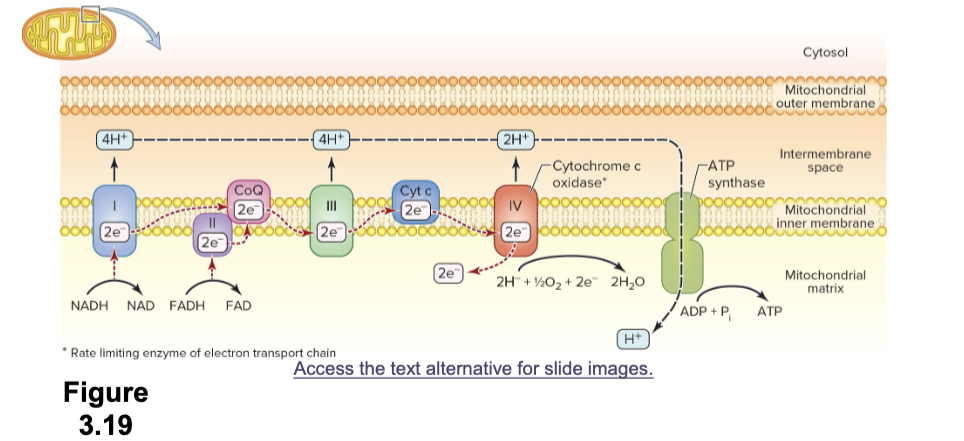
What happens in Oxidative Phosphorylation?
Happens in the intermembrane space of the mitochondria
The 6 NADH, 2 FADH2, and H+ ions inside the mitochondrial matrix create a H+ gradient
Protein complexes bind NADH and FADH2 to release H+ions and pump H+ ions into the intermembrane space and they flow to ATP synthase to then undergo an endergonic reaction between ADP+Pi to ATP
O2 is used to push the flow of electrons and H+ ions to form water called chemiosmosis
Overall how much ATP does one molecule of Glycogen produce?
32 total ATP
How efficient is Oxidative Phosphorylation?
Aerobic respiration is about only 34% efficient the rest is released as heat!!
What is the process of the feedback loop for the rate limiting enzymes?
High levels of ATP and ADP+Pi will send feedback and inhibit those enzymes, low levels of ATP and ADP+Pi stimulate productions
Calcium stimulates aerobic ATP production
List each metabolic pathway and their rate limiting enzyme
ATP-PC: creatine kinase Very short term exercise
Glycolysis: PFK (Phosphofructokinase) short term exercise
Citric Acid Cycle: Isocitrate dehydrogenase long term exercise
Oxidative Phosphorylation: Cytochrome oxidase long term exercise

List the order in which the bioenergetic from low intensity exercise to high
ATP-PC system- used first and depletes very quickly
Glycolysis- takes time to break down glucose and then depletes with oxygen
Aerobic - takes time to bring oxygen and use it for long term exercise
What is VO2 and VO2 max? What are is the resting O2 consumption at rest?
VO2-volume of oxygen within our bodies that we use
VO2max- max volume of oxygen uptake that we use for intense exercise
Our resting O2 consumption is 0.25L/min and 3.5mL/kg/min
What is one “MET”?
the amount of energy your body uses at rest about 3.5 mL/kg/min
What about energy requirement during rest to exercise transition?
initial exercise is anaerobic ATP-PC and Glycolysis then after about 4 minutes with same intensity then more ATP is needed to aerobic Citric Acid Cycle and Oxidative Phosphorylation due to lag of Oxygen intake
What does the time course of VO2 Consumption at beginning of exercise tell us about bioenergetic pathways used in muscle?
VO2 consumption in the beginning of exercise indicates energy is supplied by oxidative phosphorylation
There is a slow rise of VO2 in the beginning because exercise transitions from anaerobic to aerobic pathways to produce sufficient ATP
What is Oxygen Deficit?
It is the amount of time it takes oxygen to enter from cardiovascular system to muscle cells, this has the muscle cells in a “deficit” of oxygen needed to continue exercise in - - an average person’s oxygen deficit in initial exercise till 2.5 mL/kg/min is reached
True or False: Athletes/training helps increase oxygen deficit because they need more oxygen to train longer
False, Athletes/training can decrease the oxygen deficit, meaning the oxygen will be delivered and used quicker in muscles than in the average person. This is because they develop an aerobic bioenergetic capacity from cardiovascular and muscle adaptations. It is not because they need more oxygen to train longer
What is EPOC?
Exercise Post Oxygen Consumption- recovery in oxygen depletion from exercise, relative to our VO2 only about 20% is actually used to “repay” deficit
Rapid component- re-synthesis of PC in muscle and replenish muscle (myoglobin) and blood (hemoglobin) O2 stores
Slow component- elevated HR, increased Body Temp, increases epinephrine and norepinephrine, conversion of lactic acid to glucose (gluconeogenesis)
Explain why EPOC is greater following high intensive exercise
Higher body temp, additional O2 required for resynthesis
Greater concentrations of lactic acid in blood
Higher levels of blood epinephrine and norepinephrine at end of exercise
What is “steady state” drift?
It is the VO2max at exercise in different temperatures
In cool temperatures: exercise in colder environments allows us to increase our VO2max
In hot temperatures: exercise in hotter environments our VO2 max is less because of increases body temp. and rising concentrations of hormones in epinephrine and norepinephrine
What determines our VO2max?
Influence by genetic factors and training, however training can only do so much if our genetics determine our capacity.
What are the physiological factors that determine VO2 max?
Maximum ability of cardiorespiratory system: how well oxygen can be uptaken and delivered" to our muscles
Maximum ability of our muscles to use oxygen and produce ATP, extraction
What does a plateau of O2 consumption mean in intense exercise? If plateau is not achieved what is the secondary criteria that can confirm VO2 has been reached?
When someone’s O2 max plateaus it indicate their VO2 max has been reached, however take in to account that most people do not reach O2 plateau
If O2 does not plateau we can look at:
reaching age-predicted max heart rate
achieve blood lactate concentration of 8mM or higher
Attaining a respiratory exchange ratio of 1.15 or higher
However these criteria might not “prove” that VO2max has been reached
What is lactate threshold?
the work rate at which blood lactate acid rises systematically during incremental exercise
appears at 50%-60% VO2max in untrained people
occurs at higher work rates 65%-80% VO2max in endurance trained people they have a higher lactic acid threshold
What is OBLA?
it is the onset blood lactate accumulation due to the concentration gradient (lactate wants to move out of cell to blood) contributes to fatigue, changes pH in blood
What two major factors determine levels of lactate in the blood? What are other factors that contribute to
Lactate removal from the blood (liver, heart, muscles) (if they do not remove lactate fast enough)
Citric acid cycle is too slow so the buildup of lactate from glycolysis
Others: recruitment of fast-twitch fibers (makes more lactic acid by glycolysis is used), epinephrine and norepinephrine stimulation of glycolysis, and reduced rate of lactate removal (organs rate of using lactate slows)
What ratio is used to estimate the fuel utilization during exercise? How do we determine R? What can this ratio help determine which fuel source is used?
The respiratory exchange ratio (VCO2/VO2) the ratio of carbon dioxide produced to the oxygen consumed
R can only be determined if we are in a steady-state of exercise and assuming also that “0” protein is being used, this is important because in steady-state exercise the VCO2 and VO2 are directly reflecting the exchange of gasses
The caloric equivalent for Oxygen determines which fuel source is used based on R, this is reflective of the table so if the R is 0.7 we are using 100% Fat
for example: C16H32O2+23O2 → 16CO2 +16H2O
R= 16CO2/23O2=0.7 kcal/L O2
What are some factors that govern fuel selection during exercise?
Exercise intensity (aka the submaximal VO2)
Exercise duration
Availability of fuels (availability of muscle glycogen and glucose in blood, or available free fatty acids)
What is fuel is primarily used in low intensity exercise (about 60% VO2max)?
Fats are used in low intensity, prolonged exercise
What fuel is primarily used during high intensity exercise (>70% VO2max)?
Carbohydrates are primarily used
What 2 reasons bring the crossover of fuels from fats to carbs as exercise intensity increases?
recruitment of fast twitch fibers (ATPase breaks down ADP faster to generate more energy and therefore uses muscle glycogen)
increasing blood levels of epinephrine to generate glycogen breakdown

Explain this graph regarding Crossover Concept
When we increase our exercise intensity and our percentage of VO2max is increasing we switch fuel sources based on fast twitch fibers and hormonal factors, this will increase the usage of carbohydrates and decrease the use of fats. Fats are primarily used in the beginning of low intensity exercise that is why there is a crossover

What fuel is primarily used in prolonged, low-intensity exercise? What enzyme helps the transition and what is one reason why this happens?
initially carbohydrates are used in glycolysis to make pyruvate and then Acetyl-CoA, if we are in a prolonged, low-intensity workout we will shift our fuel source to fats, using beta oxidation to form Acetyl-CoA
Lipases will break down triglycerides to form Acetyl-CoA
This is stimulated by blood levels of several hormones
What does the saying “fats burn in the flame of carbohydrates" mean?
It means that initial exercise uses carbohydrates in Glycolysis in order to make pyruvate and then enter the citric acid cycle, if Carbohydrates are depleted, pyruvate won’t form and therefore fat oxidation will not occur
FATS NEED CARBS TO BE METABOLIZED
Are there ways to supplement carbohydrates during prolonged exercise such as a marathon?
Yes, if we deplete of carbohydrates in muscle and blood too fast we will experience fatigue, so we can ingest glucose packets, gatorade, carb-packed bars, etc.
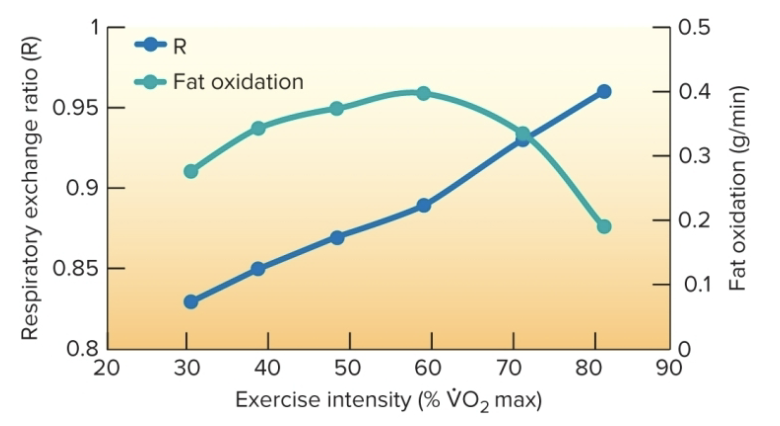
What exercise intensity is best for burning fat?
Around 60% of VO2max (prolonged moderate intensity), In order to burn fat we must be in a deficit of fuel source. If we increase our intensity we would be depleting carbs more.
This is called our FATmax- highest rate of fat oxidation which is reached just before lactate threshold

Where are the sources of our fuel supply during exercise? For carbohydrates? For fats?
Carbs: muscle glycogen and blood glucose
Free Fatty Acids: muscle fat stores and white adipocytes in numerous locations in the body

Explain these graphs during prolonged submaximal exercise
LEFT: muscle glycogen is used first due to fast twitch fibers already ready to be used, they deplete fast and there is a crossover to blood glucose then used to continue glycolysis and citric acid cycle
RIGHT: since fat needs carbs in order to be metabolized it will use muscle triglycerides first because they are already available in muscle cells, it then will use free fatty acids in the blood
What does neuroendocrinology help with messaging target tissue for exercise?
Neuroendocrine system is made up of the nervous system and the endocrine system
Endocrine System: releases hormones into blood to circulate to tissues
Nervous System: uses neurotransmitters to relay messages from one nerve to another
Both of these systems help regulate our fuel sources that are used in for our bioenergetic pathways
What are endocrine glands and what do they secrete?
Endocrine glands are glands throughout our body that release hormones into our body
Hormones are chemical messengers that can only bind to specific protein receptor on a “target tissue” to work
What are some different types of hormones, what hormone is used mainly for exercise?
Amino Acid derivative (tyrosine)
Peptide/Protein hormone (insulin)
Steroid hormone (cortisol)
Hormones that are relevant to exercise help regulate fuels for exercise, carbs, fats, proteins
What does cortisol and the GH (growth hormone) do?
It maintains blood glucose and helps stored fuel sources more available
What are the 3 cellular mechanisms of hormone action?
Activation of genes to alter protein synthesis (enter via the blood vessel to a target cell binded by a carrier protein, enter the nucleus and promote protein synthesis for a steroid response within the cell)
Activating second messengers in the cell via G protein ( hormones will act differently based on their composition, they will bind via receptor protein and activate G proteins to start a chain of reactions of second messengers)
Altering membrane transport: enzyme linked receptors (for example insulin will bind to an insulin receptor (tyrosine kinase) and will activate GLUT4 allows storage of blood glucose inside the cell)
During exercise how do our hormones respond? What do they effect on fuel utilization?
Epinephrine/Norepinephrine: ↑ mobilizes fats and carbs
Cortisol: ↑ mobilizes fats and preserves blood glucose
GH: ↑ uses gluconeogenesis to replenish blood glucose
Glucagon: ↑ mobilizes fats and preserves blood glucose
Insulin: ↓ uptake of blood glucose into the cell
Where does insulin come from what abut glucagon? What are the different responses of these hormones when we just ate a meal v.s during fasting and exercise?
Both come from Pancreas but
Insulin: β -cells
Glucagon: α-cells
After a meal:
↑ Insulin and ↓ Glucagon which ↑ storage of glycogen, fat, and protein, ↓ blood glucose, amino acid, and FFA availability
During fasting and exercise:
↓Insulin ↑ Glucagon which ↓storage of glycogen, fat, and protein, ↑ blood glucose, amino acid, and FFA availability

True or False: Trained individuals generally have a lower hormonal response during exercise because their bodies are more efficient at making fuel sources available to working muscles.
True, trained people have less insulin that is storing glucose and free fatty acids, so they are more readily available

True or False during exercise β -cells in the Pancreas release more Insulin
False during exercise Insulin levels drop, therefore allowing more available blood glucose, proteins, and FFA
What is the Cori Cycle?
When our bodies produce lactate via Glycolysis, it enters our blood stream via veins, it then is pumped out by our heart to our liver, brain and skeletal muscles, these organs transform lactate to blood glucose called gluconeogenesis