TEAS States of Matter/ chemistry
 Call Kai
 Learn
 Practice Test
 Spaced Repetition
 Match
 Flashcards
 Knowt Play
1/50

There's no tags or description
Looks like no tags are added yet.
51 Terms
1. First, what is matter?
anything that has mass and takes up space.
There are 4 states of matter:
Solid
Liquid
Gas
Plasma
2. Understand each state SUPER easily
. SOLID = STAYS IN PLACE
Particles are packed VERY close together.
Particles vibrate in place.
Has a FIXED shape.
Has a FIXED volume.
Lowest particle energy.
Example: Ice, rock, wood.
2. LIQUID = FLOWS
Particles are close but can slide past each other.
Takes the shape of its container.
Has a FIXED volume.
More energy than solids.
Example: Water, milk, juice.
3. GAS = SPREADS EVERYWHERE
Particles are VERY far apart.
Move quickly and freely.
Takes the shape of its container.
Fills the ENTIRE container.
More energy than liquids.
Example: Oxygen, helium, water vapor.
4. PLASMA = SUPER ENERGETIC GAS-LIKE STATE
Has extremely high energy.
Contains electrically charged particles.
Often found at very high temperatures.
Example: Sun, stars, lightning.
3. The BIGGEST thing to memorize: Shape vs. Volume
First, two important definitions:
Shape: What something looks like.
Volume: How much space something takes up.
State | Shape | Volume |
|---|---|---|
Solid | Fixed | Fixed |
Liquid | Changes | Fixed |
Gas | Changes | Changes |
Plasma | Changes | Changes |
Memory trick:
SOLID = keeps BOTH.
LIQUID = keeps VOLUME, loses shape.
GAS = loses BOTH.
Think about it:
Ice cube: Keeps its shape.
Water: Changes shape depending on the glass, but the amount of water stays the same.
Air: Spreads out and fills the whole room.
4. Three HARD words made EASY
1. Cohesion
Means particles of the SAME substance stick together.
Think: COHESION = CLINGING.
Strong cohesion = particles stick together tightly.
Weak cohesion = particles can separate more easily.
2. Particles
Tiny pieces that make up matter.
Think: Particles = tiny building blocks.
3. Density
How tightly packed particles are in a certain amount of space.
Think: Density = HOW PACKED TOGETHER?
High density = particles packed closely.
Low density = particles spread far apart.
5. Energy and particle movement
As energy increases, particles move more freely.
Solid
Lowest energy
Particles vibrate in place.
Liquid
Particles slide around each other.
Gas
Particles move quickly and spread apart.
Plasma
Very high energy
Charged particles move with extremely high energy.
MEMORY TRICK:
SOLID → LIQUID → GAS → PLASMA
Energy goes UP ↑
Particle movement becomes MORE FREE ↑
6. What does FLUID mean?
Your reading says liquids and gases are called fluids.
Fluid = something that can FLOW.
Why?
Liquids flow and take the shape of their containers.
Gases flow and spread throughout their containers.
Memory trick: FLUID = FLOWS.
⭐ TEAS FINAL QUICK REVIEW
Memorize these 8 facts:
Solid = fixed shape + fixed volume.
Liquid = changes shape, fixed volume.
Gas = changes shape AND volume.
Plasma = extremely high energy + charged particles.
Solid has the lowest energy.
Gas particles move quickly and spread apart.
Cohesion = particles sticking together.
Fluid = something that flows (liquid and gas).
SOLID STAYS, LIQUID FLOWS, GAS SPREADS, PLASMA GLOWS. 🔥
1. Which state of matter has a fixed shape AND fixed volume?
Solids
keep both their shape and volume.
2. Which state takes the shape of its container but keeps its volume?
Liquids
change shape but keep the same volume.
3. Which state has particles that spread out to fill the entire container?
Gas
5. Which state has the highest energy in this basic comparison?
plasma
electrically charged particles.
6. What are fluids?
liquid and gases
Gases are called fluids because they can FLOW and spread out to fill their entire container.
For example: Air flows around a room instead of keeping a fixed shape.
Remember: FLUID = FLOWS.
Both liquids AND gases are fluids because they can flow!
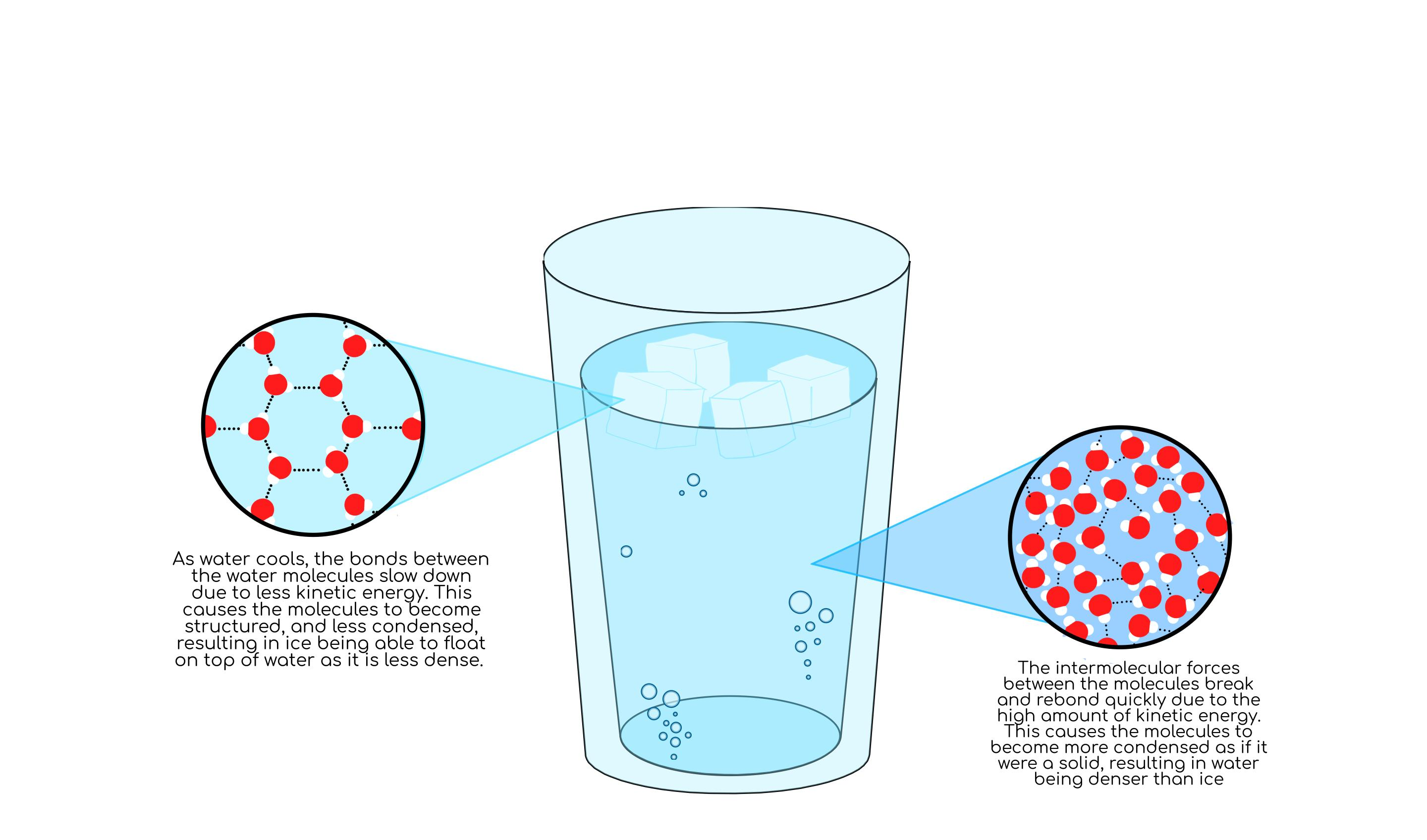
🧊 PART 1: WHY DOES WATER EXPAND WHEN IT FREEZES?
Normally, when something freezes, its particles become closer together.
BUT WATER IS DIFFERENT!
Here's what happens:
Liquid water = molecules can move around and stay relatively close.
Water freezes = hydrogen bonds arrange the water molecules into an organized crystal structure.
This structure leaves MORE space between the molecules.
More space = water EXPANDS.
Result: ICE TAKES UP MORE SPACE THAN LIQUID WATER!
Important definitions
Hydrogen bonds: Attractions between water molecules that help hold them in a certain arrangement.
Intermolecular forces: Attractions between separate molecules.
Crystal: An organized pattern of particles.
Expand: To take up more space; get bigger.
TEAS MEMORY TRICK
WATER FREEZES → SPREADS → EXPANDS!
Think: Water is weird! Most substances get smaller when freezing, but water expands.
Why does this matter?
Ice floats because it is less dense than liquid water.
Lakes freeze from the top, allowing aquatic life to survive in the water below.
☀ PART 2: WHAT IS PLASMA?
Solid → Liquid → Gas → Plasma
Plasma = extremely high-energy matter with electrically charged particles.
Let's understand what happens.
Step by step:
A gas gets an enormous amount of energy.
The electrons separate from their atoms.
Now we have positively and negatively charged particles.
Those moving charged particles make PLASMA!
Break down the hard words
Word | Super easy meaning |
|---|---|
Electron | Tiny negatively charged particle |
Nucleus | Center of an atom |
Positively charged | Has more positive than negative charge |
Negatively charged | Has more negative than positive charge |
Electric current | Flow of electric charge |
Ionized | Atoms have gained or lost electrons |
Remember: Normal atoms have electrons around their nuclei. In plasma, some electrons become separated from the nuclei.
3. Examples of plasma
SUN ☀
The Sun contains extremely hot plasma.
NEON SIGNS
Electricity energizes the gas, producing plasma that glows.
LIGHTNING ⚡
Lightning is a natural example of plasma.
STARS ⭐
Stars are made mostly of plasma.
PLASMA = PARTICLES WITH CHARGES!
Think: GAS + HUGE ENERGY = PLASMA.
⭐ FINAL TEAS CHEAT SHEET
Concept | Remember this! |
|---|---|
Water freezes | Expands |
Hydrogen bonds | Attract water molecules |
Crystal | Organized particle pattern |
Ice density | Less dense than liquid water |
Plasma | High-energy charged particles |
Electrons | Negative charge |
Nucleus | Center of atom |
Neon signs | Example of plasma |
Sun | Made of plasma |
The TWO things I really want you to remember for the TEAS:
Water is unusual because it EXPANDS when it freezes.
Plasma is made of electrically charged particles because electrons separate from their nuclei.
WATER FREEZES = MOLECULES SPREAD = VOLUME INCREASES. 💧
1. What happens when liquid water freezes?
It expands
2. Why does ice expand?
Hydrogen bonds arrange molecules farther apart
3. What is plasma?
High-energy, electrically charged particles
4. What happens to electrons when plasma forms?
They separate from their nucle
5. Which is an example of plasma?
sun

🧊 Imagine you have a glass of water.
STEP 1: Before freezing (LIQUID WATER)
Water is made of tiny particles called molecules.
These molecules are relatively close together.
They can move around and slide past each other.
STEP 2: Water starts freezing
The water gets colder.
Hydrogen bonds help the water molecules arrange themselves into an organized pattern.
This pattern leaves MORE space between the molecules.
STEP 3: Now it's ICE!
The molecules are now arranged in a more spread-out structure.
They take up MORE SPACE.
That means the ice is BIGGER in volume than the same amount of liquid water.
Let's make it even simpler!
Imagine 10 people standing close together in a room.
Then imagine those same 10 people spreading their arms out and standing farther apart.
Did you add more people? NO!
You still have the same 10 people. They're just taking up more space.
That's basically what happens to water molecules when water freezes!
⭐ Remember these 3 things for the TEAS:
Water freezes → turns into ice.
Hydrogen bonds arrange the molecules farther apart.
Molecules take up more space → water expands!
IMPORTANT: The amount of water molecules does NOT increase. They simply spread farther apart, increasing the volume.
WATER FREEZES = MOLECULES SPREAD = VOLUME INCREASES. 💧

Is the substance GAINING energy or LOSING energy?
🧪 1. First, what is a phase change?
Phase change = when something changes from one state of matter to another.
Remember our 3 main states:
Solid = ice
Liquid = water
Gas = water vapor (water in gas form)
For example:
Ice melts → becomes liquid water.
Water boils → becomes gas.
Water freezes → becomes ice.
That's a PHASE CHANGE!
IMPORTANT: The substance is still the same substance. Only its state changes.
Ice, liquid water, and water vapor are ALL H₂O!
This is called a physical change.
Physical = changes how something looks or what state it's in.
Chemical composition = what something is made of.
The water molecules are still H₂O. They haven't become a different substance.

2. THE BIG SECRET: ENERGY
There are TWO things that can happen:
ABSORB ENERGY = TAKES IN ENERGY
Think: The substance is GETTING energy.
Usually, heat is being added.
Particles gain energy and can move more freely.
Example: Ice absorbs heat and melts into water.
RELEASE ENERGY = GIVES AWAY ENERGY
Think: The substance is LOSING energy.
Usually, heat is being removed.
Particles lose energy and move less freely.
Example: Water releases heat and freezes into ice.
MEMORY TRICK:
ABSORB = ADD energy ☀
RELEASE = REMOVE energy ❄


A. When matter GAINS energy (ABSORB)
ABSORB = TAKES IN ENERGY
1. MELTING: Solid → Liquid
Example: Ice cream melting on a warm day.
Starts as a solid.
Absorbs heat.
Becomes a liquid.
Memory trick: MELTING = ICE TURNS TO WATER.
2. VAPORIZATION: Liquid → Gas
Example: Water boiling in a pot.
Starts as a liquid.
Absorbs heat.
Becomes a gas (water vapor).
Hard word: Vaporization = liquid turning into gas.
Memory trick: VAPORIZATION = WATER TURNS TO VAPOR.
3. SUBLIMATION: Solid → Gas
Example: Dry ice.
Starts as a solid.
Absorbs energy.
Turns DIRECTLY into gas.
Skips the liquid stage!
Hard word: Sublimation = solid goes straight to gas.
Memory trick: SUBLIMATION = SKIPS LIQUID!


B. When matter LOSES energy (RELEASE)
RELEASE = GIVES AWAY ENERGY
4. FREEZING: Liquid → Solid
Example: Water becoming ice in your freezer.
Starts as a liquid.
Releases heat.
Becomes a solid.
Memory trick: FREEZING = WATER TURNS TO ICE.
5. CONDENSATION: Gas → Liquid
Example: Water droplets forming on the outside of a cold glass.
Starts as a gas (water vapor).
Releases heat.
Becomes liquid water.
Hard word: Condensation = gas turning into liquid.
Memory trick: CONDENSATION = DROPLETS FORM!
6. DEPOSITION: Gas → Solid
Example: Frost forming on a cold window.
Starts as a gas (water vapor).
Releases heat.
Turns DIRECTLY into a solid.
Skips the liquid stage!
Hard word: Deposition = gas goes straight to solid.
Memory trick: DEPOSITION = GAS DROPS STRAIGHT TO SOLID!
4. THE MOST IMPORTANT TEAS CHEAT SHEET
Phase change | Starts → Becomes | Energy |
|---|---|---|
Melting | Solid → Liquid | Absorb |
Vaporization | Liquid → Gas | Absorb |
Sublimation | Solid → Gas | Absorb |
Freezing | Liquid → Solid | Release |
Condensation | Gas → Liquid | Release |
Deposition | Gas → Solid | Release |
The easiest memory trick EVER
Going TOWARD GAS = ABSORB energy ☀
Solid → Liquid
Liquid → Gas
Solid → Gas
Going TOWARD SOLID = RELEASE energy ❄
Liquid → Solid
Gas → Liquid
Gas → Solid
One little correction to remember: Energy is being transferred, not created or destroyed. Absorbing energy doesn't always mean the temperature rises during the phase change.
6. Quick definitions to memorize
Word | Easy meaning |
|---|---|
Phase change | Changing state of matter |
Absorb | Take in |
Release | Give away |
Physical change | Changes appearance or state, not substance |
Vaporization | Liquid → Gas |
Sublimation | Solid → Gas |
Condensation | Gas → Liquid |
Deposition | Gas → Solid |
1. Ice turns into liquid water. What is this called?
Melting =
solid to liquid. It absorbs energy.
2. Water vapor turns into liquid droplets. What is this called?
Condensation
gas to liquid. It releases energy.
3. A solid turns DIRECTLY into a gas. What is this called?
Sublimation
skips the liquid stage.
4. Which phase change RELEASES energy?
Freezing releases energy as liquid becomes solid.
5. Dry ice changes directly from solid to gas. Does it absorb or release energy?
Sublimation absorbs energy.
Gas turns directly into a solid. What is this called?
Deposition = gas directly to solid. It releases energy.
7. Which phase change turns liquid into gas?
Vaporization
liquid to gas. It absorbs energy.
There are really only TWO big ideas:
Adding energy makes it easier for particles to move apart.
Removing energy allows particles to come closer together.
🧪 1. What happens when we ADD energy?
ADD ENERGY = ABSORB
Imagine putting an ice cube outside on a hot summer day.
Here's what's happening:
The ice absorbs heat from its surroundings.
The particles gain energy.
They can move more freely and overcome the attractions holding them in place.
The solid becomes a liquid!
If you keep adding energy, the liquid can eventually become a gas.
Think of it like this:
Imagine people standing very close together.
When you give them more room and energy to move, they can spread apart more easily.
That's similar to what happens to particles!
The 3 phase changes that ABSORB energy:
Phase change | What happens |
|---|---|
Melting | Solid → Liquid |
Vaporization | Liquid → Gas |
Sublimation | Solid → Gas |
Memory trick
ADD HEAT = PARTICLES GET FREED!
They can move more freely and spread apart.
❄ 2. What happens when we REMOVE energy?
REMOVE ENERGY = RELEASE
Imagine putting water in your freezer.
Here's what's happening:
Water loses heat to its colder surroundings.
Its particles lose energy.
They move less freely.
Attractions between particles can hold them closer together.
Liquid water becomes solid ice!
If a gas loses enough energy, it can become a liquid or even a solid.
The 3 phase changes that RELEASE energy:
Phase change | What happens |
|---|---|
Freezing | Liquid → Solid |
Condensation | Gas → Liquid |
Deposition | Gas → Solid |
REMOVE HEAT = PARTICLES SLOW DOWN AND SETTLE DOWN!

3. What does COHESIVE FORCES mean?
Attractions that make particles stick together.
Think about magnets attracting each other.
Particles also have attractions that help hold them together.
Here's the important part:
STRONG attractions = particles are harder to pull apart.
WEAK attractions = particles are easier to pull apart.
Memory trick: COHESION = CLINGING TOGETHER.
4. WHY do some substances have higher melting and boiling points?
Imagine TWO substances:
SUBSTANCE A: STRONG ATTRACTIONS
Needs MORE energy
Imagine particles that strongly attract each other.
Harder to pull apart.
Needs more energy to melt or boil.
Often has a higher melting or boiling point.
SUBSTANCE B: WEAK ATTRACTIONS
Needs LESS energy
Imagine particles that attract each other weakly.
Easier to pull apart.
Needs less energy to change state.
Often has a lower melting or boiling point.
Let's explain melting and boiling points.
Melting point: The temperature when a solid becomes a liquid.
Boiling point: The temperature when a liquid becomes a gas.
For example:
Think about metal versus a gas like helium.
Many metals need very high temperatures to melt.
Helium has an extremely low boiling point.
WHY?
Because the attractions between particles are different.
The stronger the attractions, generally the MORE energy needed to separate particles.
SUPER IMPORTANT TEAS MEMORY TRICK
STRONG STICK = MORE HEAT TO BREAK APART.
WEAK STICK = LESS HEAT TO BREAK APART.
5. Let's connect EVERYTHING together
Here is your complete cheat sheet:
Concept | What you need to remember |
|---|---|
Add energy | Particles can move more freely |
Remove energy | Particles move less freely |
Absorb | Take in energy |
Release | Give away energy |
Cohesive forces | Particles attracting each other |
Strong attractions | More energy needed |
Weak attractions | Less energy needed |
High melting point | Needs higher temperature to melt |
High boiling point | Needs higher temperature to boil |
One important science detail: During a phase change, the temperature stays constant while energy is being used to change the arrangement of particles. The added energy helps overcome attractions rather than raising the temperature during that transition.
☀ ADD ENERGY = MOVE APART.
❄ LOSE ENERGY = SLOW DOWN.
🧲 STRONG ATTRACTION = MORE ENERGY NEEDED.
1. What happens when a substance absorbs energy?
Particles can move more freely
Absorbing energy allows particles to move more freely.
2. What happens when a substance releases energy?
Particles generally move more slowly
Losing energy means particles move less freely.
3. What are cohesive forces?
Forces that attract particles together
Cohesive forces are attractions that help particles stick together.
4. A substance has very strong attractions between its particles. What does it generally need to melt?
More energy
Strong attractions are harder to overcome, so more energy is needed.
5. Which substance generally has a lower boiling point?
One with weaker intermolecular attractions
Weaker attractions generally require less energy to overcome.
6. Which phase change releases energy?
Condensation is gas to liquid and releases energy.

This graph shows what happens to WATER when we heat it up or cool it down.
It shows:
How the temperature changes.
When water changes from solid to liquid.
When water changes from liquid to gas.
When the temperature STOPS increasing or decreasing temporarily.
🧪 1. First, understand what you're looking at
Your graph has TWO sides:
Heating curve (LEFT): We ADD heat to water.
Cooling curve (RIGHT): We REMOVE heat from water.
Let's understand the graph itself first.
What do the two sides of the graph mean?
Graph part | Meaning |
|---|---|
Vertical axis (up and down) | Temperature |
Horizontal axis (left and right) | Time |
Temperature = how hot or cold something is.
Time = how much time has passed.
So the graph is basically asking:
"As time passes, what happens to the temperature of water?"

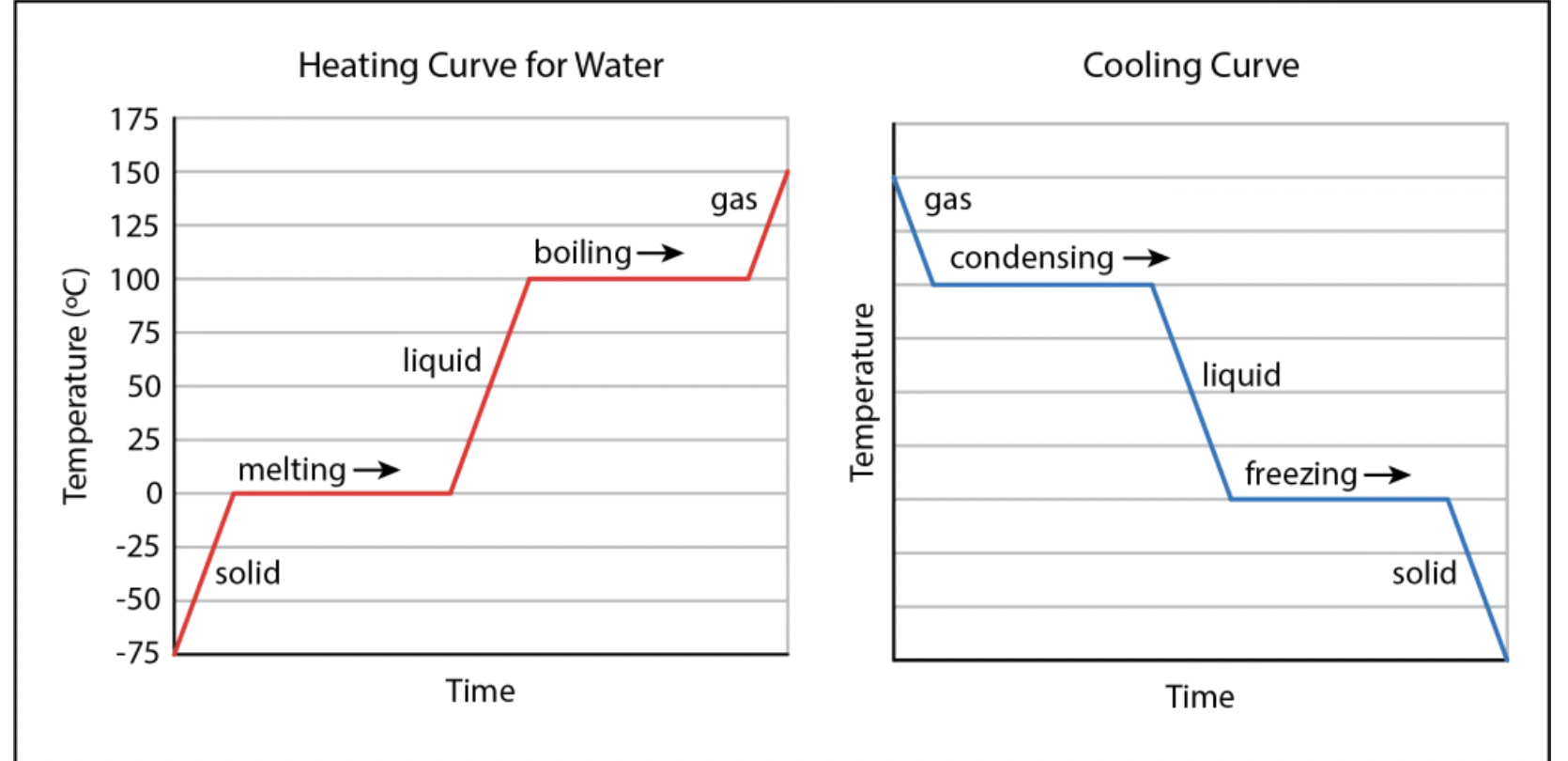
2. THE LEFT GRAPH: HEATING CURVE ☀
Imagine taking a piece of ICE out of your freezer and slowly heating it.
We're going to follow the red line from LEFT TO RIGHT.
There are FIVE steps.
Step 1: Heating the SOLID (ice)
We start with ice at -75°C.
We ADD heat.
The ice gets warmer.
Its temperature rises until it reaches 0°C.
What's happening?
The ice is STILL a solid. It is just getting warmer.
Remember
Slanted line going UP = temperature increasing.
Step 2: MELTING (solid → liquid)
Now the ice reaches 0°C.
Something interesting happens:
We keep ADDING heat.
The ice starts melting.
The temperature STAYS at 0°C.
Eventually, all the ice becomes liquid water.
WAIT! Why isn't the temperature increasing?
Because the energy is being used to help the ice CHANGE into liquid water instead of increasing its temperature.
Think of it this way:
You're using the energy to change the state, not to make the temperature go up.
TEAS IMPORTANT
FLAT LINE = PHASE CHANGE = TEMPERATURE STAYS THE SAME

Step 3: Heating the LIQUID (water)2. THE LEFT GRAPH: HEATING CURVE ☀
Now ALL the ice has melted.
We have liquid water!
We keep adding heat.
Water gets hotter.
Temperature rises from 0°C to 100°C.
The water is STILL liquid during this part.
Step 4: BOILING (liquid → gas)
Water reaches 100°C.
Now:
We keep adding heat.
Water starts boiling.
Liquid water changes into gas (water vapor).
Temperature stays at 100°C until all the liquid becomes gas.
Why does temperature stay the same?
Because the added energy is being used to separate the water molecules enough to turn liquid into gas.
TEAS IMPORTANT
BOILING = LIQUID → GAS = TEMPERATURE STAYS AT 100°C DURING THE CHANGE.
Step 5: Heating the GAS
Now ALL the liquid has become gas.
We keep adding heat.
The gas gets hotter.
Temperature rises again.
That's the end of the heating curve!

3. THE RIGHT GRAPH: COOLING CURVE ❄
Now we're doing the OPPOSITE!
Imagine starting with very hot water vapor and cooling it down.
Follow the blue line from LEFT TO RIGHT.
Again, there are FIVE steps.
Step 1: Cooling the GAS
We start with hot gas.
We REMOVE heat.
The gas gets colder.
Temperature drops until it reaches 100°C.
Step 2: CONDENSATION (gas → liquid)
Gas starts turning into liquid.
Temperature stays at 100°C.
The gas releases energy as it changes into liquid.
Eventually, all the gas becomes liquid.
Remember: Condensation = gas turns into liquid.
Step 3: Cooling the LIQUID
Now we have liquid water.
We continue removing heat.
The water gets colder.
Temperature drops from 100°C to 0°C.
Step 4: FREEZING (liquid → solid)
Water reaches 0°C.
It starts freezing.
Temperature stays at 0°C.
Eventually, all the liquid becomes solid ice.
Remember: Freezing = liquid turns into solid.
Step 5: Cooling the SOLID
All the water is now ice.
We continue removing heat.
The ice gets even colder.
Temperature drops again.
That's the end of the cooling curve!

4. THE MOST IMPORTANT THING: WHY ARE SOME LINES FLAT?
THIS is what I really want you to understand for the TEAS.
Look at your graph:
SLANTED LINE = TEMPERATURE CHANGES
The substance is getting warmer or colder, but it stays in the SAME state.
Example: Ice getting warmer but still remaining ice.
FLAT LINE = PHASE CHANGE
The substance is changing states, but the temperature stays the SAME during the change.
Example: Ice melting at 0°C.
WHY does the temperature stay the same?
When ice melts, the added energy is being used to help change the arrangement of the particles.
It isn't being used to raise the temperature.
The same idea happens when water boils.
When water freezes or condenses, energy is released while the substance changes state.
IMPORTANT: The flat line doesn't mean energy stops moving! Energy is STILL being added or removed.

5. THE TEMPERATURES YOU MUST MEMORIZE
For WATER:
0°C
Freezing point
Also the melting point.
100°C
Boiling point
Also the condensation point.
Memory trick:
0 = ICE ↔ WATER
100 = WATER ↔ VAPOR
These are the standard values at normal atmospheric pressure.
6. ALL-IN-ONE HEATING VS. COOLING CHEAT SHEET
Heating ☀ | Cooling ❄ |
|---|---|
Add heat | Remove heat |
Solid warms up | Gas cools down |
Melting at 0°C | Condensation at 100°C |
Liquid warms up | Liquid cools down |
Boiling at 100°C | Freezing at 0°C |
Gas gets hotter | Solid gets colder |
🔥 HEATING CURVE
ADD HEAT = TEMPERATURE GOES UP
Ice → Melting → Water → Boiling → Gas
❄ COOLING CURVE
REMOVE HEAT = TEMPERATURE GOES DOWN
Gas → Condensation → Water → Freezing → Ice
⭐ THE GOLDEN RULE
SLANTED = TEMPERATURE CHANGES.
FLAT = STATE CHANGES.
Heating = adding energy.
Cooling = removing energy.
Flat lines = a phase change while temperature stays constant.

1. What does the vertical (Y) axis represent?
temparature
The vertical axis shows temperature.
2. What does the horizontal (X) axis represent?
Time
The horizontal axis shows time.
3. What happens to ice when it reaches 0°C on the heating curve?
It melts
At 0°C, ice melts into liquid water.
4. Why does the temperature stay constant during melting?
Energy is being used for the phase change
Energy is used to change solid ice into liquid water.
5. At what temperature does water boil on this graph?
Water boils at 100°C under normal atmospheric pressure.
6. What does a flat line on a heating curve indicate?
A phase change is happening
Flat lines represent phase changes at constant temperature.
7. During cooling, what happens at 100°C?
Condensation
Gas turns into liquid at 100°C.
8. What happens to the temperature after all the water has frozen?
It decreases further
Once freezing is complete, the solid ice cools further.
🧪 1. What is TEMPERATURE?
"Temperature is a measure of the kinetic energy of particles."
Let's break that down.
Temperature: How hot or cold something is.
Kinetic energy: Energy something has because it is moving.
Particles: Tiny pieces that make up matter.
So what does this mean?
The faster particles move, the more kinetic energy they have, and generally the higher the temperature.
Think about it like this:
Slow-moving particles = lower temperature.
Fast-moving particles = higher temperature.
MEMORY TRICK:
🔥 FAST = HOT
❄ SLOW = COLD
2. What happens during a PHASE CHANGE?
Remember our examples?
Ice → Water = melting.
Water → Gas = boiling.
Water → Ice = freezing.
Your reading says that temperature stays CONSTANT during a phase change.
Constant = stays the same.
For example:
Imagine ice melting at 0°C.
You add heat to the ice.
The ice starts melting.
The temperature stays at 0°C.
The energy is being used to change ice into liquid water.
Why doesn't the temperature increase?
Because the energy is being used to change the state of matter, rather than increase the average kinetic energy of the particles.
That's why the graph has a FLAT LINE!
3. When DOES temperature increase or decrease?
Entirely = completely.
For example:
EXAMPLE A: ICE GETTING WARMER
All solid.
Add heat.
Temperature increases.
Temperature changes ↑
EXAMPLE B: ICE MELTING
Solid changing into liquid.
Add heat.
Temperature stays at 0°C.
Temperature stays constant
EXAMPLE C: WATER GETTING WARMER
All liquid.
Add heat.
Temperature increases.
Temperature changes ↑
THE BIG TEAS MEMORY TRICK
SLANTED LINE = TEMPERATURE CHANGES
The substance is completely solid, liquid, or gas.
FLAT LINE = PHASE CHANGE
The substance is changing from one state to another. Temperature stays constant.
5. Quick vocabulary cheat sheet
Word | Easy meaning |
|---|---|
Temperature | How hot or cold |
Kinetic energy | Energy of movement |
Particles | Tiny pieces of matter |
Constant | Stays the same |
Phase change | Changing state |
Entirely | Completely |
Average | The overall amount |
☀ 1. HEAT IN vs. HEAT OUT
HEAT IN = GAINS ENERGY
The substance ABSORBS heat.
Particles gain energy.
They generally move faster.
Temperature generally increases.
HEAT OUT = LOSES ENERGY
The substance RELEASES heat.
Particles lose energy.
They generally move slower.
Temperature generally decreases.
MEMORY TRICK:
☀ SUN = ENERGY IN = GAIN.
❄ SNOW = ENERGY OUT = LOSE.
2. What happens to GAS?
Imagine you have water vapor (GAS).
There are TWO things you can do:
A. HEAT THE GAS
Add heat.
Gas GAINS energy.
Particles move faster.
Temperature increases.
B. COOL THE GAS
Remove heat.
Gas LOSES energy.
Particles move slower.
Eventually, gas can turn into liquid (condensation).
IMPORTANT: Gas does NOT always lose energy!
It depends on whether you're heating it or cooling it.
3. BUT WHY DOES TEMPERATURE SOMETIMES STAY THE SAME?
Remember: When a substance changes states, its temperature stays constant during that change.
Let's pretend you're boiling water.
You add heat to water.
The water reaches 100°C.
It starts boiling.
You KEEP adding heat.
Temperature stays at 100°C until all the liquid becomes gas.
WHY?
Because the added energy is being used to separate the water molecules enough to change liquid into gas.
It's not being used to increase their average kinetic energy (temperature).
The same idea happens when water freezes, except energy is leaving instead of entering.
4. Let's compare the two situations
Situation | Energy | Temperature |
|---|---|---|
Heating ice | Gains | Goes up |
Melting ice | Gains | Stays same |
Heating water | Gains | Goes up |
Boiling water | Gains | Stays same |
Cooling gas | Loses | Goes down |
Condensation | Loses | Stays same |
Cooling water | Loses | Goes down |
Freezing water | Loses | Stays same |
5. THE GOLDEN MEMORY TRICK
WHEN HEATING ☀
Energy enters → substance GAINS energy.
Slanted line = temperature goes up.
Flat line = phase change, temperature stays the same.
WHEN COOLING ❄
Energy leaves → substance LOSES energy.
Slanted line = temperature goes down.
Flat line = phase change, temperature stays the same.
☀ HEATING = ENERGY IN = GAIN.
❄ COOLING = ENERGY OUT = LOSE.
FLAT LINE = TEMPERATURE STAYS THE SAME DURING A PHASE CHANGE.
A phase change simply means:
Something changes from ONE state of matter to ANOTHER.
Remember the 3 states:
🧊 Solid = ice
💧 Liquid = water
💨 Gas = water vapor
Think about water!
Imagine this:
🧊 Ice MELTS → becomes liquid water.
💧 Water BOILS → becomes gas.
💧 Water FREEZES → becomes solid ice.
ALL of these are phase changes!
Why is it called a phase change?
Phase = state of matter.
Change = becoming something different.
So phase change = changing states!
⭐ TEAS memory trick
PHASE CHANGE = SOLID, LIQUID, OR GAS SWITCHING TO ANOTHER STATE.
One important thing: The substance itself stays the same!
Ice, water, and water vapor are all H₂O. Only the state changes.