Genetics Midterm 1!
 Call Kai
 Learn
Learn Practice Test
 Spaced Repetition
 Match
Match Flashcards
 Knowt Play
1/101

There's no tags or description
Looks like no tags are added yet.
Name | Mastery | Learn | Test | Matching | Spaced | Call with Kai | Chat |
|---|
No analytics yet
Send a link to your students to track their progress
102 Terms
What is genetics?
Genetics is the study of genes and their variants (alleles)
• how they are inherited
• how they give rise to specific characteristics in an individual (phenotypes)
• how they are distributed in a population
In order to understand genetics, we need to know how genes are transmitted through generations and how they give rise to traits (phenotypes). Therefore, we need to understand DNA, RNA, proteins and chromosomes.
How should we symbolically represent genes and alleles on the same chromosome? On
homologous chromosomes? On non-homologous chromosomes?
Same chromosome: write the alleles together, with no punctuation. In your drawing, one homolog carries F and R, so you wrote it as FR. The other homolog carries F and r, so it's Fr. Writing them side by side shows they sit on the same physical chromosome.
Homologous chromosomes: separate them with a slash. The slash divides one homolog from its partner. That's why you bracketed the two chromosomes as "homologs" and wrote FR/Fr. Single genes follow the same rule: F/F means one F allele on each homolog, and R/r means an R on one homolog and an r on the other.
Non-homologous chromosomes: separate them with a semicolon. The S gene is on a different chromosome type from F and R, so you wrote it as S/s after a semicolon. That gives the full genotype FR/Fr ; S/s. Your "nonhomologs" arrows point to this split.

Starting with an E/e; G/g diploid germ cell.
a) What genotype gametes could arise from nondisjunction of the "E" and "e" chromosomes
during meiosis I?
b) What genotype gametes could arise from nondisjunction of the G sister chromatids during
meiosis II?

Central Dogma
The central dogma of molecular biology is the process by which genetic information flows from DNA to RNA and then to proteins, describing the mechanism of gene expression.
DNA —→ transcription —→ RNA (rna transcript serves directly as mRNA in prokaryotes processed to become mRNA in eularyotes) —→ translation —→ polypeptide (proteins which are made of amino acids, proteins carry out specific functions which are phenotypes)

The structure of DNA
refers to its double helix form, consisting of two long strands of nucleotides wound around each other, held together by base pairs. This structure allows for replication and encoding of genetic information.
A=T
G=C

Transcription
Transcription is the process of copying a gene's DNA sequence into RNA. It's the first step of gene expression, and in most cases it produces messenger RNA (mRNA), which is later translated into protein. Some genes are transcribed into functional RNAs such as tRNA, rRNA, and regulatory RNAs instead.
eukaryotes have splicing!

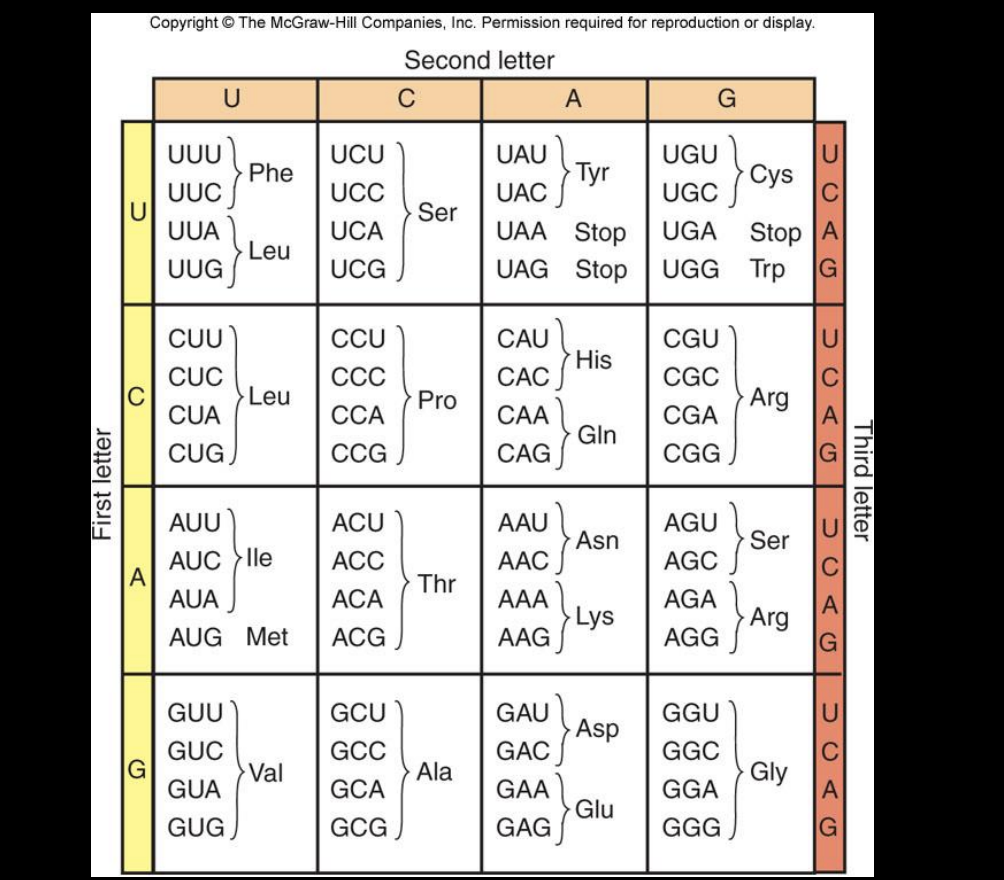
Molecular Biology Review: Codon Usage
The triplet code: a codon codes for a specific amino acid
Translation
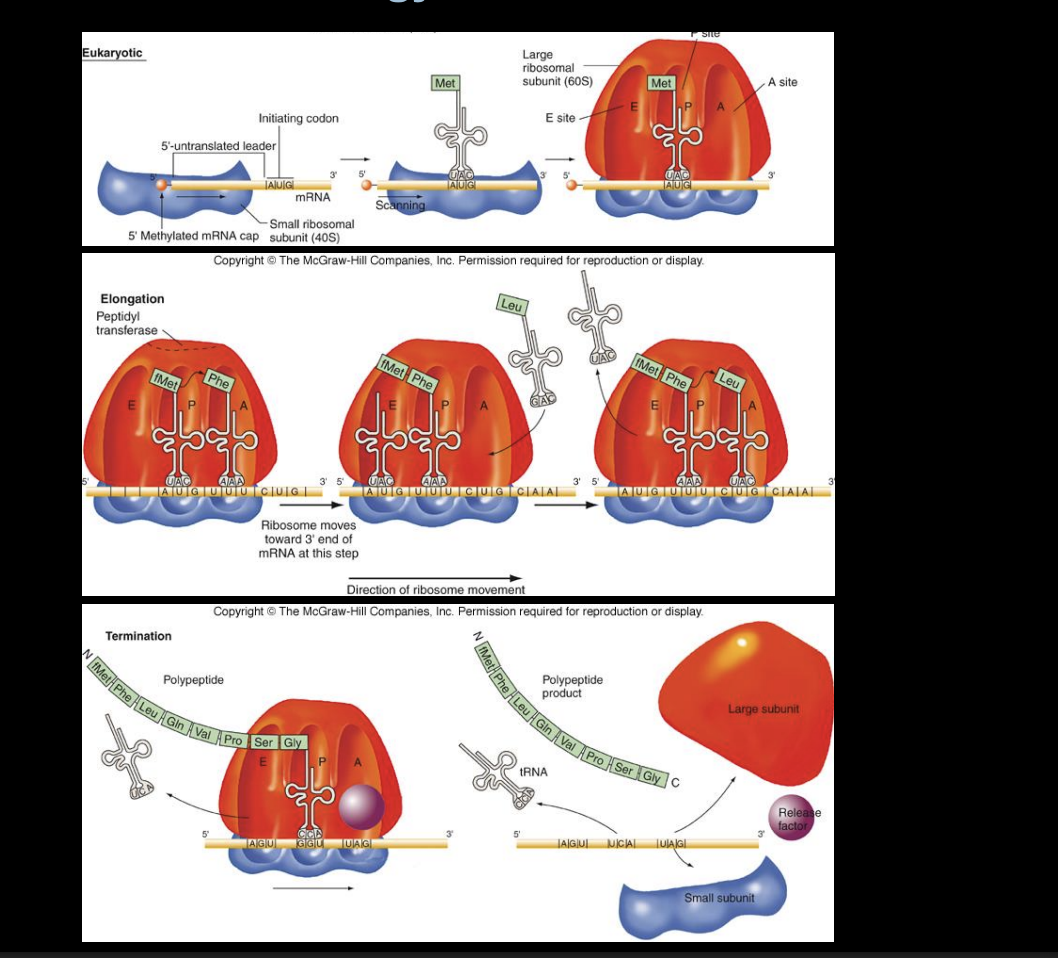
Translation is the process of using the information in mRNA to build a protein. It takes place on ribosomes, and it follows transcription (and, in eukaryotes, RNA processing).
What is a gene?
A gene is a segment of DNA that carries the instructions for making a specific functional product, usually a protein. Some genes instead code for functional RNAs (like tRNA or rRNA).
IMAGE:
white line = chromosome
2 different genes on the chromosome
the blue shows pre mRNA and the result of splicing out INTRONS resulting in only EXONS (eukaryotes only)
DNA —> transcription —> pre mRNA —> splicing —> mRNA —> translation —> polypeptides

Genes producing phenotype example
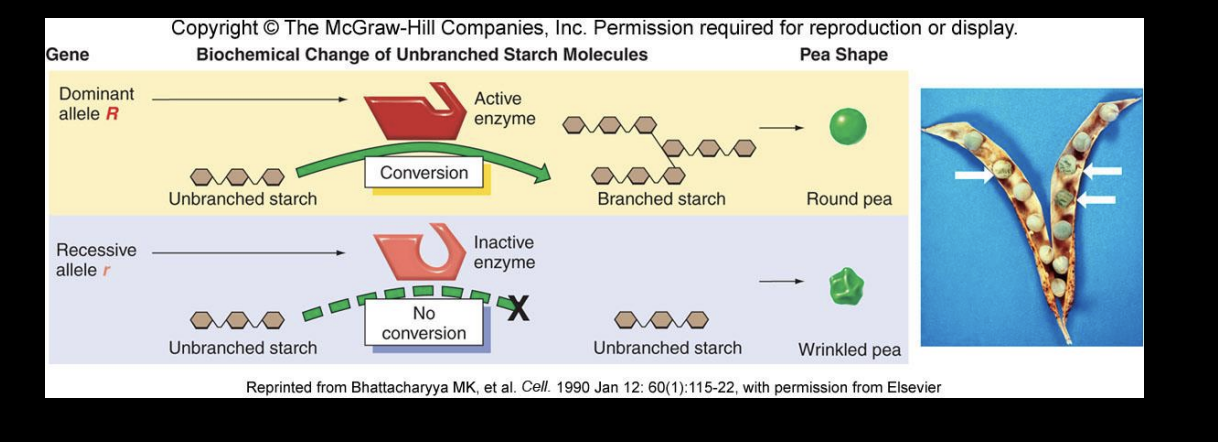
Genes encode proteins that perform biochemical function and produce phenotypes
Alleles are variants of genes that can effect what the resulting protein does and thus produce a different phenotype
How do we symbolically represent genes and their alleles in a given organism?
LETTERS = GENES
UPPERCASE/LOWERCASE AND SUPERSCRIPTS = ALLELES
EXAMPLE:
represent 2 alleles of the SAME gene: R and r
OR
multiple alleles: A^y A a a^b (all same gene but 4 different allele types)
diploid definition
Diploid (2n): having two complete sets of chromosomes in each cell — one set inherited from each parent.
means—> you have two chromosomes (one from each parent) which are homologous but may have different alleles.
Diploid (2n): the cell has two complete sets of chromosomes, one from each parent. Each chromosome type has 2 homologs, which form a homologous pair. n is still the number of different chromosome types, but the total number of chromosomes is now 2 × n, because there are 2 copies of each type (ploidy = number of copies = number of homologs per type).

Genotype and phenotype definition
Genotype = the genetic makeup of an organism — specifically, the set of alleles it carries for a given gene (or set of genes).
Phenotype = the observable characteristics or traits of an organism — what you can actually see, measure, or detect.
homozygote (diploid same alleles) and heterozygote definition (diploid different alleles)
Homozygote = an organism that has two identical alleles for a given gene.
Example: BB (homozygous dominant) or bb (homozygous recessive)
Since both alleles match, the organism will reliably show the phenotype associated with that allele (no "masking" happening).
Heterozygote = an organism that has two different alleles for a given gene.
Example: Bb
Here, if one allele is dominant, it typically masks the effect of the recessive allele in the phenotype — so a heterozygote often shows the dominant phenotype, while still carrying (and able to pass on) the recessive allele.
In eukaryotes, DNA is packaged into chromosomes
in eukaryotes —> DNA packaged into chromosomes
in prokaryotes —> DNA in circular
DNA duplex—> packaged within histones to form chromatin = CHROMOSOME

Chromosomes
duplicated from mitosis and meiosis
1 chromosome in G1 phase
S phase = DNA replication
1 chromosome becomes 2 sister chromatids

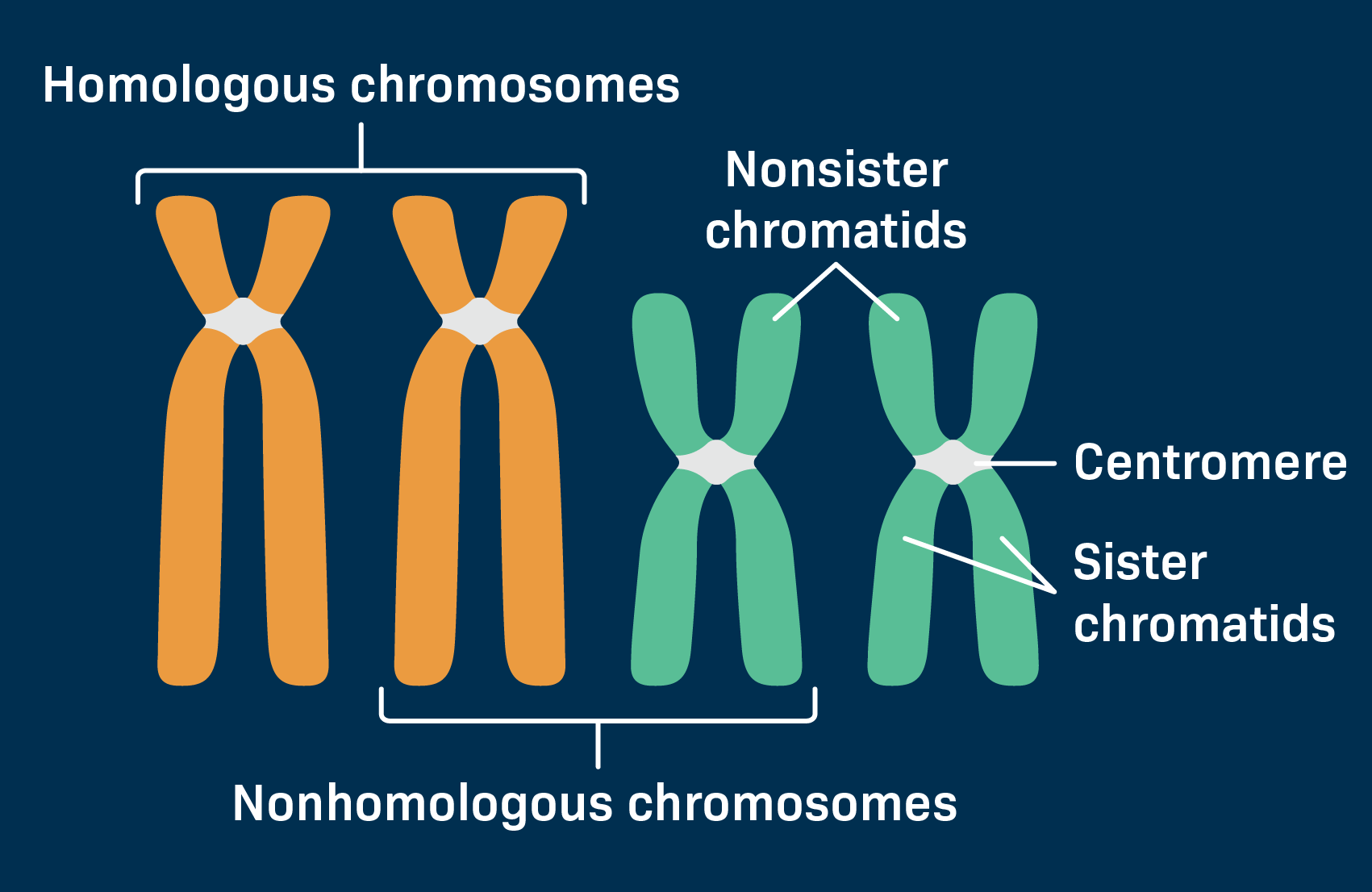
homologous chromosomes VS non-homologous chromosomes
Homologous chromosomes — a matched pair (one from mom, one from dad) carrying genes for the same traits in the same spots. (can have different alleles)
Non-homologous chromosomes — chromosomes from different pairs; they don't match and don't carry genes for the same traits.
sister chromatids—two identical copies of a single chromosome that form when DNA replicates during cell division
Ploidy = the number of homologous copies of each chromosome type in a cell.
A diploid cell has 2 homologs of each chromosome (one from each parent), a haploid cell has 1, a triploid cell has 3, and so on.
Diploid (2n) — a cell with two complete sets of chromosomes (one from each parent) — most human body cells (46 chromosomes = n )
Haploid (n) — a cell with one complete set of chromosomes — human sex cells/gametes, sperm and egg (23 chromosomes = n )
Euploid — a cell with a normal, complete number of chromosome sets (like normal diploid or haploid) — no extra or missing chromosomes
Aneuploid — a cell with an abnormal number of chromosomes — one too many or one too few (like Down syndrome, which is trisomy 21 — an extra copy of chromosome 21)

n vs. ploidy
n (the haploid number): the number of chromosomes in one complete set, meaning one of each of the species' distinct, non-homologous chromosome types. It's fixed for a species (humans: n = 23).
Ploidy: the number of complete chromosome sets in a cell, which is the same as the number of homologous copies of each chromosome type. It's the coefficient in front of the n (diploid = 2n, so ploidy = 2).
THIS IS WHAT 2N MEANS

n —> n = number of non-homologous chromosome types (23 in human)
n is the number of chromosomes in one complete set, which is the number of different chromosome types a species has. A set contains exactly one of each type, so the chromosomes within it are non-homologous to each other.
Humans have n = 23, and fruit flies in the picture had n = 4. It's fixed for the species and doesn't change with ploidy.
In the picture, n is the number of different colors (columns). Ploidy is how many of each color you have (rows = homogs), and total chromosomes = ploidy × n
PLOIDY = 2 FOR DIPLOID

helpful chromosome image

In a D/d cell, D and d are on:
A) homologs B) non-homologous chromosomes C) sister chromatids D) different strands of DNA E) I don’t know
A) homologs
Is this 1n, 2, 3n?
2n —> one allele on each homolog which means two homologs = 2n
Union of 2 gametes an egg and sperm (1n + 1n = 2n)
Egg: 1 set of 23 non-homologous chromosomes (n = 23, ploidy 1). The X is its sex chromosome.
Sperm: 1 set of 23 non-homologous chromosomes (n = 23, ploidy 1). It carries either an X or a Y.
Baby (zygote): the egg's set plus the sperm's set gives 2 sets, so ploidy 2 and 2n = 46. Each color now appears twice.
Fertilization changes the ploidy (1 → 2) and leaves n alone. There are still 23 different chromosome types, and each one now has two copies

gametes set of chromosomes (1n)
this means that n = 23 still because 23 different chromosomes but no chromosome has any copies or homologs which means ploidy is 1 and there are 23 total chromosomes
A haploid gamete has 1 complete set of chromosomes: one of each of the 23 types (22 autosomes plus either an X or a Y). That's what ploidy = 1 means.
Compare that to the diploid cell from the earlier slide, which has 2 complete sets, one from each parent. Fertilization combines the egg's single set with the sperm's single set (n + n) to make a zygote with 2 sets (2n).

The set of chromosomes in your diploid cells (2n in G1)

Sexual reproduction relies on MEIOSIS
This slide shows the cycle of ploidy in sexual reproduction: meiosis halves the chromosome number, and fertilization restores it.
Left: the 2n cell. This is a zygote, a fertilized egg. The blue and pink blobs are the two nuclei that came from the parents, one from the egg and one from the sperm. Each of those nuclei is haploid (1n), and together they make the cell 2n (two complete sets, one from each parent).
Top arrow: 2n → 1n is meiosis. Meiosis is the step that cuts the number of sets in half. A diploid cell goes in, and haploid cells come out. This is the step the slide title refers to.
Right: the 1n cells. These are the products of meiosis, each with a single set of chromosomes. From top to bottom in the images:
Sperm (the cell with the tail)
Egg (the large round cell)
Pollen grains (the clustered spheres at the bottom), which shows that plants use the same logic, since pollen contains the haploid sperm cells.

How do you generate a haploid gamete from a diploid cell?
One round of duplication and two rounds of segregation
Start (2n): 2 green homologs and 2 red homologs.
Duplication: each chromosome copies itself and becomes an X-shaped chromosome made of two sister chromatids. The cell is still 2n, because ploidy counts sets and not chromatids.
Meiosis I (first segregation): the homologs separate from each other. Each daughter cell gets one green and one red, still in duplicated X form. This is the step where the ploidy drops from 2n to n.
Meiosis II (second segregation): the sister chromatids separate, with no new duplication before it. This gives 4 cells, each with one green and one red single-chromatid chromosome (n).

Meiosis halves the number of chromosomes to produce
haploid gametes —→ ORIGINAL CELL BEFORE MEIOSIS
Two chromosome types: the one carrying the A gene and the one carrying the B gene, which are non-homologous to each other. So n = 2.
Two copies of each type: A/a are homologs, and B/b are homologs. So ploidy = 2, and the cell is 2n.
Total chromosomes: 2 × 2 = 4


FIRST STEP MEIOSIS: DNA replication, which produces a sister chromatid for each chromosome.
replication happens in S phase of interphase, just before meiosis I begins
Ploidy: still 2n, and n is still 2. You still have 2 chromosome types with 2 homologs each, and the same 4 chromosomes.
Chromatids: there are now 8 chromatids (4 chromosomes × 2 each), where before there were 4.
Alleles: each pair of sister chromatids carries the same allele, so the four chromosomes are now AA, aa, BB, and bb. The homologs are still different from each other, but a chromosome and its own sister chromatid are identical.

MEIOSIS 1:
metaphase I - homologs are paired and line up on the
metaphase plate
metaphase I, when the chromosomes line up and the spindle fibers (the yellow lines) attach to them.
Homologs pair up and face opposite poles. The A chromosome and the a chromosome are homologs, and so are the B and b chromosomes. In each pair, one homolog is attached to the left pole and the other to the right.
Sister chromatids stay together. The two A chromatids are attached to the same pole through their centromeres, and so are the two a, b, and B chromatids. Meiosis I doesn't split them, which is why each chromosome still looks like two joined lines.
Still 2n at this point. Ploidy doesn't drop until the homologs are pulled apart

anaphase I - homologs segregate away from each other
This is the moment the cell goes from 2n to n
the homologous pairs have been separated. A went one way and its homolog a went the other, and b went one way and its homolog B went the other. In the metaphase I slide, each pair sat facing opposite poles, and now they've actually moved apart.
Sister chromatids are still together.

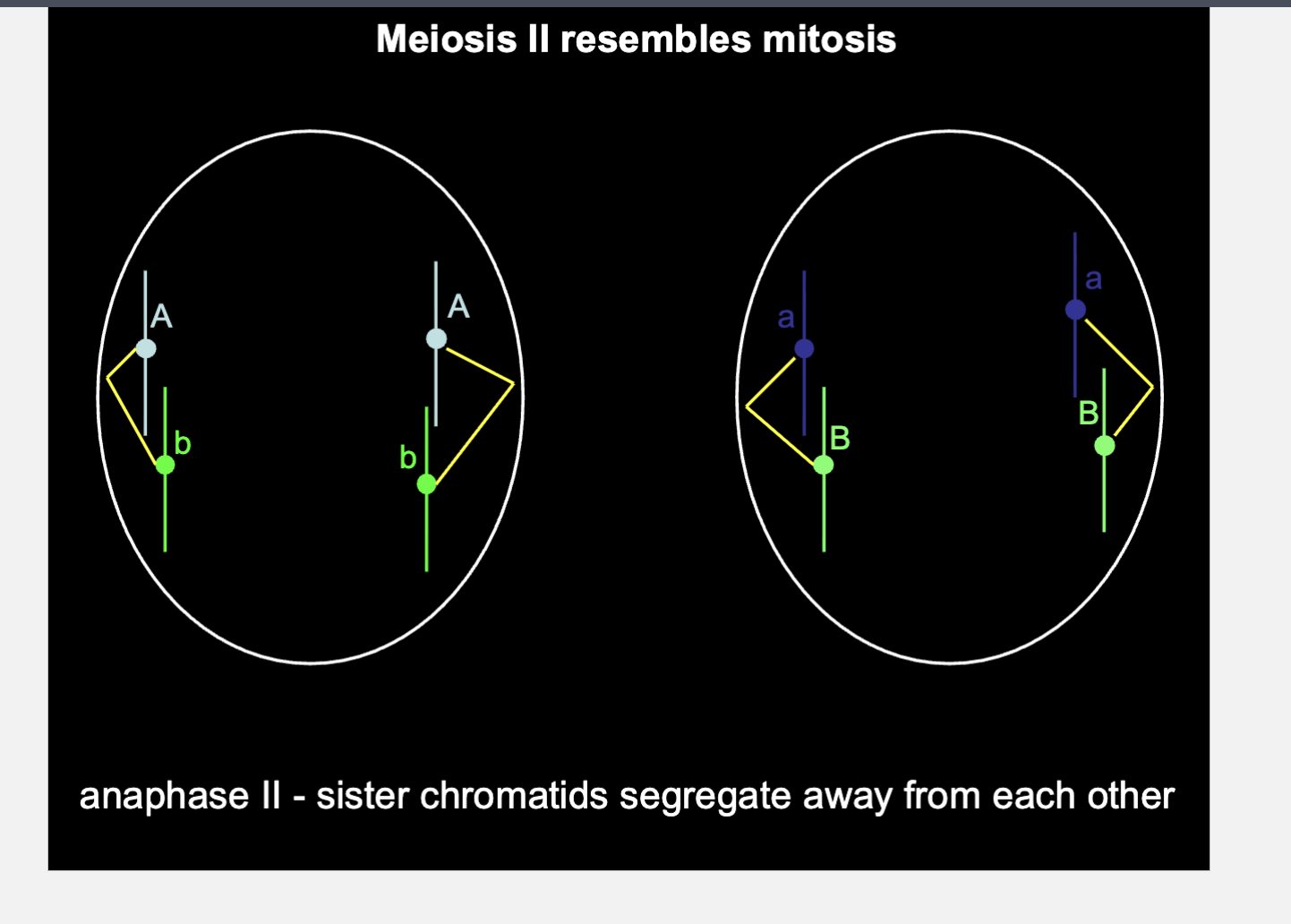
Meiosis II resembles mitosis
metaphase II - sister chromatids line up on the metaphase plate
Each cell is already n. The left cell has A and b, and the right cell has a and B. Each one has one chromosome of each type (one complete set), so the ploidy dropped to 1 back in meiosis I. Meiosis II doesn't change it.
Sister chromatids are now the ones being separated

anaphase II - sister chromatids segregate away from each other
Each cell is n (ploidy 1), with 2 single-chromatid chromosomes, one of each type. That matches the final gametes on your earlier slide
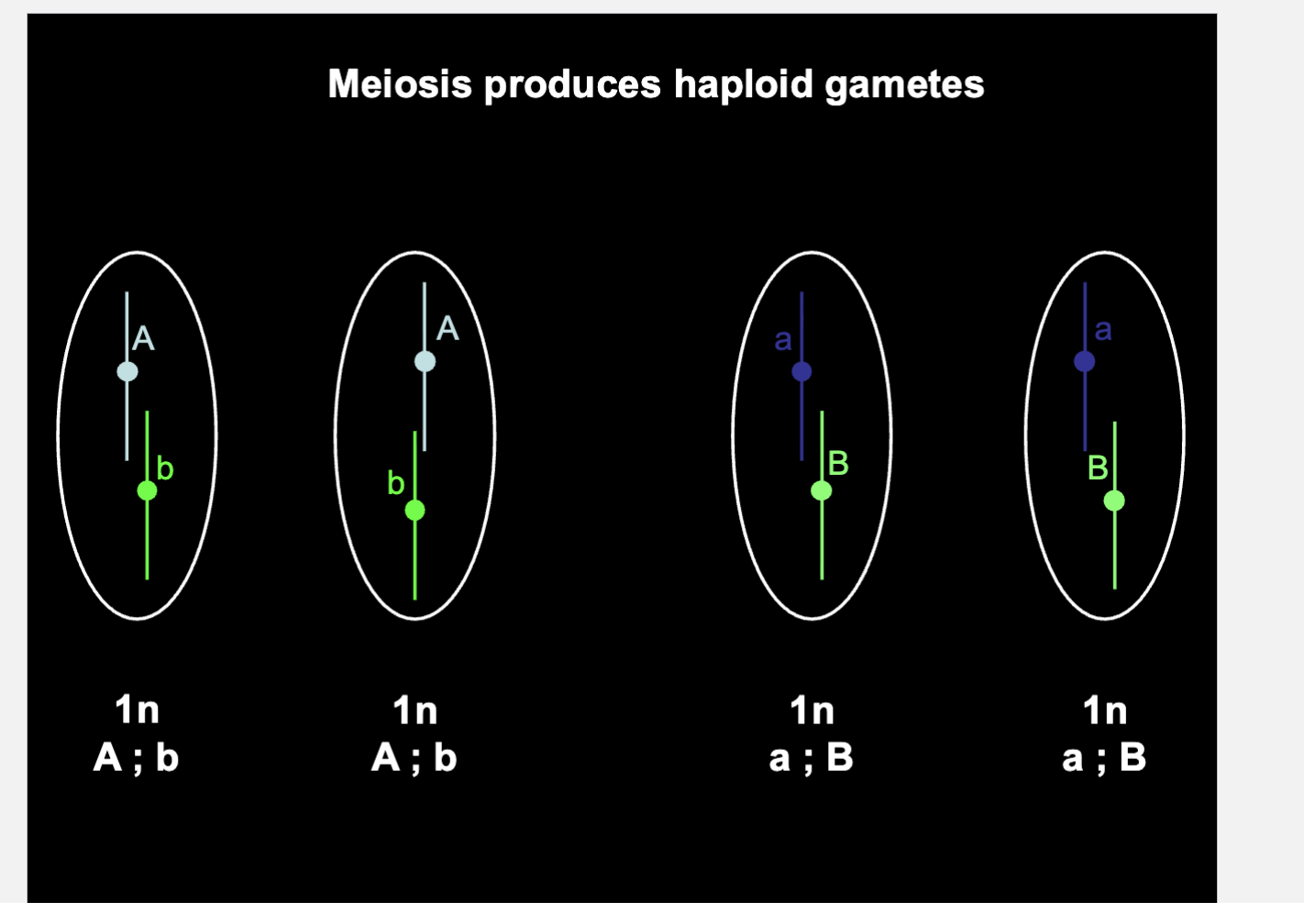
Final haploid gametes of meiosis
n is still 2 for them all
none should have homologs because ploidy is 1 for all so all are 1n
whole process of meiosis
Starting cell (2n). The cell has 4 chromosomes: 2 long and 2 short. The arrows point to a homologous pair, meaning two chromosomes of the same type. Each type has 2 homologs, so ploidy = 2. The chromosomes are already drawn as X shapes, so replication has happened, and the patches of blue and orange within a chromosome show that crossing over has mixed the two homologs' DNA.
Meiosis I. The homologs separate. Each of the two cells that result gets one long and one short chromosome. This is the step where ploidy drops from 2n to n. The chromosomes are still X-shaped, so each still has two sister chromatids.
Daughter cells (after meiosis I). These two cells are haploid (n). Each has one complete set, with one chromosome of each type.
Meiosis II. The sister chromatids separate. This doesn't change the ploidy, since the cells were already n.
Daughter cells (after meiosis II). There are 4 haploid cells, each with one long and one short single-chromatid chromosome. Their chromosomes carry different blue-and-orange patterns, so the gametes are genetically different from each other and from the parent cell. That variation comes from crossing over.


Meiosis shuffles allele combinations
to produce genetic diversity —INDEPENDENT ASSORTMENT (occurs in metaphase 1)
Image 1: A and b face the left pole, a and B face the right pole.
Anaphase I pulls the homologs apart, so one daughter cell gets A and b and the other gets a and B.
After meiosis II, the gametes are Ab, Ab, aB, aB.
Image 2: A and B face the left pole, a and b face the right pole.
One daughter cell gets A and B, and the other gets a and b.
After meiosis II, the gametes are AB, AB, ab, ab.
2^n = general rule is that the number of possible gamete combinations from independent assortment


practice question
C!!
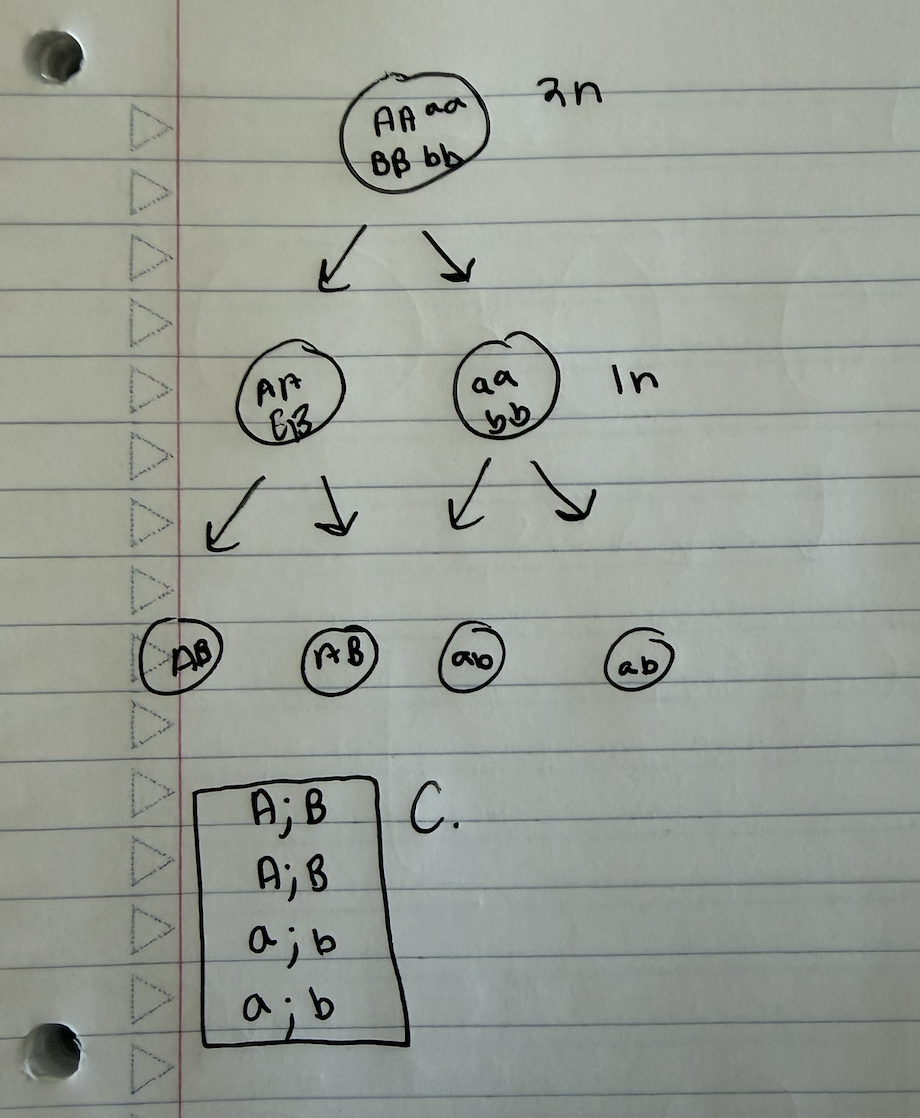

practice question
C !!


practice question

Defects in chromosome segregation result in aneuploidy,
Which can have serious repercussions

Aneuploidy can result from non-disjunction in either the first
or second meiotic division
NON -DYSJUNCTION IN MEIOSIS 1
M1 is more common in humans for non dysjunction

NON -DYSJUNCTION IN MEIOSIS 2
euploids present in non dysjunction of M2

Karyotype (Multicolor FISH) of an individual with Trisomy 21


practice question
A !!

Mendelian Genetics —>
Used Pea plants
• Allow cross and self-pollination
• Allow reciprocal crosses
• Production of large amount of
progeny to perform statistics
They allow cross and self-pollination. Mendel could let a plant self-fertilize to get true-breeding lines, or control which plants mated.
—> Mendel self-pollinated his plants for several generations and kept only the lines that never produced anything other than the parent type. A line that stayed constant that long had to be homozygous for the trait.
They allow reciprocal crosses. He could swap which parent contributed pollen and which contributed the ovule, to test whether the direction of the cross mattered (it didnt)
They produce large numbers of progeny. Big sample sizes let him apply statistics and see consistent ratios.

steps of self pollination and cross pollination for Mendels experiments
Self-pollinate plants over several generations and keep only lines that never produce a different type. These are the true-breeding lines (P generation)
Cross-pollinate two contrasting true-breeding lines (PP × pp). These are the P generation, and their offspring are the F1.
Self-pollinate the F1 (Pp × Pp) to get the F2, where the white trait reappears at about 1 in 4.
Mendel’s experiments benefitted
from:
Mendel's success came from using true-breeding parents and traits with two distinct forms (dominant/recessive), which made his F1 and F2 results clear and countable.
•traits that bred true -HOMOZYGOUS (progeny
always look like parent)—> These are the P generation, confirmed as homozygous through self-pollination.
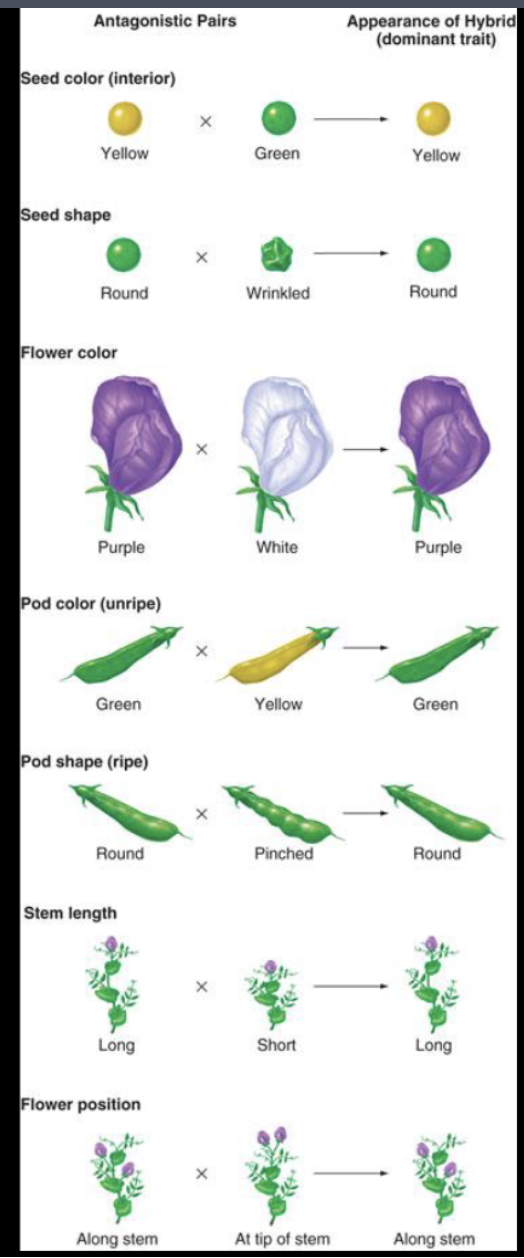
•traits that are “antagonistic”
(dominant and recessive)—→ It means the two versions of a trait are opposites, one dominant and one recessive (purple vs. white, tall vs. short) which gave clear F1 and F2 results
The figure is the P cross for each trait: two true-breeding parents crossed, with the F1 hybrid on the right showing the dominant trait.
all of the F1 generation are heterozygous and show the dominant phenotype
Law of segregation explained by meiosis
Law of segregation: the two alleles of a gene separate during gamete formation, so each gamete carries only one. Fertilization then randomly unites two gametes, restoring two alleles in the zygote.
Each plant has two copies of each gene, one on each homologous chromosome (one from mom, one from dad). Each copy is an allele, and the two can be the same (homozygous) or different (heterozygous)
• each plant carries 2 copies of a unit of inheritance (genes)
for each trait
•one from mom
•one from dad
• different copies of these genes are called alleles
• these two copies segregate away from each other during
reproduction to produce gametes (I.e. pollen and eggs, eggs
and sperm, etc) with only one allele of each gene
• fertilization = random uniting of two alleles to generate
a zygote


Mendel’s Experiment Starts with pure-breeding or true-breeding parents P —> F1
true breeding: progeny looks like parents (HOMOZYGOUS FOR ALLELES)
yellow peas X yellow peas: yellow progeny
green peas X green peas: green progeny
What happens when you cross yellow peas X green peas?
All of the offspring (F1) are yellow.
P generation: yellow (YY) × green (yy)
Gametes: the yellow parent can only give Y, and the green parent can only give y
F1: every seed gets one Y and one y, so all are Yy, which is heterozygous but is YELLOW because yellow is dominant


What happens when you cross yellow F1s?
F1 —→ F2
Gametes: each Yy plant makes half Y and half y gametes, because the two alleles segregate in meiosis I.
F2 genotypes: 1 YY : 2 Yy : 1 yy
F2 phenotypes: 3 yellow (YY, Yy, Yy) : 1 green (yy)
symbolically represent—→ a capital letter for the dominant allele (Y) and a lowercase letter for the recessive one (y)

Counting possible gametes (independent assortment, genes on different chromosomes)
Step 1: Find n for one parent.
n = the number of heterozygous gene pairs in that parent's genotype. Homozygous pairs count as 0.
Yy → n = 1
YyRr → n = 2
YyRR → n = 1
YYRR or YY → n = 0
Step 2: Gamete types per parent = 2ⁿ.
Each heterozygous gene is a 2-way choice (Y or y), and choices for different genes multiply. A homozygous gene is a 1-way "choice," so it changes nothing (2⁰ = 1).
Step 3: Combinations in the cross = (pollen types) × (egg types).
If both parents have the same n, this is 2ⁿ × 2ⁿ = 4ⁿ. This is the number of boxes in the Punnett square.
Symbolically Indicating
Genotypes and Crosses:
The Punnett Square
Alleles separate into gametes (segregation). A YY plant can only make Y gametes, a yy plant can only make y gametes, and a Yy plant makes half Y and half y. Each gamete gets just one allele per gene.
Gametes unite at random (fertilization). One gamete from each parent fuses, which restores two alleles in the zygote. Y + y gives Yy.
Dominance decides what you see. Yy is yellow because Y is dominant, so the F1 is all yellow even though every plant carries a hidden y.
The F2 follows from the F1's gametes. Yy × Yy gives 1 YY : 2 Yy : 1 yy, which is 3 yellow : 1 green. Green reappears because the hidden y pairs up with another y in 1 of 4 offspring.

Genotypes and Phenotypes
different genotypes can result in the same phenotype

mono-hybrid cross – cross between 2 parents heterozygous for
a single gene
Crossing two F1 plants (Yy × Yy) is the classic monohybrid cross to form F2!!

A Test Cross can determine the
genotype of a particular plant
TEST CROSS —→ USE HOMOZYGOUS RECESSIVE
What is the genotype of a plant that produces yellow peas?
A. Y/Y
B. Y/-
C. Y/y
D. y/y
B. Y/- —→ because yellow is dominant so AT LEAST one big Y is needed but it can be paired with another big Y or a little y

practice question
D, R/R × R/-.
100% dominant offspring from dominant × dominant means at least one parent is homozygous dominant (R/R). The other parent is R/- and can't be determined from this cross alone
How would you determine the genotype of the R/- progeny?
A) Perform a test cross with r/r plants
B) Perform a test cross with R/r plants
C) Perform a monohybrid cross with r/r plants
D) Perform a monohybrid cross with R/r plants
A) Perform a test cross with r/r plants (use both RR x rr and Rr x rr and need test cross results to match and see)
work out the predicted test cross results for both possibilities (RR × rr gives all round, Rr × rr gives 1:1 round to wrinkled). then compare the observed offspring to both predictions. Whichever prediction matches tells you the genotype
Genotypic versus phenotypic ratios in a monohybrid cross

Genes encode proteins that perform biochemical function
For example, a human gene (A) is required
for the production of melanin
One allele of this gene (a) is defective for the
production of melanin, resulting in albinism
gene A is HAPLO - SUFFICIENT
Haplo-sufficient = one functional copy of a gene is enough to produce the normal phenotype.

Law of independent assortment
Independent assortment is the independent segregation of different homologous chromosome pairs during meiosis, allowing different combinations of alleles to enter gametes
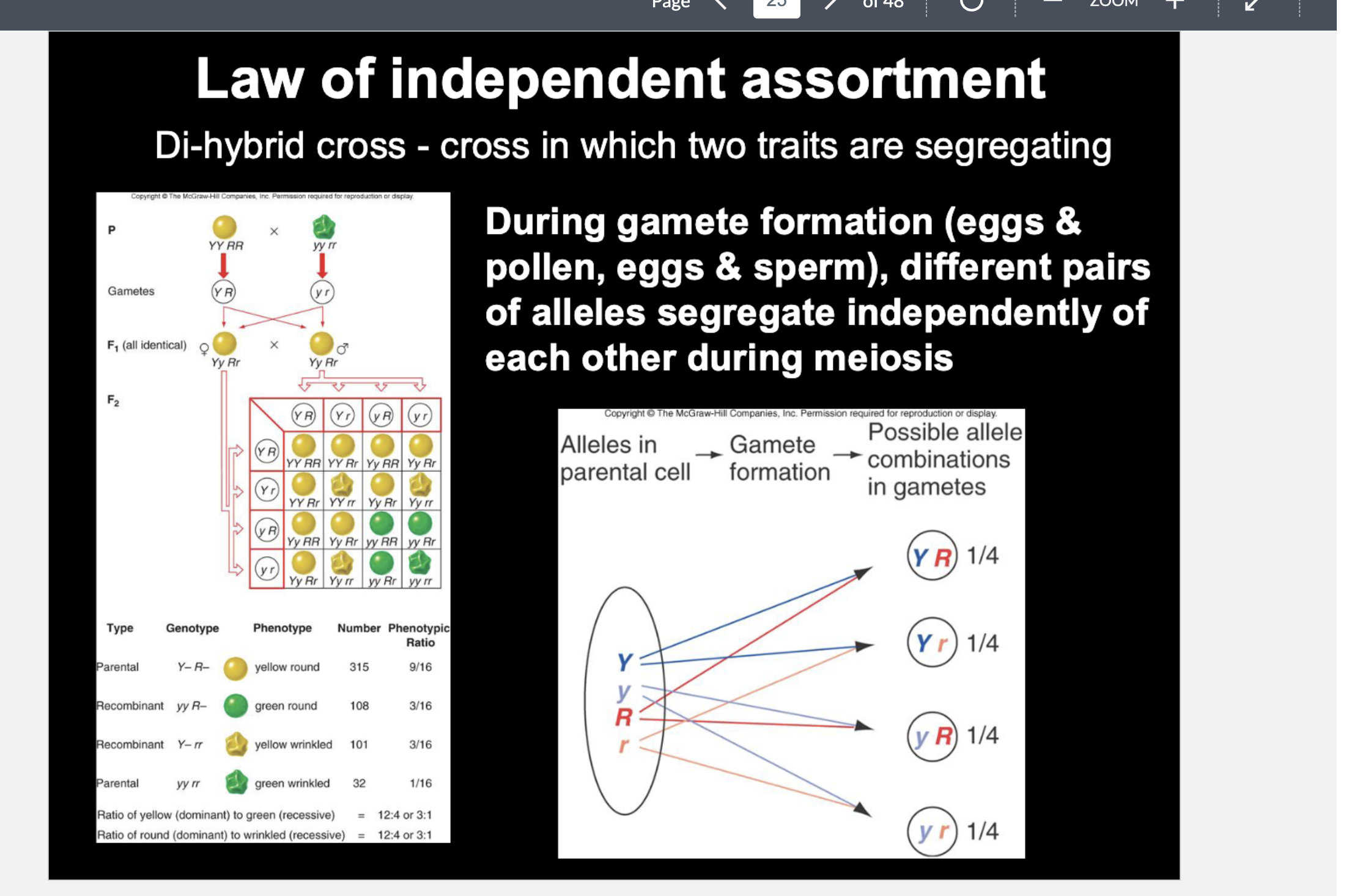

When calculating the number of possible gametes, you only count the heterozygous gene pairs.


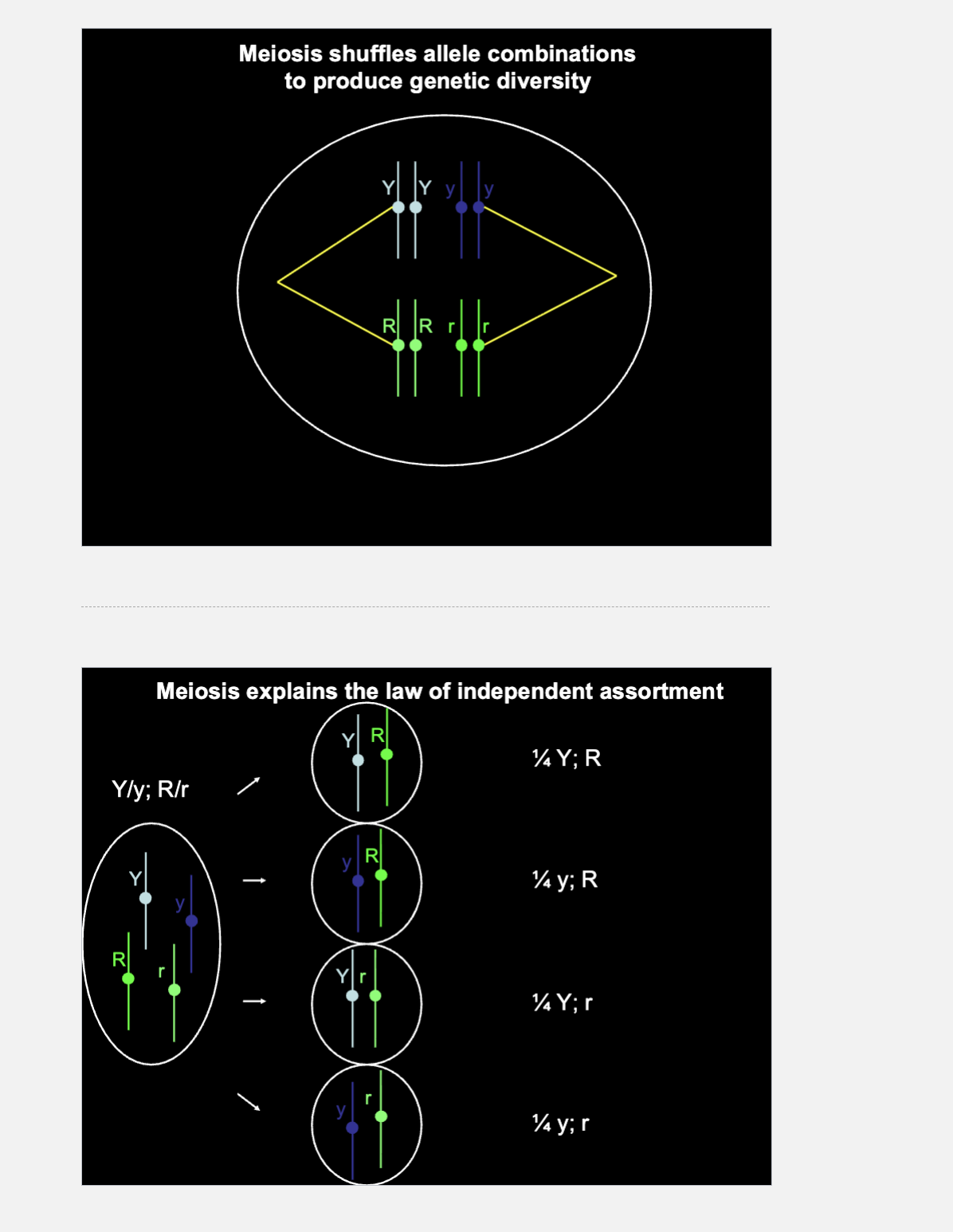
Meiosis explains the law of independent assortment
The actual random orientation that produces independent assortment happens when the homologous chromosome pairs line up at the metaphase plate during Metaphase I of meiosis.
The cell has: Yy; Rr —→ This means there are two different chromosome types:
One homologous pair carries the Y/y gene.
Another homologous pair carries the R/r gene.
So: n=2 ALSO BECAUSE BOTH ATE HETEROZYGOUS
ignore all homozygous pairs lined up (count as 0)
During meiosis, the Y/y homologous pair can separate independently from the R/r homologous pair.
2^n=2^2=4 gamete posibilities from this independent assortment
because there are 2 chromosome types.
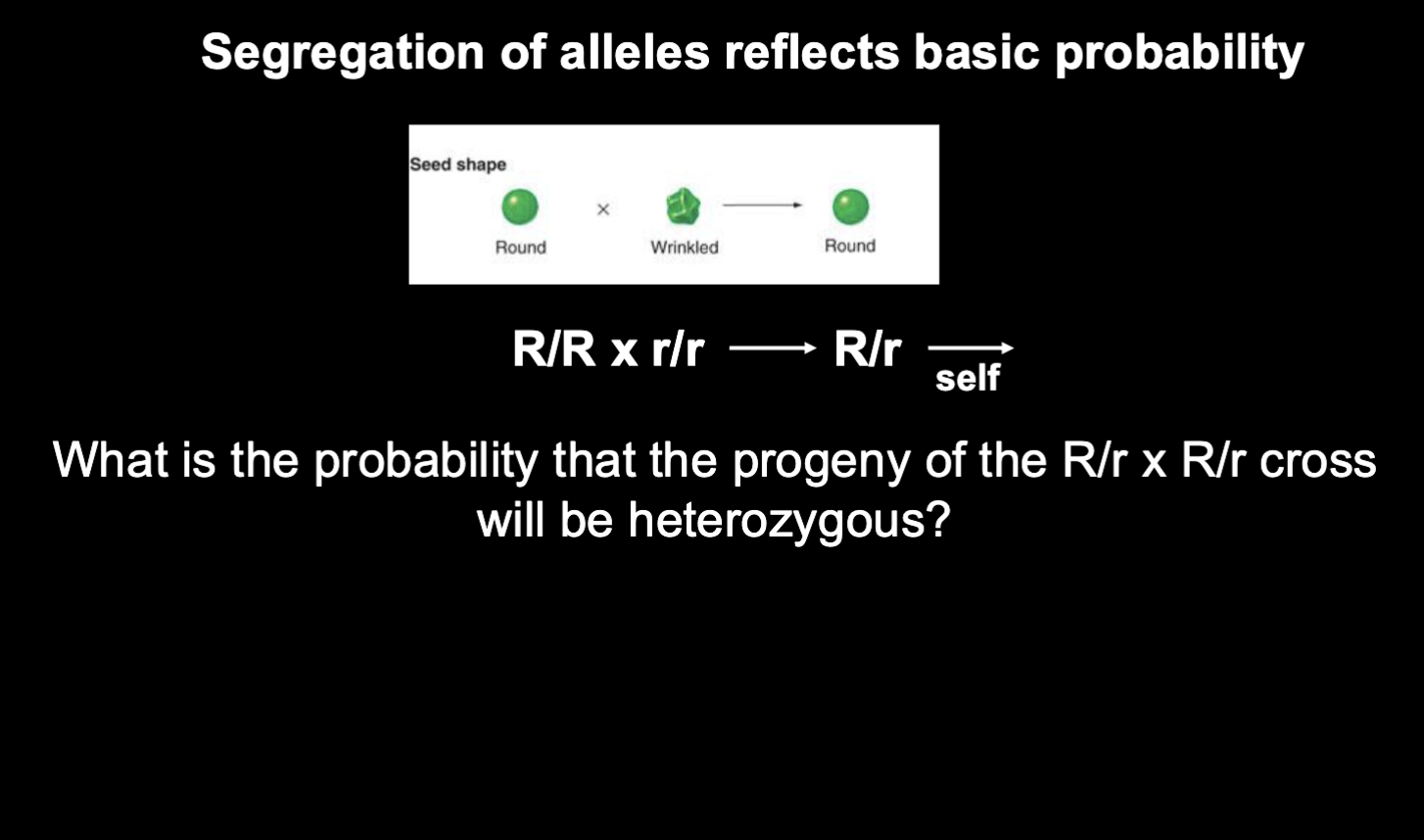
Segregation of alleles reflects
basic probability
Law of the product: probability of 2 or more independent
events occurring together is the product of the probabilities
that each event will occur by itself.
question: .5 x .5 = .25
Law of the sum: probability of two or more mutually
exclusive events occurring is the sum of their individual
probabilities

Segregation of alleles reflects basic probability EXAMPLE
probability that one parent will contribute a dominant allele
X
probability that the other parent will contribute the recessive allele
(1/2 X 1/2) + (1/2 X1/2) = 2/4 = 1/2

What is the probability of obtaining yellow, wrinkled
offspring?
A) 9/16
B) 3/16
C) 1/16
D) 1/4
E) 1/8
B


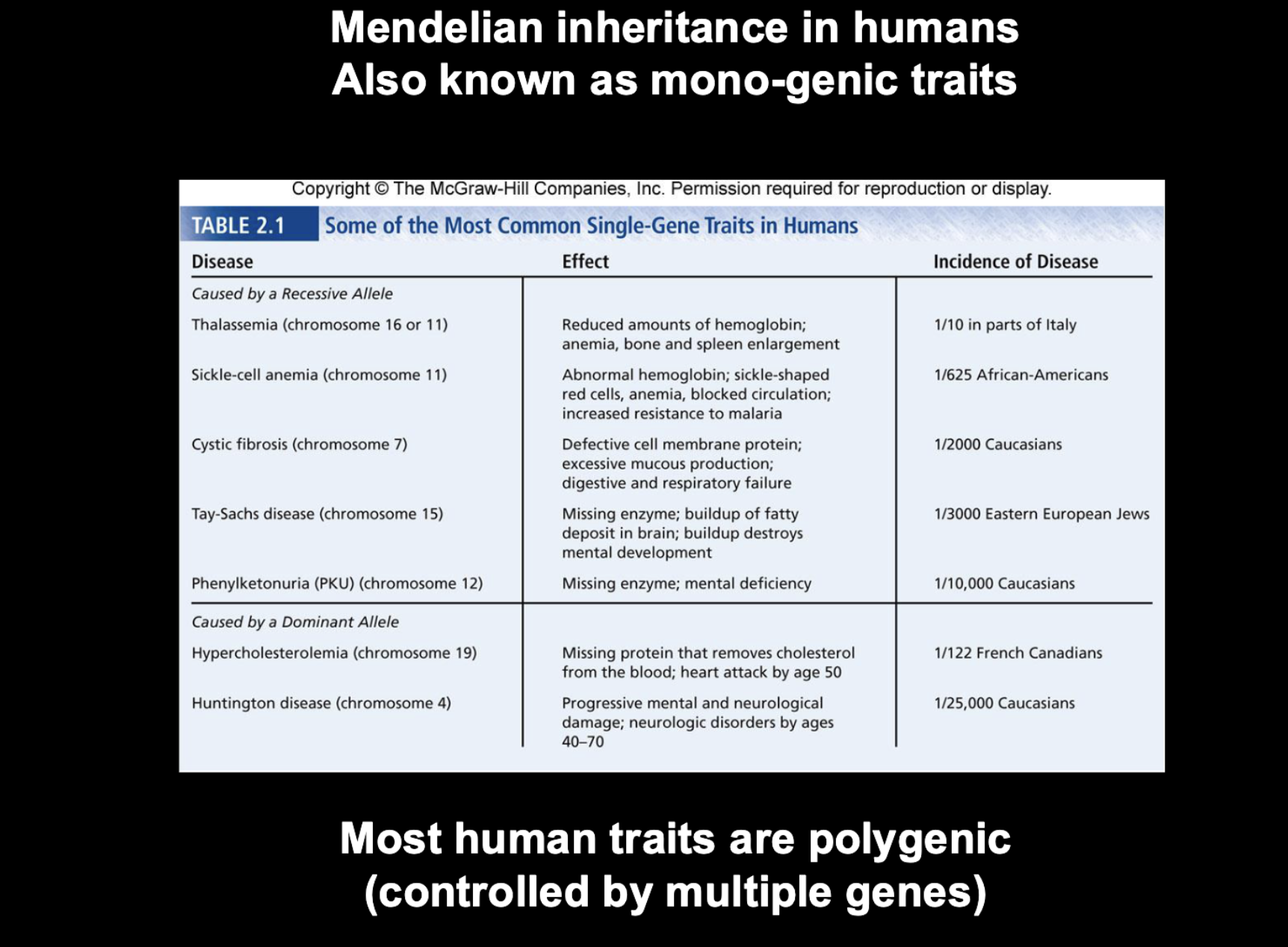
Mendelian inheritance in humans
Also known as mono-genic traits
One gene is represented by one letter type (such as A/a), with two alleles—one inherited from each parent.
For a monogenic trait, those two alleles determine the phenotype according to the inheritance pattern.
For example:
Gene: A/a
Genotypes: AA, Aa, aa
Mendelian Inheritance in Humans
Mendelian (monogenic) traits = traits/diseases mainly controlled by one gene (example Aa AA or aa are different versions of one gene).
They can be caused by either:
Recessive alleles → usually requires 2 copies of the recessive allele to show the disease.
Examples: cystic fibrosis, sickle-cell anemia, Tay-Sachs.
Dominant alleles → 1 copy of the dominant allele can cause the disease.
Examples: Huntington disease, hypercholesterolemia.
Polygenic traits = traits controlled by multiple genes.
Most human traits are polygenic rather than controlled by one gene.
Easy way to remember:
Mono = one gene → Mendelian
Poly = many genes → Polygenic
Roberta and Bob lost their first child to Tay Sachs, a
recessive disease. What is the probability that their next
two children will not be affected?
a) 6/8
b) 9/16
c) 3/4
d) 1/16
e) None of the above
B


Patterns of inheritance in humans are represented
with pedigrees
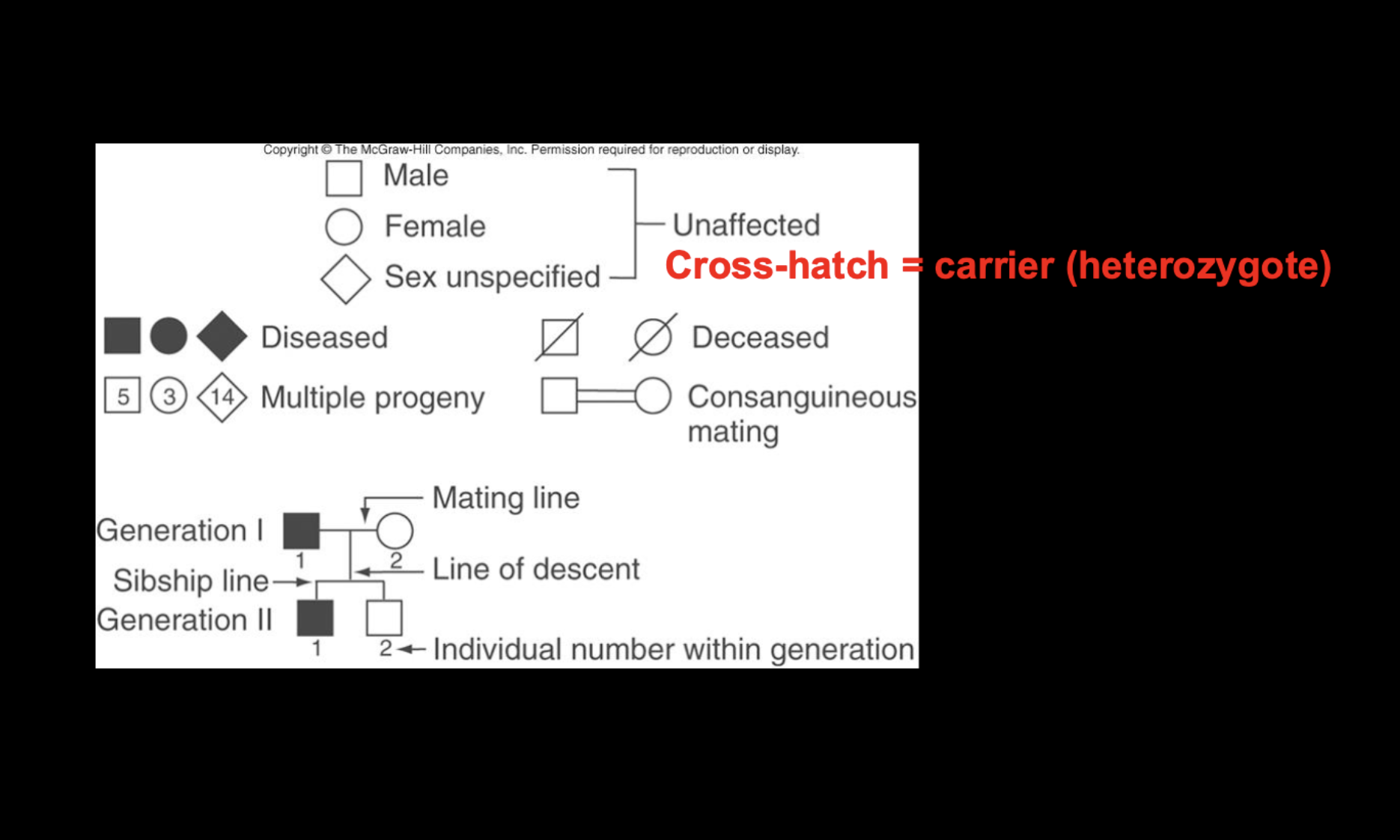
The 2 numbering systems in a pedigree

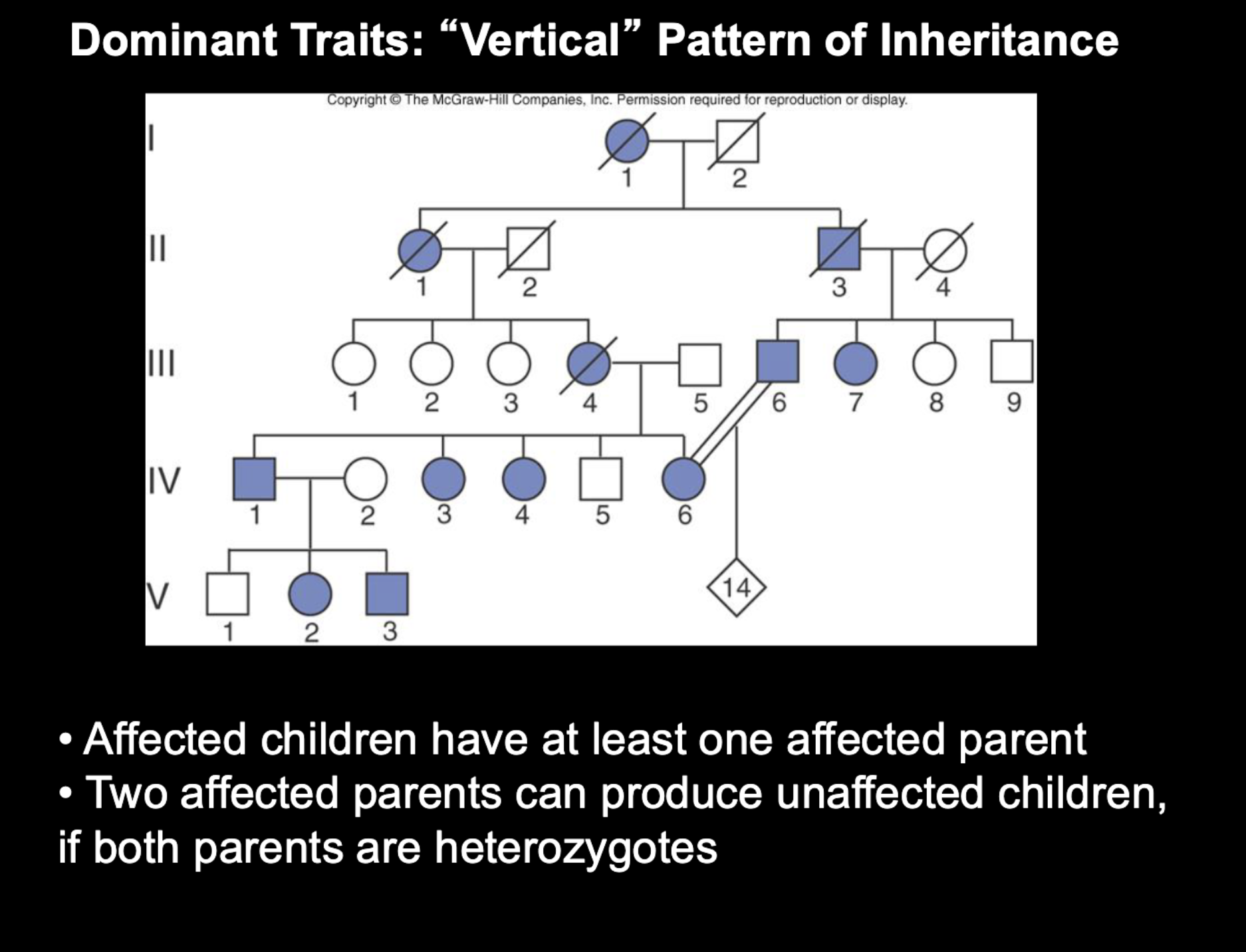
Dominant Traits: “Vertical” Pattern of Inheritance
Disease allele: in a dominant pedigree, the disease-causing allele is the dominant one (A), and one copy is enough to be affected.
Vertical pattern: the trait appears in every generation along a family line, with no skipping. Unaffected people (aa) can't pass it on, so a branch with no affected person ends there.
Rule 1: every affected child has at least one affected parent. This is why the trait follows the family line down.
Rule 2: two affected parents can have unaffected children if both are heterozygous (Aa × Aa), with a 1/4 chance of aa for each child.
Genotypes: unaffected = aa. Affected = AA or Aa. An affected person with an unaffected parent must be Aa.

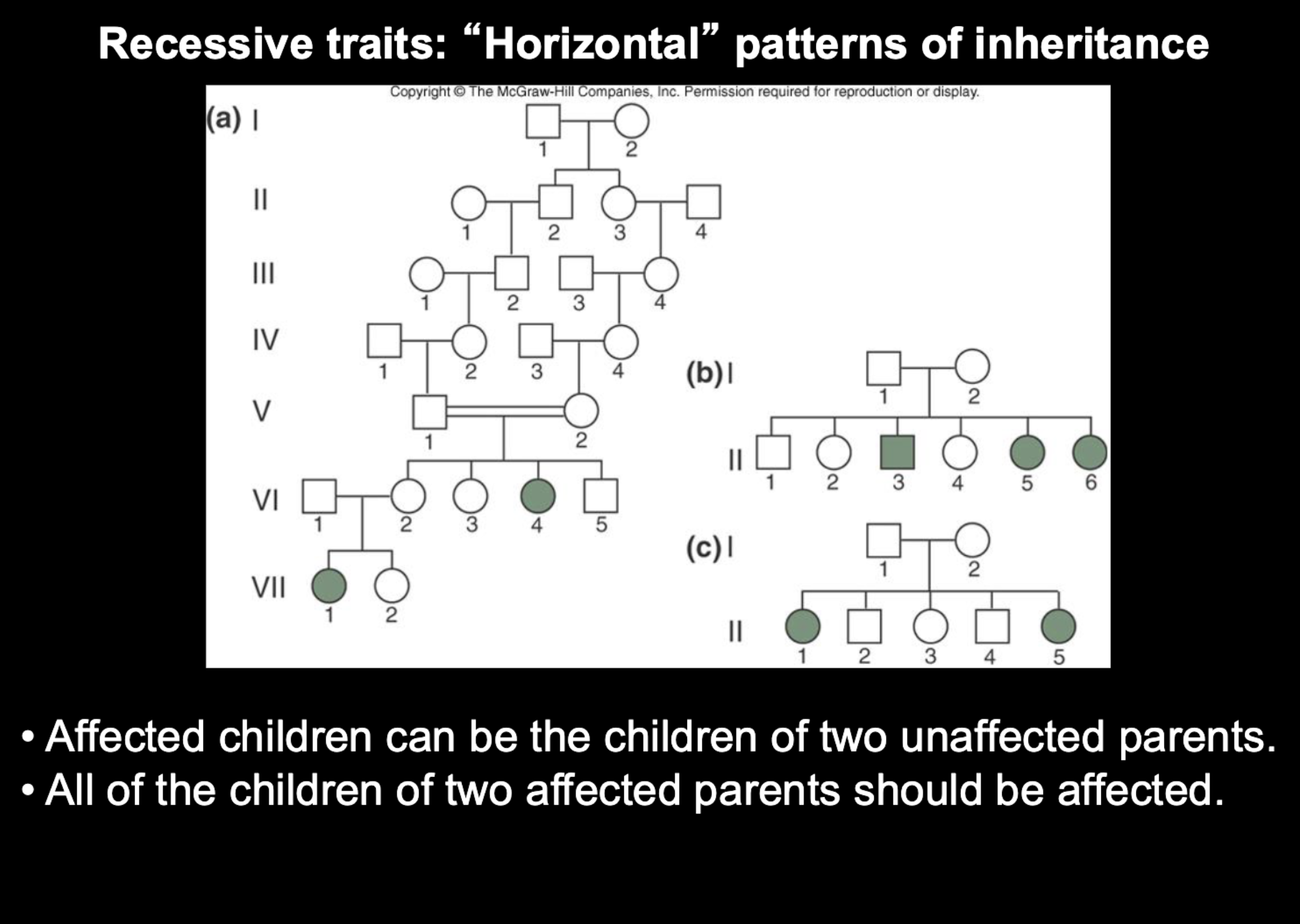
Recessive traits: “Horizontal” patterns of inheritance
Disease allele: in a horizontal pattern, the disease-causing allele is the recessive one (a). You need two copies (a/a) to be affected.
Horizontal pattern: affected people show up side by side among siblings in one generation, rather than running down a family line like a dominant trait. Pedigrees (b) and (c) show this.
Rule 1: affected children can have two unaffected parents. Both parents are carriers (A/a), so each child has a 1/4 chance of being a/a.
Rule 2: all children of two affected parents should be affected. Both parents are a/a, so they can only pass on a.
Skipping generations: unaffected carriers (A/a) hide the allele, so the trait can be absent for generations and then appear. This is a clue for recessive, but it isn't the definition, and recessive traits don't always skip. The most reliable test is an affected child with two unaffected parents, which only happens with a recessive trait.
Reading genotypes:
Affected = a/a
Any parent of an affected child that is an unaffected parent = A/a
Other unaffected people = A/- (at least one dominant allele, exact genotype unknown)

If the recessive trait is common, the patterns of inheritance
may show a vertical pattern of inheritance (eg. sickle cell
anemia among African-Americans
The trick: look for two unaffected parents with an affected child.
Two unaffected parents with an affected child: recessive, even if the pedigree looks vertical.
Two affected parents with an unaffected child: dominant. Both parents are Aa and had an aa child. A recessive trait can't do this, because two affected parents (aa) can only have affected children.
Neither situation appears: use the pattern as a guide, but it's only a probable answer.
Vertical, with no skipped generations, means probably dominant.
Affected people mostly among siblings, with skipped generations, means probably recessive.
Main idea: recessive traits usually show a horizontal pattern, but if the recessive allele is common in a population, the pedigree can look vertical, like a dominant trait.
Why: when the allele is common, many people are carriers (A/a). An affected person (a/a) is then likely to marry a carrier, and an a/a × A/a cross gives each child a 1/2 chance of being affected. Affected people show up in consecutive generations.
Example: sickle cell anemia has a common disease allele in some populations, including many people of African ancestry, so affected people often have affected children. The disease allele is still recessive.
Symbols on this slide:
Solid black = affected (a/a)
Hatched = carrier (A/a)
Open = unaffected (A/A)

Studying inheritance and pedigrees can also do harm
The single-gene assumption was the core mistake. Eugenicists like Henry Goddard claimed that "feeblemindedness" was one simple recessive trait. They never identified an actual gene, and they just assumed it followed Mendelian rules like Tay-Sachs does.
The traits were subjective labels. "Immoral," "lazy," "moron," and "sex pervert" were opinions assigned by field workers, not measurable traits.
The pedigrees were built to support a conclusion. The goal was to show that these traits ran in families, so the state could argue that sterilizing someone would prevent "unfit" future generations.
They ignored environment. Families share poverty, schooling, and living conditions as well as genes, so a trait appearing in several generations doesn't prove it's inherited.
Buck v. Bell (1927)
The U.S. Supreme Court upheld a Virginia law allowing the state to sterilize people it judged "unfit," usually people in institutions labeled as having intellectual disabilities or mental illness.
The plaintiff was Carrie Buck, a young woman in a Virginia state institution. The state said she was "feebleminded," that her mother was too, and that her young daughter was as well.
The slide quotes Justice Oliver Wendell Holmes Jr., who wrote the opinion, which was decided 8 to 1. "Three generations" refers to Carrie, her mother, and her daughter. The state treated that three-generation pattern as proof the condition was inherited


From antagonistic traits (clearly dominant and clearly recessive) to NOT antagonistic (codominant or incomplete dominance)


Incomplete Dominance—→ phenotype of heterozygote is intermediate between the phenotypes of the two homozygote parents (often due to reduced gene dosage)
compare this to a regular complete dominance monohybrid cross (antagonistic: dominant fully and recessive fully)

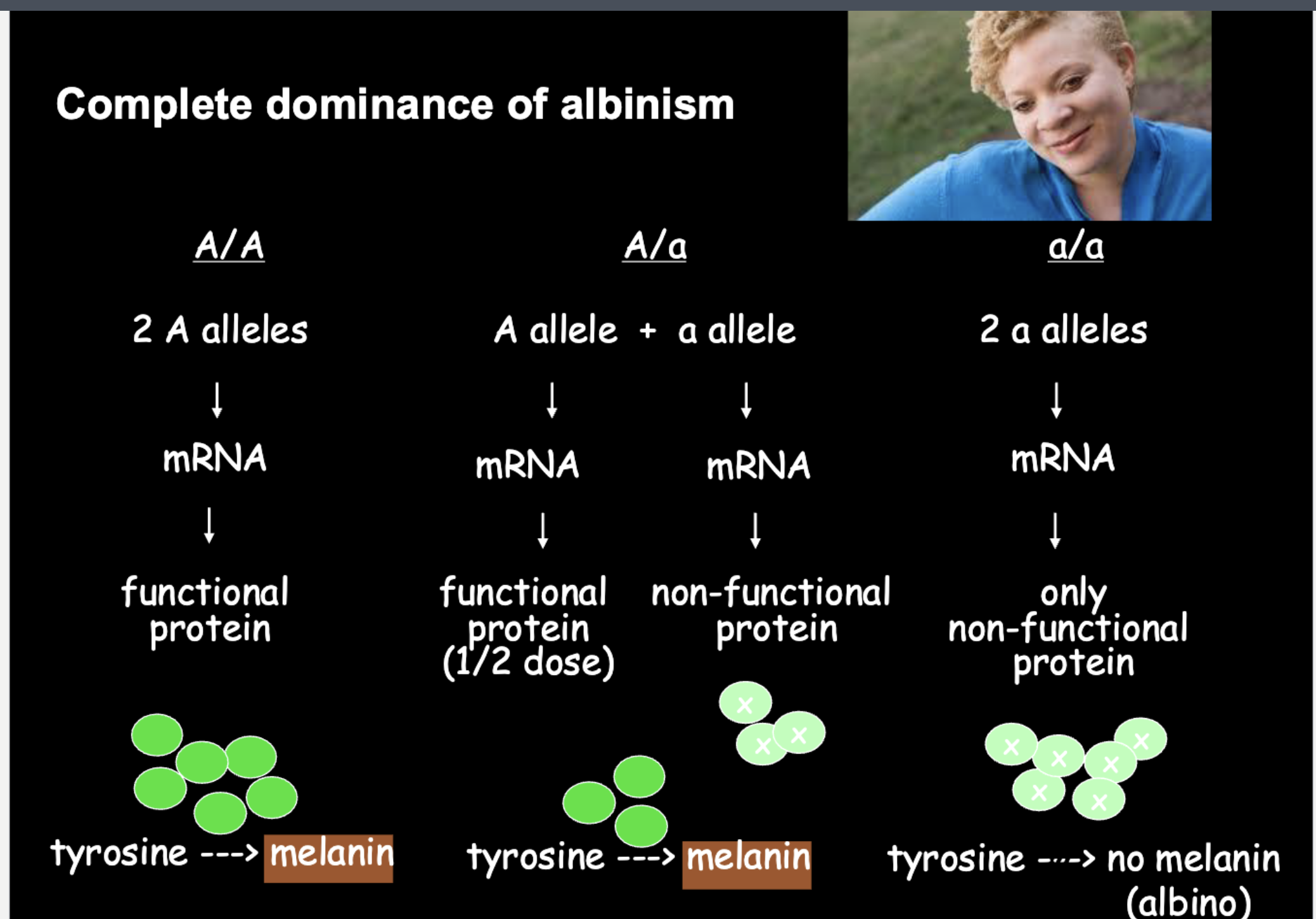
albinism is an example of COMPLETE dominance
Why it's called complete dominance: the heterozygote (A/a) looks the same as A/A, even though it makes only half as much functional protein. The dominant allele fully masks the recessive one.
Top row (albinism): complete dominance. Half the working enzyme (A/a) is enough to make full pigment, so A/a looks like A/A. This is haplosufficiency.
Bottom row (white → red pigment): incomplete dominance. Half the working enzyme (A/a) isn't enough to make full pigment, so the heterozygote makes less red and ends up pink, an intermediate between red (A/A) and white (a/a). This is haploinsufficiency, the opposite of haplosufficient.


Co-dominance—→ phenotype of the heterozygote looks like both homozygote parents
Your neighbor has a field of lovely white, lavender, and
purple flowers. He mates 2 lavender-flower plants with each
other and is surprised to see the production of all 3 colors in
the F1 generation. Up close, the lavender flowers are pure
lavender, not a mix of white and purple cells. In all your
genetic wisdom, you explain to your neighbor that this is a
single-gene trait and is an example of:
a) co-dominance
b) incomplete dominance
c) antagonistic traits
d) dominance
e) none of the above
If you count the F1 flowers, what proportion of them do you
expect to be lavender?
a) None
b) 1/2
c) 3/4
d) 1/4
e) 3/16
b) incomplete dominance —→ clue from lavender being an even mix between the two colors (no co dominance)
B) ½
Lavender is the heterozygote, so the cross is lavender × lavender, or A/a × A/a. The Punnett square gives:
1/4 A/A (purple)
2/4 A/a (lavender)
1/4 a/a (white)

A gene can have more than 2 alleles
Which genotype(s) below could NOT be a parent of
a child with blood type A?
1) IA/IB
2) IA/i
3) IB/i
4) i/i
5) They could all be a parent
They could all be a parent!!!

Sickle cell anemia is an example of dominance, incomplete
dominance and co-dominance under a variety of conditions
This slide shows that the dominance relationship between two alleles isn't fixed. It depends on which phenotype you measure and on the conditions. The same carrier (HbβᴬHbβˢ) can look like complete dominance, incomplete dominance, or co-dominance depending on the level you look at.

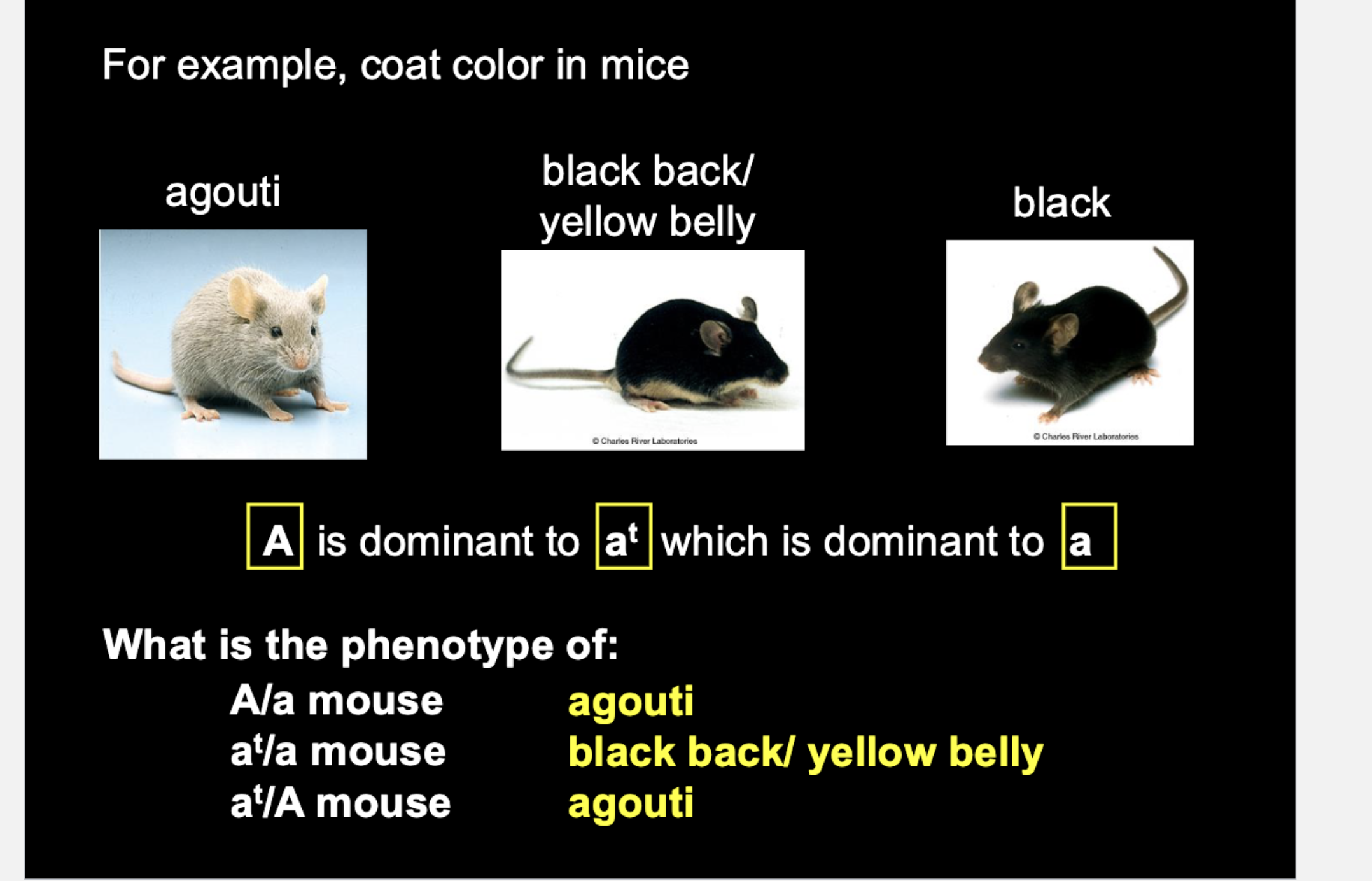
Alleles of some genes show a dominance series
What is the phenotype of:
A/a mouse
at/a mouse
at/A mouse
Variations in dominance affect the phenotypic ratio observed
among the progeny of a cross
A monohybrid cross follows one gene. When two heterozygotes are crossed (Aa × Aa), the genotypic ratio is always 1 AA : 2 Aa : 1 aa. The phenotypic ratio depends on how the alleles interact:
Complete dominance (3:1): AA and Aa look the same, so 3 show the dominant phenotype and 1 shows the recessive.
Incomplete dominance or codominance (1:2:1): The heterozygote has its own distinct phenotype (either blended or both!), so the phenotypic ratio matches the genotypic ratio.
Environment-dependent alleles (phenotype = genotype + environment)
Some alleles make a protein that works only under certain conditions, like shibire in flies or the pigment enzyme in Siamese cats.
The genotypes never change with the environment. Only whether each allele’s protein functions changes, and that changes the phenotype.
How to solve these problems
Set up the Punnett square and get the genotypic ratio.
At the given temperature, decide which alleles make a working protein.
Check which genotypes have at least one working copy (under complete dominance).
Count the phenotypes to get the ratio.
LETHAL ALLELES—→ The Punnett square still works the same way. The only extra step is to cross out the genotype that dies before counting phenotypes.

Environment-dependent alleles EXAMPLE
The Genetics: Every cat inherits two alleles for this gene. A standard full-color cat has \(CC\) or Cc, while a Siamese cat strictly has \(cc)
The Environment: For that Siamese cat (cc), where a hair is growing on its body (specifically, the temperature of that skin) dictates whether the melanin-producing enzyme switches on or off
INACTIVE (Warm Areas): In the cat's core body region (chest, back, and belly), the temperature is high (above 35°C / 95°F). At this warm temperature, the mutated enzyme changes shape, breaks down, and becomes completely non-functional. Because it cannot produce melanin, the fur grows out white, cream, or light fawn.
ACTIVE (Cool Areas): At the cat's extremities (ears, paws, nose, and tail), the surface temperature drops (below 33°C / 91°F). Because these areas are cooler, the mutated enzyme remains stable and functions normally. It successfully produces melanin, causing the fur in those specific spots to grow out dark brown or black

LETHAL EXAMPLE
Example: the allele for yellow coat color in mice is dominant
to the agouti allele:
Ay is dominant to A FOR COAT COLOR
Is the AY allele recessive or dominant?
a) recessive
b) dominant
c) both
d) it depends on the phenotype being scored
e) I don’t know
d) it depends on the phenotype being scored.
Coat color: A^y is dominant. A^y/A mice are yellow, the same as A^y/A^y would be if it survived, so one copy is enough to show yellow.
Lethality (survival) : A^y is recessive. A^y/A mice live, and only mice with two copies (A^y/A^y) die.
A/A survives (two copies of A).
A^y/A survives (one A is enough to prevent death).
A^y/A^y dies (no A present).
Death only shows up when a mouse has two copies of A^y, which is what “recessive for lethality” means. A single A^y copy isn’t enough to kill, so A^y/A mice live and show the yellow coat.
Result: 1 yellow (A^y/A) : 1 agouti (AA)
How a test cross tells you the genotype
Unknown yellow mouse is... | Offspring |
|---|---|
A^y/A^y (homozygous) | all yellow |
A^y/A (heterozygous) | 1 yellow : 1 agouti |
Because the cross gave agouti offspring, the yellow parent must carry an A allele, so it is heterozygous. A 1:1 ratio from a test cross means the unknown parent is heterozygous.
Why the slide asks “Where are the A^y/A^y?”
Every yellow mouse tested turns out to be A^y/A, never A^y/A^y. The next slide gives the answer: A^y/A^y is lethal, so those embryos die and are never born. That is why crossing two yellow mice gives 1 A^y/A^y (dead) : 2 A^y/A : 1 AA, or 2 yellow : 1 agouti instead of 3:1.


So many alleles : what is wild-type and what is not?
Dominant allele = R = wild-type
Recessive allele = r = mutant/ non-functional
Wild-type = an allele present at >1% frequency in the population. Alleles below 1% are mutant. Multiple alleles can be wild-type at once. The term is often used informally to mean “the working version,” which usually, but not always, matches.
Wild-type is defined by frequency, not by whether the allele is “healthy” or “normal.”
A gene can have multiple wild-type alleles at once. A gene like that is called polymorphic.
Rare (mutant) alleles are often loss-of-function or disease-causing, so frequency and function often line up. That’s a typical pattern, not the definition.
Typical pattern: wild-type = dominant, loss-of-function mutant = recessive
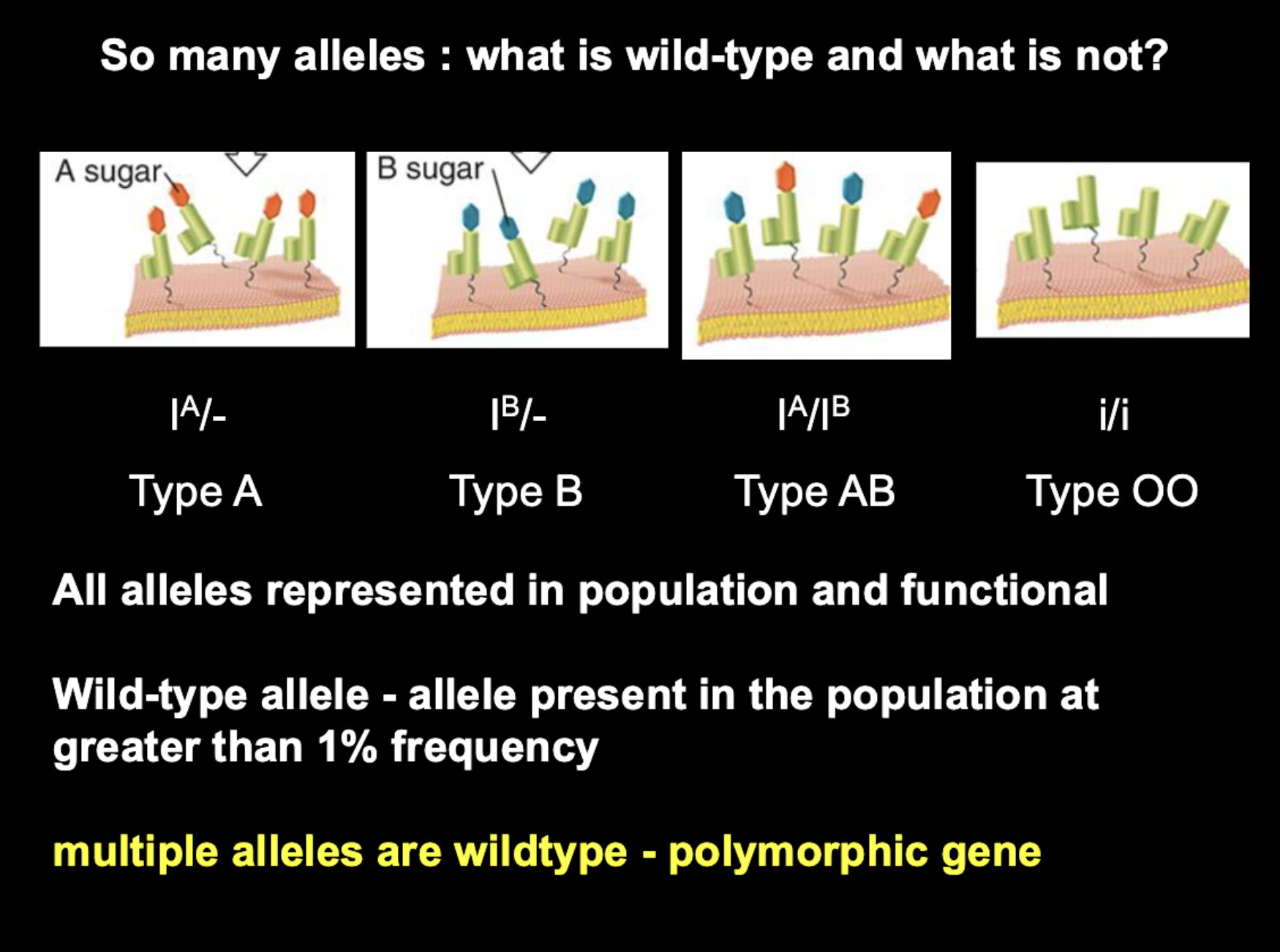

wild type example —→ Agouti is the wild-type allele for mouse coat color
Wild-type is defined by frequency, and selection shapes frequency.
Black coats make mice easy for predators to spot, so black mice often don’t survive to reproduce. The alleles that cause black coats (aᵗ and a) therefore stay rare, below 1%. Agouti (A) is present at over 99%, so it is the wild-type allele.
A is also the most dominant allele, which fits the usual pattern. But the slide’s argument for why A is wild-type is predation and reproduction, not dominance.
The allele whose phenotype helps survival and reproduction in a given environment tends to rise in frequency, and if it ends up above 1% it’s wild-type. In the mouse example, agouti camouflage is favored, so A is at >99%

Law of independent assortment results in production of
“recombinant” progeny
The P generation is YY RR (yellow, round) × yy rr (green, wrinkled).
Parental phenotypes are the ones that match those original parents: yellow round and green wrinkled.
Recombinant phenotypes are new combinations of the two traits that neither P parent had: green round (yy R-) and yellow wrinkled (Y- rr)
A 9:3:3:1 ratio only appears when the two genes assort independently, which happens when they are on different chromosomes. Then the alleles for color and shape shuffle freely into gametes, so all four (2^n) gamete types (YR, Yr, yR, yr) form in equal amounts. That shuffling is what produces the recombinant phenotypes.
Independent assortment means that the alleles of different genes sort into gametes independently of each other, because each homologous pair orients randomly at metaphase I. This produces equal numbers of all four gamete types in a dihybrid and gives 9:3:3:1 in the F2


TEST CROSS —→
Dihybrid test cross = Y/y; R/r × y/y; r/r gives 1:1:1:1.
Dihybrid × dihybrid = 9:3:3:1.
Recombinants present means the alleles can be shuffled, either by independent assortment or by crossing over.
Recombinants at 50% means the shuffling is completely free, which is what independent assortment predicts.
Test cross: Y/y; R/r × y/y; r/r
Gametes
Y/y; R/r parent (unknown): YR, Yr, yR, yr, each 25%
y/y; r/r parent (tester): only yr, 100%
50% RECOMBINENT —→ shows independently assort
Punnett square
YR | Yr | yR | yr | |
|---|---|---|---|---|
yr | Yy Rr | Yy rr | yy Rr | yy rr |
yellow, round | yellow, wrinkled | green, round | green, wrinkled |
Result: 1 yellow round : 1 yellow wrinkled : 1 green round : 1 green wrinkled
If the genes assort independently, the heterozygote makes all four gamete types in equal amounts (25% each): YR, Yr, yR, and yr.

What if these genes were on the same chromosome (& close)? —→ LINKED GENES
With independent assortment, each homolog pair orients randomly, so Y can end up with R or with r. With linkage, Y and R sit on the same chromosome, so one choice (which homolog goes where) decides both genes at once.
YR | yr | |
|---|---|---|
yr | YR/yr | yr/yr |
yellow, round | green, wrinkled |
test cross —> 1:1 ratio
On this slide there is no crossing over between the genes, so no recombinant gametes form and no recombinant offspring appear.
Gametes: only YR and yr, the same combinations the parent inherited. Yr and yR never form.
Test cross: only parental phenotypes, 1 yellow round : 1 green wrinkled, with 0% recombinants.

Meiotic recombination “unlinks” genes on the same
chromosome
crossovers occur between homologs in meiosis of an individual
- we cannot observe the products of those meiotic events until
the gametes that result are fertilized by another gamete to
produce progeny
• use individual where recombination does not need to be
considered as the source of gametes to fertilize the
individual you are interested in (test cross)

To observe crossovers, they need to occur in heterozygotes
Top right: recessive alleles in “cis” (ER/er)
“Cis” means both recessive alleles are on the same chromosome. Here one chromosome carries E and R, and the other carries e and r.
The boxed gametes are the new combinations created by the crossover. Because the homologs carry different alleles, the swap now makes something different, so it’s detectable.
Bottom right: recessive alleles in “trans” (eR/Er)
“Trans” means the recessive alleles are on opposite chromosomes. One chromosome carries e and R, the other carries E and r.


Cross-overs can occur anywhere along a homolog pair
0% recombination: 1 : 1 (only the two parental types)
Between 0% and 50%: four classes, but the two parental classes are equally common and bigger, and the two recombinant classes are equally common and smaller (for example 40 : 40 : 10 : 10)
50% recombination: 1 : 1 : 1 : 1
The rule: a crossover only creates recombinant gametes if it lands between the two genes being tracked. That’s what separates the two genes onto different chromosomes. A crossover outside both genes swaps a piece that doesn’t change how the two alleles are paired with each other.
8/24 = 33%: across the 6 meioses, there are 6 × 4 = 24 gametes total. Four of the six crossovers fall between the genes, each making 2 recombinant gametes, so 4 × 2 = 8 recombinant gametes out of 24, which is 33%.
This also shows why recombination frequency tracks distance. The farther apart two genes are, the more of the chromosome lies between them, so a randomly placed crossover is more likely to land in that interval.
Pooling gives you the recombination frequency, and that frequency is your estimate of the distance between the two genes (1% recombination = 1 map unit, or 1 centimorgan).
CALCULATING RECOMBINATION FREQUENCY (distance between 2 genes on the same chromosome)
Set up the cross. Cross the heterozygote (the individual you’re studying) with a homozygous recessive tester. Each offspring’s phenotype then shows which gamete the heterozygote contributed.
Add up the total offspring. 430 + 430 + 70 + 70 = 1,000.
Sort the phenotype classes into parental and recombinant. The two biggest classes are parental (E R = 430, e r = 430). The two smallest are recombinant (E r = 70, e R = 70).
Add the recombinant offspring. 70 + 70 = 140.
Divide by the total and multiply by 100. (140 ÷ 1,000) × 100 = 14%.
Convert to map distance. 1% recombination = 1 map unit (centimorgan), so the genes are 14 map units apart.
Interpret the result. Under 50% means the genes are linked. At 50% (all four classes about equal) they are unlinked.
The formula is: (recombinant offspring ÷ total offspring) × 100.

Frequency of recombination between two genes reflect
how far apart they are on the chromosome
When two genes are far apart on a chromosome, a crossover occurs between them in nearly every meiosis (~100% of meioses). Each crossover involves only 2 of the 4 chromatids, so it produces 50% recombinant gametes and 50% parental gametes. Therefore the recombination frequency is about 100% × 50% = 50%, the same as genes on different chromosomes that assort independently
Scenario 1: genes on different chromosomes (independent assortment)
The two chromosome pairs line up and separate independently of each other during meiosis.
So the parental and recombinant combinations are equally likely, and no crossover is needed.
Result: 50% parental and 50% recombinant gametes, about 25% of each of the four types.
Scenario 2: genes on the same chromosome but far apart (crossovers)
There is so much chromosome between the genes that a crossover lands between them in nearly every meiosis.
Each crossover involves only 2 of the 4 chromatids, so 2 gametes are recombinant and 2 are parental.
Extra crossovers can’t push the frequency above 50%, because double crossovers swap alleles and then swap them back.
Result: 50% parental and 50% recombinant gametes, about 25% of each of the four types.


Linked genes that are far apart behave like unlinked genes
Recombination frequency = 50%
Genes on the same chromosome (linked, near or far): the F₁ is written with its alleles lined up on each homolog, like c d / C D. The parental gametes are the combinations written on each chromosome: cd and CD. Read the pairing as it is written, not by assuming capitals go together. If the F₁ were written C d / c D, the parental gametes would be Cd and cD.
Genes on different chromosomes: the F₁ is written A/a ; B/b, which doesn’t show which alleles were paired. So you look at the P generation (a/a ; B/B × A/A ; b/b) and see which alleles came together from each parent. That gives parental gametes aB and Ab, and recombinants AB and ab.

Distance between genes on the same chromosome
is expressed as % recombinant gametes or % recombination
1 map unit (m.u.) = 1% recombination = 1 centimorgan (cM)
- What would 5% recombinant gametes suggest?
- What would 30% recombinant gametes suggest?
- What would 50% recombinant gametes suggest?
Each percentage translates directly into map units, and from that you can read how close the genes are.
5% recombinant gametes
The genes are 5 map units (5 cM) apart.
They are tightly linked, very close together on the same chromosome, so a crossover rarely lands between them.
A test cross gives mostly parental types, about 47.5 : 47.5 : 2.5 : 2.5.
30% recombinant gametes
The genes are 30 map units (30 cM) apart.
They are still linked, but farther apart, so crossovers separate them fairly often.
Parentals still outnumber recombinants, about 35 : 35 : 15 : 15.
50% recombinant gametes
The genes behave as unlinked. They are either on different chromosomes or on the same chromosome but so far apart that a crossover separates them nearly every time.
A test cross gives 25 : 25 : 25 : 25, or 1 : 1 : 1 : 1.
50% is the maximum you can measure, so you can’t tell how far apart the genes are beyond “far enough to look unlinked.”
The G and H genes are 20 m.u. apart on chromosome 3.
In a population of gametes from a gh/GH individual, what %
of chromosome 3’s would you expect to be recombinant?
1) 10%
2) 20%
3) 40%
4) 80%
What % of chromosome 3’s would you expect to be gH?
1) 10%
2) 20%
3) 40%
4) 80%
2) 20%
1) 10%
The G and H genes are 20 m.u. apart on chromosome 3.
In a population of meiosis events from a gh/GH individual,
what % of meiosis events would you expect to have a c.o.
between the G and H genes?
1) 10%
2) 20%
3) 40%
4) 80%
3) 40% —→ 20 m.u. means 20% of gametes are recombinant. Each meiosis with a crossover between the genes produces only 50% recombinant gametes, since only 2 of the 4 chromatids are involved. So the fraction of meioses with a crossover is 20% ÷ 50% = 40%

The B and E genes are 10 m.u. apart on chromosome 21.
In a population of gametes from a Be/bE individual, what % of
chromosome 21’s would you expect to be parental?
1) 10%
2) 20%
3) 40%
4) 80%
5) 90%
5) 90%
The S and T genes are far apart (i.e. at opposite ends) on
chromosome 8. In a population of meiosis events, what % of
meiosis events would you expect to have a c.o. (at least 1)
between the S and T genes?
1) 0%
2) 25%
3) 50%
4) 100%
4) 100%.—→ Genes at opposite ends of a chromosome have so much room between them that essentially every meiosis has at least one crossover between them. A: crossover in ~100% of meioses × 50% recombinant gametes gives the 50% recombination frequency that far-apart genes show

Practice Question
