Parasites part 1 Ana Salazar
 Call Kai
 Learn
 Practice Test
 Spaced Repetition
 Match
 Flashcards
 Knowt Play
1/14

There's no tags or description
Looks like no tags are added yet.
15 Terms

Scientific name: Toxocara canis
Common name: Canine roundworm
Phylum: Nematoda
Identification: Round egg with thick, rough/pitted shell.
Zoonotic risk: Yes. Can cause visceral or ocular larva migrans in humans.
Diagnosis: Fecal flotation; identify roundworm eggs.
Transmission: Ingest embryonated eggs or infected paratenic hosts. Direct or indirect route.
Treatment: Pyrantel pamoate or fenbendazole.

Scientific name: Toxocara cati
Common name: Feline roundworm
Phylum: Nematoda
Identification: Round egg with thick, rough shell.
Zoonotic risk: Yes. Can cause larva migrans.
Diagnosis: Fecal flotation.
Transmission: Ingest eggs or infected prey.
Treatment: Pyrantel pamoate or fenbendazole.

Scientific name: Baylisascaris procyonis
Common name: Raccoon roundworm
Phylum: Nematoda
Identification: Round egg with thick, dark, rough shell.
Zoonotic risk: Yes. Can cause severe neural or ocular larva migrans.
Diagnosis: Fecal flotation.
Transmission: Ingest eggs from raccoon feces or infected prey.
Treatment: Veterinary-directed deworming.
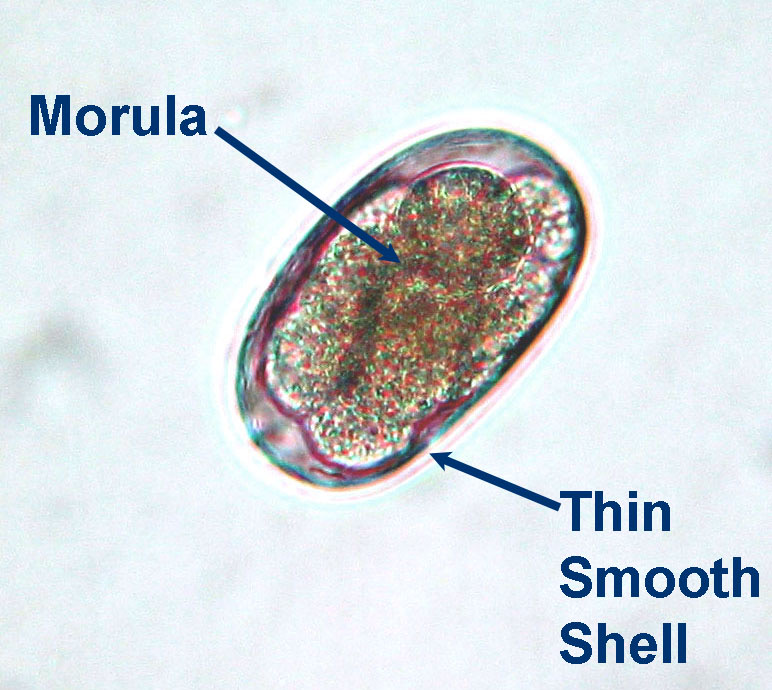
Scientific name: Ancylostoma caninum
Common name: Dog hookworm
Phylum: Nematoda
Identification: Oval egg with thin shell and developing cells.
Zoonotic risk: Yes. Can cause cutaneous larva migrans.
Diagnosis: Fecal flotation.
Transmission: Skin penetration, ingestion, or nursing. Direct life cycle.
Treatment: Pyrantel, fenbendazole, or approved preventives.

Scientific name: Uncinaria stenocephala
Common name: Northern hookworm
Phylum: Nematoda
Identification: Oval, thin-shelled egg; approximately 25% larger than Ancylostoma.
Zoonotic risk: Rarely; possible skin larva migration.
Diagnosis: Fecal flotation.
Transmission: Ingest larvae or skin penetration. Direct life cycle.
Treatment: Veterinary-prescribed dewormer.

Scientific name: Trichuris vulpis
Common name: Canine whipworm
Phylum: Nematoda
Identification: Barrel-shaped egg with two bipolar plugs.
Zoonotic risk: No established zoonotic infection.
Diagnosis: Fecal flotation.
Transmission: Ingest embryonated eggs. Direct life cycle.
Treatment: Fenbendazole or approved preventives.

Scientific name: Physaloptera spp.
Common name: Stomach worm
Phylum: Nematoda
Identification: Oval egg with thick shell and developing larva.
Zoonotic risk: No recognized common zoonotic infection.
Diagnosis: Fecal flotation; eggs can be difficult to find.
Transmission: Eating infected insects or paratenic hosts. Indirect life cycle.
Treatment: Veterinary-directed deworming.

Scientific name: Giardia duodenalis
Common name: Giardia
Phylum: Metamonada
Identification: Oval cyst with internal nuclei; trophozoite has two nuclei.
Zoonotic risk: Some strains infect humans and cause diarrhea.
Diagnosis: Fecal antigen test, flotation, or direct smear.
Transmission: Ingest cysts from contaminated water or feces. Direct life cycle.
Treatment: Fenbendazole or veterinarian-directed medication.

Scientific name: Tritrichomonas blagburni
Common name: Feline intestinal trichomonad
Phylum: Parabasalia
Identification: Pear-shaped, motile organism with flagella.
Zoonotic risk: No established zoonotic risk.
Diagnosis: Fresh fecal smear or PCR.
Transmission: Ingest trophozoites from contaminated feces. Direct life cycle.
Treatment: Ronidazole under veterinary supervision.

Scientific name: Cystoisospora spp.
Common name: Coccidia
Phylum: Apicomplexa
Identification: Round or oval oocyst.
Zoonotic risk: No; generally host-specific.
Diagnosis: Fecal flotation.
Transmission: Ingest sporulated oocysts. Direct life cycle.
Treatment: Ponazuril or sulfadimethoxine.

Scientific name: Toxoplasma gondii
Common name: Toxoplasmosis parasite
Phylum: Apicomplexa
Identification: Very small, round oocyst.
Zoonotic risk: Yes. Can cause flu-like illness and serious fetal disease.
Diagnosis: Serology or PCR.
Transmission: Undercooked meat or cat-shed oocysts. Indirect life cycle.
Treatment: Clindamycin for affected cats.

Scientific name: Cryptosporidium spp.
Common name: Cryptosporidium
Phylum: Apicomplexa
Identification: Very tiny, round oocyst (4–6 µm).
Zoonotic risk: Yes. Can cause watery diarrhea.
Diagnosis: Acid-fast stain, antigen test, or PCR.
Transmission: Ingest oocysts from contaminated water or feces. Direct life cycle.
Treatment: Supportive care; depends on host and case.

Scientific name: Dipylidium caninum
Common name: Flea tapeworm
Phylum: Platyhelminthes
Class: Cestoda
Identification: Multiple eggs grouped inside egg packets.
Zoonotic risk: Yes. Humans can become infected by swallowing an infected flea.
Diagnosis: Fecal examination or proglottid identification.
Transmission: Swallow infected flea. Indirect life cycle.
Treatment: Praziquantel and flea control.

Scientific name: Taenia spp.
Common name: Taenia tapeworm
Phylum: Platyhelminthes
Class: Cestoda
Identification: Round egg with thick, radially striated shell.
Zoonotic risk: Some species can infect humans.
Diagnosis: Fecal examination or proglottid identification.
Transmission: Eating infected prey or raw tissues. Indirect life cycle.
Treatment: Praziquantel.
CTVT page/section: ______

Scientific name: Echinococcus spp.
Common name: Hydatid tapeworm
Phylum: Platyhelminthes
Class: Cestoda
Identification: Round egg with thick, radially striated shell.
Zoonotic risk: Yes. Can cause hydatid disease.
Diagnosis: Fecal testing/PCR; eggs resemble Taenia eggs.
Transmission: Ingest infected organs or eggs. Indirect life cycle.
Treatment: Praziquantel in definitive hosts.