Exam 1: Lesson 4- Chromosome and Karyotype Rearrangements
 Call Kai
 Learn
 Practice Test
 Spaced Repetition
 Match
 Flashcards
 Knowt Play
1/64

There's no tags or description
Looks like no tags are added yet.
65 Terms
Define aneuploidy and polyploidy and know the difference
Aneuploidy= gain or loss (2n+1/2n-1) of individual chromosomes
Polyploidy= addition of one or more (3n, 4n) entire sets of chromosomes
What causes aneuploidy? most common?
Commonly:
mistakes in maternal meiosis
>60% made in Meiosis 1
Less likely:
Mistakes in paternal meiosis (makes up 10% of down syndrome cases)
Mitotic errors
Why are chromosomal aberrations leading to disease and disorders?
improper amount of chromosomes leads to improper development and expression of genes
Why are autosomal numerical aberrations less tolerated by the cell/organism than aberrations in the number of sex chromosomes?
Sex chromosomes have built in mechanisms, such as X inactivation, and features, such as low gene density on Y chromosomes, that makes more or less X or Y chromosomes less impactful
Autosomes do not have these features, so more or less chromosomes influences protein production much more
What is chromosomal nondisjunction and how does it affect ploidy?
failure of homologous chromosomes or sister chromatids to separate properly during cell division
causes aneuploidy, because it increases or decreases the number of INDIVIDUAL CHROMOSOMES (trisomy or monosomy)
What is the difference between chromosomal disjunction errors during meiosis I and meiosis II and how does each affect the cell?
Meiosis 1- homologous chromosome pairs fail to separate properly
pulls a pair of 2 chromosomes to one side, creating 4 abnormal gametes (2 n+1 and 2 n-1)
Meiosis 2- homologous chromosomes separated properly, but then the sister chromatids in a cell separate wrong, causes 2 bad gametes (n+1 & n-1) and 2 normal gametes
What are the usual consequences of meiotic errors?
miscarriages
aneuploidy
reduced fertility
What is Autosomal Monosomy? Viable in mammals?
one individual chromosome from a pair of autosomal chromosomes is missing
not viable in mammals!
die before implantation, no pregnancy
What is the meaning of the statement ‘autosomal monosomies unmask lethal alleles’?
With only one chromosome instead of two, there is only one copy of an allele, so a recessive lethal allele that would normally not be expressed would be expressed since it is not masked by a dominant allele
Example of autosomal monosomy in mammals
Monosomy 21 in humans
2 cases
1st caused by mistake in meiosis
2nd caused by mitotic non-disjunction (monosomy 21 & trisomy 4)
What is autosomal Trisomy? Viability?
3 autosomal chromosomes instead of 2
often lethal, some are viable
4% of human conceptions
Are autosomal trisomies more or less viable depending on the size of the chromosome?
Trisomies of SMALL chromosomes can be viable
Trisomies of LARGER chromosomes can be lethal
Why is autosomal trisomy more tolerated when it happens in small chromosomes than when it happens
in large chromosomes?
Small chromosomes are less gene dense
the less gene dense a chromosome, the more likely it is to survive trisomy (less additional genetic material)
Trisomy for many different chromosomes is routinely observed in spontaneous abortions, but
monosomy is not. Why?
autosomies are usually lethal before pregnancy
trisomies survive longer so the abortion can be detected
What are the three human chromosomes that can be trisomic in liveborns? Which is the most common
among the three?
Trisomy 21 (down syndrome) - most common
Trisomy 13 (Patau Syndrome)
Trisomy 18 (Edwards Syndrome)
Cite and explain one possible reason for the trisomy 21 disorder. Name the syndrome
Down Syndrome
maternal meiosis non disjunction
What is unique about Down Syndrome among the trisomies?
the ONLY autosomal trisomy where individuals MAY live longer (30-40 yo)
Features of Down Syndrome/Trisomy 21
most spontaneously aborted
impaired cognition
premature aging
heart defects
high frequency of leukemia
low frequency of tumors (3 copies of tumor suppressor genes)
What is a huge risk factor for having a baby with down syndrome?
Mother over the age of 35
What is a treatment thats been explored for down syndrome?
insrting XIST into trisomy 21 cell to silence one chromosome 21 into a Barr body
Features of Trisomy 13 (Patau Syndrome)
risk factor= increased maternal age
usually lethal in embryonic stage
mental and motor retardation
Features of Trisomy 18 (Edwards Syndrome)
congenital abnormalities: heart and neurological, syndactyly (fused fingers/toes… think edward scissorhands)
Spontaneous abortions with trisomy of chromosome 1 or chromosome 19 are never seen. Do they ever
occur? Explain
They rarely occur bc they almost always die before pregnancy is reached
bc of 1 & 19 have highest gene density of all chromosomes, making trisomy much less viable because of the additional genetic information
Why are cases of polyploidy rare in mammals, birds, and reptiles?
usually fatal in embryonic stage
What are the 2 causes of Polyploidy?
germline event (rare)
somatic genome duplication (common)
What tissues does somatic genome duplication occur in? y?
tissues of high regenerative capacity like liver, placenta, bone marrow
polyploidy used as a buffer against oxidative stress and genotoxic damage
Which germline events can lead to human polyploidy? causes?
Tetraploids (4 full chromosome sets)
mitotic failure in embryogenesis
cell fusion
Triploids (3 full chromosome sets)
egg fertilized with 2 sperms
ovum fused with polar body & fertilized by sperm
meiosis 1 or 2 errors in oogenesis or spermatogenesis
What is the most common chromosomal abnormation in human gestation? Stats?
Triploids (3n=69), lethal
1-2% of all recognized conceptions
1-13% of spontaneous abortions/miscarriages
1/10,000 live births
Is tetraploidy viable?
viability is very rare… however, tretraploid/diploid mosaics are more viable bc some cells are normal
What are the consequences of numerical aberrations in sex chromosomes for the organism?
usually viable
sub fertility of infertility
MILD mental and physical problems
low number of genes
Due to genes that escape X inactivation
How does X inactivation affect numerical abberations of sex chromosomes?
corrects some of genetic imbalance, making the offspring more compatible with life than in autosomal abnormalities
…. inactivates all but 1 X chromosome, so if theres 3, then 2 are silenced
What are the most common sex chromosome aneuploidies?
Klinefelter’s Syndrome
X-Trisomy (47, XXX)
X-Monosomy aka Turner’s Syndrome (45, X)
Features of Klinefelter’s Syndrome
(47, XXY)
sterile males
higher risk for x-linked autoimmune disorders
hypogonadism
Features of X-Trisomy
Trisomy= 47, XXX
fertile females, BUT 50% sons are XXY
In X-polysomy, are genes overexpressed?
YES,
Which affects fertility more, X overdose or underdose? Why?
Underdose because overdose affects can be limited by X-inactivation… only the few genes that escape X inactivation are over expressed
What is the phenotype of Turner Syndrome (45,X) and what are the genetic consequences of having only one X?
Phenotype:
short
sterile (underdeveloped ovaries)
Genetic Consequences:
Haploinsufficiency (one copy of X is not sufficient for normal function) of PAR and other genes that escape X-inactivation…. Need 2 copies of each of these genes to function properly
What is XYY Syndrome AKA? Phenotype?
Jacobs Syndrome
subtle characteristics
tall & very thin
fertile w/ decreased sperm quality
What kind of mistake in meiotic cell division can lead to XYY aneuploidy?
non-disjunction in male meiosis 2
What are the types of structural chromosome abberations?
deletions
duplications
inversions
translocations
Issues during which process cause aberrations in somatic cells? germ cells?
Somatic cells= mitosis
germ cells= meiosis
What is a deletion and what are the consequences of this aberration?
loss of any genetic material
loss of chromosome segments
loss of gene(s) and gene products
meiotic pairing problems
changed phenotypes: phenotypic variation and disease
Which has a more severe effect on phenotype: deletion of the p arm of the X chromosome or deletion of the q arm? Explain.
Deletion of the q arm (long arm)
because q has more genes that escape X inactivation… and for normal function, you need pairs of these genes… deletes one of them
In Y chromosomes, would deletion of p or q arm be worse? WHy?
q arm (long arm) bc theres 3 AZF (azoospermia factor) regions that influence fertility here… deletion of these causes infertility
In a pair of homologous chromosomes, one homolog has a deletion. What will happen in pachytene?
normal pachytene=crossing over, therefore:
the normal homolog forms a compensation loop/deletion loop, where the deleted region should be paired
The normal parts of the chromosomes synapse and cross over normally
Name the main consequences of duplications.
overdose of genetic material
problems in meiotic pairing
changes in phenotype: phenotypic variation and disease
What is the role of duplications in evolution? Give an example.
Genes duplicated in evolution to:
protect essential genes
Generate new genes (variation and adaptive mutations)
ie. Bar eye mutation in Drosophila (eyes are a range of wide to narrow)
What are paralogous genes aka paralogs? Give an example.
Separate genes in a species that are duplications from the same ancestral gene
share some similarity, but have distinct gene products and function
Ie.
duplication of starch digestion genes: AMY1 salivary amylase
in humans: 5-7 copies based on how much starch is in diet
Chimp= 2 copies, digests roots and tubers
What are inverions? Genetic consequences?
linear order of a segment is inverted 180*
NO LOSS OF GENETIC MATERIAL
Consequences:
changes the linear relationship/order of genes
affects homologous pairing and crossing over in meiosis
What is the fundamental difference between deletions/duplications and inversions?
Deletions & duplications change the amount of genetic material in the genome= genome unbalanced
Inversions do not change the amount of genetic material in genome= genome balanced
What are translocations?
Exchange of genetic material between non-homologous chromosomes (=no loss or gain of genetic material)
Name the two main types of translocations
Types:
Non-reciprocal (1 donates to the other)
Reciprocal (2 swap/donate to each other)
In which way do translocations differ from deletions/duplications/inversions?
Translocations occur between two NON-homologous chromosomes,
deletions/duplications/inversions all occur within a single chromosome or between homologous chromosomes
What type of translocation has generated the Philadelphia chromosome? Which chromosomes?
HSA9/22 RECIPROCAL translocation (btw Chr 9 and 22)
What is the human Philadelphia chromosome? which genes involved?
marker chromosome in chronic myeloid leukemia
fusion of BCR-ABL genes
causes continuous proliferation of cells (leukemia)
What is the dog version (homolog) of the Philadelphia chromosome?
Raleigh Chromosome
What is the difference between balanced and unbalanced gametes?
Balanced gametes= normal, complete set of genes with no gains or losses in genetic material
Unbalanced gametes= gains or losses in genetic material
What are the possible consequences of translocations for reproduction? Next generation?
normal, but sub-fertile, translocation can be inherited
next generation can be:
normal gametes (healthy)
balanced translocations (fertility issues)
unbalanced translocations (unhealthy)
What kind of translocation is called ‘Robertsonian translocation’?
Fusion of 2 acrocentric chromosomes
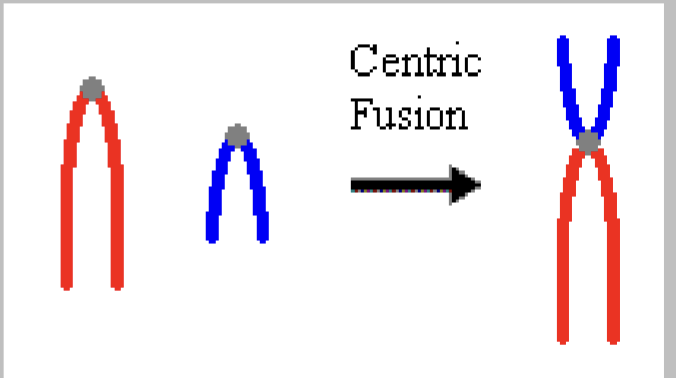
Compare phenotypic consequences of deletions and inversions. Which are more severe? Why?
Deletions are more severe because there is a LOSS of genetic material
gene dosage issues
high lethality
What are fragile sites?
heritable loci on chromosomes that are prone to forming gaps or breaks when cells are exposed to chemicals which inhibit DNA replication
Give an example of a human genetic disorder associated with fragile sites. Explain its molecular
mechanism
Fragile X Syndrome (progressive neurodegenerative disorder)
—> caused by an unstable expansion of a CGG trinucleotide repeat located in the 5' untranslated region (5' UTR) of the FMR1
What are Disorders of Sex Development, also known as sex reversal conditions?
Phenotypic sex does not match what the chromosomal sex says you should be
XX males
XY females
What causes XX males?
SRY + (common)= SRY translocated to the X chromosome (determines male sex)
SRY - = mutation ins autosomal gene SOX9
What causes XY females? AKA?
Swyer Syndrome
SRY - = deletion or mutation in SRY
SRY + = mutations in X-linked or autosomal genes