QRC GenChem and Basic Laboratory
 Call Kai
 Learn
Learn Practice Test
 Spaced Repetition
 Match
Match Flashcards
 Knowt Play
1/104

There's no tags or description
Looks like no tags are added yet.
Name | Mastery | Learn | Test | Matching | Spaced | Call with Kai | Chat |
|---|
No analytics yet
Send a link to your students to track their progress
105 Terms
Element
Classify whether it is element, compound, homogenous or heterogenous mixture: A shiny, silvery-colored solid that conducts electricity and cannot be broken down into simpler substances by chemical means.
Compound
Classify whether it is element, compound, homogenous or heterogenous mixture: A clear liquid boils at 78C and remains unchanged in composition during boiling
Heterogenous mixture
Classify whether it is element, compound, homogenous or heterogenous mixture: A substance made up of two components that can be separated by filtration.
Homogenous mixture
Classify whether it is element, compound, homogenous or heterogenous mixture: A blue liquid with a uniform composition and boils at a constant temperature and cannot be separated into simpler means.
Intensive properties
Are physical properties that are independent of the amount of substance
Extensive properties
Are physical properties that are dependent of the amount of substance. Notation: “If you double the mass, will the quantity be doubled too?“
Intensive
Classify whether extensive or intensive property: Density
Intensive
Classify whether extensive or intensive property: Molar mass
Intensive
Classify whether extensive or intensive property: Boiling Point
Intensive
Classify whether extensive or intensive property: Specific Heat Capacity
Plasma
It is a state of matter that is composed of ions and free electrons, and is commonly found at very high temperatures such as stars and lightning.
Systeme Internationale d’Unites
What is the French term of SI Units?
Dalton proposed a billiard ball model
What does a Dalton’s model of atom look like?
George Stoney
He proposed that electricity is made up of negatively-charged particles (electrons).
Sir William Crookes
He stated that the cathode rays carry a negative charge.
Eugene Goldstein
He used cathode ray to study canal rays, which had electromagnetic properties opposite to those of an electron.
Henri Becquerel
He discovered radiation by studying the effects of uranium on photographic film.
Frederick Soddy; Margaret Todd
___ discovered that there appeared to be more than one element at certain positions on the periodic table. The term isotope was coined by ___ as a suitable name for these elements.
Richard Abegg
He discovered that noble gases have a stable electron configurations.
Heins Geiger
He developed a device that can detect alpha particle.
Law of Triads (Johann Dobereiner)
Is a law proposed for the arrangement of periodic table of elements where the atomic weight of the middle element should be the average of the atomic weights of the other two elements.
Law of Octaves (John Newlands)
Is a law proposed for the arrangement of periodic table of elements where every eighth elements have similar properties
Lothar Meyer
He proposed that the arrangement of periodic table of elements should have periodic recurrence.
Henrey Moseley
He discovered that the wavelengths of X-ray emission from elements corresponded to their atomic number.
Alkali Metals
Are soft, silvery metals that react vigorously with water to form M-OH and H2 gas. It is found naturally only in compounds.
React with water with exceptions: Be does not react with water and Mg is slow
What is the reactivity of G2A elements with water?
Lanthanides
Are f-block metals that form +3 cations and are found in earth’s crust (that’s why it is called as rare earth metals)
Actinides
Are f-block elements which have many oxidation states and are radioactive
Rutherfordium (104Rf) to Oganesson (118Og)
What elements are highly radioactive, synthetic transactinides
Diamond
It is an allotrope of carbon which is characterized as the hardest known natural material.

Graphite
Is an allotrope of carbon made up of layers of hexagonal sheets

Fullerenes
Are a family of carbon allotropes characterized by hollow, cage-like structures composed of carbon atoms arranged in pentagonal and hexagonal rings (e.g. C60)

Carbon nanotubes
It is a cylindrical graphene sheet.
Mercury, Gallium, Francium, and Bromine
What elements are liquid at room temperature
International Union of Pure and Applied Chemistry
IUPAC means
Ox SilA Fe
Oxygen, Silicon, Aluminum, and Iron
What elements does Earth’s crust contain?
Ox Ca? HydNi
Oxygen, Calcium, Hydrogen, and Nickel
What elements does human body have?
Cis STOP: Carbon, Sulfur, Tin, Oxygen, and Phosphorus
Semiconductors
Some metal and non metals
What elements have allotropes (they are 5 only)
D.
A vessel contains an equilibrium mixture of NO2(g) and N204(g) at a fixed temperature and a total pressure of 1.00 bar, as shown below. Which diagram best represents the system at equilibrium after argon is added, while maintaining both the temperature and the total pressure constant?

A.

B.

C.

D.

(a) no shift
(b) shifts toward more moles of gases
What is the effect on equilibrium when an inert gas is added in a condition where there is:
(a) constant volume
(b) constant pressure
Solvation
It is the interaction of any solvent with ions or molecules.
Henry’s Law (S=kHP)
As pressure increases, solublity increases
As temperature increases, solubility decreases
Why? A(g) ⇌ A(aq) + ∆ – Solubility of gas in liquid is exothermic, so as temperature increases, equilibrium shifts toward the gas, decreasing its solubility.
What is the principle behind the effects of pressure and temperature to the solubility of gas in liquid?
Soft drinks are cabonated drinks that contain no alcohol, which could be an alternative to beer, wine, or other alcoholic drinks (Hard drinks)
What is the difference between soft drinks and hard drinks?
Transuranium elements
These are significantly synthetic elements that are usually radioactiv and often have very short half-lives.
(a) Hemihydrate
(b) Sesquihydrate
Hydrates can have fractional moles of water molecules. What is the prefix used for hydrates if it has (a) 0.5H2O, and (b) 1.5H2O?
Stoichiometric point (characteristic of increasing concentration of product, but at this point, it becomes a plateau due to all limiting reactants being used up)
It is the point in a chemical reaction at which the reactants are present in the exact mole ratio required by the balanced chemical equation.
Reverse rxn, Forward rxn, and system is at equilibrium
What reaction is favored if Q>K, Q<K, and Q=K?
G1A, Acetates, Nitrates, and Ammonium are always soluble
G17 are soluble except Pb, Hg, Ag
Sulfates are soluble except Ba, Ca, Sr, Pb, Hg, Ag
Hydroxides are insoluble except Ba, Ca, Sr
Sulfides are insoluble except bonded with G1, G2, and NH4
Carbonates, chromates, and phospates are insoluble except when bonded with G1 and NH4
What are the solubility rules for G1A, G17, Sulfides, Acetates, Nitrates, Ammonium, Chromates, Carbonates, Phosphates, Hydroxides, and Sulfates?
Na2CO3 (soda ash)
K2CO3 (potash)
When saponin-rich plants are burned, they produce ashes rich in salts like ___ and ___. State their common names as well.
Strong monoprotic acid: H3O+ = A–
* HA is not included because since it is strong, there is complete ionization
Strong polyprotic acid (H2SO4): H3O+ > HSO4– > SO42–
In ranking the concentrations of all species present in a strong acid, how is it arranged for monoprotic and polyprotic acids?
Weak monoprotic acid: HA > H3O+ = A– > OH–
Weak polyprotic acid (H2CO3): H2CO3 > H3O+ > HCO3– > CO32– > OH–
In ranking the concentrations of all species present in a weak acid, how is it arranged for monoprotic and polyprotic acids?
(Use a ladder diagram)

The most dominant species is HCO3–
Carbonic acid has two ionizable protons, where Ka1=4.5×10⁻⁷ and Ka2=4.7×10⁻¹¹. What is the most dominant species at pH of 7?
A. 0.15 = [HClO2] + [ClO2–]
B. 0.10 = [H3PO4] + [H2PO4–] + [HPO42-] + [PO43–]
C. 0.20 = [Mg2+]; 0.40 = [Br–]
2[Mg2+] = [Br–]
What is the mass balance equation of the ff.:
A. 0.05M HClO2 and 0.10M NaClO2
B. 0.10M H3PO4
C. 0.20M MgBr2
CHA = [HA] + [A–]
What is the formula for mass balance equation?
MBE: 0.10M = [Na+]
0.10M = [H2CO3] + [HCO32–] + [CO32–]
CBE: [Na+] + [H3O+] = [HCO32–] + 2[CO32–] + [OH–]
What is the MBE and CBE for 0.10M NaHCO3?
Multiply to the charge
For writing CBE, what is the important rule to remember if the charge of a species is not 1?
Use mass balance equation:
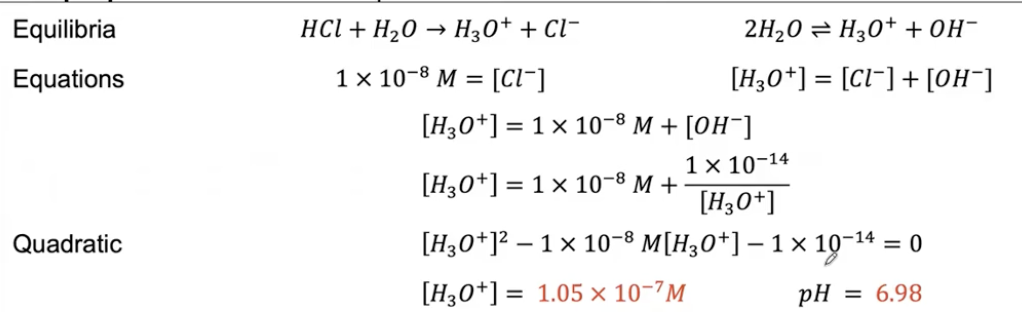
To calculate the pH of a specific concentration of an acid, how can you calculate it?
For instance, you are asked of the pH of 1×10⁻⁸M HCl.

What are the cations, reagent used, and confimatory tests for Group 1 cations?

What are the cations, reagent used, and confimatory tests for Group 2 cations?

What are the cations, reagent used, and confimatory tests for Group 3 cations?

What are the cations, reagent used, and confimatory tests for Group 4 cations?

What are the cations, reagent used, and confimatory tests for Group 5 cations?
Florence Flask
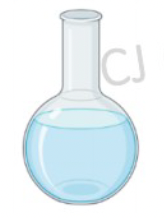
Thiele tube

Capillary Tubes

Separating funnel

Dropping Funnel

Distilling Flask

Condenser

Fractionating Column

Distillation adapters

0.0001g
What is the typical precision of analytical balances?
weighing by difference
For hygroscopic substances, what is the preferred technique for getting its mass?
Buret
It is a precision glass tube with graduations used to measure the volume of liquid dispensed through a stopcock.
Volumetric buret: Uses a stopcock and relies on gravity to dispense liquid manually
Digital buret: Uses a manual plunger to deliver liquid
Electronic buret: Relies on automated dispensing
What are the 3 types of buret? What are their characteristics?
Condensers convert vapor to liquid, while fractionating column separates two liquids with almost similar boiling points.
Differentiate condenser and fractionating columns?
HNO3 and HCl
Aqua regia is a 1:3 mixture of ___ and ___.
Pipet
It permit the transfer of accuratelt known volumes from one container to another.
Volumetric: Delivers fixed volume
Serological Pipet: Blow-out type
Mohr pipet: Drain-out type
Micropipet: Delivers smaller volumes
Laboratory pipets include volumetric, serological, mohr, and micropipets. Differentiate each.
The pipet can deliver volumes from 1–100mL volumes, it is class A (of higher accuracy), and ±0.5 uncertainty

What does the markings indicate?
Population
In sampling, it is the entire group of individuals or items or data points under study.
Sample
It is the subset of a population selected for analysis.
1. Simple random: Every sample unit has equal chances of being chosen
2. Systematic: Every nth sample unit is chosen
3. Stratified: Population is divided into sub-group (strata), and a sample unit is chosen from each group
4. ClusterPopulation is divided into clusters, and all/some can be chosen
In probability sampling techniques, how are these techniques done:
1. Simple random
2. Systematic
3. Stratified
4. Cluster
1. Convenience: Sample unit is taken that is easy to access
2. Judgmental: Sample unit is judged to be useful for study
3. Quota: Population is grouped, and a specific number of sample units are chosen from each group
4. Snowball: One sample unit recruits future sample unit
In non-probability sampling techniques, how are these techniques done:
1. Convenience
2. Judgmental
3. Quota
4. Snowball
Gross Sample
It is a large, initial portion collected from various parts of the population. It is meant to capture overall variability and is often too large to analyze directly.
Laboratory Sample
A portion taken from the gross sample that is homogenized and already processed.
Grinding
It is a method of reducing particle size which reduce crushed material into fine powder.
Milling
It is a method of reducing particle size which produce uniform fine particles.
Ball MillingI
It is a process where material is palced in a rotating container with balls to grind it into finer particles.
Cryogenic Grinding
It reduces particle size by freezing the material with liquid nitrogen before grinding.
Dry Ashing
It involves high-temperature incineration in a muffle furnace where water and volatiles are vaporized, leaving organic matter.
Wet Ashing
It involves treating the sample with acids (or bases) in an open container and heated on a hot plate to break down organic matter while keeping minerals dissolved in the solution.
Microwave Digestion
It is a digestion process used to dissolve organic and inorganic samples for trace metal analysis.
Fusion
It is a digestion proces where inorganic samples are often dissolved using a large excess of an alkali metal salt called as flux. The sample is mixed with the flux, heated until molten, and cooled at room temperature where the resulting melt dissolves easily in water/acid.
Swirl it gently, let it sit undisturbed for few minutes, and add ethanol to break the emulsions.
In liquid-liquid extraction, what will you do when emulsions exist?
Diethyl ether, DCM, hexane, and toluene
What are the common solvents used in LLE that are immiscible with water?
Recrystallization
It is the primary method for purifying non-volatile organic solids due to its effectivity in separating a desired compound from impurities based on differences in solubility.
Hot gravity filtration is dispensing the hot solution into a stemless funnel with fluted filter paper to remove impurities.
Vacuum filtration is collecting the crystals using a Buchner funnel with a filter paper, where a vacuum draws the solution out.
Differentiate hot gravity filtration with vacuum filtration.
A Thiele tube uses a flame-heated oil bath where the sample in a capillary is heated by convection and the melting temperature is read from a thermometer. A Mel-Temp uses an electrically heated metal block to heat capillary samples at a controlled rate with a digital readout, while a Fisher-Johns apparatus heats a tiny sample placed between glass plates on a hot stage and allows direct microscopic observation of melting.
Differentiate how Thiele tube, Mel-Temp apparatus, and Fisher-Johns apparatus work for melting point determination.
Distillation
It is a key separation technique in the laboratory, widely used to purify liquids and separate mixtures based o difference in boiling points.