family relations exam 2 study guide
 Call Kai
 Learn
 Practice Test
 Spaced Repetition
 Match
 Flashcards
 Knowt Play
1/129

There's no tags or description
Looks like no tags are added yet.
130 Terms
Racial-ethnic group — Cherlin’s definition
people who share a common identity and whose members think of themselves as distinct from others by virtue of ancestry, culture, and sometimes physical characteristics
what are the 3 elements of racial ethnic groups?
1: Ancestry: where one’s forebearers came from
2: culture: Language, religion, customs, food
3: physical traits: Features that others notice and read
what does it mean to say that “racial ethnic groups are social creations”? give the census “Hispanic” category as an example
they reflect cultural norms, social inequality, and political power
they can be redefined as circumstances change
Ex: the term Hispanic is now widely used in the United States and sometimes the term Latino - however in the mid 20th century, those terms were hardly ever used. they were typically referred to their specific groups such as Puerto Rican, Mexican, Cuban, etc. There was no Hispanic category in the 1970 Census. By the 1980s, the category was added
define collective efficacy
the capacity of a community to attain goals such as maintaining a safe and orderly environment
Turner Station in the 1960s example of collective efficacy
Turner Station is a historically Black neighborhood in Baltimore. It was located near huge plant with 30,000 works and 1/3 of those workers were Black. In the 1960s, most of the men in Turner Station held well-paying jobs at the steel plant. None of the Black steelworkers had a college education or even graudated high school, yet many of them used their ample incomes to send their children to college. they took great pride in their neighborhood. it had collective efficacy: the capacity of a community to attain goals such as maintaining a safe and orderly environment.
how does Chapter 6 apply intersectionality to Black women?
intersectionality is the extent to which lives are affected by overlapping systems of class, race, and gender-based disadvantages. Black women stand at the intersection of overlapping circles of race, class and gender - receiving multiple types of discrimination at the same time
define mediating structures
midlevel social institutions and groupings, such as the church, the neighborhood, the civic organization, and the family
what is a good example of a mediated structure
Black churches - throughout African American history the church has been an enduring institution which Black families could gain the oppression of slavery, reconstruction, segregation, and discrimination
it also links the Black middle class and the Black poor
define consensual union
a cohabiting relationship in which a couple consider themselves to be married but have never had a religious or civil marriage ceremony
why does consensual union matter for Puerto Rican non marital births
Nonmarital births don't necessarily mean single parenthood. A child may be born to two parents who live together and raise the child as a family, even though they are not legally married.
It reflects cultural and social norms. Marriage and family formation can look different across societies, so legal marriage alone doesn't fully describe family structure in Puerto Rico.
define immigrant enclave
a large, dense, single-ethnic-group, almost self-sufficient community
How did the first wave of Cuban immigrants to America become an immigrant enclave
came to america to flee the communist government of Fidel Castro
arrived with substantial amounts of education, skills, and capital because they were not fleeing to find higher paying jobs
settled in Miami - they limited much of their lives to a large, dense, single ethnic group, almost self sufficient community in Miami (this is an immigrant enclave)
define assimilation
the process by which immigrant groups merge their culture and behavior with that of the dominant group in the host country
How did the first wave of Cuban immigrants choose a different path than assimilation?
instead of dispersing into the U.S. and learning English, many Cubans chose to remain clustered in Cuban neighborhoods of one metropolitan area, listen to Spanish-language radio stations, buy food at Cuban markets, and eat at Cuban restaurants and send their kids to Cuban private schools. they lived in am immigrant enclave
define hyper-selectivity
immigrant groups with educational levels that exceed the levels in both the sending and receiving countries
what does hyper-selectivity explain about Asian Americans
High educational achievement: Some Asian American groups have high college graduation rates because their immigrant parents were already highly educated.
Economic success: Highly educated parents may have more resources to invest in their children's education and opportunities.
Ethnic differences: It helps explain why some Asian American groups have higher average incomes and educational attainment than others.
Stereotypes: It helps explain the origins of the “model minority” stereotype without assuming that all Asian Americans are successful or that success is simply due to cultural values.
define social capital
the resources that a person can access through his or her relationships with other people
how do immigrant communities use social capital
the immigrant community provides members with resources that help them to achieve the goals they could not achieve alone
Ex:Chinese Americans tend to do well in school because the highly educated Chinese immigrant community uses cultural practices to support their children in education
immigrants help out other immigrants
what is socially assigned race
The category others place a person in. Measured by asking:
“How do other people usually classify you in this country?”
how does socially assigned race differ from self-identified race
Self-identified race is the racial group a person identifies themselves as belonging to.
Socially assigned race is the racial group that other people perceive or categorize someone as belonging to, based on things like their appearance, skin color, or name.
Example: A person may identify as multiracial, but other people may perceive them as Black based on their appearance.
what survey question measures socially assigned race?
“How do other people usually classify you in this country?”
what shrank the pool of marriageable Black men? (marriage market explanation)
changes in the labor market in the 1970s affected all young men without college educations, but it hit African Americans particularly hard
Because of this, Black women are having a hard time finding suitable, employed spouses
also, the mass incarceration of Black men removes them from the pool of eligibles while they are in prison and makes it hard for them to find jobs when they are out
What happened in the Pettit & Western (2004) study?
• For Black men without a diploma, prison was
more common than not.
• Prison removes men from the marriage market
during the years most people partner, and
lowers their earnings after release.
• Pettit and Western call it a new stage in the life
course.

the group for whom prison became “a new stage in the life course”
African American men
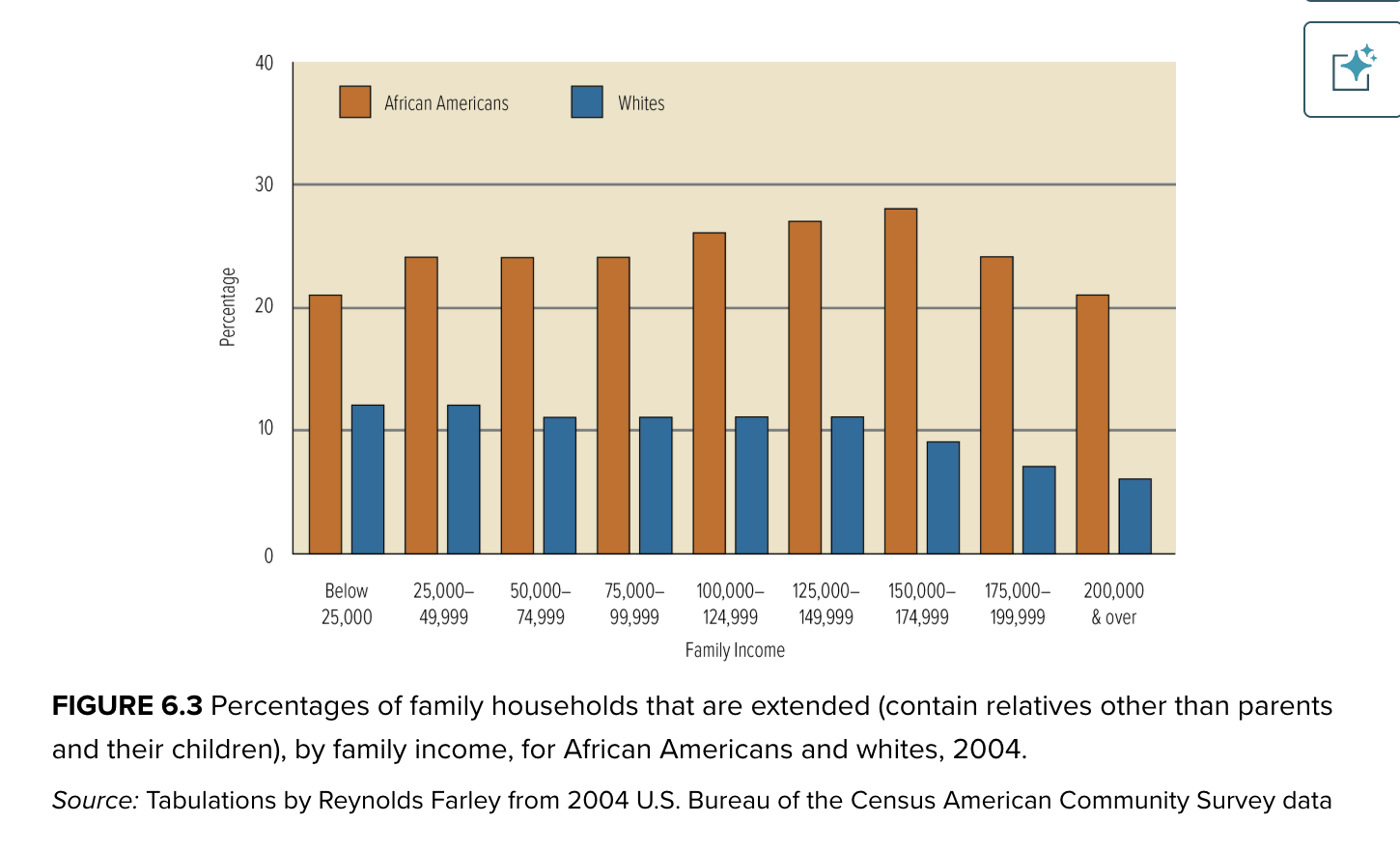
Culture as a “tool kit” — what Figure 6.3 (extended households by income) shows and why it supports
this idea
Graphed across income levels from low to high are the percentage of family households that are "extended"-that is, the percentage that contain relatives other than parents (or stepparents) and their children. Often the additional relatives are grandparents. Note that at all income levels-even among those earning more than $200,000-Black family households are much more likely than white households to include a grandparent or other relative. In African American families, ties to a network of kin are more important than marital ties
Whites as “outliers” — why Cherlin uses this term for white Americans’ kinship
White Americans, although the most populous group in the nation, are the outliers among racial-ethnic groups. They rely most heavily on two-parent, nuclear families. When that family configuration works well, as in dual-earner, long-term marriage-based households, it can provide a stable, prosperous environment for raising children. But when it can't be accessed, as in births to single women and the nonresident fathers of their children, or as in the case of separation and divorce after the birth of children, white parents have less support on which they rely. They typically have not been immersed in the extended kinship networks or multigenerational households that are more common among African Americans, Hispanics Asians, and American Indians.
They cannot call upon these kin as readily.
Jones et al. (2008) — how being seen as White by others relates to self-rated health
Being seen as White goes with better
health: +8.7, +15.4, and +23.6 points.Those assigned White were statistically
indistinguishable from the White reference
group

Massey, Durand & Pren (2016) — why border enforcement “backfired”
Enforcement did not reduce first trips, and the chance of eventually getting across stayed at 0.95 or higher through 2008.
it made crossing costlier and riskier: smuggler fees rose from about $550 in the 1980s to $2,700 in 2010, and routes moved into the Sonoran Desert.
So migrants stayed. A circular flow of male workers to three states became settled families in all 50 states

Willis et al. (2023) — how often Pacific Islanders were misclassified, and how misclassification related
to health
About 1 in 5 Pacific Islander respondents said others do not see them as Pacific Islander, most often reading them as Hispanic or Asian.
Being misread was associated with nearly
triple the odds of poor or fair health.
The aggregation problem — what combining “Asian or Pacific Islander” hid in Arkansas COVID-19 data
The aggregation problem is when researchers combine different racial or ethnic groups into one category, hiding important differences in their experiences and outcomes.
In Arkansas COVID-19 data, combining Asian Americans and Pacific Islanders into one category labeled “Asian or Pacific Islander” hid the disproportionately high impact of COVID-19 on Pacific Islanders
The Marshallese case — what explained the high COVID-19 death toll, and what did not
The family structure is not the cause. Work that could not stop, wages too low to quarantine, and exclusion from Medicaid turned
close ties into a route for the virus. The same ties then made each death reach further
Figure 6.4 — the main point about variation among Hispanic groups
Figure 6.4 shows an example of the diversity in Hispanic family patterns. It presents the percentage of households headed by a woman with no husband or cohabiting partner present for four Hispanic groups and, for comparison, whites and Blacks. At one extreme, Dominicans have levels of households headed by women that are nearly identical to the high levels among Blacks. At the other extreme, Cubans have levels that are not much higher than the low levels among whites.
Consequently, any statement about overall Hispanic levels of households headed by women would mask this great diversity. Any statistic you read about Hispanics as a whole tends to reflect the experience of Mexicans, since they are by far the largest group; but such statistics lump together groups that sharply differ from one another.

Table 6.1 — direction of change in nonmarital births for Black and white children, 1979–2020, and
what happened to the gap

Figure 6.2 — how married-couple families vary by income, and whether the racial gap closes at higher
incomes
for both African Americans and whites, the higher the family's income, the greater is the percentage that are headed by a married couple.
Clearly, among both African Americans and whites, married couples are less commonly found in low-income households. Note also, however, that at each income level, white families are more likely to be headed by a married couple than Black families. Even when there are no income differences between the families being compared, a racial difference still exists, and the difference is particularly pronounced among the poor and near poor. Economics, it seems, is part of the story of racial differences in family structure; but it is not the whole story.

Intermarriage by gender — which men and which women are more likely to marry out
african american men are more likely to marry out than african american women are
Asian American women are more likely to marry out than Asian American men
federal race categories — what changed in the 1997 revision
the official categories have changes 3 times:
1997: First federal standard. Four races —
American Indian or Alaskan Native; Asian
or Pacific Islander; Black; White — plus a
separate question on Hispanic origin.1997 revision: Asian or Pacific Islander” split into Asian
and Native Hawaiian or Other Pacific
Islander. People may mark more than
one race, first used in the 2000 Census2024: One combined race-and-ethnicity
question. Middle Eastern or North
African added, no longer counted as
White. Detailed groups collected by
default
CHAPTER 7
CHAPTER 7
define union
a stable, intimate relationship between two people who usually live in the same household but may or may not be married
Living apart together (LAT) — definition
a relationship in which two people define themselves as a couple but do not live together
basically long distance relationship
Institutional marriage — what it emphasized
a marriage in which the emphasis is on male authority, duty, and conformity to social norms (pre-20th century form of marriage)
love not required
what is individualistic marriage
a marriage in which the emphasis is on self-development, flexible roles, and open communication
how do spouses judge success in an individualistic marriage?
by whether the marriage meets their personal needs and promotes their individual happiness, fulfillment, and growth.
how does individualistic marriage differ from Companionate marriage
Individualistic marriage: Focuses on personal happiness, self-fulfillment, and individual growth. Spouses ask, “Does this marriage make me happy and help me become who I want to be?”
Individualistic marriage: Focuses on personal happiness, self-fulfillment, and individual growth. Spouses ask, “Does this marriage make me happy and help me become who I want to be?”
Companionate marriage: Focuses on love, companionship, mutual support, and building a life together. Spouses value their emotional bond and shared responsibilities.
Companionate marriage — what spouses expected, the division of labor, and when it peaked
a marriage in which the emphasis is on affection, friendship, and sexual gratification
husband worked outside the home, the wife worked inside the home
they were supposed to be each other’s companion, friend, and lover
reached its peak at midcentury
Enforceable trust — definition; why it matters for buying a home or raising children
the ability to call on the law and on family and friends to enforce the agreements you have made with a partner
raising kids and buying a home is expensive
you can invest in these things and have less fear of abandonment because of legal obligations to stay
Specialization model — who specializes in what
a model of the marriage market in which women specialize in housework and child care and men specialize in paid work outside the home
Income-pooling model — who is more and less likely to marry under it
a model of the marriage market in which both spouses work for pay and pool their income
a woman with greater earning potential and higher education should be more likely to marry because she is more attractive to men seeking to pool incomes and vice versa for woman marrying men with higher incomes
Dating — what it changed about who controls partner choice
it shifted the power from parents to teens and young adults. it made it harder for parents to influence the process
Rosenfeld et al. (2019) — who the “intermediary” was and what replaced it
in dating, the intermediary is someone who knew you and vouched for you. now everyone dates online and does their own research on a person before they date them.
do couples who meet online break up sooner?
Couples who met online broke up no more often
than couples who met any other way
Cohabitation and class — what cohabitation usually is for college-educated adults, compared with the
less educated
College-educated adults: Cohabitation is often a step toward marriage. Couples may live together after finishing school, finding stable jobs, and becoming financially secure. They are more likely to marry once they feel financially ready.
moderately educated Cohabitation is more likely to be an alternative to marriage or a way to test a relationship without making a long-term legal commitment. Financial instability and uncertainty about employment may make marriage seem harder to achieve or maintain.
least educated cohabitants:see no prospects of finding a man suitable for marrial. live in serial cohabitation with little thought of marriage
Sassler & Miller — how quickly working-class and moderately educated couples move in together
Interviews with cohabiting couples found working-class couples moved in together much sooner after starting to date than middle-class
couples, often for practical reasons such as rent, and with less explicit discussion of where the relationship was going.
Marriage as a “capstone” — what has happened to marriage’s practical and symbolic importance
practical importance of being married has declined, but its symbolic importance has increased
because marriage is now optional, it causes married couples to stand out from others
it has evolved from a marker of conformity to a marker of prestige
Selection vs. protection — what the selection explanation says about married people’s better health
people favor choosing healthy partners over troubled and ill partners
Musick & Bumpass — what happened to well-being after people entered marriage or cohabitation
The main finding was that entering marriage or cohabitation could improve well-being, but the benefits were generally stronger or more consistent for marriage.
Marriage: People tended to experience improvements in psychological well-being and happiness.
Cohabitation: People could also experience benefits, such as greater well-being, but these improvements were generally smaller or less consistent than those associated with marriage.
Cohabitation trend — share of women ages19–44 who had ever cohabited, late 1980s vs. late 2010s
during the 1980s, only about 1/3 of women aged 19-44 had ever cohabited; by the late 2010s, the figure increased about 2/3rds.
Figure 7.1 — which education groups are most likely to have cohabited, and the trend
women with more education were less likely to have ever cohabited

Table 7.1 — the 1950s pattern for premarital pregnancy and cohabitation
pregnancy usually led to a hasty marriage because childbearing outside of marriage was highly stigmatized. cohabitation is common only among the poor; it is not considered respectable among the nonpoor
CHAPTER 8
CHAPTER 8
Define care work
activity in which one person meets the needs of spouses, partners, children, parents, or others who cannot fully care for themselves
what are time-diary studies
surveys in which people are asked to keep a record of what they are doing every minute during a time period - usually a single day
why do time diaries beat asking for estimates
Asked “How many hours a week do you spend on
housework?”, people overestimate, and both spouses tend to credit themselves with more than their partner would.
A diary has to add up to 24 hours. That constraint is what makes it more accurate
what is gender essentialism
the acceptance of the principle of equality between men and women combined with the belief that women and men are innately different
what is normal unpredictability
the pervasiveness of unpredictability in job hours and schedules which makes it difficult for workers to control time
which workers does normal unpredictability affect most
working parents in lower-white collar, blue collar, and service occupations
what is spillover
the transfer of mood or behavior between work and home
what is flextime
a policy that allows employees to choose, within limits, when they will begin and end their working hours
what is the most common family-related benefit for work
flextime
Behind the rise — the forces that pulled married women into paid work
personal services such as aducation, health care, communication, cooking, entertainment and so forth expanded - giving more job opportunities for women
population shifted from farms to cities so parents started having fewer children and working more
Uneven change — for which women was the rise in employment less of a change
it was a major change for married women to enter the workforce
the change is less pronounced for women from poor or minority backgrounds, who have always had a greater need to work
Why care work is underpaid — the three reasons, especially the public-goods reason
care work = “women’s work” and is undervalued. they may think it’s more important to pay the ‘breadwinners’ more
labor that creates public goods tends to be underpaid because of the free rider problem - obtaining public good without having to pay for them
many people find satisfaction in caring for others and are willing to accept lower paying jobs if it means they help more people
Pedulla & Thébaud — what happened to young women’s preferences when supportive policies were
mentioned
in a survey, young women were asked how they would ideally strucutre their future and family lives. At random, some of them were asked this question without any mention of institutional support, while some were asked to imagine that "policies were in place that guaranteed all employees access to subsidized childcare, paid parental and family medical leave, and flexible scheduling." The percentage of college-graduate or college-bound women who said that they would prefer an egalitarian marriage or partnership-in which financially supporting the household and managing the household would be mutually shared-rose from 62 percent to 95 percent when the language about supportive policies was included, with a similarly large increase among non-college women
Unmarried mothers — housework, leisure, and sleep compared with married mothers
studies show that single and cohabiting mothers tend to do less housework, have more leisure time, and sleep more than married mothers
Hours by social class — long hours vs. too few and unpredictable hours: who faces which
Higher-income, college-educated workers: More likely to face long work hours, demanding careers, and pressure to work overtime to advance professionally.
Lower-income, less-educated workers: More likely to face too few hours, unpredictable schedules, and inconsistent income. Their shifts may change at the last minute, making childcare and family planning difficult.
COVID-19 — which parents bore the largest work-family burden
mothers - particularly essential worker mothers who worked in hospitals, grocery stores, nursing homes, public transport had to continue working
their kids were home in quarantine while they had to continue working
Two-tiered system — who gets more family-friendly benefits
The two-tiered system means that higher-income and professional workers tend to receive more family-friendly benefits than lower-wage workers.
Higher-income/professional workers: More likely to have paid parental leave, paid sick days, flexible schedules, and better health insurance.
Lower-wage workers: More likely to have limited benefits, unpredictable schedules, and less flexibility to take time off for family responsibilities.
Goldin’s “quiet revolution” — what changed in young women’s expectations about work
Earlier cohorts expected to work until
marriage or children. Young women from
the late 1970s on expected long working
lives, and planned for themWork shifted from a job that helped the
household to a career that was part of
who a woman wasFrom a secondary earner fitting work
around a husband’s job to a partner
making joint decisions about two
careers.Structural forces opened the jobs. What made the change lasting was that young women began investing in education and delaying marriage in expectation of careers.
Daminger (2019) — the four steps of cognitive labor and which ones women did more of
Anticipate: Noticing a need before it
becomes a problem: the
shoes are getting small.identify: Working out the options:
which stores, what price,
what sizedecide: choosing among the options
monitor: Following up- did they
arrive, do they fit, does
anything need to go back?
**Women did more cognitive labor overall, and far more of the anticipating and monitoring, the least visible steps.
The “child penalty” (Kleven) — what happens to mothers’ and fathers’ earnings after a first birth
• Before the first birth, women’s and men’s earnings
follow nearly the same path.
• After it, mothers’ earnings drop and do not
recover. Fathers’ earnings do not change.
• United States: about 31 percent lower, five to ten
years later
GSS gender-attitudes trend — the shape of the trend since the 1970s, including the stall
Kelly & Moen — why random assignment matters in their workplace study
Random assignment matters because it helps researchers determine whether a workplace intervention actually caused improvements in work–family balance, rather than the improvements being caused by preexisting differences between employees.
Figure 8.1 — the trend in married mothers’ labor force participation since 1948
In 1948, only about 1/4 of married women whose youngest children were at least 6 years old (and therefore in school) were in the labor force, as were only about 1/10 of married women with children under age 6.
The rates rose sharply through the 1990s, leveled off around 2000, and have declined slightly since then.
For the moment, the historic rise in married women's labor force participation rates seems to have peaked. In 2020, 75% of all married women with school-aged children, and 65 percent of those with pre-school-aged children, were in the labor force

Figure 8.2 — why the housework and child-care gap narrowed, and when the narrowing stopped
The gap narrowed primarily because women reduced the amount of time they spent on housework and child care. Women spent about 100 minutes less on these tasks in 2012 than in 1965. Men spent about 65 minutes more on these tasks in 2012 than in 1965. In other words, the majority of the narrowing occurred because women cut back their time rather than because men expanded theirs.
the gap narrowed substantially between the 1965 and 1998 time-diary studies, but there has been no further narrowing since then. In fact, the gap had widened slightly by 2012.

Family and Medical Leave Act (1993) — what it guarantees, to which employers it applies, and
whether the leave is paid
requires companies with 50 or more employees to provide 12 weeks of unpaid leave for birth, adoption, foster care, or personal or family illness
CHAPTER 9
CHAPTER 9
Inductive vs. coercive control — the difference, with an example of each
Coercive: parenting tactic that uses threat of punishment or force
inductive: parenting tactic that is based on setting consistent limits, explaining the reasons for these limits to the child, requesting the child to comply, and praising their compliance
what does authoritative style of parenting mean
a parenting style in which parents combine high levels of emotional support with consistent, moderate control of their children
mix of support and control
what is the permissive style of parenting
a parenting style in which parents provide emotional support but exercise little control over their children
what is the authoritarian style of parenting
a parenting style in which parents combine low levels of emotional support with coercive attempts at control of their children
list the 3 parenting styles
authoritative, permissive, and authoritarian
what is androgynous behavior
behavior that has both masculine and feminine characteristics
what does multipartner fertility mean
having children with more than one partner during one’s lifetime
Ambiguous loss — definition; the example of a father in prison
Ambiguous loss: A loss where someone is physically or emotionally absent, but their status or presence in your life is unclear.
Father in prison example: A father is physically absent from his children’s lives because he is in prison, but he is still alive and emotionally important to them. His children may miss him and feel uncertain about their relationship with him.
Diverging destinies — what has diverged, and by what
in the 1st half of the 20th century, most children, rich or poor, white or black, lived in 2 parent families
since then, cohabitation, divorce, and childbearing outside of marriage increased, the living arrangements of children have become diverged by income
Baumrind and ethnicity — Cherlin’s caution, and the physical-discipline finding behind it
Diana Baumrind studied parenting styles, but Cherlin cautions that we should not assume the same parenting behavior has the same meaning or effects across all ethnic groups. Parenting practices must be understood within their cultural and social contexts.
kohn — why middle-class and working-class parents stress different values
claimed that the differing parenting styles derive from the occupational conditions of the parents
middle class parents whose jobs provide autonomy and self-direction are more likely to emphasize those values with their children. thus, middle-class parents socialize their children to grow up and take middle-class job
working class parents, with their emphasis on obedience and conformity, socialize their children for the kinds of blue and pink collar jobs the parents have held.
Wilcox’s “soft patriarchs” — what conservative Protestant fathers combine
fathers who combine strict discipline with warms and involvement of style that blends the authoritarian and authoritative styles
protestant fathers frequently spank their children, but they also hug and praise their children more than other fathers and yell at them less and spend more time with them
protestants teach fathers to be involved yet disciplinary
Fathers’ indirect influence — the two indirect routes
provide financially for the family
being supportive of the mother
Nonresident fathers — what matters more than how often they visit
the way nonresidential fathers behave as parents seems to make more of a difference than how often they see their children
Adoption as “a devalued status” — what the phrase means
Most people may admire it in the abstract, but many seemingly good candidates for adoptive parenthood, such as middle-class couples who are unsuccessful in efforts to conceive a child, avoid it in practice, either out of a strong preference for biological children or a fear that an adoption will not work out.