EXAM 2
 Call Kai
 Learn
 Practice Test
 Spaced Repetition
 Match
 Flashcards
 Knowt Play
1/41

Earn XP
Description and Tags
CHEM 433 (unit 2)
42 Terms
step 1 of gluconeogenesis
pyruvate --> oxaloacetate --> PEP, via pyruvate carboxylase and PEP carbokinase (BYPASS)
step 2 of gluconeogenesis
PEP --> 2-phosphoglycerate via enolase
step 3 of gluconeogenesis
2-phosphoglycerate --> 3-phosphoglycerate via phosphoglyceromutase
step 4 of gluconeogenesis
3-phosphoglycerate --> 1,3-bisphosphoglycerate via phosphoglycerate kinase
step 5 of gluconeogenesis
1,3-bisphosphoglycerate --> glyceraldehyde-3-phosphate via GA3P dehydrogenase
step 6 of gluconeogenesis
glyceraldehyde-3-phosphate --> dihydroxyacetone phosphate via triose phosphate isomerase
step 7 of gluconeogenesis
glyceraldehyde-3-phosphate --> fructose-1,6-bisphosphate via aldolase
step 8 of gluconeogenesis
fructose-1,6-bisphosphate --> fructose-6-phosphate via fructose-1,6-phosphatase (BYPASS)
step 9 of gluconeogenesis
fructose-6-phosphate --> glucose-6-phosphate via phosphoglucose isomerase
step 10 of gluconeogenesis
glucose-6-phosphate --> glucose via glucose-6-phosphatase (BYPASS)
Stage 1 (rxns 1-5) of Glycolysis
energy investment; consumes 2 molecules of ATP
Stage 2 (rxns 6-10) of Glycolysis
energy return; generates 4 molecules of ATP and 2 molecules of NADH
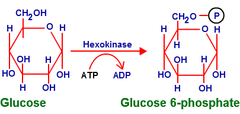
Step 1 of glycolysis
Glucose + ATP results in Glucose 6-phosphate + ADP + H+
Step 1 enzyme
Hexokinase
Rxn 1 of Glycolysis
- Traps G6P inside the cell bc the charged phosphate group acts as a molecular marker that cannot cross the plasma membrane
- Classified as isomerization (I) and Far-from-equilibrium (F)
Step 2 of glycolysis
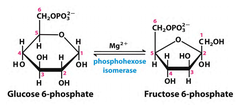
Glucose 6-Phosphate changes to form Fructose 6-phosphate
Step 2 enzyme
Phosphoglucose Isomerase
Rxn 2 of glycolysis
- Classified as isomerization (I) and Near-Equilibrium
Step 3 of glycolysis
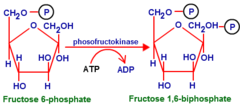
Fructose 6-Phosphate + ATP results in Fructose 1,6-biphosphate + ADP + H+
Step 3 enzyme
Phosphofructokinase
Rxn 3 of glycolysis
- Second priming step: an example of bisphosphorylation
- Classified as phosphorylation (P) and Far-from-Equilibrium (E)
Step 4 of glycolysis
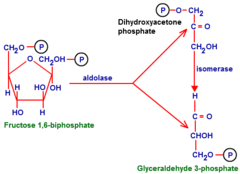
Fructose 1,6-biphosphate splits to form glyceraldehyde 3-phosphate + dihydroxyacetone phosphate
Step 4 enzyme
Aldolase
Rxn 4 of glycolysis
- Classified as C-C bond cleavage (C) and Near-Equilibrium
Step 5 of glycolysis
Dihydroxyacetone phosphate rearranges to form glyceraldehyde 3-phosphate
Step 5 enzyme
Triose Phosphate Isomerase
Rxn 5 of glycolysis
- Classified as isomerization (I) and Near-equilibrium (E)

Step 6 of glycolysis
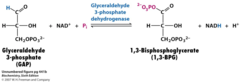
Glyceraldehyde 3-phosphate + NAD+ + phosphate group results in 1,3-biphosphoglycerate + NADH + H+
Step 6 enzyme
Triose Phosphate Dehydrogenase
Rxn 6 of glycolysis
- creates a high-energy acyl phosphate bond in 1,3-BPG with a large standard free energy of hydrolysis
- classified as oxidation (O), phosphorylation (P), and Near-equilibrium (E)
Step 7 of glycolysis
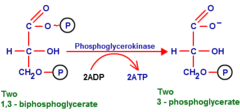
1,3-biphosphoglycerate + ADP results in 3-phosphoglycerate + ATP
Step 7 enzyme
Phosphoglycerate Kinase
Rxn 7 of glycolysis
- Catalyzes the first substrate-level phosphorylation step in glycolysis, producing +2 ATP per glucose
- Classified as ATP-making (A), phosphorylation (P), and Near-equilibrium (E)
Step 8 of glycolysis
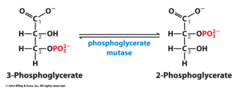
3-phosphoglycerate rearranges to form 2-phosphoglycerate
Step 8 enzyme
Phosphoglycerate Mutase
Rxn 8 of Glycolysis
- involves an internal group transfer (not a simple isomerization) mediated by a phosphorylated active-site histidine residue and a transient 2,3-bisphosphoglycerate (2,3-BPG) intermediate
- Classified as Near-equilibrium (E)
Step 9 of glycolysis
2-phosphoglycerate results in a water molecule and phosphoenolpyruvate
Step 9 enzyme
Enolase
Rxn 9 of glycolysis
- Uses Lys345 as a general base, Glu211 as a general acid, and active-site Mg2+ ions to electrostatically stabilize negative charges on the enolate intermediate
- Classified as Dehydration (D) and Near-equilibirum (E)

Step 10 of glycolysis
Phosphoenolpyruvate + ADP + H+ results in pyruvate + ATP
Step 10 enzyme
Pyruvate Kinase
Rxn 10 of Glycolysis
- Catalyzes the second substrate-level phosphorylation step, producing +2 ATP per glucose. Strongly exergonic bc enolpyruvate spontaneously undergoes enol-to-keto tautomerization to form keto-pyruvate, creating a much lower-energy product.
- Classified as ATP-making (A) and Far-from-equilibrium
