states of matter
 Call Kai
 Learn
 Practice Test
 Spaced Repetition
 Match
 Flashcards
 Knowt Play
1/11

There's no tags or description
Looks like no tags are added yet.
12 Terms
solids
• strong forces of attraction between particles, hold them together in fixed positions
• particles don't move from positions, all solids keep a definite shape and volume
• particles vibrate about their positions, hotter the solid becomes, more they vibrate, causing them to expand slightly when heated
liquids
weak force of attraction between particles, randomly arranged and free to move past each other but particles stay close together
• definite volume, don't keep definite shape and will flow to fill bottom of container
• particles constantly moving with random motion. the hotter the liquid gets, the faster they move, causing liquids to expand slightly when heated.
gases
• very weak force of attraction between particles
• free to move, very far apart
• particles travel in straight lines
• don't keep definite shape or volume, fill any container
• move constantly, random motion
• hotter they get, faster they move. expand when heated OR pressure increases
moving between states
Heating (melting, boiling, subliming)
When the [state] is heated, the particles gain kinetic energy and move/vibrate faster. They gain enough energy to overcome the forces of attraction between them. The particles change from [starting arrangement] to [ending arrangement].
Cooling (condensing, freezing)
When the [state] is cooled, the particles lose kinetic energy and move more slowly. The forces of attractionpull the particles closer together. The particles change from [starting arrangement] to [ending arrangement].
diffusion in liquids + dilution
potassium manganate molecules diffuse through the solution, from a region of higher concentration to a region of lower concentration, down the concentration gradient
after few hours, equilibrium is reached, concentration of particles is now evenly spread through the solution
dilution:
Dilution is the process of adding more solvent (usually water) to a solution
This decreases the concentration of solute particles
The solute particles become more spread out but are still present in the solution
The colour of the solution becomes fainter with each dilution, but it does not disappear immediately
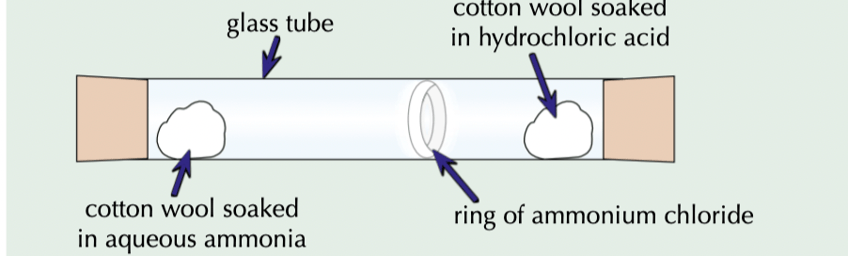
diffusion in gases - ring in middle
cotton wool soaked in aqueous ammonia on one side of glass tube, cotton wool soaked in hydrochloric acid, white ring of ammonium chloride forms in middle of tube
bungs on both sides
NH3 gas diffuses from one end, HCL gas diffuses from other. when they meet they react to form ammonium chloride
ring forms nearer to cotton wool with hydrochloric acid because ammonia particles are smaller and lighter, diffuse through air more quickly
diffusion of gases (e.g. bromine)
bromine gas
fill half a glass jar with bromine gas and the other half full of air
separate them with a glass plate
remove glass plate, you will see bromine gas slowly diffusing through jar, from high concentration to low concentration, down the concentration gradient

solutions terminology
solution: mixture formed when solute dissolved in solvent
solvent: liquid in which solute dissolves
solute: substance which dissolves in liquid / solvent to form solution
saturated solution: solution where maximum amount solute been dissolved
soluble/insoluble: can/can't dissolve in a solvent
solubility
= ability of a substance to dissolve in a solvent
measured in grams of solute per 100g of solvent
investigate how temp affects solubility
1. make saturated solution, add excess ammonium chloride to 10cm cubed of water in a boiling tube.
2. stir solution well, place tube in water bath at 25C
3. after 5 mins, check that all excess solid has sunk to bottom of tube, use thermometer to make sure solution has reached 25C
4. weigh empty evaporating dish, pour some solution into basin, make sure not to pour in any of undissolved solid
5. reweigh dish with contents, gently heat using bunsen burner, to remove all water
6. once all water evaporated, reweigh dish and contents.
7. repeat previous steps twice more, with water bath at different temperatures
8. use the different masses to work out solubility at each temperature using equation
solubility equation
solubility (g per 100g of solvent) =
mass of solid (g) / mass of water removed (g) x 100
solubility graph
x axis - temp
y axis - solubility
