7
 Call Kai
 Learn
Learn Practice Test
 Spaced Repetition
 Match
Match Flashcards
 Knowt Play
1/119

There's no tags or description
Looks like no tags are added yet.
Name | Mastery | Learn | Test | Matching | Spaced | Call with Kai | Chat |
|---|
No analytics yet
Send a link to your students to track their progress
120 Terms
refers to the genetic composition of gametes (spermatozoon or
ovum), can be passed down, colloquially used to refer to non-tumor cells
germline
refers to the genetic composition of cells other than gametes,
cannot be passed to offspring, often refer to cancer
somatic
all refer to changes passed down as germline changes in genes or sometimes as epigenetic (alterations not involving changes to the DNA sequence eg, environmental, trauma, smoking, famine)
Hereditary, inherited, heritable
condition that occurs in families more often than would be
expected by chance. These may be genetic in etiology or they may be a
sign of shared environmental or lifestyle factors
familial
the proportion of individuals with a specific genotype who
express the corresponding phenotype (observable characteristics)
penetrance
present at birth (may or may not be genetic)
congenital
transmission of information from
parent to offspring that affects gene expression
without altering the underlying DNA sequence. It allows
organisms to pass down environmental adaptations, such as
diet or stress responses, to subsequent generations through
mechanisms like DNA methylation, and non-coding RNA.
epigenetic inheritance
an epigenetic process where only one copy (either
maternal or paternal) is active while the other is silenced
imprinting
genetic variation within a population, upon which natural selection can operate
polymorphisms
The Central Dogma: genetic information flows from ____ to ____ to ____
DNA
mRNA
protein
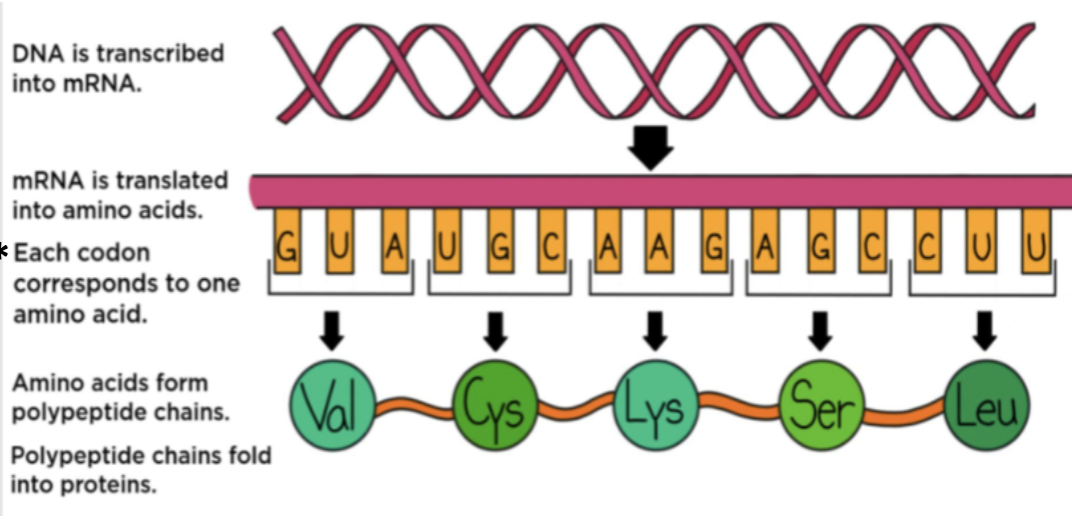
these are the 2 major types of genetic diseases
germline and somatic
Types of genetic diseases
Germline diseases can be _____
chromosomal
numerical - change in the number of chromosomes
structural - change in the structure of chromosomes
Types of genetic diseases - Germline
Medelian disorders and patterns of inheritance include ____ and ____ _____
autosomal and sex linked
Types of genetic diseases - germline
mendelian disorders and patterns of inheritance are described as one molecular _____ leading to a straight forward consequence that it _____ inherited
lesion
predictably
what are the 2 types of autosomal inheritance
dominant and recessive
Types of genetic diseases - germline
single gene disorders with atypical inheritance. This includes _______ ____ and ____ ___
trinucleide repeats and imprinted regions
Somatic diseases are usually talking about _____
cancer
for complex mutagenic disorders (germline) these diseases often feature _____ polymorphisms that modify disease risk but do not fully predict _____ - it is modified by other contributing _____
multiple
phenotype
factors
examples of complex mutagenic disorders
Diabetes
Heart disease
hypertension
psychiatric disease
cleft palate
contributing factors for complex mutagenic disorders
● Multiple mutations (pathogenic variants)
● Polymorphisms (naturally occurring variations)
● Environmental exposures
● Diet
● Substance use
● Social environment
comlpex mutagenic disorders are caused by multiple _____ variations and _____ factors
genetic
environmental
why do we do genetic testing? (3)
• Diagnosis
• Prognosis
• Therapeutic decisions
what are the consequences of genetic testing
_____ loss with ____ testing
pregnancy
prenatal (fetus)
what are the consequences of genetic testing?
_____ or ______ discrimination
employment
insurance
illegal but real
what are the consequences of genetic testing?
_____ stress
social
dealing with the results
implications for family members
genetic testing has (low/high) cost
high
what are the consequences of genetic testing? (in all)
• Pregnancy loss with prenatal (fetal) testing
• Employment or insurance discrimination (illegal but real)
• Social stress
• Dealing with results
• Implications for family members
• Cost
the way that we do genetic testing is highly ____ and depends on the ____ we are interrogating
variable
lesion
appropriate selection of test depends on the molecular lesion in each clinical scenario
Changes detected by various methods
cytogenetics
numerical or large structural chromosomal changes (translocations)
Changes detected by various methods
Sequencing
small insertions/deletions, point mutations, missense, nonsense, and translocations
Tests have variable resolution
_____ have low power, while ______ has high power
cytogenetics
sequencing
Nearly all techniques of genetic testing use creative ways to take advantage of specific annealing of ____ and ____ and detection of a label or reaction product
A:T
G:C

tach advances have allowed ____ scale genetic sequence assessment for a _____ cost
large
reasonable
previously this method was used for sequencing and included a Clonal sequencing reaction in a tube (1 read, 1 direction)
dye terminator sequencing
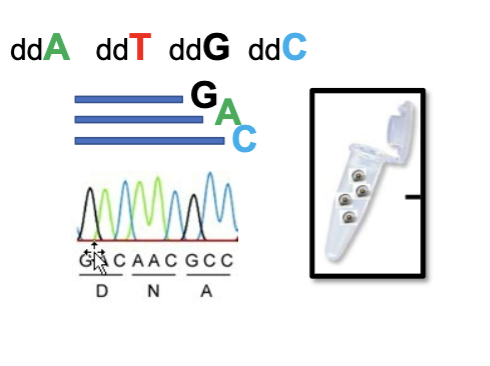
with advancements, we now use this method of sequencing where there is Clonal sequencing reaction in each well (millions of reads)
next generation sequencing

with _____ _____ ___ you would have to do reads over and over, with ___ ____ ___ you get information much faster
dye terminator sequencing
next gen sequencing

Advantages of Next Generation Sequencing
Highly multiplexed sequencing, ____ targets at once, tens of genes to thousands of genes
many
Advantages of Next Generation Sequencing
Higher analytical sensitivity, 5 to 20 times more ______
sensitive
Advantages of Next Generation Sequencing
Markedly _____ cost per base sequenced, varies by
method, but about 2353 times _____ per million
bases sequenced at UIHC
decreased
cheaper
Advantages of Next Generation Sequencing
Requires ____ starting material
less
less cells for intitial extraction
Advantages of Next Generation Sequencing
Can multiplex different ____ ____ on the same run
patient samples
Advantages of Next Generation Sequencing
• Can detect multiplexed _____ (translocations) from RNA
fusions
Cytogenetics is a way to look at whole _____ and regions by dark and light bands
chromosomes
chromosomal abnormalities - cytogenetic analysis
This is done through a culture of ____ ____
blood lymphocytes (requires live cells)
this is the most convenient source
any cell dividing in the culture may be analyzed
chromosomal abnormalities - cytogenic analysis
after cells are lysed on the glass slide, the chromosomes are _____ and viewed via ______
stained
microscopy
The most commonly diagnosed
chromosomal condition in the U.S., affecting approximately 1 in 700
babies. It occurs when an individual has an extra copy of chromosome
21
Down Syndrome (Trisomy 21)
A chronic condition that causes thick, sticky
mucus to build up in the lungs and digestive system. It is most
prevalent in white people of Northern European ancestry.
Cystic Fibrosis (CF)
A family of hereditary blood disorders that limit
hemoglobin production, causing mild to severe anemia. It is
more common in individuals of Mediterranean, Indian, and
Southeast Asian descent.
Thalassemia
The most common inherited cause of intellectual
disability. It is caused by a change in the FMR1 gene on the X
chromosome.
Fragile X syndrome
An autosomal dominant disorder that causes
the progressive breakdown of nerve cells in the brain, typically
appearing in mid-life.
Huntingtons Disease
A condition characterized by very high
levels of "bad" (LDL) cholesterol from birth, which significantly
increases the risk of early heart disease.
Familial Hyoercholestrolemia
Sickle cell disease
This is a mutatio on the HBB chromosome short arm __
11
HBB is a missense mutation where the amino acid glutamic acid is replaced by ____
valine
Sickle cell disease is Inherited in an _____ _____ manner so two mutated copies
(one from each parent) are usually required for disease
autosomal recessive
Symptoms of Sickle cell disease
Red blood cells form into a what shape
a “C” shape
Sickle cell disease symptoms
Episodes of ____ ___
severe pain
most often in your back, legs, arms and sometimes chest
Sickle cell disease symptoms (remaining)
fatigue and weakness
stroke
anemia
liver, kidney, heart
blood clots
Treatment of Sickle cell disease
______ makes blood cells less likely to sickle
Hydroxyurea
Treatment of Sickle cell disease
_____ ____ transplant
bone marrow
Treatment of Sickle cell disease
Gene therapy which edits a patient’s gene to make more normal ______
hemoglobin
Thalassemia is an Autosomal recessive disease caused by mutations in genes responsible for
_____ synthesis, resulting in reduced alpha or beta protein chains.
hemoglobin
Alpha-thalassemia involves 4 genes on chromosome __ where deletions
cause decreased production of ______
16
hemoglobin
Thalassemia is diagnosed ____ in life and ____ of symptoms may vary
early
severity
Thalassemia is characterized by mild to severe_______
anemia
Fatigue, Dizziness, Shortness of
breath, Fast heart beat, Headaches, Pale skin, Difficulty concentrating

Treatment of Thalassemia
blood transfusions, iron chelation, Folic acid supplements,
Luspatercept (drug which helps make more red blood cells), Stem cell
transplant in severe cases
Huntingtons Disease is an Autosomal dominant mutation on chromosome ___ that lead to an
abnormal protein that triggers progressive breakdown of brain nerve cells
4
brain nerve cells
symptoms of Huntingtons Disease usually starts between ages ___ and ___
30 and 50
symptoms of Huntingtons Disease - movement
Movement ie, involuntary jerking (chorea), muscle rigidity, balance
issues, and difficulty walking, speaking, or swallowing
symptoms of huntingtons disease - cognitive
ie, difficulty with planning, focus, and memory, often
leading to dementia
symptoms of Huntingtons Disease - psychiatric
ie, irritability, depression, anxiety, and personality changes
Huntingtons Disease is diagnosed with ___ ___ can detect the genetic mutation by
abnormal ____
blood test
protein
what is the cure for Huntingtons Disease
no cure or treatment to stop the disease progression
Leads to total dependency within 10 to 15 years of symptoms onset
Familial hypercholesterolemia is a Autosomal Dominant defect often on chromosome ___ (LDL Receptor) that prevents the liver from removing excess _____
19
cholestrol
Familial hypercholesterolemia has significantly increased risk of early ____ ____ and ____
heart attacks and strokes
may not be found until one of these 2 happens
Familial hypercholesterolemia
High ___ levels often identified via standard blood test during yearly physical
LDL
individuals with Familial hypercholesterolemia will have Yellowish _____ deposits (xanthomas) in: _____ particularly the achilles or knuckles, and around the ____ or a grayish ring around the cornea
cholestrol
tendons
eyes
Familial hypercholesterolemia is treated with ____and other _____-lowering medications to
bring levels down and prevent heart disease
statins
cholestrol
prognosis for familial hypercholesterolemia
with early detection and treatment is excellent but life
threatening if untreated.
Most common genetic cause of developmental delay/intellectual disability
Down Syndrome (Trisomy 21)
what is a major risk factor for down syndrome
maternal age
sporadic ____ ____ in the ovum is the most common reason for the cause of down syndrome
meiotic nondisjunction
sister chromatids fail to separate properly, leading to gametes with an abnormal number of chromosomes
3 in the case of chromosome 21
Autosomal Dominant Mendelian Disorders
mutant product is non- functional and interferes with the function of the normal / wild-type protein
dominant negative effect
Autosomal Dominant Mendelian Disorders
mutation introduces new function of the altered protein or increases wild type
function with deleterious sequelae
gain of function
in autosomal dominant disorders, if one parent is affected ___ of their offspring is affectes
50%

_____ and ____ inheritance can be observed in autosomal dominant mendelian disorders
Maternal
paternal
for autosomal dominant and recessive, you can use a ____ ___ to determine if the individual is affected or not
punnett square

Marfan Syndrome is characterized by ______ abnormalities caused by heterozygous deleterious changes in ______ gene
mesenchymal (connective tissue)
fibrillin-1
Fibrillin-1 - loss of its function results in ______ soft tissue
abnormal
Marfan clinical manifestations
• Tall thin habitus
• Long limbs and fingers (arachnodactyly)
• Dysmorphic chest (pectus excavatum or carinatum)
• High arched palate
• Hyperflexibility
• Dental crowding
• Aortic dissection
• Mitral valve prolapse
• Severe kyphoscoliosis
Marfan syndrome is ___ inherited and ___ penetrant
75%
100%
- penetrance refers to the likelihood someone will exhibit
disease phenotype when they have the molecular lesion
in autosomal dominant recessive mendelian disorders If the trait is carried in homozygous fashion :
disease will manifest
homozygous means two abnormal copies(alleles) of a given gene.
in autosomal dominant recessive If the trait is carried in heterozygous fashion the
individual is a ____ and (does/does not) manifest disease
carrier
does not
in autosomal recessive disorders If both parents are carriers, __% chance of being carrier,
__% chance of being affected
50
25
in autosomal recessive If one parent is affected, ___% chance of being carrier
50
in autosomal recessive disorders Carrier status can be inherited from male or female parent
and May observe generational ______
skipping
Multisystem disease affecting epithelia including respiratory,
gastrointestinal, pancreas, and exocrine sweat glands
cystic fibrosis
cystic fibrosis is caused by Caused by cystic fibrosis transmembrane conductance regulator
(CFTR) gene which codes for a ____ channel
chloride
in cystic fibrosis Deficient ion transport leads to ____ secretions
viscous
Can block airways and reduce clearing of debris leading to chronic
pulmonary infections and cardiorespiratory complications
• Can block pancreatic ducts leading to obstructive chronic
pancreatitis and pancreatic insufficiency, malabsorption of fat
and protein
• Can block bile canaliculi in the liver, ultimately increased risk for
cirrhosis
viscous secretions from CF can block ____, ______ ____, and ____ ____
airways
pancreatic ducts
bile canaliculi