Eukaryotic Transcription and Regulation
 Call Kai
 Learn
Learn Practice Test
 Spaced Repetition
 Match
Match Flashcards
 Knowt Play
1/82

There's no tags or description
Looks like no tags are added yet.
Name | Mastery | Learn | Test | Matching | Spaced | Call with Kai | Chat |
|---|
No analytics yet
Send a link to your students to track their progress
83 Terms
What are the 3 types of eukaryotic RNA polymerases?
RNA Polymerase I (Pol I)
RNA Polymerase II (Pol II)
RNA Polymerase III (Pol III)
RNA Pol I (Pol I)
synthesizes the majority of rRNAs
RNA Polymerase II (Pol II)
synthesizes all mRNAs and most regulatory and untranslated RNAs
initially produces a pre-mRNA, which undergoes 3 major processing steps
RNA Polymerase III (Pol III)
synthesizes short, structured RNAs such as tRNAs and 5S rRNA
In what ways is eukaryotic RNA polymerases structurally related to bacterial RNA polymerases?
each contains homologs of 5 bacterial core subunit
What makes eukaryotic RNA polymerase different from prokaryotic RNA polymerase?
eukaryotic RNA polymerases contain additional subunits, making them more complex than bacterial RNA polymerase

carboxyl-terminal domain (CTD)
consists of repeats of a 7-amino-acid (heptapeptide) sequence: Tyr-Ser-Pro-Thr-Ser-Pro-Ser

What part of the carboxyl-terminal domain (CTD) can be phosphorylated?
serine residues

What does carboxyl-terminal domain (CTD) phosphorylation do?
Changes the properties of Pol II and plays important roles in transcription and mRNA processings

What are the 2 parts of the eukaryotic protein-coding gene structure?
regulatory sequence and protein-coding region

Regulatory sequence
eukaryotic gene expression regulation can occur at multiple stages: transcription regulation, post-transcriptional regulation, and translational regulation
transcriptional regulation
controls when and how much RNA is produced
post-transcriptional regulation
controls RNA processing, stability, localization, etc.
translational regulation
controls how efficiently an mRNA is translated into protein

protein-coding region (a.k.a open reading frame (ORF))
only the region between the start codon and stop codon encodes the final protein product

The regulatory sequence contains an enhancer/silencer. What is the enhancer/silencer and where is it located?
These sequences are located many thousands of base pairs away from the core promoter. Regulate transcription over long distances in a position and orientation independent manner.
They bind specific transcriptional factors that regulate transcription initiation.
These help determine: when a gene is expressed (developmental stage), where a gene is expressed (what tissue), and how strongly a gene is expressed.
enhancers
Regulatory DNA elements that increase the transcription of distant genes.
Contain clusters of binding sites for transcriptional activators.
Multiple of these allow a gene to respond to different combinations of activators, providing precise control of gene expression in different tissues and at different times.
silencers
Regulatory DNA elements that decrease the transcription of distant genes. Typically contain binding sites for transcriptional repressors

What 2 parts does the promoter in eukaryotic genes have and where is it located?
core promoter and proximal promoter elements. located at the 5’ end of the gene.

core promoter
A minimal set of sequences necessary for assembly of the transcription machinery and transcription initiation. This allows for basal levels of transcription.
Where is the core promoter located?
it is the region surrounding the transcription start site (TSS).
extends approximately 50 bp upstream and 50 bp downstream of the TSS
Includes the TSS, designated +1
Do all eukaryotic genes have the same core promoter structure?
There is no single universal sequence or required set of core promoter elements. Most genes contains a combination of different core promoter elements.

What are 4 typical core promoter elements?
TATA box
BRE (B recognition element)
Initiator (Inr) sequence
DPE (downstream promoter element)

looping of DNA between the enhancer sites and the core promoter region helps with what?
helps proteins bound to the enhancer to interact with the transcriptional apparatus
What is the consensus sequence of the TATA box?
5’-TATAA-3’

TATA box
Located ~25-35 bp upstream of the TSS (+1).
It is A-T rich, which facilitates DNA unwinding and formation of the transcription bubble.
**It is distinct from, although functionally analogous in some respects to the -10 consensus sequence (5’-TATAAT'-3’) in prokaryotes.

BRE (B recognition element)
Located near TATA box.
Serves as a recognition site for the general transcription factor TFIIB (transcription factor II B).

Initiator (Inr) sequence
Located around the TSS (+1)
Helps specify the site where transcription begins

DPE (downstream promoter element)
Located downstream of the TSS
Commonly found in RNA Pol II promoters that lack a TATA box, known as TATA-less promoters
Helps promote transcription initiation in the absence of a TATA box.

proximal promoter elements
Regulatory sequences next to the core promoter sequences.
Transcriptional activators bind to proximal promoter elements and increase transcription.
These elements help determine the level of gene expression.
5’ untranslated region (5’ UTR)
serves as landing pads for translational machinery (ribosome and other factors)


3’ untranslated region (3’ UTR)
contains a terminator sequence, which marks the endpoint for transcription and releases the RNA polymerase, and also contains sequences that regulate mRNA stability

Pol II initially produces a pre-mRNA, which undergoes 3 major processing steps to form mature mRNA. What are these 3 major steps?
5’ capping
RNA splicing
Polyadenylation

5’ capping
a 5’ cap is added to the 5’ end of the pre-mRNA

RNA splicing
introns are removed, and exons (the protein-coding portions) are joined together
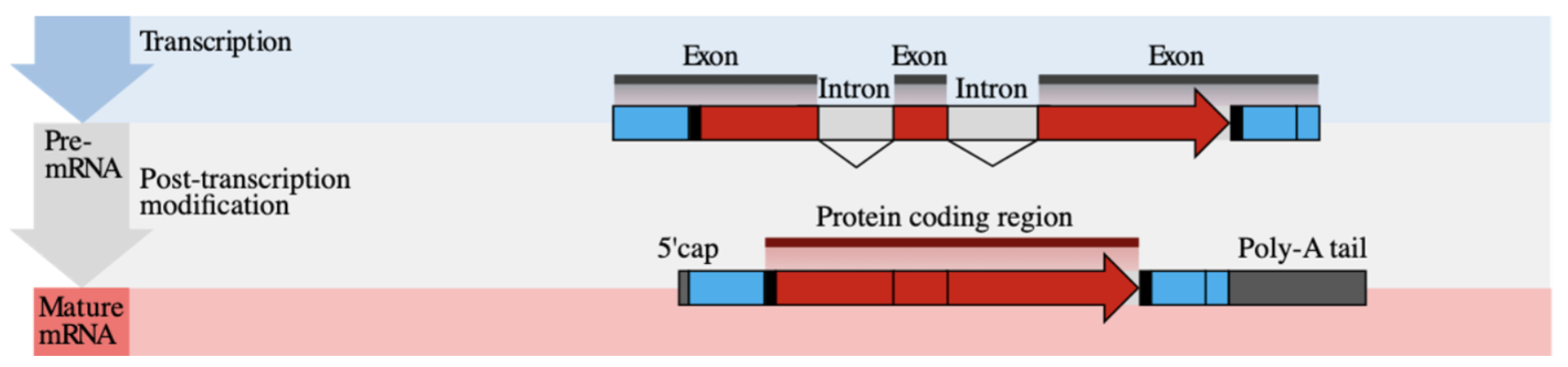
Polyadenylation
A poly A tail is added to the 3’ end of the pre-mRNA. This is an inherent part of the termination mechanism. This is not templated by the genome.

co-transcriptional
most processing occurs while mRNA is being synthesized and some soon after transcription (post-transcriptional)
Ex: The 5’ cap is added as soon as transcription has been initiated. Splicing and editing begin while the transcript is still being made.
How regulated in RNA Pol II transcription in eukaryotes?
tightly regulated by a highly complex, multicomponent machinery involving more than 100 proteins in humans, which are organized into often very large multiprotein assemblies
What is the key difference between bacterial and eukaryotic transcription initiation?
How polymerase recognizes the promoters.
Bacteria: RNA polymerase, together with a sigma factor, recognizes promoter sequences.
Eukaryotes: RNA polymerases do not directly recognize their core promoter sequences.
How are eukaryotic core promoter sequences recognized?
by a set of proteins called general transcription factors (GTFs). (These proteins are not part of the RNA polymerase complex)
General transcription factors are named as TFNX. What do each of these letters mean?
transcription factors
N= roman numeral I, II, or III (signifying the polymerase)
X= a letter
What does TFII mean?
a general transcription factor for RNA polymerase II
In order for transcription to occur, what must RNA polymerase II do?
It needs to be recruited to the appropriate location around the transcription start site, on the core promoter.

General transcription factors for RNA Pol II include what factors?
TFIIA, TFIIB, TFIID, TFIIE, TFIIF, and TFIIH

TFIID
A large multi-subunit protein which includes the TATA-binding protein (TBP).
Binding of TFIID to the core promoter is followed by the recruitment of additional GTFs and eventually RNA Pol II

TATA-binding protein (TBP)
a sequence-specific DNA-binding protein that recognizes the TATA box

pre-initiation complex (PIC)
complete assembly of GTFs and RNA Pol II at the promoter

The pre-initiation complex (PIC) forms an inactive closed complex. What does that mean?
the promoter DNA remains double-stranded and RNA Pol II is positioned at the promoter but cannot yet initiate transcription as the complex is ‘poised for transcription’

TFIIH
Plays a key role in the transition from ‘closed to open complex’

What 2 activities does TFIIH have?
ATP-dependent helicase type activity and kinase activity
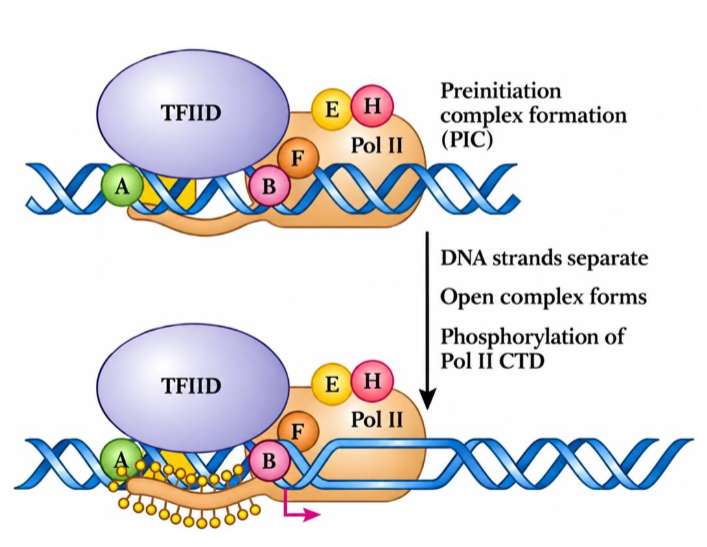
ATP-dependent helicase type activity
opens up about 11-15 base pairs around the TSS, leading to forming the transcriptional bubble

kinase activity
Adds phosphates to certain amino acids within the C-terminal domain (CTD) of the RNA polymerase II.
A kinase is an enzyme that transfer a phosphate group, typically from ATP, to another molecule. Commonly modified amino acids include: serine, threonine, and tyrosine.

abortive initiation
Once RNA Pol II begins RNA synthesis, it may initially produce several very short RNA transcripts.
Why? RNA Polymerase II is physically anchored to the promoter by general transcription factors (GTFs) and must undergo a steric and energetic tug-of-war before it can break free and move into productive elongation.

For productive transcription to continue, RNA Pol II must undergo Promoter escape. What is promoter escape?
RNA Pol II breaks many of its interaction with the promoter-bound initiation machinery. It then begins moving downstream along the DNA template.
CTD phosphorylation is an important signal promoting promoter escape and the transition to elongation.
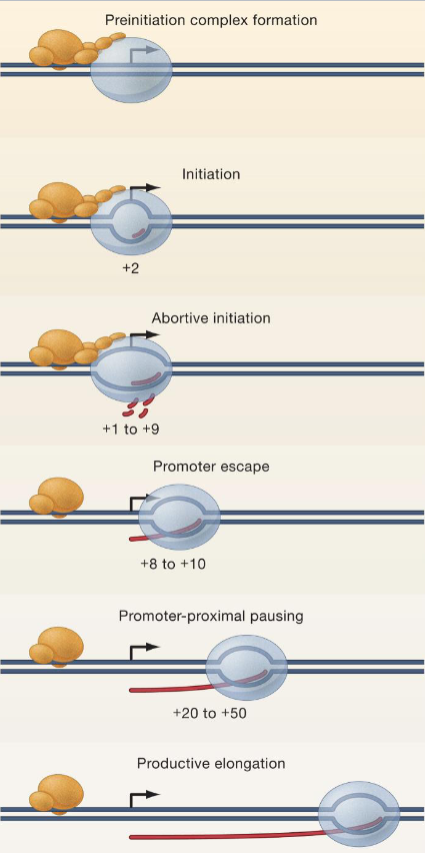
Shortly after promoter escape, Pol II often undergoes promoter-proximal pausing. What is this?
Provides an important regulatory checkpoint before productive elongation.

Productive elongation
Upon pause realize, Pol II enters this stage and continues synthesizing the RNA transcript.

What happens after Pol II leaves the promoter?
Some GTFs dissociate, while other may remain at or near the promoter to facilitate additional rounds of transcription
What is a key difference between bacterial and eukaryotic transcription?
Eukaryotic pre-initiation complex (PIC) does not assemble efficiently on its own. Therefore the basal rate of transcription is generally low, even at relatively strong promoters. In prokaryotes, a strong promoter = high transcription rate.
Efficient transcription of most eukaryotic genes requires what additional thing besides a relatively strong promoter?
additional regulatory proteins
transcriptional activator
Any protein that stimulates transcription initiation
They bind specific DNA sequences within promoter proximal elements or enhancers, thereby promoting transcription
promoter-proximal elements
regulatory DNA sequences located near the core promoter
contain specific consensus sequences that serve as binding sites for regulatory transcription factors
Different promoters contain different…
Combinations of transcription factor-binding sites, therefore each gene can be regulated by a unique combination of transcription factors.
response elements
regulatory DNA sequences that serve as binding sites for transcriptional activators and enable transcription initiation to respond to general signals from outside of the cell
Examples:
• cAMP response element (CRE)
Recognized by cAMP-responsive element-binding protein (CREB).
Allows transcription to respond to signaling pathways involving cAMP.
• Heat-shock elements (HSEs)
Recognized by heat-shock transcription factors (HSFs).
Activate genes involved in the cellular response to heat and other stresses.

mediator
Multi-subunit complex facilitates communication between activating transcription factors bound to enhancers or upstream regulatory elements and the GTFs and RNA Pol II at the promoter.
Forms a physical bridge between regulatory proteins bound to distant regulatory regions and the transcription machinery at the core promoter

The mediator is a huge complex of 25-30 subunits with a mass of more than 1MDa (megadalton). What does this tell us overall about the mediator?
it has a big molecular weight

Transcriptional activators are modular proteins containing what 2 major functional domains?
DNA-binding domain
Activation domain
Do most transcriptional factors bind directly to the RNA polymerase?
No, they use specialized structural domains to recognize and bind specific DNA elements. Such as promoter, enhancers and silencers.
Transcriptional activators stimulate transcription in what 2 major ways?
Promote pre-initiation complex (PIC) formation or activity
directly through components such as TFIID
indirectly through mediator complex
Alter chromatin structure
covalent modification of histones
ATP-dependent chromatin remodeling
transcriptional activator often attract ATP-dependent chromatin-remodeling complexes and histone acetylases
What are 2 important features of eukaryotic transcriptional regulation?
coordinated gene regulation
combinatorial control
coordinated gene regulation
different genes can contain the same response element
a single stimulus can therefore activate multiple genes simultaneously through the same transcriptional regulator
this allows groups of genes to be coordinately regulated in response to the same signal
this is important during development and help establish cell fate

combinatorial control
gene expression is determined by the specific combination of transcription factors and other regulatory proteins present in a cell
the same regulatory proteins can have different effects depending on the other regulatory proteins present
these regulatory proteins influence the ability of RNA Pol II and the transcription machinery to access and transcribe a gene
The same gene can be expressed at different levels, at different times, and in different cell types, depending on the combination of transcription factors present. (It is not simply the number of activators versus repressors; their identity, combination, and location determine the transcription level.)

In the figure:
• Transcription factors above the DNA = activators
• Transcription factors below the DNA = repressors
What kind of transcriptional regulation is this: A has less favorably positioned activators and more repressors near the promoter —> low transcription. B has an activator located very close to the promoter, which interacts with the RNAP to stabilize its interactions with TFIID —> high transcription.
Combinatorial control
After initiation, the basic mechanism of transcription elongation is similar in prokaryotes and eukaryotes. What is a major difference though?
eukaryotic pre-mRNA is extensively processed as it emerges from RNA Pol II
What major processing events occur to pre-mRNA and what is special about these?
5’ end-capping
splicing
3’ end polyadenylation and termination
Much of this processing occurs co-transcriptionally.

5’ end-capping
First major modification of the nascent (just beginning to exist) pre-mRNA. Consists of a guanine nucleotide connected to the 1st nucleotide of the mRNA through an unusual 5’-5’ triphosphate bridge

What is special about the 5’ cap guanine nucleotide?
It is methylated on the 7 position directly after capping in vivo by a methyltransferase. It is referred to as a 7-methyguanylate cap, abbreviated m7G.
When is the 5’ end of the RNA capped?
when approximately 20-30 nucleotides of RNA have emerged from RNA Pol II

5’ end-capping occurs in what 3 major steps?
RNA triphosphate removes the terminal phosphate from the 5’ end of the nascent RNA
A capping enzyme adds GMP from GTP to the first nucleotide of the RNA, creating a unusual 5’-5’ linkage
Guanine-7-methyltransferase methylates the newly added guanine to from the m7G cap
What are the function of the 5’ cap?
serves as a recognition site for the export of mature mRNA from the nucleus to the cytoplasm
prevention of degradation by exonucleases
promotion of translation
cap-binding proteins (CBP)
recognizes 5’ cap. remains associated with the cap till mRNA has been transported into the cytoplasm.

3’ end polyadenylation and termination
3’ end of the gene (within the 3’ UTR) contains signals that direct the end of the transcription and polyadenylation.
Consists of a poly-A site flanked by a polyadenylation signal (AATAAA, poly-A signal) and a downstream GT-rich element.
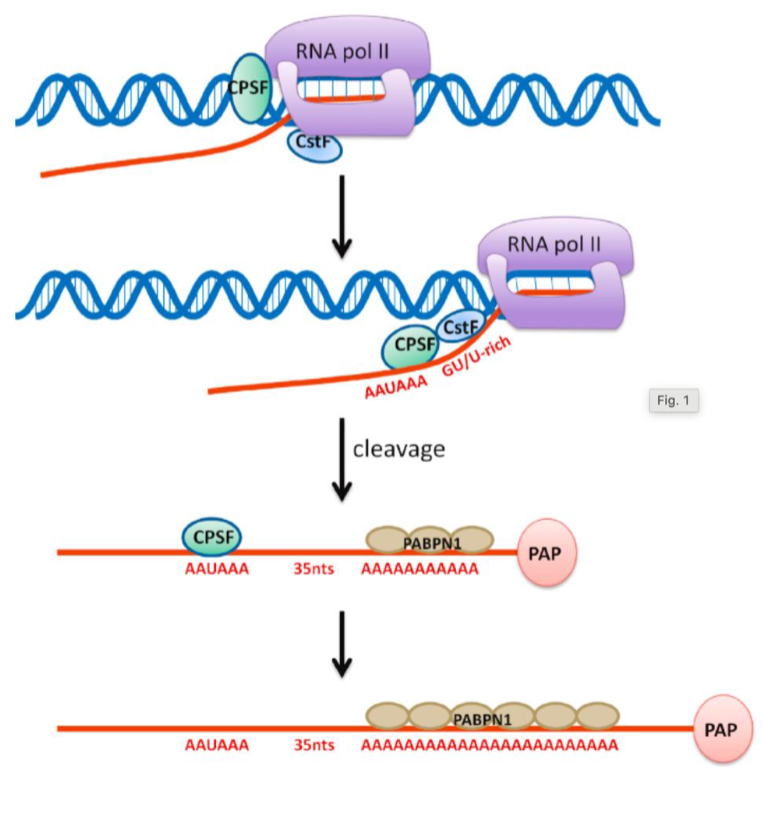
Steps of 3’ end polyadenylation
poly-A single (TTATTT) and the downstream GT-rich element are transcribed into the pre-mRNA
protein complex, CPSF (cleavage and polyadenylation specificity factor) recognizes the poly-A signal
CPSF has endonuclease activity and cuts the pre-mRNA between the poly-A signal (AAUAAA) and the downstream GU-rich element, leaving the AAUAAA sequence on the pre-mRNA and a free 3’ OH. This effectively releases the mRNA from the transcribing machinery.
An enzyme called poly-A polymerase (PAP) then adds a string of approx. 200 adenine residues, forming the poly-A tail. (poly-A tail not directly encoded by the DNA template; it is added post-transcriptionally)

What are the functions of the poly-A tail?
protects the 3’ end from degradation
increases mRNA stability
promotes efficient translation