BCH4024 Douma Exam 4 - Lecture 12
 Call Kai
 Learn
Learn Practice Test
 Spaced Repetition
 Match
Match Flashcards
 Knowt Play
1/50

There's no tags or description
Looks like no tags are added yet.
Name | Mastery | Learn | Test | Matching | Spaced | Call with Kai | Chat |
|---|
No analytics yet
Send a link to your students to track their progress
51 Terms
What is the direction of ribosome movement during translation?
5' to 3' along the mRNA.
What direction are proteins synthesized during translation?
From N-terminus to C-terminus.
What is a codon?
A sequence of three nucleotides in mRNA that encodes a specific amino acid.
What does it mean that the genetic code is non-overlapping?
Each base is read only once as part of a single codon.
How many possible codons are there?
64.
What is the start codon and what amino acid does it encode?
AUG; it encodes Methionine.
What are the three stop codons?
UAA, UAG, UGA.
What molecule brings amino acids to the ribosome?
tRNA (transfer RNA). 'Cloverleaf' secondary structure.
Where is the amino acid attached on the tRNA molecule?
The 3' end.
What is the anticodon?
A three-base sequence in tRNA that base pairs with the mRNA codon.
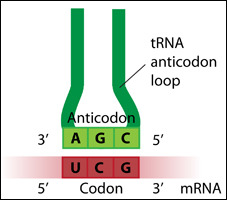
In what orientation do anticodon and codon base pair?
Antiparallel (5' to 3' mRNA binds 3' to 5' tRNA).
Which position(s) of the codon are the biggest determinants of what amino acid it encodes?
Positions 1 and 2 on the codon (2 and 3 on anticodon). The strongest interactions (normal Watson-Crick base pairing) happen at those positions.
What position in the codon is known as the wobble position?
The third position of the codon (first position of the anticodon).
What allows one tRNA to recognize multiple codons?
Wobble base pairing at the third codon (first anticodon) position.
What is the third position of the codon called?
The wobble base.
Why is the third position of the codon called the wobble base?
Because the third base of most codons pairs loosely with the corresponding anticodon base, permitting rapid dissociation of the tRNA from its codon during protein synthesis.
What can uracil also bind to, outside of adenine, in the wobble position?
Guanine (G).
What unusual base can be found in the anticodon wobble position?
Inosine (I), which can pair with A, U, or C.
How many different tRNAs are needed to recognize all codons?
About 32 tRNAs.
What enzyme charges tRNAs with their corresponding amino acids?
Aminoacyl-tRNA synthetase.
What is a charged tRNA?
A tRNA molecule attached to its specific amino acid.
What powers the charging of tRNA with an amino acid?
ATP hydrolysis.
What are the two subunits of the prokaryotic ribosome called?
Large subunit (50S) and small subunit (30S).
What is the main catalytic component of the ribosome?
rRNA (ribosomal RNA).
What is the function of initiation factors?
They act on the 30S ribosomal subunit to form the translation initiation complex.
What does Initiation Factor 1 (IF-1) do?
It blocks premature tRNA binding at the A-site.
What does Initiation Factor 3 do?
It blocks premature binding of the 50S subunit.
What is the Shine-Dalgarno sequence?
The region of mRNA, upstream of the start codon, that guides the initiating 5'-AUG to its correct position.
What is the first amino acid added in prokaryotic translation?
N-formylmethionine (fMet).
Which ribosomal site does the start codon align with during initiation?
P site (peptidyl site).
Which factor binds to and brings the initiator tRNA to the ribosome (P-site) in prokaryotes?
Initiation factor IF-2 bound to GTP.
How does IF-2 dissociate all of the initiation factors (IF-1 and IF-3) that were initially preventing translation?
It hydrolyzes GTP
What are the three ribosomal sites called?
A site (aminoacyl site), P site (peptidyl site), and E site (exit site).
What factors are needed to bring aminoacyl-tRNAs into the ribosome during elongation?
Elongation factors (EFs) bound to GTP.
What exactly do these elongation factors do?
EF-Tu delivers aminoacyl-tRNA to the A-site.
What happens to the EF-Tu once it facilitates the base pairing between the aminoacyl-tRNA anticodon and the mRNA codon?
It hydrolyzes its GTP to facilitate dissociation from the translation complex.
What molecules bind to the small 30S ribosomal subunit to block aminoacyl-tRNA entry into the A site?
Tetracyclines
How is EF-Tu-GDP recycled?
It is recycled by EF-Ts, a nucleotide exchange factor.
What does EF-Ts do?
It binds EF-Tu-GDP and 'tells' it to let go of the GDP molecule and bind a new GTP molecule.
What catalyzes the formation of peptide bonds?
The ribosomal RNA (rRNA) in the large ribosomal subunit.
What is the major function of the ribosome during translation?
It serves as a peptidyl transferase.
What does chloramphenicol do?
It binds the large 50S subunit, blocking peptidyl transferase activity.
What moves the ribosome down the mRNA during elongation?
Elongation factor EF-G using GTP hydrolysis.
What does erythrymycin do?
It binds to the large 50S subunit, blocking the binding site for translocase.
What happens at the A site during translation?
New charged tRNAs enter and base pair with the codon.
What happens at the P site during translation?
Growing peptide chain is held by the tRNA.
What happens at the E site during translation?
Uncharged tRNAs exit the ribosome.
What triggers termination of translation?
The ribosome encounters a stop codon.
What proteins recognize stop codons and terminate translation?
Release factors (termination factors).
How is translation terminated?
Release factors promote hydrolysis of the bond between the polypeptide and tRNA.
What molecules aid in ribosome dissociation?
Ribosome recycling factors (RFFs)