physics chapter 1
 Call Kai
 Learn
 Practice Test
 Spaced Repetition
 Match
 Flashcards
 Knowt Play
1/44

There's no tags or description
Looks like no tags are added yet.
45 Terms
SI units:
length
mass
time
current
amount of substance
temperature
luminous intensity
meter—m
kilogram—kg
second—s
ampere—A
mole—mol
kelvin—k
candela—cd
Vector
have magnitude and direction
Vector quantities include displacement, velocity, acceleration, and force.
Scalars
have magnitude only and no direction
Scalar quantities include distance, speed, energy, pressure, and mass
how to add vectors
tip to tail— if all straight, just add
if amgled, use pythagoreous
how to add vectors when at angle
find x component
find y component
x= vcostheta
y=vsimtheta
add x components
add y components
vector magnitude is the square root of x component squared plus y component squared — py theorem
use inverse tam y/x for angle
see examples!!!!
vector subtraction
same thing , just subtract instead if straight
if angled, use pythagorous and subtract components instead of adding
Multiplying Vectors by Scalars
Magnitude: Multiply the original magnitude by the scalar’s absolute value, \(|n|\).
Positive scalar (+): Vector keeps the same direction.
Negative scalar (−): Vector points in the opposite direction.
To determine the direction of the vector B, we must look at the sign on n. If n is a positive number, then B and A are in the same direction. However, if n is a negative number, then B and A point in opposite directions
Multiplying Vectors by Other Vectors
dot product makes scalar: ABcostheta
cross product makes vector: ABsimtheta
theta is between the two vectors
use right hand for direction of cross product:
Start by pointing your thumb in the direction of vector A.
Extend your fingers in the direction of vector B. You may need to rotate your wrist to get the correct configuration of thumb and fingers.
Your palm establishes the plane between the two vectors. The direction your palm points is the direction of the resultant C.
Displacement
An object in motion may experience a change in its position in space, known as displacement (x or d). This is a vector quantity and, as such, has both magnitude and direction.
Understand that displacement does not account for the actual pathway taken between the initial and the final positions—only the net change in position from initial to final.
Distance
Distance (d) traveled, on the other hand, considers the pathway taken and is a scalar quantity.
distance vs displacement example:
Example: What is the displacement of a person who walks 2 km east, then 2 km north, then 2 km west, and then 2 km south?
Solution: While the total distance traveled is 8 km, the displacement is a vector quantity that represents the change in position. In this case, the displacement is zero because the person ends up back at the start, as shown below.
Velocity
Velocity (vector):
How fast AND in what direction an object moves.
Calculated using displacement ÷ time.
SI unit: m/s.
speed
How fast an object moves, without direction.
Calculated using total distance ÷ time.
SI unit: m/s.
Instantaneous speed vs. instantaneous velocity
Instantaneous means at one specific moment.
Instantaneous speed = magnitude (size) of instantaneous velocity.
They are always equal in magnitude.
force
Every change in velocity is motivated by a push or a pull—a force
do objects have to touch for forces to exist between them
Forces can exist between objects that are not even touching
the SI unit for force is
newton (N), kgxm/s²
Acceleration due to gravity, g, value
9.8 m/s²
what is g, what effects its value
this attractive pull toward the Earth,
Acceleration due to gravity, g, decreases with height above the Earth and increases the closer one gets to the Earth’s center of mass
Gravity
an attractive force that is felt by all forms of matter
what exerts gravity
However, all objects exert gravitational forces on each other;
The magnitude of the gravitational force between two objects is
Fg=Gm1m2/r²
r is the distance between their centers of mass
G is the universal gravitational constant 6.67×10⁻¹¹N⋅m²/kg²
m1 and m2 are the masses of the two objects
relate Fg to r
make qs from chatgpt, practice!!
the magnitude of the gravitational force is inversely related to the square of the distance
Steps:
Identify how much the distance changes.
Square that number.
Divide 1 by the result.
Multiply by the original force if one is given
Friction
what is it
how does it differ from other forces
type of force that opposes the movement of objects.
Unlike other kinds of forces, such as gravity or electromagnetic force, which can cause objects either to speed up or slow down, friction forces always oppose an object’s motion and cause it to slow down or become stationary
There are two types of friction:
static and kinetic
Static friction
symbol
what is it
fs
exists between a stationary object and the surface upon which it rests
Max vs actual static friction equation
0 ≤ fs ≤ μsN
where μs is the coefficient of static friction and N is the magnitude of the normal force.
The coefficient of static friction is a unitless quantity that is dependent on the two materials in contact.
The normal force is the component of the force between two objects in contact that is perpendicular to the plane of contact between the object and the surface upon which it rests.
Actual static friction:
Actual friction = applied force
Use applied force when finding actual friction on an object that remains stationary.
Friction acts in the opposite direction of the applied force.
Kinetic friction (fk)
what is it
what is the equation
exists between a sliding object and the surface over which the object slide
A wheel, for example, that is rolling along a road does not experience kinetic friction because the tire is not actually sliding against the pavement. The tire maintains an instantaneous point of static contact with the road and, therefore, experiences static friction. Only when the tire begins to slide on, say, an icy patch will kinetic friction come into play. Any time two surfaces slide against each other, kinetic friction will be present and its magnitude can be measured according to this equation:
fk = μkN
The value of μs is always
finish the sentence
explain the significance
larger than the value of μk
Therefore, the maximum value for static friction will always be greater than the constant value for kinetic friction.
Static friction (\(f_s\)) prevents an object from starting to move.
Kinetic friction (\(f_k\)) opposes an object that is already sliding.
Static friction is stronger than kinetic friction: it takes more force to start moving an object than to keep it moving.
What is mass?
define
type
unit
relation to gravity
The amount of matter in an object; also a measure of its inertia (resistance to changes in motion).
Scalar (magnitude only).
Measured in kilograms (kg).
Does not change with gravity.
One kilogram of material on Earth will have the same mass as one kilogram of material on the Moon
What is weight?
define
type
relation to gravity
equation
A: The gravitational force acting on an object's mass.
Vector (magnitude and direction).
Measured in newtons (N).
Changes depending on gravitational strength.
Fg=mg
The weight of an object can be thought of as being applied
at a single point in that object called the center of mass or gravity
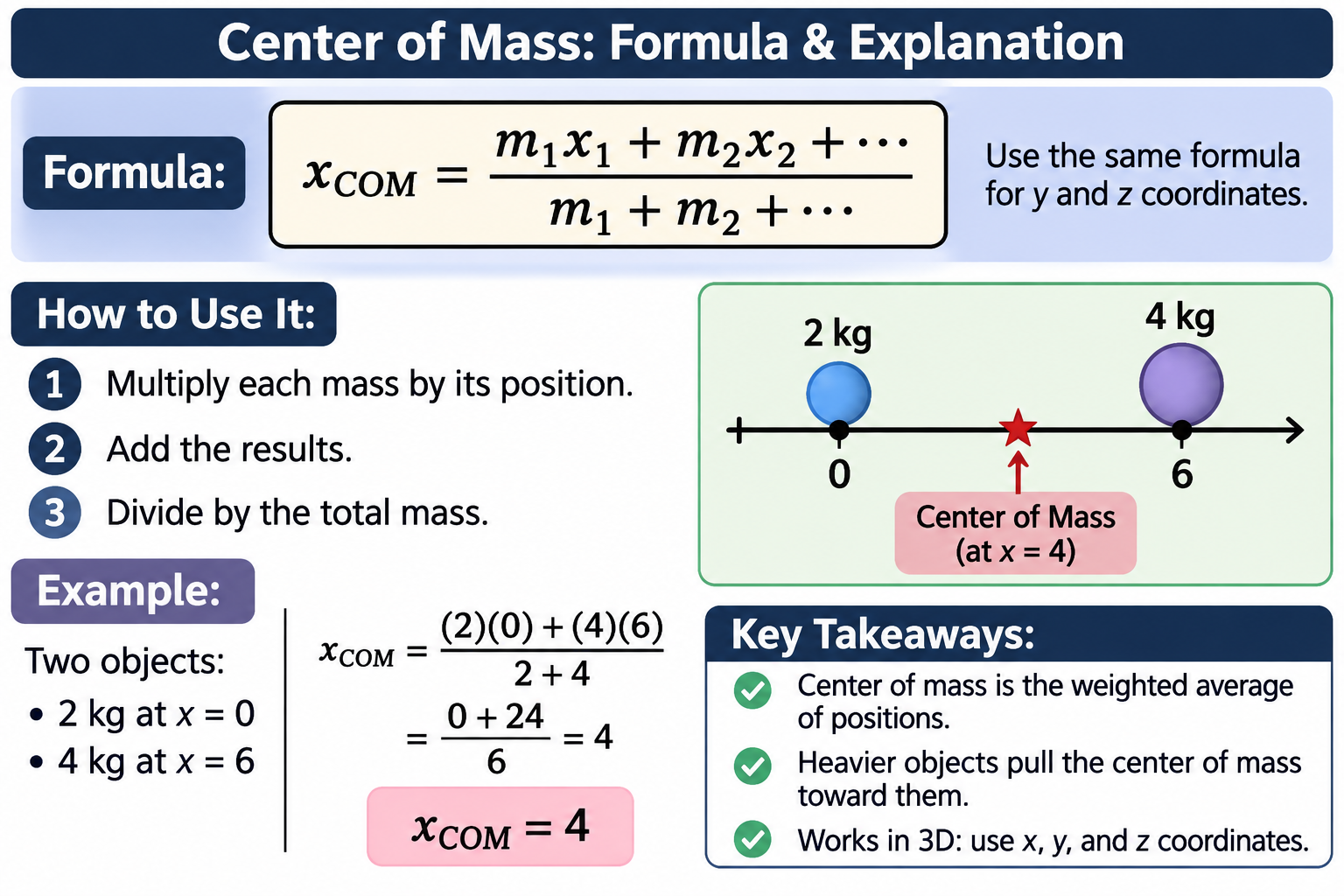
What is the center of mass?
The point where an object's mass can be considered concentrated when analyzing its motion.
How do you calculate the center of mass?
Only for a homogeneous body (with symmetrical shape and uniform density) should one expect the center of gravity to be located at its geometric center
Multiply each object's mass by its position.
Add the results together.
Divide by the total mass.
The same formula applies to the y- and z-coordinates.
Acceleration (a)
define
type
unit
is the rate of change of velocity that an object experiences as a result of some applied force
Vector quantity (magnitude and direction).
SI unit: meters per second squared (\(m/s^2\)).
acceleration of a graph
Q: What does the slope of a velocity vs. time graph represent?
A: Acceleration.
Positive slope = positive acceleration.
Negative slope = negative acceleration.
Steeper slope = greater acceleration magnitude.
To find instantaneous acceleration from a velocity-versus-time graph:
Find the specific time you're asked about (for example, 3 seconds).
Draw a straight tangent line touching the curve at that point.
Pick two points on that tangent line.
Calculate its slope:
Newton’s Laws: First Law
A body either at rest or in motion with constant velocity will remain that way unless a net force acts upon it.
fnet=ma=0
Second Law
The net force acting on an object equals its mass multiplied by its acceleration.
fnet=ma
third law
More formally, the law states that for every force exerted by object A on object B, there is an equal but opposite force exerted by object B on object A
Fab=-Fba
Linear Motion
the pathway of the moving object continues along a straight line
This one-dimensional motion can be fully described by the following equations:
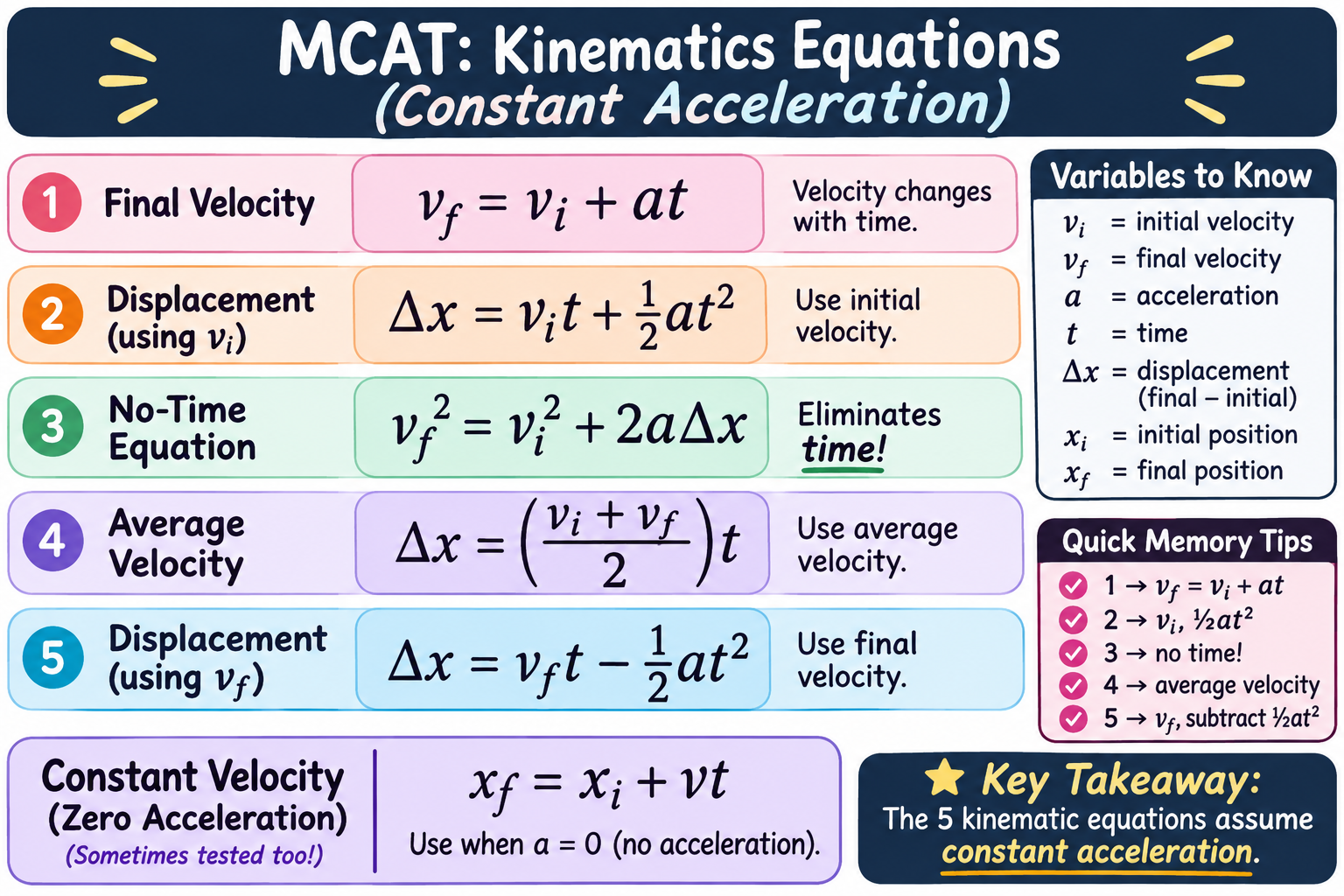
make chatgpt questions for linear motion at constant acceleration, 30 of them
Projectile motion
Horizontal (x-axis): Velocity remains constant; acceleration = 0.
Vertical (y-axis): Gravity causes constant acceleration downward (g = 9.8 m/s²).
Horizontal and vertical motions are independent and analyzed separately.
Assume negligible air resistance on the MCAT.
Projectile motion equations
