Review Notes: Lipid Biosynthesis - Biosynthesis of Fatty Acids
 Call Kai
 Learn
 Practice Test
 Spaced Repetition
 Match
 Flashcards
 Knowt Play
1/16

There's no tags or description
Looks like no tags are added yet.
17 Terms
How Does Fatty Acid Synthesis (FAS) start?
→ FAS begins by transporting Acetyl-CoA OUT of the mitochondria
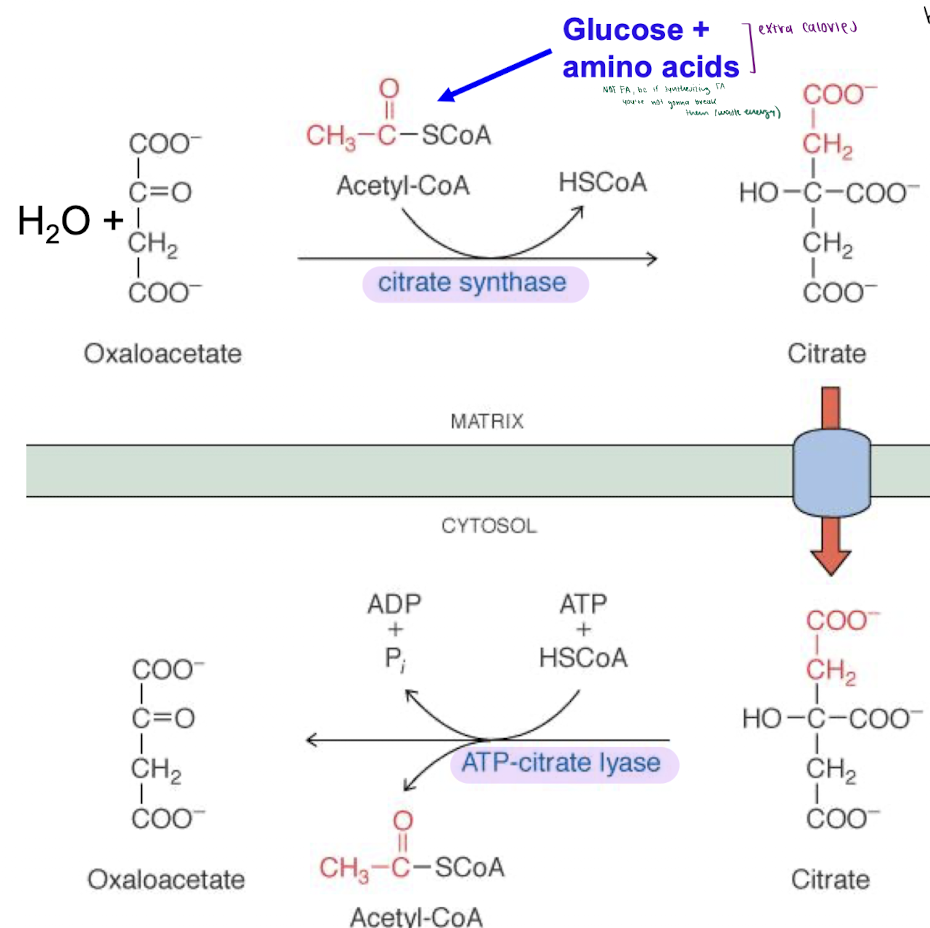
A-CoA can’t cross the IMM bc its linked to CoA, thus have to shuttle it out as citrate (pull citrate from matrix into cytosol)
process of pulling A-CoA out of matrix as citrate for FAS:
uses citrate synthase to react OAA + H2O + A-CoA to form citrate in the matrix
citrate then crosses IMM using tricarboxylic acid transporter
citrate crosses OMM via membrane porins
citrate now in cytosol is converted via ATP-citrate lyase back into OAA + A-CoA using
uses ATP + HSCoA & produces ADP + Pi as well
source of Acetyl-CoA for FAS:
A-CoA for FAS comes from glucose & amino acids, thus extra calories, NOT FA’s bc if you’re synthesizing FA you’re not gonna break them (would waste energy)
Fatty Acid Synthesis (FAS) Overview
→ A-CoA has to be transported from matrix into cytosol as citrate using the enzymes citrate synthase & ATP-citrate lyase
crosses IMM via tricarboxylic acid transporter & crosses OMM into cytosol via porin
ATP-citrate lyase uses 1ATP
→ FA are synthesized from A-CoA predominantly in LIVER & adipose tissue (& mammary tissue)
requires: ATP, NADPH, CO2
if making an even # FA: starts with A-CoA
if making an UNEVEN # FA: starts w palmitoyl-CoA, then A-CoA
note: a product of FAS is Hamitic acids (C16:0)

→ irreversible & committed step in FAS: acetyl-CoA carboxylase rxn
the activation of this acetyl-CoA carboxylase (ACC) is tightly regulated via allostery, covalent mod, & transcriptional regulation
after A-CoA enters cytosol from matrix: ACC uses biotin as a cofactor to transfer CO2 onto A-CoA to form Malonyl-CoA
this uses the biotin-carboxylase + HCO3- + ATP to add CO2 to biotin, then transcarboxylase to add CO2 to A-CoA
note: NOT HMG-CoA, as thats used in synetsfhis of ketone bodies & cholesterol
ACC activity:
ACC is active when dephos & polymerized
inactive when phosphorylated & depolymerized
citrate activates the ACC
fatty-acyl CoA’s are allosteric inhibitors of the ACC - as they’re long-chain FA’s in cytosol for oxidation, so they dont want FAS
high AMP levels → activate AMPK → AMPK phosphorylates ACC, depolymerizing it → ACC is inactive since AMPK turns on catabolic pathways
glucagon (low blood sugar) DOESNT want ACC on, thus results in ACC being phosphorylated
insulin (high blood sugar) wants to build FA, thus wants ACC on → results in ACC being dephosphorylated
ACC is a large 3 domain enzyme in the CYTOPLASM
a homodimer w 2 identical protein subunits
3 domains: biotin carboxylase, biotin carrie protein, transcarboxylase
process:
biotin carboxylase uses ATP to attach HCO3- onto biotin cofactor /arm
transcarboxylase transfers CO2 from biotin arm to A-CoA → from Malonyl-CoA for FAS
malonyl-CoA is the ACTIVATED form fro FAS

→ ACC has adaptive control:
lots of calories → increased ACC transcription to make FAS
not a lot of calories → decreased ACC transcription
Q. will ACC be active when phosphorylated?
No.
glucagon would result in ACC being phosphorylated (turned off) bc it signals low blood sugar and thus doesn’t want to use limited glucose to make A-CoA for FAS
insulin would result in ACC being dephosphorylated (turned on) bc it signals high blood sugar and thus has extra calories to store as
Q. Predict how palmitoyl-CoA affects the citrate transporter and glucose-6-P dehydrogenase
citrate transporter is used to transport citrate from matrix across IMM into intermembrane space to enter cytosol for FAS (citrate was converted from A-CoA)
Glucose-6-P dh is used in the PPP to makes NADPH in the 1st oxidation rxn - this NADPH is used for anabolic pathways like FAS
answer:
palmitoyl-CoA is a FA (C16:0), thus it would want B-OX of FA’s to occur & thus INHIBITS the citrate transporter (tricarboxylic acid transporter) & G-6-PDH as they are used for FAS not oxidation of FA’s
citrate transporter provvides A-CoA for FAS
G6PDH is used in PPP to make NADPH for FAS
Role of Fatty Acid Synthase in FAS
Fatty acid synthase = catalyzes synthesis of long-chain saturated FA’s in the cytosol using 1 A-coA primer, 7 malonyl-CoA donors & NADPH
Uses acetyl-CoA to start the chain & adds 2C per cycle via decarboxylative condensation w malonyl-CoA (7 cycles yield C16 palmitate)
Uses 2 NADPH molecules/cycle to convert beta-keto group into a fully saturated hydrocarbon chain
Releases free palmitate once the 16C chain reaches its target length
forming even chain FA: last 2C come from A-CoA
bc primed by A-CoA, then M-CoA is used
forming uneven chain FA: last 3C come from propionyl-CoA
bc primed by propionyl-CoA, then M-CoA is used
get propionyl-CoA from propionate
Fatty acid synthase structure
bacteria: catalyzed by 6 diff enzymes + separate ACP
mammals: FAS is catalyzed by individual domains of a large polypeptide w an ACP domain
consists of a homodimer of 2 identical protein subunits
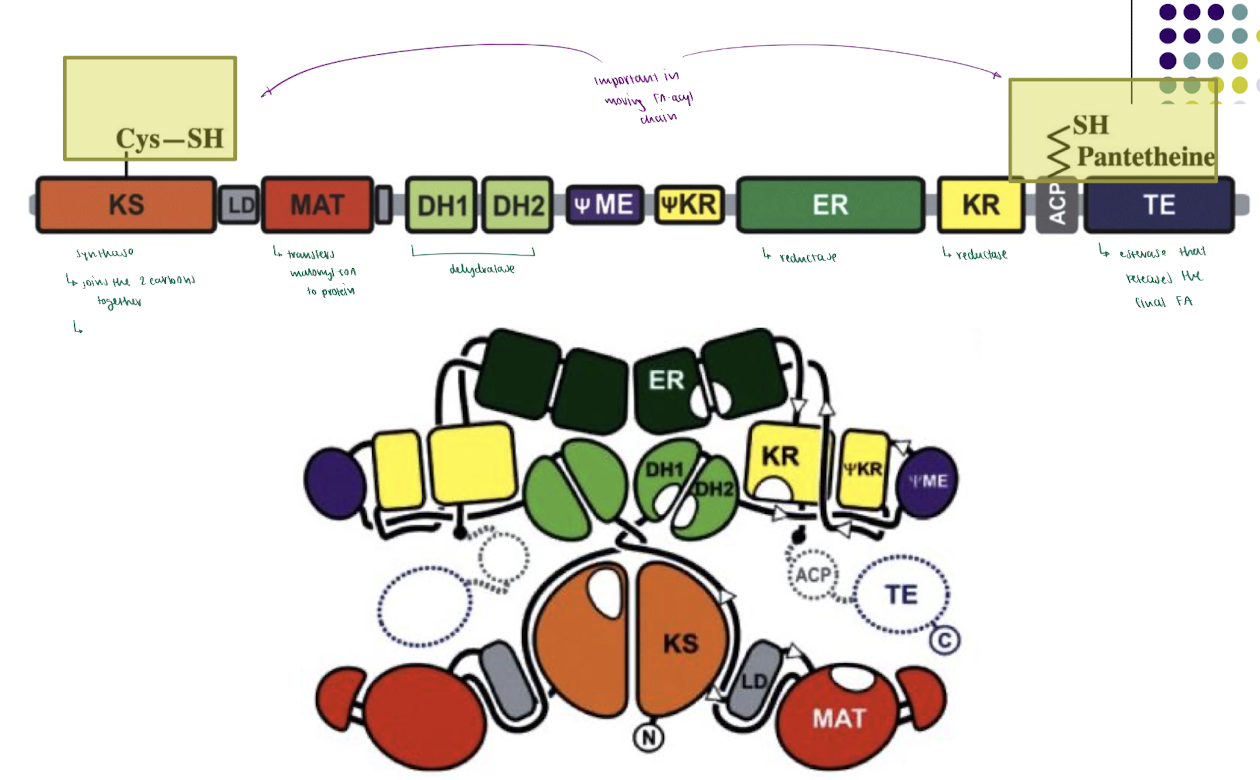
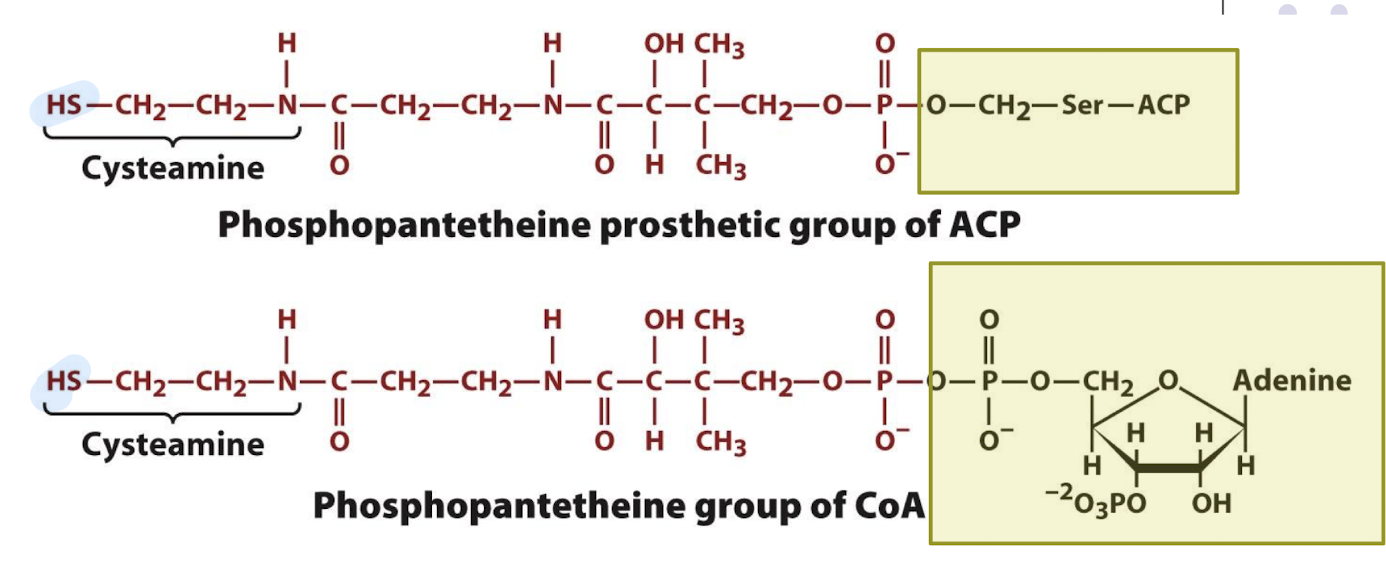
ACP (acyl carrier protein) anchors the growing FA chain to the complex via a thioester bond - intermediates swing b/w sulfhydryl groups of the ACP & KS domains
ALL molecules (A-CoA & M-CoA) enter FAS complex at ACP - thus we always need to free up ACP for incoming malonyl-CoA
FAS complex domains/ catalytic sites:
MAT (Malonyl/Acetyl-CoA–ACP transferase): Loads acetyl & malonyl groups onto the ACP

KS (B-ketoacyl-ACP synthase): Catalyzes condensation and CO2 release to form a B-ketoacyl intermediate.
KR (B-ketoacyl-ACP reductase): Reduces the B-keto group to a B-hydroxy group using NADPH.
DH (B-hydroxyacyl-ACP dehydratase): Removes H2O to form a trans-∆^2-enoyl intermediate.
ER (Enoyl-ACP reductase): Reduces the DB using a 2nd NADPH to yield a saturated acyl chain.
TE (Thioesterase): Hydrolyzes the completed 16-C thioester to release palmitate
note: ACP structure

Process of FAS at the fatty acid synthase complex
FAS:
occurs in cytoplasm
requires 2NADPH per cycle & theres 7 cycles
products:
palmitate
14 NADPH (2 per cycle)
gross 7 H2O (1 per cycle)
net: -1H2O used to release palmitate
involves 4 steps: condensation, reduction, dehydration. reduction (CRDR)

→ B-OX of FA’s & FAS are DISTINCT opposing pathways
B-OX: occurs in matrix & rxns follow OHOT
FAS: occurs in cytosol & rxns follow CRDR

step 1 : Condensation
→ an INDIRECT transfer of energy
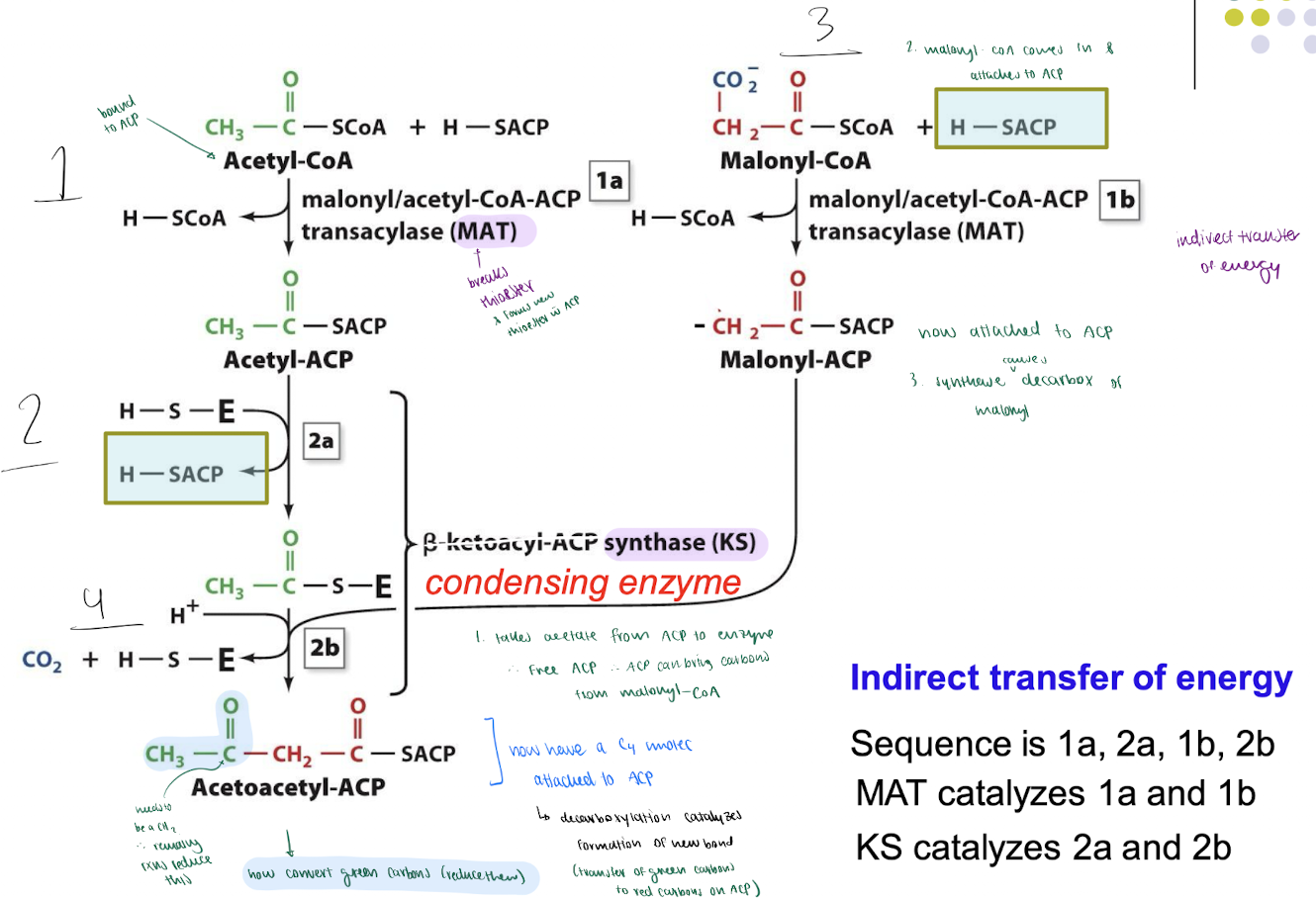
receive A-CoA at ACP: MAT/MT catalyzes the rxns converting A-CoA → Acetyl-ACP + CoA at a single active site
MAT breaks thioester & forms new thioester w ACP
synthase (KS) takes acetate from ACP & transfers it to enzyme → frees up ACP
ACP now can bind M-CoA using MAT (breaks thioester & form ne one to ACP)
synthase (KS) causes decarboxylation of malonyl + attaches the decarboxylated malonyl to the acetate group on the enzyme → forms Acetoacetyl-ACP (4C) & releases the enzyme + CO2
now have a 4C molecule attached to ACP
decarboxylation using synthase (KS) catalyzed the formation of a new bond
note: during this step, the FA intermediate is passed back & forth b/w ACP and KS’s SH groups
→ now we need to reduce the acetate group attached to decarboxylated malonyl to a CH2


Step 2 : Reduction
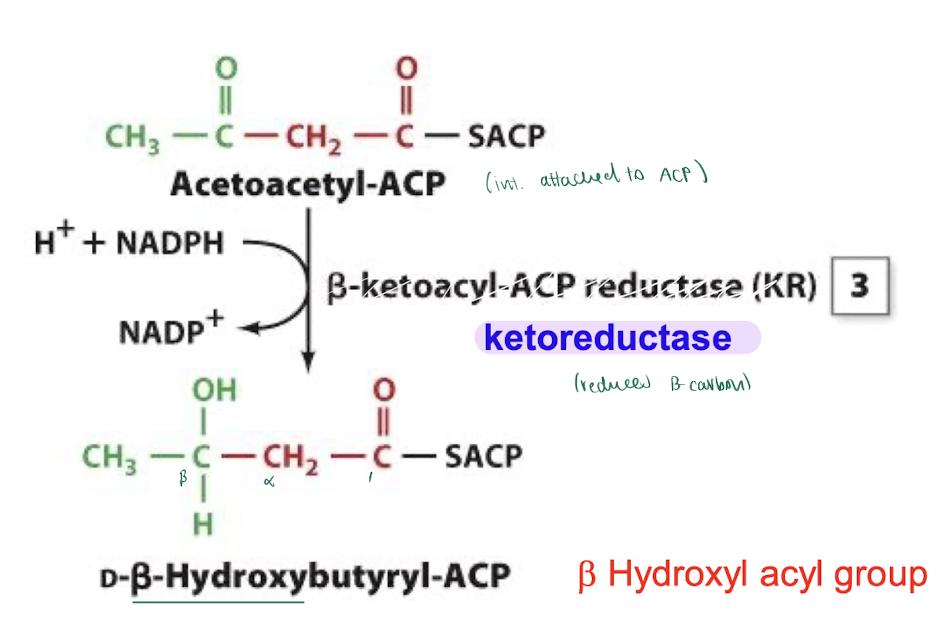
Ketoreductase (KR) uses NADPH to reduce the beta-carbon of Acetoacetyl-ACP from a carbonyl to an alcohol → forms D-B-Hydroxybutyryl-ACP
forms a B-hydroxyl acyl group
Step 3 : Dehydration
dehydrase (DH) removes H2O from D-B-Hyrdoxybutyryl-ACP to form a DB b/w B-carbon & α-carbon → forms α,B-trans-butenoyl-ACP
forms an enoyl acyl group (trans c=c)

Step 4 : Reduction
enoyl reductase (ER) uses NADPH to reduce α,B-trans-butenoyl-ACP’s DB to a single bond → forms butyryl-ACP
forms reduced Acyl group (4C)

→ the butyryl (4C) group is transferred from ACP to Cys-SH of KS (condensing enzyme) → frees up ACP for next round of FAS
even # FA: primed by A-CoA
after the first cycle was primed by A-CoA, the cycles following only have M-CoA enter at ACP
uneven # FA: primed by propionyl-CoA
→ after 7 cycles of CRDR: get a C16 attached to ACP = palmitoyl-ACP
thioesterase (TE) uses H2O to cleave thioester & releases palmitate as the FINAL & 1º product of FAS
palmitate can undergo further elongation and/or desaturation rxns

overall FAS:


overall stoic of palmitate synthesis (FAS):

Q.

No part of the molecule will have radioactive carbon in it, as malonyl-CoA’s labelled CO2 is radioactive, but during FAS’s 1 step of condensation synthase (KS) decarboxylates M-CoA - thus the radiative carbons are released as CO2 when combining A-CoA’s acetate group & decarboxylated malonyl
Where do the A-CoA’s used in FAS come primarily from?
→ A-CoA used in synthesis of FA’s come primarily from carbs & proteins, NOT B-OX of FA’s
process in liver (hepatocyte) cells:
carbs & proteins are broken down into A-CoA in matrix
A-COA in matrix is converted to citrate via citrate synthase & then crosses IMM via citrate translocase & then crosses OMM via porin into cytosol
citrate is then converted back into A-CoA in cytosol via ATP-citrate lyase
citrate then activates Acetyl-CoA carboxylase to convert A-coA into M-CoA
Malonyl-CoA brings most of the carbons in for FAS after its primed w A-coA (even #) or propionyl-CoA (uneven #)
Malonyl-CoA inhibits CATI used in B-OX for long-chain FA to enter matrix bc we don’t want B-OX during FAS
M-CoA is converted to palmitate-CoA (C16:0) in 7 cycles
palmitate is converted in smooth ER by enzymes into stearate & oleate
converted to TAG’s + cholesteryl-esters that are shipped out of liver in VLVL particles

Localization of Fatty Acid metabolism
FA are synthesized in the cytosol from A-CoA (from carbs & proteins), but mostly M-CoA
long-chain FA are broken down into A-CoA for energy in the matrix, by first being transported into matrix as fatty acyl-carnitine to then have B-OX
produced A-CoA can be used to form ketone bodies in liver during starvation or for CAC to produce energy + also regenerates citrate for FAS using citrate synthase

→ a Shuttle is required for transfer of acetyl groups
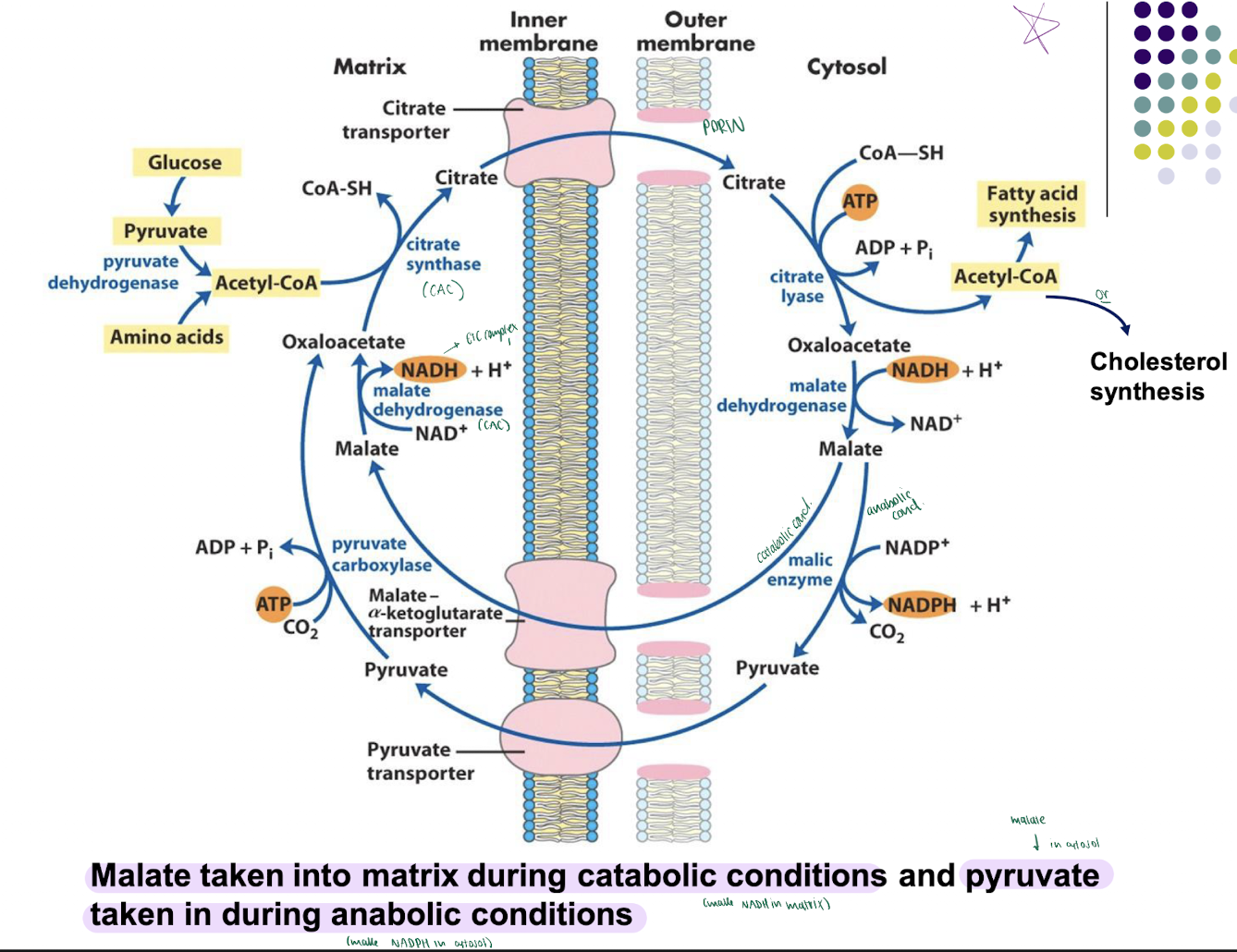
cytosolic malate dh & malic enzyme convert NADH → NADPH in the cytosol
uses electrons from NADH to form NADPH in cytosol which is then used for: lipid biosynthesis in the cytosol
FA synthesis
cholesterol synthesis
how: transports citrate from CAC in matrix across IMM via tricarbocylate transporter system, then across OMM via porin into cytosol
ATP-citrate lyase uses ATP to convert citrate → OAA & produces A-CoA
cytosolic malate dh uses NADH to convert OAA → malate
Malic enzyme produces NADPH by converting malate -. pyruvate in cytosol

What conditions is malate vs. pyruvate taken into the matrix?
→ malate is taken into matrix during catabolic conditions thru porin, then malate-α-KG transporter
malate is used in matrix under catabolic conditions to make NADH using mito malate dh → used by ETC complex 1
→ pyruvate is taken in matrix during anabolic conditions thru porin, them pyruvate transporter
bc malate is converted by malic enzyme to pyruvate under anabolic conditions to produce NADPH in the cytosol - then pyruvate enters matrix to be converted to OAA via private carboxylase

Q. Which of the following is not directly required in the synthesis of palmitate?
a. Acetyl-CoA
b. Biotin
c. HCO3- (CO2)
d. malonyl-CoA
e. NADH
answer: e, NADH
bc while NADH can be used to make NADPH for FAS in the cytosol, its NOT direct as it uses cytosolic malate dh, then malic enzyme to make NAPDH

Compare FAS & B-OX
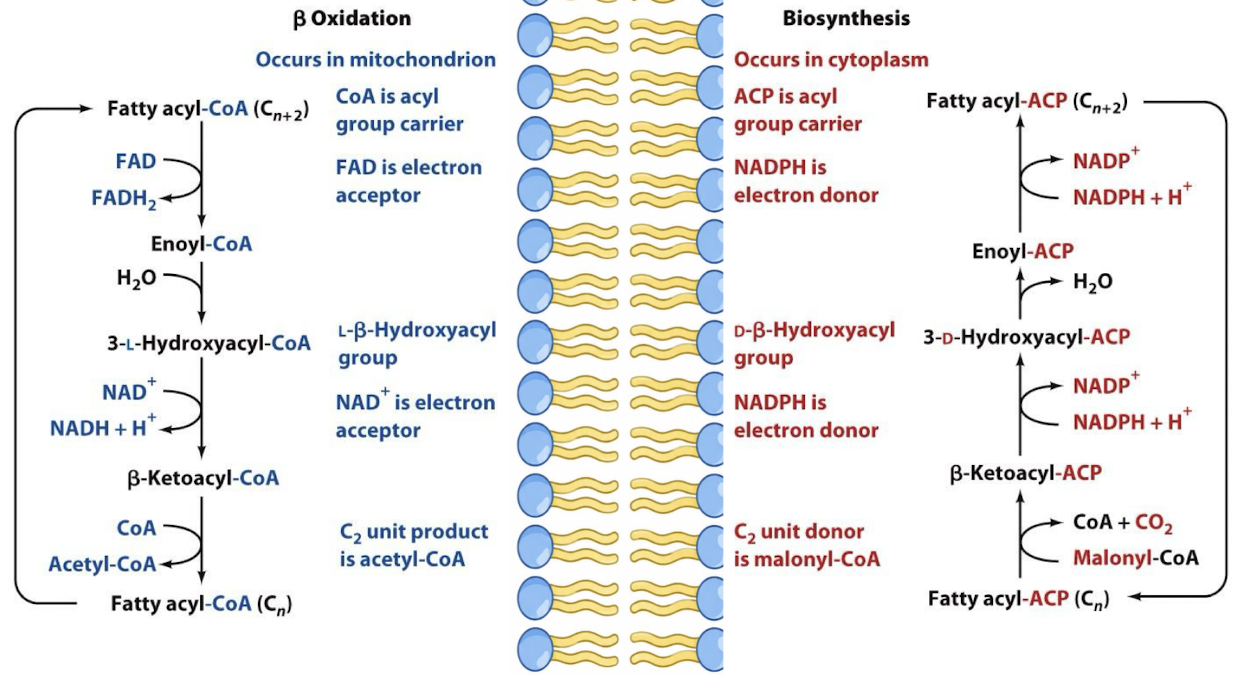
→ FAS & B-OX use fully distinct enzymes (don’t share any enzymes)
FAS = FA synthesis in cytosol
acyl group carrier: ACP
electron donor: NADPH
produces D-B-hydroxyacyl group
C2 unit donor: malonyl-CoA
ends w palmitate
uses reduced e- carrier NADPH
uses 1-2 ATP per C-C bond formed
ACC is tighly regulated
FAS complex (multi-enzyme)
occurs in cytoplasm
ends w a FA
B-OX = oxidation of FA in mito
acyl group carrier: CoA
electron acceptors: FAD & NAD+
produces L-B-hydroxyacyl group
C2 unit donor: acetyl-CoA
typically ends with production of A-CoA
generates NADH & FADH2
uses 2 ATP per FA oxidized
NO regulatory enzymes
uses separate enzymes
occurs in matrix
typically begins with a FA
Q. Animals that have fasted and are then fed high-carbohydrate, low-fat (high calorie) diets are likely to show a marked increase in their amounts of acetyl CoA carboxylase and the fatty acid synthase complex within a few days. True or False?
True, this is adaptive control converting excess glucose to fat
when fasting u have decreased insulin
with high calorie diet you have increased transcription of enzymes to convert carbons to FA as FAS has adaptive control
note: Xu5P in the PPP affects transcription of genes in carb & lipid metabolism
Regulation of FAS in hepatocytes (liver cells)
note: the gene that codes for FAS may be a possible oncogene
note: mammary, liver, & adipose tissue make FA
→ regulation by AMPK is critical for FAS
Regulation of the irreversible & committed step in FAS: acetyl-CoA carboxylase
role of ACC: after A-CoA enters cytosol from matrix: ACC uses biotin cofactor to transfer CO2 onto A-CoA to form Malonyl-CoA
tightly regulated via allostery, covalent mod, & transcriptional regulation
ACC activity:
ACC is active when dephos & polymerized
inactive when phosphorylated & depolymerized
citrate activates the ACC
fatty-acyl CoA’s are allosteric inhibitors of the ACC - as they’re long-chain FA’s in cytosol for oxidation, so they dont want FAS
high AMP levels → activate AMPK → AMPK phosphorylates ACC, depolymerizing it → ACC is inactive since AMPK turns on catabolic pathways
glucagon (low blood sugar) DOESNT want ACC on, thus results in ACC being phosphorylated
insulin (high blood sugar) wants to build FA, thus wants ACC on → results in ACC being dephosphorylated
overall ACC regulation:
regulated by phos/dephos: active when dephos & polymerized
inhibited by AMPK & PKA - these phosphorylate ACC
occurs w: high AMP, high glucagon
activated by insulin-dependent dephosphorylation
fatty-acyl CoA’s are allosteric inhibitors - as they signal B-OX

FAS response to high sugar diet
→ FAS increases dramatically in response to a high sugar diet
Xu5P (intermediate in PPP) regulates fat metabolism in the LIVER:
Xu5P activates a phosphoprotein phosphatase (PP2A) → dephos PFK-2, thus activating it → high [ F-2,6-BP ]
deactivates its phosphatase (FBPase-2) domain (inhibits gluconeo)
activates its kinase (PFK-2) domain (increasing glycolysis)
Xu5P has a similar effect on PFK-2 as insulin that activates it using PP-1
result: high [ F-2,6-BP ]
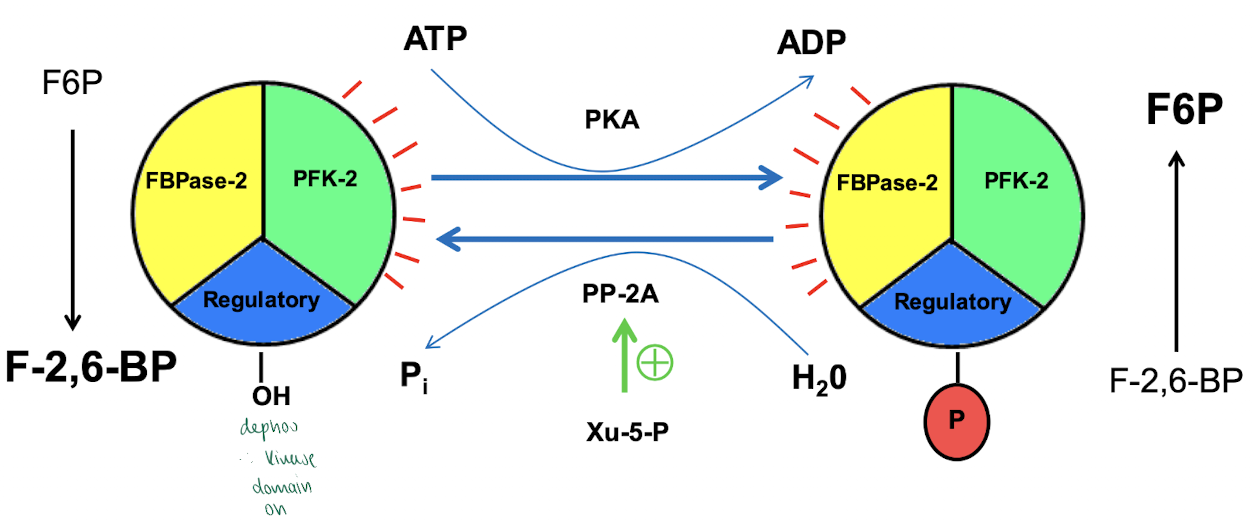
process:
Xu5P activates kinase domain of PFK-2
increased [ F-2,6-BP ] → inhibits gluconeo (F-1,6-BPase) & ACTIVATES glycolysis (PFK-1)
activated glycolysis results in high [A-CoA] from PDC
[ A-CoA ] is used in FA synthesis
Coordinated Regulation of FAS & B-OX
FAS: high blood glucose
dietary carbs result in high blood glucose → increases insulin levels
high insulin activates phosphatase → dephosphorylates ACC, now ACTIVE
ACC converts A-CoA from (carbs or AA via glycolysis/PDC) → M-CoA
high [ M-CoA ]
inhibits CATI on OMM, thus turning off B-OX bc fatty acyl-CoA isn’t converted to fatty acyl-carnitine to cross OMM then IMM via carnitine carrie protein
FAS occurs converting M-CoA into FA
TAG synthesis
HOWEVER, high [ fatty acyl-CoA ] normally used for B-OX in the matrix will inhibit the ACC
→ thus, theres RECIPROCAL regulation of FA synthesis in cytosol & B-OX of FA in matrix
FAS: low blood glucose
low blood glucose increase glucagon
glucagon activates PKA → phosphorylates ACC, inactivating the ACC
FAS turned off
thus M-CoA cant inhibit CATI for B-OX
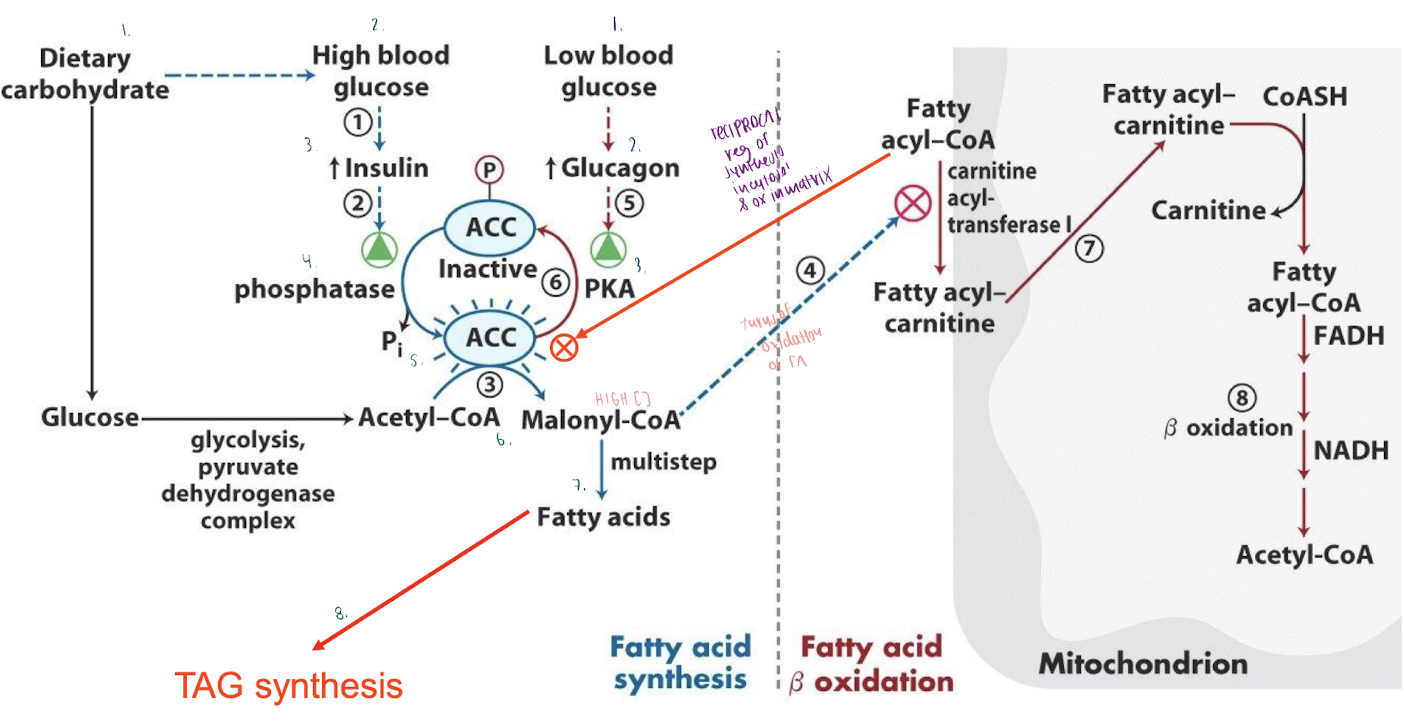
B-OX of FA:
high fatty acyl-CoA INHIBITS ACC of FAS - thus cant convert A-CoA → M-CoA
rate of fatty acid transport into matrix (regulation of CAT-1 & availability of carnitine) is an important regulator of B-OX
high [ M-CoA ] from FAS ACC carboxylase INHIBITS CATI - thus we can’t convert fatty acyl-CoA → fatty acyl-carnitine to enter matrix for B-OX
induction of enzymes & increased # of mitochondria affect the rate of B-OX
exercise & starvation INCREASE enzymes for B-OX (bc we need energy) → thus increasing capacity for B-OX of FA to A-CoA
redox state of the cell affects rate of B-OX, as all catabolic pathways are affected by ATP:ADP
low ADP = high NADH:NAD+ & high FADH2:FAD → thus decreasing rate of B-OX as theres less cosubsrates for its OHOT rxns
How are Unsaturated fatty acids produced?
→ unsaturated FA are produced by Desaturases
Desaturases = mixed-function oxidases that oxidize FA & NADH → adding DB to FA
mammals CANT introduce DB’s using desaturates after C9
process:
take saturated FA and used NADH + Oxygen to oxidize it → produce a DB using 2e- each from the FA & NADH to reduce oxygen to 2H2O

NOT on exam
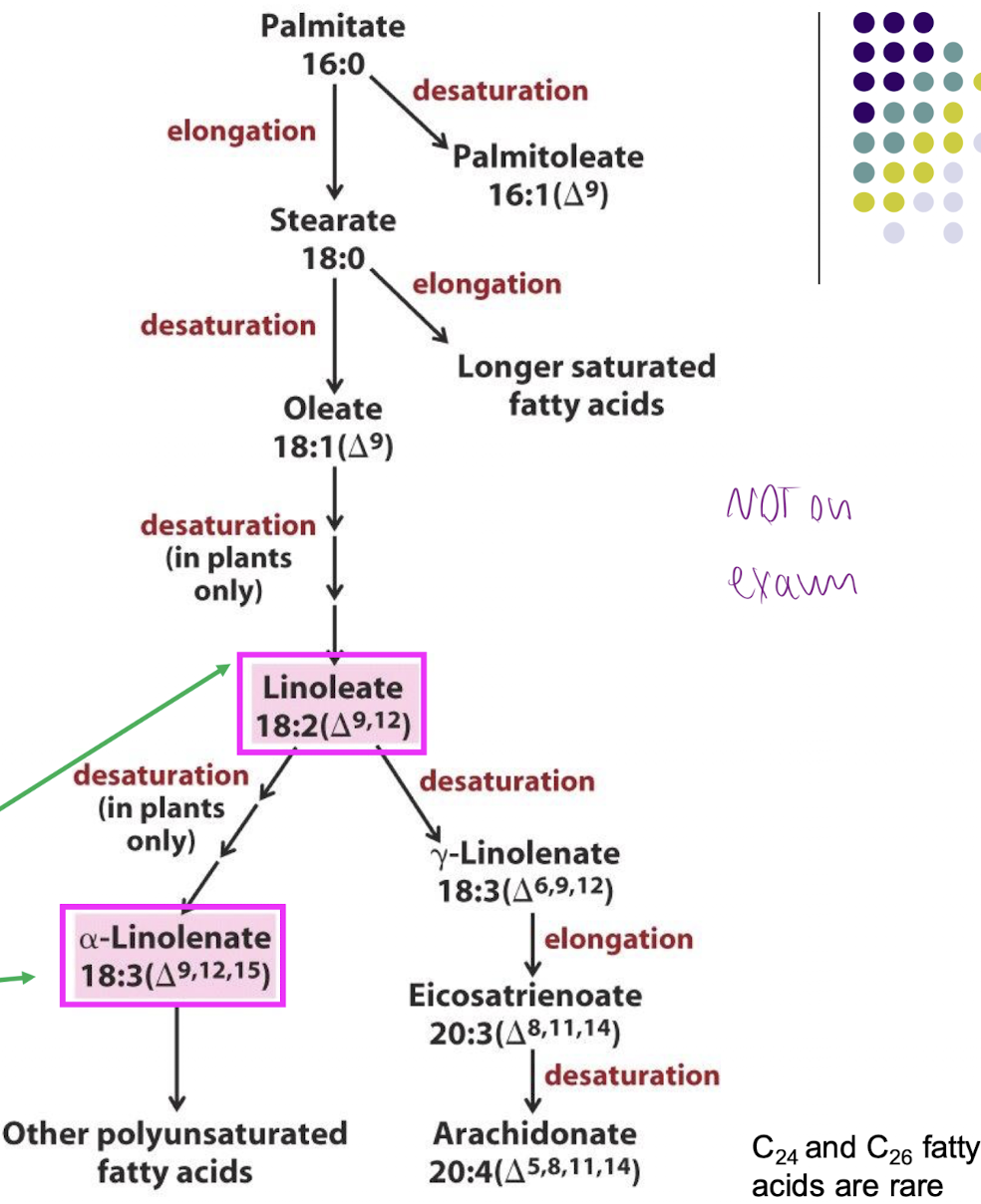
→ palmitate from FAS is the precursor of many other FA
ex. lineolate & α-linolenate
these are essential FA’s bc they have a DB after C9 which cannot be done in mammals using desaturases - thus we must eat them in our diet bc we CANT make them