Gen Psych Test 1 Review
 Call Kai
 Learn
Learn Practice Test
 Spaced Repetition
 Match
Match Flashcards
 Knowt Play
1/133

There's no tags or description
Looks like no tags are added yet.
Name | Mastery | Learn | Test | Matching | Spaced | Call with Kai | Chat |
|---|
No analytics yet
Send a link to your students to track their progress
134 Terms
Accuracy
The degree to which an experimental measure is free from error.
Belmont Report
A 1979 report that provides ethical guidelines in 3 ways: Respect for person, Beneficence, Justice.
Beneficence
Ethical guideline that instructs to minimize harm, do cost/benefit analysis, be reviewed by an IRB (institutional review board).
Between-Subjects design
Experimental design where each participant is in only one condition, so data is compared from different participants for control and experimental.
Case Study
A descriptive research method that involves the intense examination of an atypical person or organization.
Confound
Anything that affects a dependent variable and that may unintentionally vary between the experimental conditions of a study.
Control Group
The participants in an experiment who receive no intervention or who receive an intervention that is unrelated to the independent variable being investigated.
Correlation Coefficient
A descriptive statistic that indicates the strength and direction of the relationship between two variables; Represented by an r value of -1 to 1.
Dependent variable
The variable that is measured in a research study.
Descriptive research
Research methods that involve observing behavior to describe that behavior objectively and systematically.
Descriptive statistics
Statistics that summarize the data collected in the study.
Directionality problem
A problem encountered in correlational studies; the researchers find a relationship between two variables, but they cannot determine which variable may have caused changes in the other variable.
Experiment
A research method that tests causal hypotheses by manipulating measurable variables.
Experimental group
The participants in an experiment who receive the treatment.
External validity
The degree to which the findings of a study can be generalized to other people, settings, or situations.
False positive
A result that occurs when there is no real effect but a study produces a statistically significant result by chance.
HARKing
“Hypothesizing After the Results are Known” instead of generating a theory before running the study and analyzing the results.
Hypothesis
A specific, testable prediction, narrower than the theory it is based on.
Independent Variable
The variable that is manipulated in a research study.
Inferential statistics
A set of procedures that enable researchers to decide whether differences between two or more groups are probably just chance variations or whether they reflect true differences in the populations being compared.
IRB
Institutional Review Board; Groups of people responsible for reviewing proposed research to ensure that it meets the accepted standards of science and provides for the physical and emotional well-being of research participants.
Internal validity
The degree to which the effects observed in an experiment are due to the independent variable and not to confounds.
Justice
The ethical guideline that instructs benefits and risks of a study to be distributed fairly, with no exploitation.
Mean/median/mode
Measures of center: average, middle, and most common value respectively.
Meta-analysis
A “study of studies” that combines the findings of multiple studies to arrive at a conclusion.
Naturalistic observation
A type of descriptive study in which the researcher is a passive observer, separated from the situation and making no attempt to change or alter ongoing behavior.
Participant observation
A type of descriptive study in which the researcher is involved in the situation.
p-hacking
Testing the same hypothesis using statistical tests in different variations until one produces a statistically significant result.
Population
Everyone in the group the experimenter is interested in.
Preregistration
Documenting a study’s hypotheses, methods, and analysis plan ahead of time and publishing it on a time-stamped website.
Random assignment
Placing research participants into the conditions of an experiment in such a way that each participant has an equal chance of being assigned to any level of the independent variable.
Random selection (random sampling)
Selecting research participants for an experiment in such a way that gives each member of the population an equal chance of being chosen to participate in the study.
Reactivity
A phenomenon where participants change their behavior or responses because they know they are being studied or observed, rather than reacting to the experimental treatment itself.
Reliability
The degree to which a measure is stable and consistent over time.
Respect for Person
The ethical principle that provides informed consent, autonomy to participants, and right to stop.
Replication
Repetition of a research study to confirm or contradict the results.
Sample
A subset of a population.
Self-report
Methods of data collection in which people are asked to provide information about themselves, such as in surveys or questionnaires.
Standard deviation
A statistical measure of how far away each value is, on average, from the mean.
Theory
A model of interconnected ideas or concepts that explains what is observed and makes predictions about future events. Theories are based on empirical evidence.
Third variable problem
A problem that occurs when the researcher cannot directly manipulate variables; as a result, the researcher cannot be confident that another, unmeasured variable is not the actual cause of differences in the variables of interest.
Within-subjects design
Experimental design where each participant is in all conditions, so each participant has a measured control and experimental data.
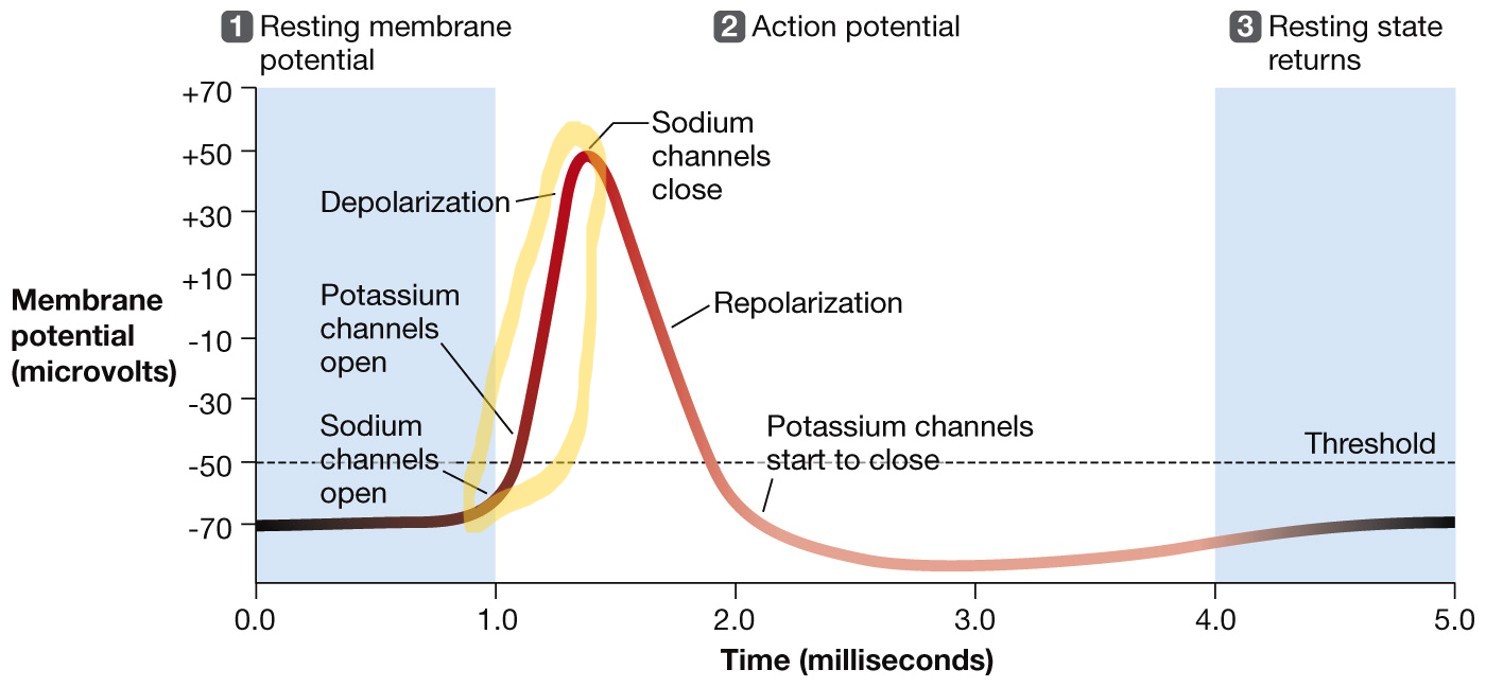
Absolute refractory period
The brief period of time following an action potential when the ion channel is unable to respond again.

Action Potential
The electrical signal that passes along the axon and subsequently causes the release of chemicals from the terminal buttons.

Agonist
A drug that facilitates neurotransmitter activity by blocking reuptake, increasing amount released, or increasing receptor sensitivity.

All-or-none principle
The principle that when a neuron fires, it fires with the same potency each time; a neuron either fires or not, although the frequency of firing can vary.
Amygdala
A brain structure that serves a vital role in learning to associate things with emotional responses and in processing emotional information.

Antagonist
A drug that inhibits neurotransmitter activity, either through blocking receptors, decreasing the amount of neurotransmitters released, or increasing enzyme activity and destruction.

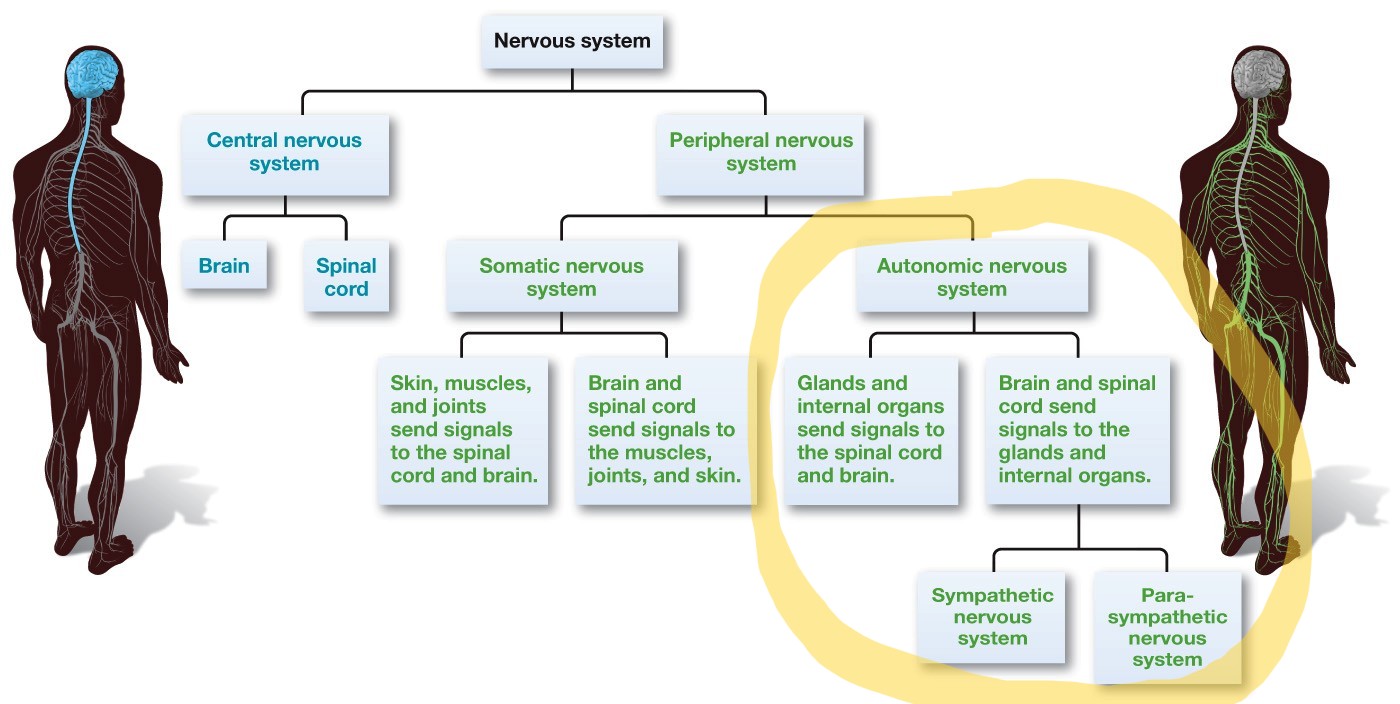
Autonomic nervous system (ANS)
A component of the peripheral nervous system; it transmits sensory signals and motor signals between the central nervous system and the body’s glands and internal organs.
Axon
A long, narrow outgrowth of a neuron by which information is conducted from the cell body to the terminal buttons.

Axon Hillock
The region in the neuron between the cell body and axon; where action potentials begin and where the threshold value must be reached.

Basal Ganglia
A system of subcortical structures that are important for the planning and production of movement.

Brain Stem
An extension of the spinal cord, it houses structures that control functions associated with survival, such as heartrate, breathing, swallowing, vomiting, urination, and orgasm.

Broca’s Area
A small portion of the left frontal region of the brain, crucial for the production of language.

Cell body/soma
The site in the neuron where information from thousands of other neurons is collected and integrated.

Central Nervous System
The brain and spinal cord.

Cerebellum
A large, convoluted protuberance at the back of the brain stem; it is essential for coordinated movement and balance.

Cerebral Cortex
The outer layer of brain tissue, which forms the convoluted surface of the brain; the site of all thoughts, perceptions, and complex behaviors.

Corpus callosum
A massive bridge of missions of axons that connects the hemispheres of the brain and allows information to flow between them; Made up entirely of white matter.

Dendrite
Branchlike extensions of the neuron that detect information from other neurons.

Depolarize
Some signals received in the dendrites cause ion channels to open in the cell body, causing the polarization of the cell to decrease, and the charge to become more positive. Rapid depolarization is triggered at the threshold (-55mV) until the cell body depolarizes to +40mV, when an action potential occurs.
Enzyme deactivation
Enzymes in the synapse bind to and deactivate, or deconstruct, some of the neurotransmitters after release.
Excitation
Neurotransmitter action that depolarizes the cell body, causing or making it easier for an action potential to occur.

Fight-or-flight
A sympathetic nervous system response that prepares the body for action; Dilates pupils, relaxes bronchi, accelerates/strengthens heartbeat, inhibits stomach/intestine activity, contracts blood vessels.
Frontal lobe
Regions of the cerebral cortex important for movement and higher-level psychological processes associated with the prefrontal cortex.

Hippocampus
A brain structure that is associated with the formation of memories.

Homeostasis
The process by which a living thing keeps its internal conditions stable and balanced, even when the outside environment changes; maintained by the hypothalamus.
Hyperpolarization
A reaction to neurotransmitters that increases polarization, making the neuron less likely to fire by increasing the distance between the current value and threshold value.
Hypothalamus
A brain structure that is involved in the regulation of bodily functions (maintaining homeostasis), including body temperature, body rhythms, blood pressure, and blood glucose levels; it also influences our basic motivated behaviors.

Inhibition
Neurotransmitter action that hyperpolarizes the cell body, making it harder for an action potential to occur.

Myelin sheath
A fatty material, made up of glial cells, that insulates some axons to allow for faster movement of electrical impulses along the axon.

Neuron
The basic unit of the nervous system; cells that receive, integrate, and transmit information. They operate through electrical impulses, communicate with other neurons through chemical signals, and form neural networks.

Neurotransmitter
A chemical substance that transmits signals from one neuron to another.
Nodes of Ranvier
Small gaps of exposed axon between the segments of myelin sheath, where action potentials take place.

Occipital Lobe
Regions of the cerebral cortex important for vision.

Parasympathetic Nervous System
A division of the autonomic nervous system that returns the body to its resting state.

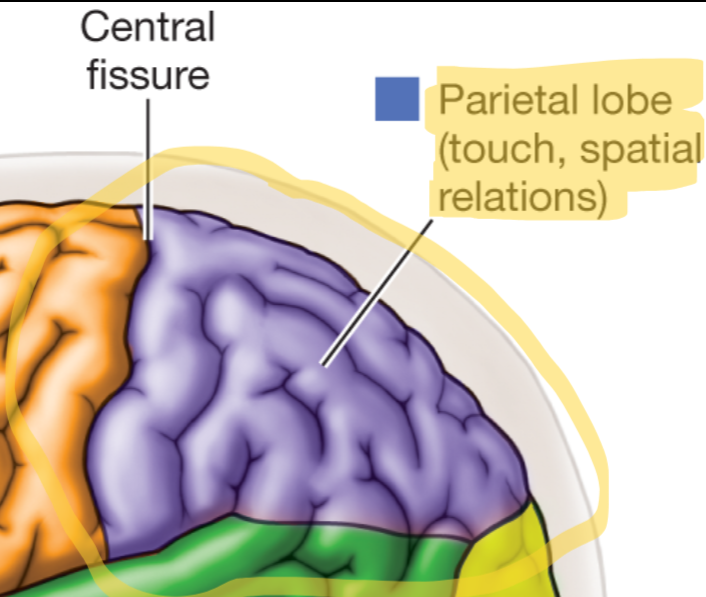
Parietal lobe
Region of the cerebral cortex important for the sense of touch and for attention to the environment.
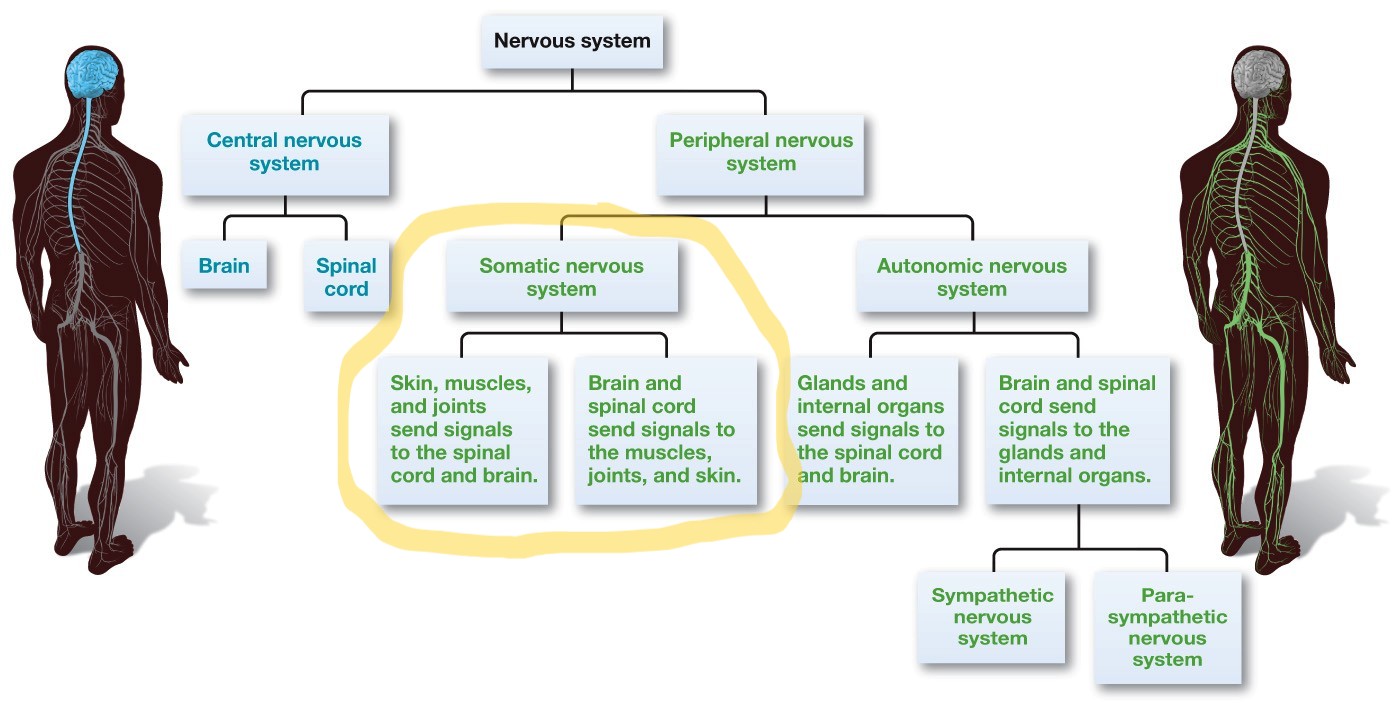
Peripheral nervous system (PNS)
All nerve cells in the body that are not part of the central nervous system. The peripheral nervous system includes the somatic and autonomic nervous systems.

Primary motor cortex
The rearmost part of the frontal lobe, bordering the central fissure. Responsible for motor control, and has physical regions that control different regions of the body, called the “primary motor homunculus”.

Primary somatosensory cortex
The frontmost part of the parietal lobe, bordering the central fissure. Responsible for most sensations, and has physical regions that correspond to different regions of the body, called the “primary somatosensory homunculus”.

Receptor
In neurons, specialized protein molecules on the postsynaptic membrane; neurotransmitters bind to these molecules after passing across the synapse.

Relative Refractory Period
The brief period of time following action potential when a neuron’s membrane potential is more negative, making it harder to fire again.

Resting potential
The normal electrical charge of a neuron when it is not active; -70mV.

Reuptake
The process whereby a neurotransmitter is taken back into the presynaptic terminal buttons, thereby stopping its activity.

Somatic nervous system
A component of the peripheral nervous system; it transmits sensory signals and motor signals between the central nervous system and the skin, muscles, and joints.
Sympathetic nervous system
A division of the autonomic nervous system; it prepares the body for action.

Synapse
The gap between the terminal buttons of a “sending” neuron and the dendrites of a “receiving” neuron, where chemical communication occurs between the neurons.

Temporal lobe
Region of the cerebral cortex important for processing auditory information, for memory, and for object and face perception.

Terminal button
At the ends of axons, small nodules that release chemical signals from the neuron into the synapse.

Thalamus
The gateway to the brain; it receives almost all incoming sensory information before that information reaches the cortex.

Threshold
The minimum amount of depolarization that must occur for an action potential to be released; -55mV.

Wernicke’s area
The region of the brain responsible for language perception, located in the upper left temporal lobe.

Absolute threshold
The minimum intensity of stimulation necessary to detect a sensation half the time.

Difference threshold
The minimum amount of change required to detect a difference between two stimuli.
Accommodation
The stretching and changing of shape the lens does to focus on different depths.
Adaptation
The action potentials reach the section of the brain where they are processed, and allow adaptation to your environment; adjusting your perception of sensations to make them more tolerable.
Bottom-up processing
Perception based on the physical features of the stimulus.
Top-down processing
The interpretation of sensory information based on knowledge, expectations, and past experiences.
Closure
The gestalt principle of perceptual organization that states we have a tendency to fill in spaces where there are gaps, turning negative space into an image.
Color afterimages
Adaptation to a sensation reduces sensitivity to constant stimuli. For a brief moment, after staring at a color for a long time, your cones become less sensitive to that color and perceive the complimentary.