Research Methods FInal Exam
 Call Kai
 Learn
 Practice Test
 Spaced Repetition
 Match
 Flashcards
 Knowt Play
1/65

There's no tags or description
Looks like no tags are added yet.
66 Terms
counterbalancing
participant takes placebo 1st
experimental design
have a control group & randomly assign participants to group
internally valid
Pretest-posttest design advantages vs. disadvantages
Advantages
randomization and control group protects internal validity
with small sample size randomization may not produce equal groups (pretest can check)
can be used to sleect participants (pretest)
Disadvantages
time & resources intensive
sensitize participants to what is being studied
pretest effects can reduce external validity
Design confounds
Accidentally introduced with our independent variable
varies systematically with the independent variable
ex) poptart ad may have great music!
Unsystematic variability is RANDOM
not an issue for internal validity
ex) some ppl who saw the ad heard the music, but others who did not see the ad heard the same music too
Independent Groups Design
Participants participate in only one group/condition/lvl of IV
randomly assign to group/level of IV
Between-subjects design
Repeated measures design
All participants are in all conditions
participate in all lvls of IV
within-subjects design
Repeated measures design advantages vs. disadvantages
Advantages -
fewer participants
extremely sensitive to statistical differences btwn groups
No concern abt differences in participant variables (as with random assignment to groups)
Disadvantages -
Order effects - dependent variable affected by consistently having one condition
(i.e., lvl of the independent variable)
Order effects
practice effect:
participants are better at 2nd condition due to practice
Also known as a learning effect
fatigue effect:
participants do worse on later conditions simply due to fatigue
Carryover effect
Effect of 1st treatment influences response to 2nd
e.g., “hard’ then “easy” task, anxiety-inducing then control
e.g., “priming” in Stroop Task…
Repeated measures design:
Counterbalancing
Split participants into diff. groups
Each group is assigned to a diff order
Takes care of order effects
easy with IV of 2 lvls
possible with 3 (3!=3×2×1=6)
hard for with 4 lvls (4!=4×3×2×1=24)
Latin Square
Too many orders to use to complete counterbalancing
one method of partial counterbalancing
More Design Considerations:
Time interval between treatments
more time helps reduce order effects
More Design Considerations:
Independent group vs. repeated measures
advantages & disadvantages to each
generalizability?
nature of study
Matched-groups design:
Match participants on a characteristic
Natural pairings: twins, siblings, spouses
Either the DV or a variable that is strongly related to the DV
Match ppl and, then randomly put one member of the pair in one condition & the other in another condition
Independent vs. Within-groups (Repeated measures)
· Independent –
Participants participate in only one group/condition/lvl of the IV
· Repeated Measures (or within-groups) –
All participants are in all conditions/lvls of the IV
Advantages and disadvantages to a pre-test
Advantages –
- Randomization and control group protects internal validity
- With small sample size randomization may not produce = groups (pretest can check)
- Can be used to select participants (pretest)
Disadvantages
- Time & resource intensive
- Sensitize participants to what is being studied
- Pretest effects can reduce external validity (making results less generalizable)
Solomon 4-group design
Presented that the first outcome showed no effect of the pretest, while the second outcome showed the pretest had an effect
Demand Characteristics
Cues that inform the subject how expected to behave
(Subjects may want to help you confirm or prove your hypothesis wrong, so you could use deception, use filler questions on a questionnaire, or ask subjects their expectations)
Placebo Groups
Controls what kind of effect? Just taking the drug may make someone “feel better”
Experimenter Bias/Expectancy Effects:
Knowledge of experimental condition can influence that participant based on how the experimenter behaves (even if very subtle)
Single and Double Blind Experiments
- Single-blind Experiment –
Participant unaware of placebo or drug group (control or experimental)
- Double-Blind Experiment –
Experimenter also unaware
Counterbalancing
Splitting participants into different groups. Each group is assigned to a different order.
Latin Square
Too many orders to use to complete counterbalancing, this is one method of partial counterbalancing
Pilot Studies
Trial run with small number of participants
Manipulation Checks
Make sure levels of the IV are valid (i.e., which celebrities are relevant to adolescents now?)
Threats to Internal Validity
- History:
Outside events influence subjects during the course of an experiment &/or between testing
- Maturation:
Changes in participants due to the passage of time
- Testing:
Effects of taking a 2nd test after a 1st
- Statistical Regression:
Regression to the mean
- Selection:
Differential selection of participants for groups
- Attrition:
Differential loss of respondents in different treatment groups
Straightforward vs. Staged Manipulations of the IV
Straightforward –
Stimuli &/or instructions vary such that they define lvls of IV
- Easy to do
- Most common
Can involve differences in…
- Written info – diff word lists, written “opinions”
- Physical stimuli – manipulate loudness, brightness, time stimulus is visible, etc.
- Audio & visual components
Staged –
Manipulating the situation
Useful for…
- Inducing some specific psychological state
- Replicating environmental/social influences
- Common in: social psych, consumer psych, emotion research
Sensitivity (in context of manipulating the DV)
Degree to which a measure can detect changes
(Is a measure of a DV sensitive enough to show a change when the IV is changed?)
Ex: yes/no is less sensitive than a 5-point scale

Pre-experimental designs:
One shot case study
Give all participants manipulation → X O
- No control
- Subject to all threats, not internally valid

Pre-experimental designs:
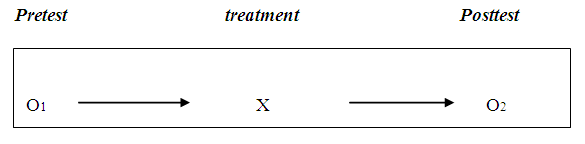
One group pretest-posttest
For all participants, collect response data, give manipulation, collect response data again
- Pretest comparison
- No control group for comparison
- Internal validity issues: history, maturation, testing
Pre-experimental designs:
Static group comparison
2 group design
- Control group comparison!
- No pretest comparison
- Internal validity issue: selection

Factorial Designs: Notation
2x2 (simplest)
# of lvls of 1st IV x # of lvls of 2nd x # of lvls of 3rd (etc.)
Interpreting Main Effects and Interactions
Main Effects:
Did just the one IV influence the DV on its own?
Interactions:
Effect of one IV depends on the lvl of the other IV
Simple Main Effects
When interaction is significant…
- Examine mean difference at each lvl of the IV
Independent Groups (Between Subjects Design)
A factor with an IV has different ppl in each lvl
Repeated Measures (Within Subjects Design)
A factor with repeated measures has the same ppl at each lvl
Mixed Design
Factorial design with independent groups and repeated measures
Single Case (Subject) Designs & types
Behavior measured from baseline period to treatment periods
ABA
Multiple Baseline design
Reversal Design (ABA)
Baseline (A) → Treatment (B) → Baseline (A)
Multiple Baseline Design
Change is observed under multiple circumstances
- The manipulation applied to different behaviors
- Measure behavior in different settings
Quasi-Experimental Design & Types
Cannot randomly assign participants to groups, so selection is the biggest concern. There are 2 groups, all get a pretest, only 1 group is treated, and then both get the posttest.
Interrupted Time Series Design
Control Series Design
Interrupted Time Series Design
Examines the dependent variable over an extended period of time, both before & after the independent variable is implemented
- Possible regression to the mean
Control Series Design
Improves uninterrupted time series by adding an appropriate “control group”
- A similar population that did not receive a particular manipulation
Case Studies:
A detailed description of an individual, a small group of people with a common experience, disorder/situation, a unique event
- Very useful in rare or unusual cases (Ted Bundy, 9/11, Heaven’s Gate)
- Strengths include: providing detailed qualitative info, providing insight for further research
- Weaknesses: Can’t generalize results to entire population, researchers subjective feelings may influence the case study, difficult to replicate, time consuming
Archival Research:
Using previously compiled information
Statistical research: public health stats, crime reports, temperature
Survey archives: archived data of previously administered surveys
Written and mass communication records: Newspapers, magazines, internet, historical documents
Types of Replications
Direct (exact), conceptual, and replication-plus-extension
Direct (Exact) Replications:
An attempt to replicate precisely the procedures of a study
- Ascertain whether the same results are obtained with replication
Conceptual Replications:
The use of different procedures (operational definitions) to replicate research finding
- The IV from previous study is manipulated in different ways
Replication-Plus-Extension:
Replication of original study with new variables added to test additional questions
Generalization Considerations
College students:
70% of research; today college students more diverse
Volunteers:
Required? Higher SES, more sociable, etc.
Gender Considerations:
Studying only one gender; Many more of one gender in a study
Locale:
Where ppl live affects them
Literature Review:
Summarizes results across studies
- What findings are strongly supported & weakly supported
-Points out inconsistent findings & areas lacking research
-Future directions for research
Meta-Analysis:
Determining the reliability of a finding
-Statistically examining the results from many different studies
-Researcher combines actual results
-Use of effect size
Three Branches of Statistics
Design, Description, Inference
Three Branches of Statistics - Design
Design: Plan for collecting data
- Who will you sample?
- How will you recruit participants?
- What observations are you looking for?
- How will you obtain these observations?
Three Branches of Statistics - Description
Description: summary of sample data
- Numerical: mean, range, etc.
- Usual: graph, table, figure
Three Branches of Statistics - Inference
Inference: Use sample data to make predictions
- Samples stats allow prediction of population parameters
Descriptive Statistics -
Central Tendency:
Location of the data (center)
mean, median, mode
Mean
Found by adding all the score & dividing by the # of scores
- Central tendency with interval or ratio scales
Median
Middlemost score that divides group in half
- Central tendency with ordinal, interval, and ratio scales
Mode
Most frequently occurring score
Descriptive Statistics -
Variability:
The amount of “spread” in the distribution of scores around the center
range, standard deviation, variance
Range
Difference between highest & lowest score
Standard Deviation
(s) (SD) in reports
Variance
Standard deviation squared
Inferential Statistics are necessary because…
Necessary because results of a study are based on data obtained from a style sample of participants & not an entire population