DNA Lectures and Socrative (GOCHIN)
 Call Kai
 Learn
Learn Practice Test
 Spaced Repetition
 Match
Match Flashcards
 Knowt Play
1/225

There's no tags or description
Looks like no tags are added yet.
Name | Mastery | Learn | Test | Matching | Spaced | Call with Kai | Chat |
|---|
No analytics yet
Send a link to your students to track their progress
226 Terms
What is the structure of DNA?
a) single strand of deoxynucleotides connected by hydrogen bonds, running parallel
b) two strands of deoxynucleotides connected by hydrogen bonds, running anti-parallel
c) two strands of deoxynucleotides connected by phosphodiester bonds, running anti-parallel
d) two strands of deoxynucleotides connected by phosphodiester bonds, running parallel
c)
Which is the coding strand of DNA?
a) 5’ —> 3’ strand
b) 3’ —> 5’ strand
a)
Which strand is the template strand of DNA?
a) 5’ —> 3’ strand
b) 3’ —> 5’ strand
b)
Which strand of DNA is the strand from which the protein sequence is read?
a) coding strand
b) template strand
c) 5’ —> 3’ strand
d) A & C
e) B & C
d)
Which strand of DNA is the new daughter strand assembled from?
a) coding strand
b) template strand
c) 5’ —> 3’ strand
d) 3’ —> 5’ strand
e) B & C
f) B & D
f)
What direction are sequences written in DNA?
a) 5’ —> 3’
b) 3’ —> 5’
a)
True or false
DNA is a negatively charged molecule due to exposed phosphate groups, while hydrophobic bases are arranged in stacks on the inside of the double helix.
a) true
b) false
a)
What is true about the Watson-Crick model?
a) bonded base pairs G-C, A-T
b) A-T have 3 hydrogen bonds
c) G-C have 3 hydrogen bonds
d) A & B
e) A & C
e)
Which hydrogen bonded base pair is more stable and why?
a) G-C base pairs, because it has 3 hydrogen bonds
b) A-T base pairs, because it has 3 hydrogen bonds
a)
True or False
DNA is physically and chemically very stable and absorbs UV light with a maximum at 260 nm.
a) True
b) False
a)
Which of the following is true about the denaturation of DNA?
a) DNA will denature into single strands
b) DNA denaturation depends on melting temperature
c) DNA melting temperature depends on the length of DNA and the # of G-C bases
d) DNA will reanneal when cooled
e) hyperchromic shift (increase in OD260) occurs with denaturation
f) all of the above
f)
True or false
DNA hybridization is the basis for the “genes on a chip” technology, which is used to examine mutations in genomic DNA or changes in expression patterns (cDNA).
a) True
b) False
a)
True or False
DNA with correctly matched base pairs has a lower melting temperature, which can be used in assays designed to recognize specific base mutations.
a) true
b) false
b)
True or False
DNA with mismatched base pairs has a lower melting temperature, which can be used in assays designed to recognize specific base mutations.
a) True
b) False
a)
True or False
Biotechnology Recombinant DNA technology was originally developed as a research tool, but it now being used to identify defective genes associated with disease and to potentially correct genetic defects.
a) True
b) False
a)
What are the strategies for production and amplification of recombinant DNA?
a) recombinant DNA produced by cloning
b) PCR
c) DNA sequencing
c) A & B
d) All of the above
c)
What is recombinant DNA?
a) produced by cloning is engineered by combining two or more separate DNA strands cleaved using restriction enzymes to create sticky ends that can then be annealed together.
b) in vitro temperature cycling method using primers known to be complementary to the ends of the DNA segment that is to be replicated. Thermal cycling of a mixture of primers, DNA substrate, dNTP’s and DNA polymerase is used to produce billions of copies of the DNA fragment
a)
What is PCR?
a) produced by cloning is engineered by combining two or more separate DNA strands cleaved using restriction enzymes to create sticky ends that can then be annealed together.
b) in vitro temperature cycling method using primers known to be complementary to the ends of the DNA segment that is to be replicated. Thermal cycling of a mixture of primers, DNA substrate, dNTP’s and DNA polymerase is used to produce billions of copies of the DNA fragment
b)
What is DNA sequencing?
a) Genomic DNA separated on an electrophoretic gel can be identified using a radiolabeled or fluorescently labeled DNA probe that hybridizes with a specific sequence.
b) cDNA(complementary to expressed mRNA) is hybridized to oligonucleotides on a chip that have been selected to represent a particular disease state. Differences between hybridization patterns for patient vs. control DNA provide information on changes in gene expression..
c) commonly performed by the Sanger method. Dideoxynucleotides (ddNTPs) lacking a 3’-hydroxyl group are included in small amounts along with larger quantities of dNTPs. When incorporated, they terminate strand synthesis. With a suitable ratio of ddNTPs to dNTPs, strands of every possible length will be generated. They are separated on a DNA gel or by capillary electrophoresis and the sequence read out from the output.
c)
What is restriction digest?
a) Using bacterial restriction endonucleases can be used to identify variations in base sequence in a gene or in selected regions of a genome (a DNA “fingerprint”).
b) Genomic DNA separated on an electrophoretic gel can be identified using a radiolabeled or fluorescently labeled DNA probe that hybridizes with a specific sequence.
c) cDNA(complementary to expressed mRNA) is hybridized to oligonucleotides on a chip that have been selected to represent a particular disease state. Differences between hybridization patterns for patient vs. control DNA provide information on changes in gene expression..
a)
True or False
DNA probes (Allele Specific Oligonucleotides or ASO’s) are an important component in Southern blots, Northern blots, and PCR.
a) True
b) False
a)
Which best describes PCR?
a) (mRNA) can be measured using a Northern blot or quantitative RT-qPCR and a cDNA microarray.
b) disease specific mutations occur at a restriction site and therefore eliminate cleavage at that site. Mutations can also create new restriction sites. The change in size of the fragmented DNA reveals the mutation. Mutations not within a restriction site are detected using normal and mutant ASO’s for hybridization to the DNA. This technique is useful when the disease specific mutations are known.
c) using primers containing a known disease-causing mutation will amplify the DNA only if the mutation is present. Can be used to identify mutations, deletions or insertions or variable numbers of tandem repeats (VNTRs) using primers that bracket the region of interest
d) can be measured with a Western blot, which performs gel separation analysis on proteins and is used along with ELISA to test for the presence of antibodies or antigens in a patient’s serum.
c)
Which of the following best describes RFLP mapping?
a) (mRNA) can be measured using a Northern blot or quantitative RT-qPCR and a cDNA microarray.
b) disease specific mutations occur at a restriction site and therefore eliminate cleavage at that site. Mutations can also create new restriction sites. The change in size of the fragmented DNA reveals the mutation. Mutations not within a restriction site are detected using normal and mutant ASO’s for hybridization to the DNA. This technique is useful when the disease specific mutations are known.
c) using primers containing a known disease-causing mutation will amplify the DNA only if the mutation is present. Can be used to identify mutations, deletions or insertions or variable numbers of tandem repeats (VNTRs) using primers that bracket the region of interest
d) can be measured with a Western blot, which performs gel separation analysis on proteins and is used along with ELISA to test for the presence of antibodies or antigens in a patient’s serum.
b)
Which of the following best describes how gene expression levels (mRNA) can be measured?
a) (mRNA) can be measured using a Northern blot or quantitative RT-qPCR and a cDNA microarray.
b) disease specific mutations occur at a restriction site and therefore eliminate cleavage at that site. Mutations can also create new restriction sites. The change in size of the fragmented DNA reveals the mutation. Mutations not within a restriction site are detected using normal and mutant ASO’s for hybridization to the DNA. This technique is useful when the disease specific mutations are known.
c) using primers containing a known disease-causing mutation will amplify the DNA only if the mutation is present. Can be used to identify mutations, deletions or insertions or variable numbers of tandem repeats (VNTRs) using primers that bracket the region of interest
d) can be measured with a Western blot, which performs gel separation analysis on proteins and is used along with ELISA to test for the presence of antibodies or antigens in a patient’s serum.
a)
Which of the following best describes how protein expression levels can be measured?
a) (mRNA) can be measured using a Northern blot or quantitative RT-qPCR and a cDNA microarray.
b) disease specific mutations occur at a restriction site and therefore eliminate cleavage at that site. Mutations can also create new restriction sites. The change in size of the fragmented DNA reveals the mutation. Mutations not within a restriction site are detected using normal and mutant ASO’s for hybridization to the DNA. This technique is useful when the disease specific mutations are known.
c) using primers containing a known disease-causing mutation will amplify the DNA only if the mutation is present. Can be used to identify mutations, deletions or insertions or variable numbers of tandem repeats (VNTRs) using primers that bracket the region of interest
d) can be measured with a Western blot, which performs gel separation analysis on proteins and is used along with ELISA to test for the presence of antibodies or antigens in a patient’s serum.
d)
How is the the technology: cleavage of DNA using restriction endonucleases used in diagnosis or treatment?
a) Forensics, mutation analysis, human protein production
b) Location of allele specific mutations, gene locus, translocations
c) Detection of unusual mutations
d) Mutation analysis, library of clones
e) Detection of cancer and disease
d)
How is the the technology: rapid sequencing of DNA for gene/protein ID used in diagnosis or treatment?
a) Forensics, mutation analysis, human protein production
b) Location of allele specific mutations, gene locus, translocations
c) Detection of unusual mutations
d) Mutation analysis, library of clones
e) Detection of cancer and disease
c)
How is the the technology: cloning of DNA to produce billions of identical copies used in diagnosis or treatment?
a) Forensics, mutation analysis, human protein production
b) Location of allele specific mutations, gene locus, translocations
c) Detection of unusual mutations
d) Mutation analysis, library of clones
e) Detection of cancer and disease
a)
How is the the technology: hybridization of DNA with a probe oligonucleotide to locate specific sequences used in diagnosis or treatment?
a) Forensics, mutation analysis, human protein production
b) Location of allele specific mutations, gene locus, translocations
c) Detection of unusual mutations
d) Mutation analysis, library of clones
e) Detection of cancer and disease
b)
How is the the technology: monitoring expression level of the gene used in diagnosis or treatment?
a) Forensics, mutation analysis, human protein production
b) Location of allele specific mutations, gene locus, translocations
c) Detection of unusual mutations
d) Mutation analysis, library of clones
e) Detection of cancer and disease
e)
What laid the groundwork for DNA technology?
a) discovery of the ingredients for synthesizing DNA ins a test-tube
b) discovery of DNA polymerase stable at high temperatures
c) PCR
d) A & B
e) B & C
d)
What are the ingredients for synthesizing DNA?
a) DNA template
b) dNTPs: dATP, dTTP, dGTP, dCTP
c) Primer with a free 3’-OH
d) DNA polymerase I
e) Mg 2+
f) all of the above
f)
What is true in regards to DNA?
a) The structure of DNA provides a mechanism for heredity
b) DNA is a template for its own duplication
c) DNA encodes information (for producing proteins)
d) all of the above
d)
What is true in regards to the physical and chemical properties of DNA? (ex: B-DNA, A-DNA, Z-DNA)
a) multiple structural forms for regulation of gene expression
b) B-DNA (physiological)
c) A-DNA (low water content)
d) Z-DNA (left-handed helices-high salt or methylation)
e) all of the above
e)
Which of the following is/are true about the physicochemical properties of DNA?
a) Chemically inert at high temperatures (100°C) and long times.
b) RNA is much more sensitive to degradation by RNAses found commonly on the skin.
c) Duplex DNA denatures by strand separation, at a melting temperature which depends on the relative amounts of AT vs. GC base pairs.
d) DNA can anneal upon cooling, through hybridization (*critical for PCR)
e) all of the above
f) A, C, D
e)
Indicate the complementary DNA sequence to the sequence: 5’-dAGCTCT3’
a) 3’AGCTCT5’
b) AGAGCT
c) TCGAGA
d) 3’-AGAGCT-5’
e) AGAGCU
b)
If 20% of the bases in a DNA duplex are A, what percentage are G?
a) 20%
b) 30%
c) 40%
d) 60%
e) 80%
b)
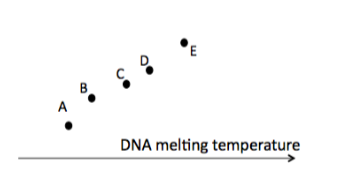
Indicate the duplex DNA fragment with the highest GC content from the graph.
a) A
b) B
c) C
d) D
e) E
e)
As the helix structure of DNA is disrupted by heating, the UV absorption of the DNA …
a) Does not change
b) Significantly decreases
c) Depends on the ionic composition of the solution
d) Moves to a higher wavelength
e) Significantly increases
e)
A single nucleotide polymorphism in a gene might be found using an oligonucleotide probe with the wild-type sequence by observing
a) An increase in the melting temperature of the DNA-probe complex
b) An increase in the OD260 of the DNA-probe complex
c) A decrease in the frequency of absorption of the DNA-probe complex
d) A decrease in the melting temperature of the DNA-probe complex
e) A decrease in the OD260 of the DNA-probe complex
d)
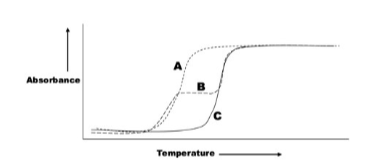
DNA denaturation was used to ascertain if a patient had a mutation in one or both alleles of a gene. A probe DNA containing the wild-type sequence was hybridized to the patient's DNA, followed by a temperature melt. Which of the curves shown in the figure shows that the patient has a mutation on both of the two alleles?
a) A
b) B
c) C
a)
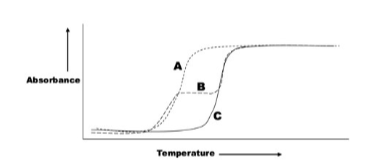
EXPLANATION: DNA denaturation was used to ascertain if a patient had a mutation in one or both alleles of a gene. A probe DNA containing the wild-type sequence was hybridized to the patient's DNA, followed by a temperature melt. Which of the curves shown in the figure shows that the patient has a mutation on both of the two alleles?
a) A
The answer must be A, because we are looking for mutation on both of the two alleles.
Choice C is incorrect because when comparing to normal melting curve diagram we see that no mutations on any of the alleles.
Choice B is incorrect because when comparing to normal melting curve diagram we see that there must only be one mutation on one of the alleles not two.
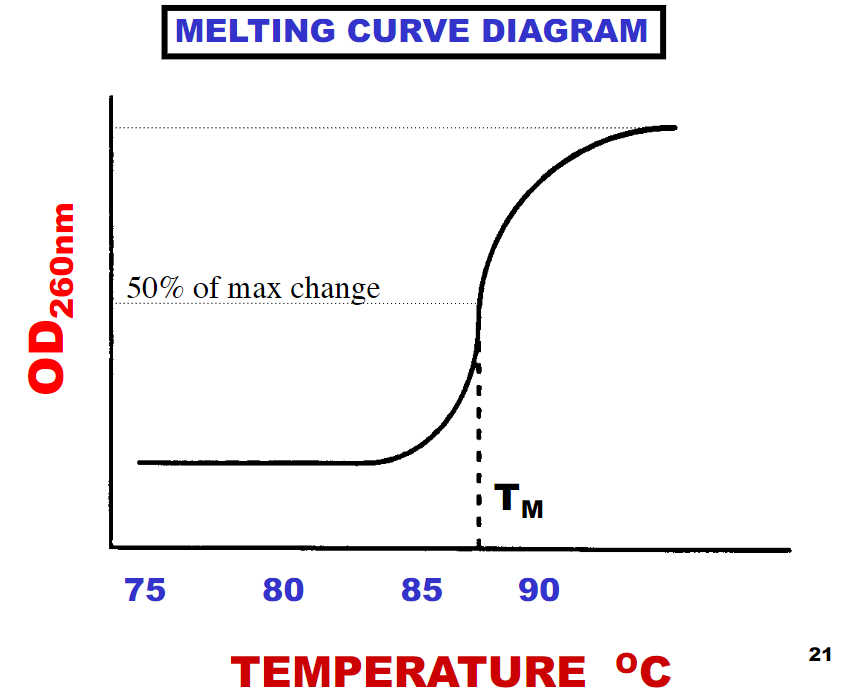
*NOTE: Melting temperature is dependent of length of DNA and # of G-C bases and hyperchromic shift(increase in OD260) occurs with denaturation
*NOTE 2: DNA with mismatched base pairs has a lower melting temperature, which can be used in assays designed to recognize specific base mutations.
An important difference between the sugars that make up RNA and DNA is
a) Hydroxylation at the 2’ position
b) Hydroxylation at the 3’ position
c) Glycosidic bond at the 1’ position
d) Uracil vs. Thymine
e) Linkage of the phosphodiester backbone
a)
What is the difference between ribonucleotides and deoxyribonucleotides?
a) Deoxyribonucleotide SUGARS only have ONE -OH on its 3’ Carbon
b) Ribonucleotide sugars have an -OH group on 2’ and 3’ carbon
c) DNA has two strand, arranged in double helix and is a much longer polymer than RNA
d) all of the above
d)
True or False
In DNA, the sugar-phosphate backbone is invariant
a) true
b) false
a)
Where is the phosphodiester bond in DNA located?
a) 5’ phosphate of one nucleotide binds to the hydroxyl (OH) group attached to the 3′ carbon of the deoxyribose sugar in an adjacent nucleotide
b) 5’ hydroxyl (OH) group of one nucleotide binds to the phosphate group attached to the 3′ carbon of the deoxyribose sugar in an adjacent nucleotide
a)
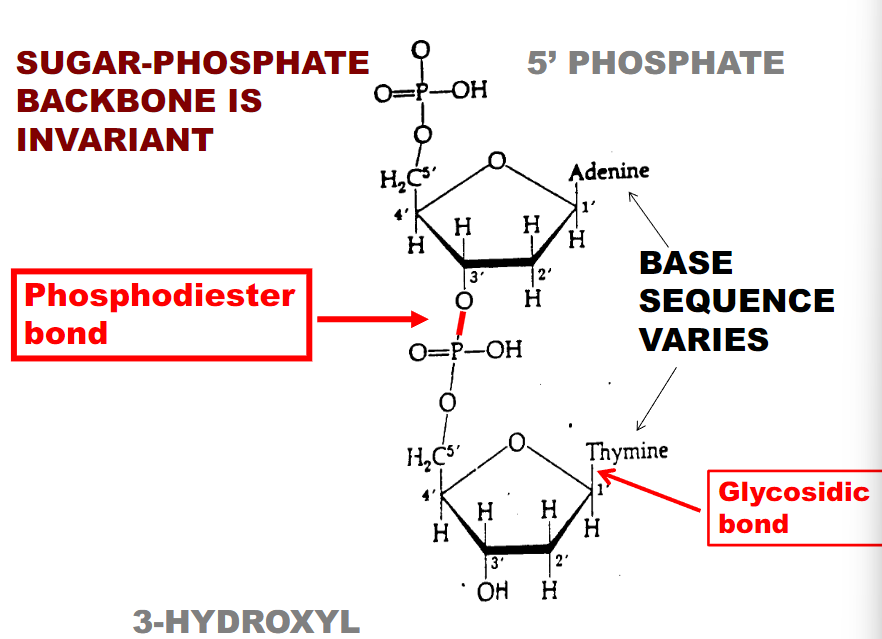
Where is the glycosidic bond in DNA located?
a) nitrogen atoms from the amino group in the nucleotides are covalently linked to the anomeric carbon (1’ carbon) of the ribose sugar structure through an N-glycosidic bond
b) 5’ phosphate of one nucleotide binds to the hydroxyl (OH) group attached to the 3′ carbon of the deoxyribose sugar in an adjacent nucleotide
a)
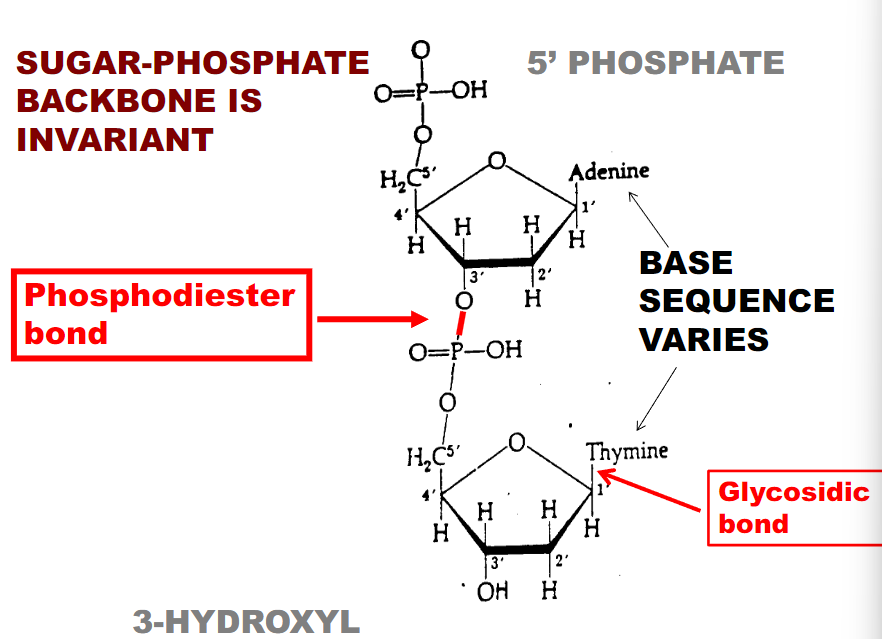
True or False
The Base sequence varies in DNA
a) true
b) false
a)
Chargaff’s Rules
a) [A] =[T] and [G] = [C]
b) [purines] = [pyrimidines]
c) [amino bases] = [keto bases]
d) all of the above
d)
Which of the nucleotide bases are considered amino bases?
a) adenine and thymine
b) adenine and guanine
c) adenine and cytosine
d) only adenine
c)
Which of the nucleotide bases are considered keto bases?
a) guanine and thymine
b) guanine and adenine
c) guanine and cytosine
d) only guanine
a)
What is cleavage of DNA using restriction endonucleases?
-Breaking down cellular DNA into fragments,
used for cloning or detection of genetic mutations.
What is Restriction fragment length polymorphism (RFLP)
a) DNA cut by restriction enzymes is separated by size using agarose gel electrophoresis or pulsed-field gradient electrophoresis
b) DNA is negatively charged and travels to the positive pole of the gel. Smaller pieces move faster.
c) A restriction digest of genomic DNA will produce millions of fragments. A method is required to select the DNA of interest from the mixture.
d) All of the above
d)
What are DNA Probes?
a) Short piece of single stranded DNA or RNA which is fluorescently labeled or radiolabeled.
b) Designed to hybridize to the DNA of interest
c) The DNA sequence of interest could be the region of a mutation, a disease causing repeat sequence or a particular marker
d) all of the above
d)
What is a Southern Blot?
a) Process by which the probe is hybridized to the DNA that has been separated by electrophoresis. Bands that are complementary to the probe are visualized.
b) The amount of mRNA can be evaluated on a gel using a probe, or a cDNA microarray can be used containing preselected probes for different genes.
c) Proteins separated by size on a gel are transferred to a solid membrane and detected by antibodies applied to the membrane.
a)
Polymerase Chain Reaction (PCR) in DNA analysis
a) Primers are designed to bracket a region of the DNA that is of interest. This could be the region of a mutation, a disease causing repeat sequence or a particular marker.
b) The DNA duplex is melted at high temperature and the primers annealed by reducing the temperature.
c) DNA polymerase is then used to copy the region between the two primers and create new strands of DNA.
d) The process is repeated over and over until millions of copies of the selected region are made.
e) All of the above
*Note: that only the DNA of interest is in the sample
e)
True or False:
DNA polymerization is always 5’ to 3’
a) True
b) False
a)
What is the direction of the template strand?
a) 5’ —> 3’
b) 3’ —> 5’
a)
True or false
DNA polymerase acts on the template strand and requires a primer. Primer is always directed: 3’ —> 5’
a) true
b) false
b)
True or false
DNA polymerase acts on the template strand and requires a primer. Primer is always directed 5’ —> 3’
a) true
b) false
a)
Assessing gene expression
a) Changes in gene expression levels provide a molecular fingerprint of cell transformation, neoplasia, abnormal pathology, infectious organisms, etc.
b) mRNA can be amplified by quantitative RT-PCR and converted into cDNA (complementary DNA)
c) Amount of mRNA can be evaluated on a gel (Northern blot) using a probe, or a cDNA microarray can be used containing preselected probes for different genes.
d) This is Functional Genomics
e) all of the above
e)
Comparative gene expression
a) Control and patient samples are labeled with green and red fluorescence dyes, respectively, and loaded on the same gene chip
b) Up- or down-regulation of genes in the patient’s sample can be detected by the color on the chip after processing.
c) all of the above
c)
What is gel separation of RNA?
a) Southern Blot
b) Northern Blot
c) Western Blot
b)
What is gel separation of protein?
a) Southern Blot
b) Northern Blot
c) Western Blot
c)
Assessing protein levels
a) Gel Separation of protein —> Western Blot
b) Proteins separated by size on a gel are transferred to a solid membrane and detected by antibodies applied to the membrane.
c) Either the antigens or antibodies can be investigated.
d) All of the above
d)
Steps in Correct order of HIV ELISA Test (Enzyme Immunoassay):
1) HIV antigens in wells
2) Patient serum added
3) WASH
4) Enzyme-conjugated anti-Ig antibody added
5) Substrate added and changes color if anti-Ig present
6) Wash
a) 1, 2, 4, 3, 5, 6
b) 1, 2, 3, 4, 6, 5,
c) 1, 2, 3, 5, 4, 6
b)
What is enzyme linked immunosorbent assay (ELISA)
Rapid test to detect the presence of antibodies in serum or to detect antigens in an unknown sample.
What type of ELISA can detect antigens?
a) indirect ELISA
b) direct ELISA
b)
What type of ELISA can detect antibodies?
a) indirect ELISA
b) direct ELISA
a)
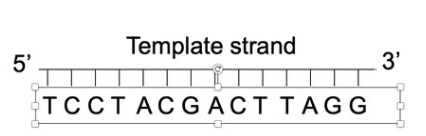
From the template strand shown in the figure, which one is the correct primer to use in PCR?
a) TCCTA
b) T T A G G
c) G G A T T
d) C C T A A
e) A G G A T
d)

A study is conducted to determine the role of resistance training on muscle hypertrophy. The investigators want to know whether there is increased transcription of myosin following resistance training. Which of the following can be used to determine if a particular gene is transcribed?
a) Enzyme linked immunosorbent assay
b) Karyotype
c) Northern blot
d) Southern blot
e) Western blot
c)
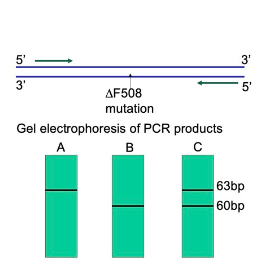
A known deleterious mutation on the CTFR gene causing cystic fibrosis (autosomal recessive disease) is a deletion of 3 bases known as deltaF508. In the PCR result shown in the figure, which patient has cystic fibrosis?
a) A
b) B
c) C
b)
A 31-year-old man comes to the office for an annual examination. He uses cocaine
intravenously, drinks three to four beers nightly, and smokes one pack of cigarettes daily. Based on his risk factors, it is recommended that he gets tested for human immunodeficiency virus HIV. He is told that the screening test will involve taking a sample of his blood, diluting it, and putting it on a plate coated with antigens from HIV. The test is positive if antibodies in his blood bind to the proteins on the plate. Which of the following is the test described above?
a) Enzyme linked immunosorbent assay
b) Karyotype
c) Northern blot
d) Southern blot
e) Western blot
a)
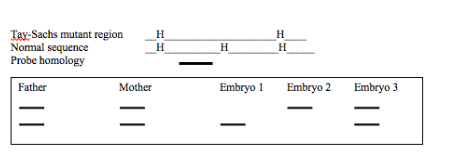
A widespread mutant allele for Tay-Sachs disease lacks a HindIII restriction site in the gene sequence. HindIII restriction sites are indicated by “H” in the diagram. A probe is available for this region, with the homology shown in figure A. A couple, both carriers, is conceiving a child through in vitro fertilization and requests pre-implantation diagnosis of three embryos E1, E2, E3 to determine if the child will have Tay-Sachs, as shown in the autoradiogram Southern blot) (lower pat of figure, smaller fragments at the bottom of the gel)). What are you able to advise the parents?
a) Embryo 1 is free of the Tay-Sachs mutation
b) Embryo 2 is free of the Tay-Sachs mutation
c) Embryo 3 is free of the Tay-Sachs mutation
d) All embryos free of the Tay-Sachs mutation
e) No embryos are free of the Tay-Sachs mutation
a)
What is a chromosome?
a) highly condensed and not transcriptionally active
b) loosely condensed and transcriptionally active
c) single DNA molecule
c)
What is chromatin
highly compacted form of chromosome
What is heterochromatin?
a) highly condensed/ tightly bound to histone/ not transcriptionally active
b) loosely condensed/ loosely bound to histone/ transcriptionally active
a)
What is euchromatin?
a) highly condensed/ tightly bound to histone/ not transcriptionally active
b) loosely condensed/ loosely bound to histone/ transcriptionally active
b)
True or false
Chromatin consists of nucleosomes (histones + DNA) wrapped into solenoid fibers and loops in a hierarchical assembly.
a) true
b) false
a)
What are nucleosomes?
Histones + DNA
Histones are ______
a) positively charged
b) negatively charged
a)
What does acetylation of histone do?
a) Acetylation of histone reduces the positive charge of the histone and allowing it to dissociate from DNA for replication and transcription
b) Acetylation of histone increases the positive charge of the histone preventing it to dissociate from DNA and prevent replication and transcription
a)
True or False
This occurs during DNA replication:
Chromosomes are replicated forming a dyad of two chromatids held together by a centromere
a) true
b) false
a)
True or false:
Telomeres at the ends of chromosomes are special structures to distinguish them from DNA breaks
a) true
b) false
a)
What are the several types of sequences of genomic DNA:
a) unique sequences
b) moderately repetitive DNA
c) highly repetitive DNA
d) all of the above
d)
What are unique sequences of genomic DNA?
a) Regulatory regions for transcription factor binding. LINES, SINES and DNA only transposons. LINES (L1) code for reverse transcriptase which enables LINES and SINES (Alu) to be copied and pasted into new regions of the genome, a process called retro transposition. Transposons move by a cut and paste mechanism called transposition (in yeast, bacteria).
b) Tandem repeat sequences: Satellite DNA (large number of bases in the repeat unit) – centromere; minisatellite (6 – 10 bases in the repeat unit) – telomere; microsatellite (4 or fewer bases in the repeat unit) – used for fingerprinting in forensics.
c) Genes for many proteins, enzymes (single copy). Genes for histones, immunoglobulins, rRNA (mid-range copy number)
c)
What is moderately repetitive DNA?
a) Regulatory regions for transcription factor binding. LINES, SINES and DNA only transposons. LINES (L1) code for reverse transcriptase which enables LINES and SINES (Alu) to be copied and pasted into new regions of the genome, a process called retro transposition. Transposons move by a cut and paste mechanism called transposition (in yeast, bacteria).
b) Tandem repeat sequences: Satellite DNA (large number of bases in the repeat unit) – centromere; minisatellite (6 – 10 bases in the repeat unit) – telomere; microsatellite (4 or fewer bases in the repeat unit) – used for fingerprinting in forensics.
c) Genes for many proteins, enzymes (single copy). Genes for histones, immunoglobulins, rRNA (mid-range copy number)
a)
What is highly repetitive DNA?
a) Regulatory regions for transcription factor binding. LINES, SINES and DNA only transposons. LINES (L1) code for reverse transcriptase which enables LINES and SINES (Alu) to be copied and pasted into new regions of the genome, a process called retro transposition. Transposons move by a cut and paste mechanism called transposition (in yeast, bacteria).
b) Tandem repeat sequences: Satellite DNA (large number of bases in the repeat unit) – centromere; minisatellite (6 – 10 bases in the repeat unit) – telomere; microsatellite (4 or fewer bases in the repeat unit) – used for fingerprinting in forensics.
c) Genes for many proteins, enzymes (single copy). Genes for histones, immunoglobulins, rRNA (mid-range copy number)
b)
What is unique single copy DNA?
a) sequences of proteins, enzymes
b) Nucleotide sequence in tRNA, rRNA (1000 copies) Histones (20 – 50 copies) Immunoglobulins (copy number varies) Collagen, Actin
a)
What is unique mid-range copy numbers of DNA?
a) sequences of proteins, enzymes
b) Nucleotide sequence in tRNA, rRNA (1000 copies) Histones (20 – 50 copies) Immunoglobulins (copy number varies) Collagen, Actin
b)
What are exons?
a) Code for protein/ highly conserved
b) Enable diversity of translated proteins. Functions of non-coding and repeat sequences are not fully understood.
a)
What are introns?
a) Code for protein/ highly conserved
b) Enable diversity of translated proteins. Functions of non-coding and repeat sequences are not fully understood.
b)
What are moderately repetitive regulatory regions?
a) transcription factors
b) cis and trans acting
c) SINES – Short INterspersed ElementS
d) LINES – Long INterspersed ElementS (RT)
e) A & B
f) C & D
e)
What are moderately repetitive interspersed repeats?
a) transcription factors
b) cis and trans acting
c) SINES – Short INterspersed ElementS
d) LINES – Long INterspersed ElementS (RT)
e) A & B
f) C & D
f)
What are LINES?
a) Retrotransposons= mobile genetic elements that can copy and paste themselves into new loci.
b) Code for reverse transcriptase required for this activity.
c) Non-functional relics of genes
d) A & B
e) A & C
f) All of the above
d)
What are SINES?
a) Retrotransposons= mobile genetic elements that can copy and paste themselves into new loci.
b) Code for reverse transcriptase required for this activity.
c) Non-functional relics of genes
d) A & B
e) A & C
f) All of the above
e)
True or False
DNA only transposons with an integrase function can cut and paste themselves into new regions. They occur in bacteria and yeast and can contribute to drug resistance.
a) true
b) false
a)
What is true in regards to retrotransposons?
a) a jumping gene which requires RT to make a mobile copy of itself
b) Reverse transcriptase transcribes RNA back into DNA
c) New DNA copy is inserted at a different place in the genome
d) all of the above
d)
Which of the following is true?
a) Histone acetyltransferases (HAT’s) and histone deacetylases (HDAC’s) are very important for regulating accessibility of DNA. HDAC inhibitors are an important class of anticancer agents in development.
b) Only immortalized cells (germline cells, cancer cells) have the enzyme that is required to sustain telomeric length, making telomeric DNA or telomerase a target for anticancer therapy.
c) In genomic DNA, microsatellite repeat sequences are very useful in forensics because the number of repeats varies between individuals. Repeat sequences can make the DNA more prone to replication errors by mismatch, slippage, unequal crossover or transposition.
d) all of the above
d)
True or False:
The LDLR receptor contains several Alu repeats in close proximity. increases the chance of recombination events involving unequal crossover.
a) true
b) false
a)