optics
 Call Kai
 Learn
 Practice Test
 Spaced Repetition
 Match
 Flashcards
 Knowt Play
1/25

Earn XP
Description and Tags
peter veitch should retire
26 Terms
TM Mode
magnetic field perpendicular to travel. Pi (p) polarisation. E field is parallel to plane of incidence
TE Mode
Electric field perpendicular to travel. Sigma (s) polarisation. E field is perpendicular to plane of incidence.
Phase inverted
phase shift of 180 degrees. When nt is high.
isotropic dielectric interface
boundary between 2 uniform, non-conducting (dielectric) materials whose optical and electrical properties are identical in all directions respectively.
Brewster’s angle
polarisation by reflection. angle at which no pi polarised light reflected.
total internal reflection
no transmitted light
critical angle
angle at which no light is transmitted, only reflected.
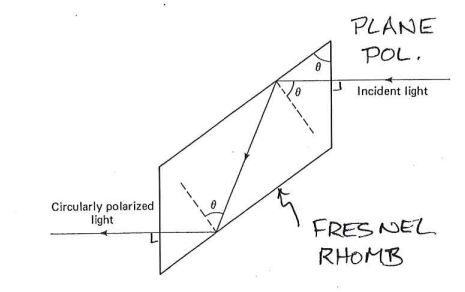
Fresnel Romb
converts plane polarised light into circularly polarised light by exploiting phase change at total internal reflection
loss
UV absorption - electric/molecular transitions
IR absorption - vibrational transitions
OH (hydrogen ion) absorption - water vapour in glass, OH vibrations
Rayleigh scattering - random fluctuations in molecular positrons; scattered power/intensity ∝ ω⁴
dispersion
modal - occurs in multimode optical fibres and waveguides. causes pulse stretch, making pulses difficult to distinguish
material - different wavelengths/frequencies travel at different speeds through medium. refractive index changes with wavelength.
waveguide - vg and vp depend on wavelength due to geometric structure and boundary conditions of the waveguide.
non-linear - intensity changes refractive index, therefore part of pulse travels faster than low intensity part of pulse
ABCD Matrix
A: dimensionless. Relates output position to input position when the input angle is zero. Magnification factor
B: distance. Relates output position to input angle. If B=0, imaged directly aka conjugate plane
C: inverse distance. Relates output angle to input position. If C=0, system is afocal (no convergence/divergence)
D: dimensionless. Relates output angle to input angle when input position is zero.
step-index fibre
has a uniform core refractive index, and drops to a lower refractive index at boundary
graded index fibre
core has refractive index that is highest at centre and decreases continuously radially.

multimode
many modes, larger core than a single mode fibre
meridional ray
passes through centre axis

skew ray
does not pass through centre axis

complementary critical angle
angle a light ray makes with the core-cladding interface surface. 90-critical angle
numerical aperture
fibre’s ability to gather and guide light
acceptance angle
maximum angle light can enter a fibre and be guided
V-parameter
determines how many modes can propagate through a fibre.
single mode V <2.405
weakly guiding fibre
nearly TEM (Ez is small). linearly polarised (LP) modes. reduces to paraxial wave equation. (Δn/n « 1)
modal noise
uncontrolled strain and temperature give each mode a random phase, recombining them at the detector and produces a ‘speckle’ pattern
attenuation
gradual loss of light power or signal amplitude as an EM wave travels through a medium
Beer-Lambert Law
relates power in and power out to loss A (formula sheet)
Loss
A = αL (L is length of fibre)
loss mechanism