lecture 5 - embryology, growth & development pt.3
 Call Kai
 Learn
 Practice Test
 Spaced Repetition
 Match
 Flashcards
 Knowt Play
1/50

There's no tags or description
Looks like no tags are added yet.
51 Terms
around what day does embryonic folding begin?
20

explain the entire process of folding
Longitudinal:
amniotic cavity + ectoderm layer + mesoderm layer used to create folds on either side of neural tube (lateral folds)
a pocket forms on either side of the neural tube (coelom)
Day 25:
some of the yolk sac begins to get pinched off in the midgut area (yolk stalk)
coelom get larger
Median:
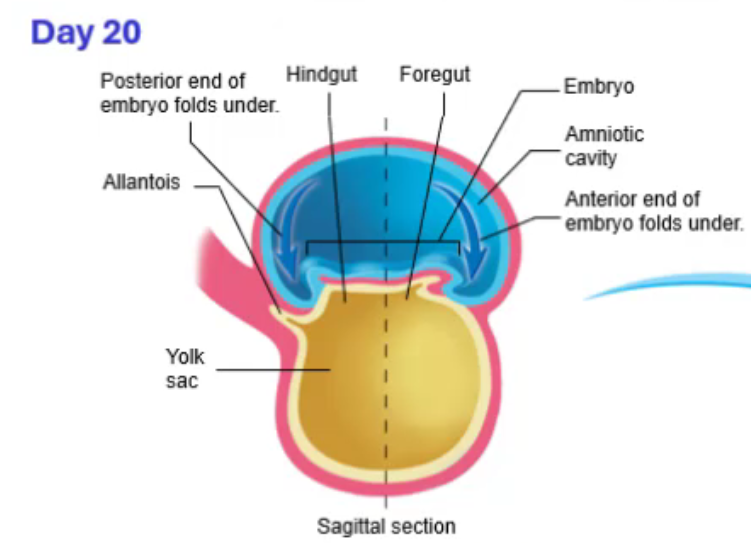
at head and tail region, amniotic cavity is folding around 3 germ layers
begins to form the ends of the gut tube from the endoderm layer (hindgut + foregut)
there is a pinching off of the yolk sac near the connecting stalk called the allantois
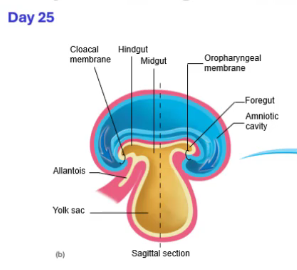
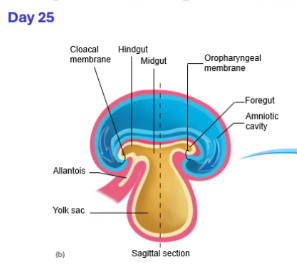
Day 25:
foregut and hindgut have gotten close to each other → forms the midgut region
oropharyngeal + cloacal membrane comes in contact w/ endoderm
Overall:
evaginations (out-pockets) begin to form (ie lung buds, liver and pancreas, branchial arches)
evaginations of gut tube start to move and eventually form structures that are part of the head + neck region (ie pharynx)
in order for us to go from a two-dimensional three layers of cells into a three-dimensional structure, we have to fold the ______ cavity around the _____ germ layers.
amniotic, three

2 ways the amniotic cavity folds around the 3 germ layers
folds longitudinally (lateral folds) to form the gut tube
folds in the median plane to make a head and tail fold
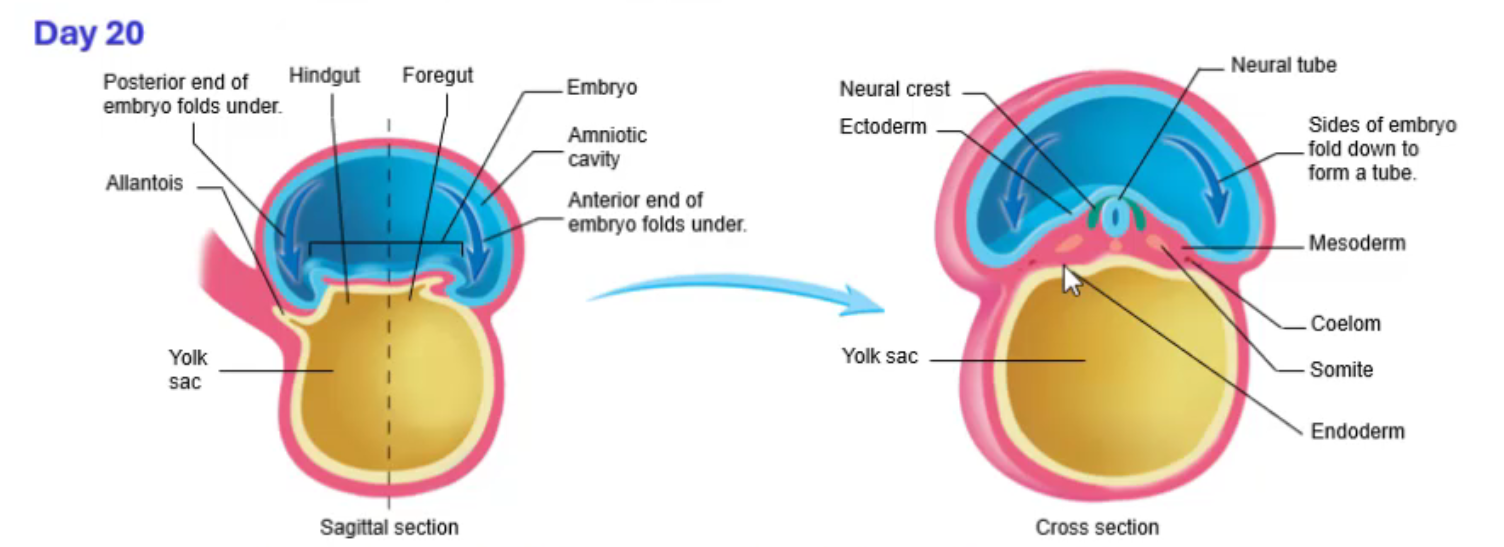
explain the longitudinal folding (day 20)
amniotic cavity + ectoderm layer + mesoderm layer used to create folds on either side of neural tube (lateral folds)
a pocket forms on either side of the neural tube (coelom)

coelom
formed during longitudinal folding
a space on either side of the neural tube (in the mesoderm)
eventually becomes the body cavities

lateral folds
folds on either side of the neural tube using the amniotic sac, ectoderm + mesoderm layer when folding longitudinally

explain the folding in the median plane (day 20)
at head and tail region, amniotic cavity is folding around 3 germ layers
begins to form the ends of the gut tube from the endoderm layer (hindgut + foregut)
there is a pinching off of the yolk sac near the connecting stalk called the allantois

allantois
pinching off of the yolk sac near the connecting stalk during folding along the median plane
eventually becomes part of the bladder
folding in the median plane (day 25)
foregut and hindgut have gotten close to each other → forms the midgut region
oropharyngeal + cloacal membrane comes in contact w/ endoderm

eventually, the oropharyngeal membrane will ________, giving us an opening for the ____ in the _____ region.
disintegrate, mouth, foregut
eventually, the cloacal membrane will ________, giving us an opening for the ____ in the _____ region.
disintegrate, anus, hindgut
explain folding longitudinally (day 25)
some of the yolk sac begins to get pinched off in the midgut area (yolk stalk)
coelom get larger

yolk stalk
occurs when folding longitudinally
narrowed region of the yolk sac that is beginning to get pinched off

by day __, the amniotic cavity has made it fully around the 3 germ layers
30

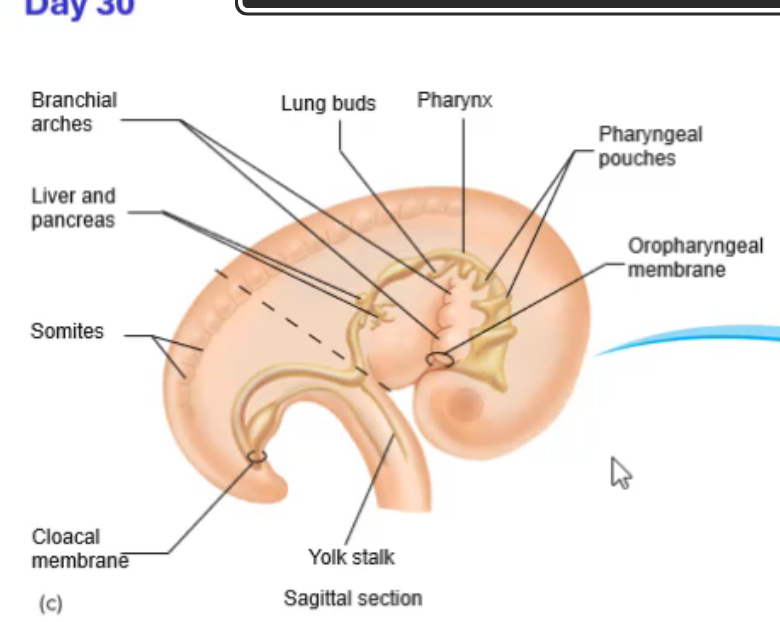
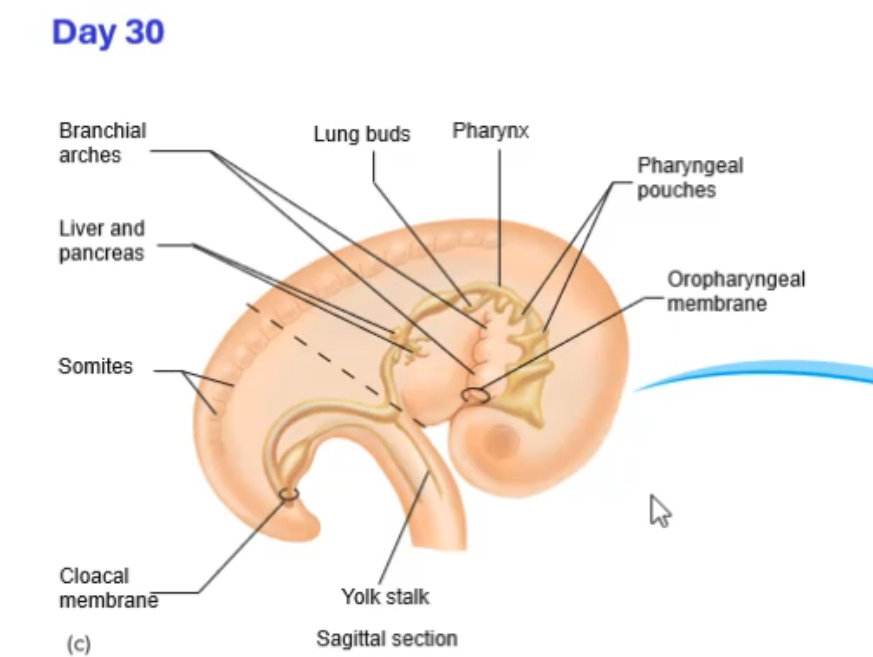
explain day 30 of folding
evaginations (out-pockets) begin to form (ie lung buds, liver and pancreas, branchial arches)
evaginations of gut tube start to move and eventually form structures that are part of the head + neck region (ie pharynx)

pharyngeal pouches
evaginations of the gut tube that will eventually form our tonsils and auditory tubes
auditory tubes
passageway from our throat to our ears
formed by evaginations of the gut tube
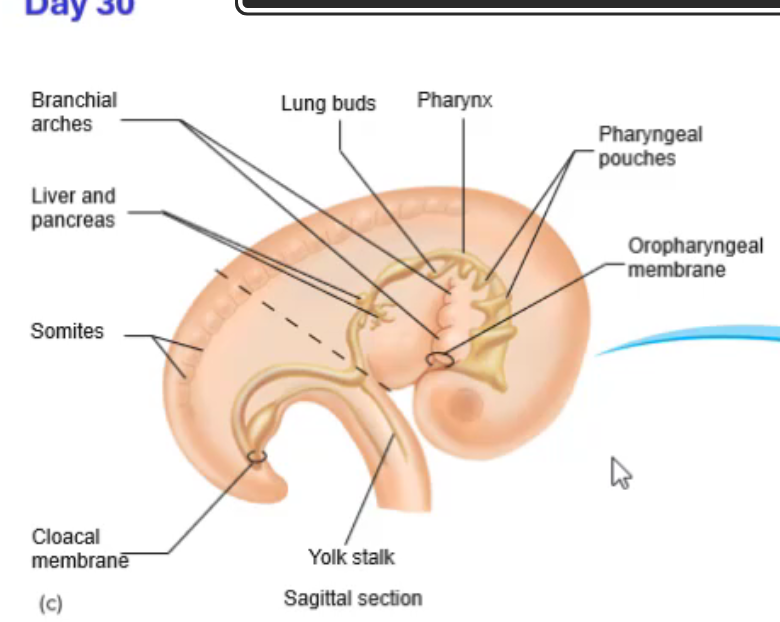
branchial arches
evaginations in the region of the head
form in the ectoderm layer

evaginations
pockets/pouches attached to a region that go on to form other regions of the body

lung buds
an evagination from the gut tube that will eventually become the lungs

what causes the embryo to curve around the spinal area on day 30?
the development of the neural tube, somites and vertebral column is faster than the rest, causing the embryo to curve

evaginations from the gut tube form
anterior pituitary
thyroid gland
lungs
liver
pancreas
auditory tubes
branchial arches form
pharynx
auditory tubes
tonsils
thymus
parathyroid glands
what does the coelom form (in order)
fuses first around the heart as the pericardial cavity
expands to become the pleural and peritoneal cavities
cavities eventually become separated by serous membranes
the limbs begin as ____ ____
limb buds

limb bud development for the upper limbs starts around day __, and for the lower limbs __
24, 28
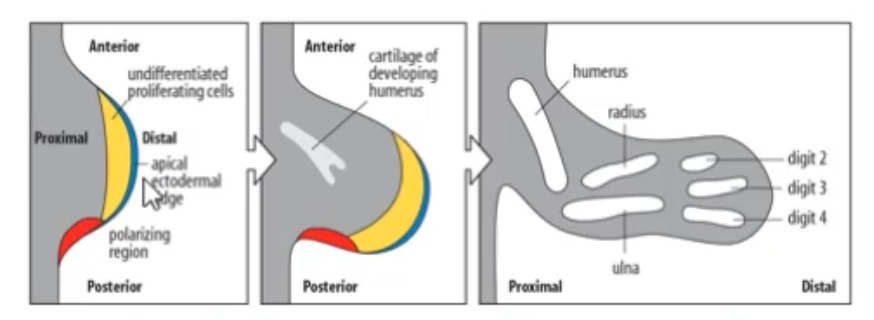
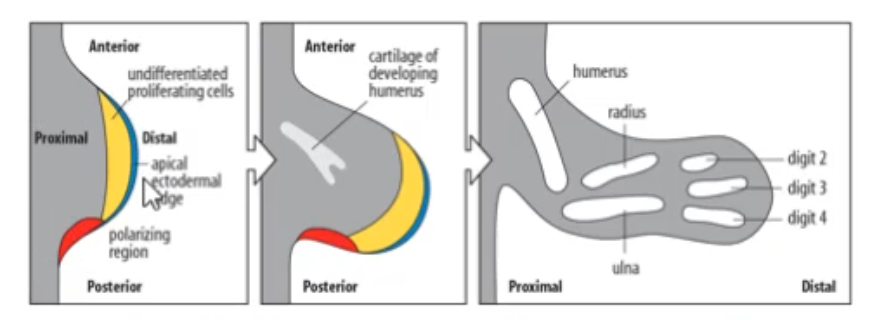
limb bud
ectoderm cells thicken in area of limb → form the apical ectodermal ridge
job is to stimulate outward growth of tissues
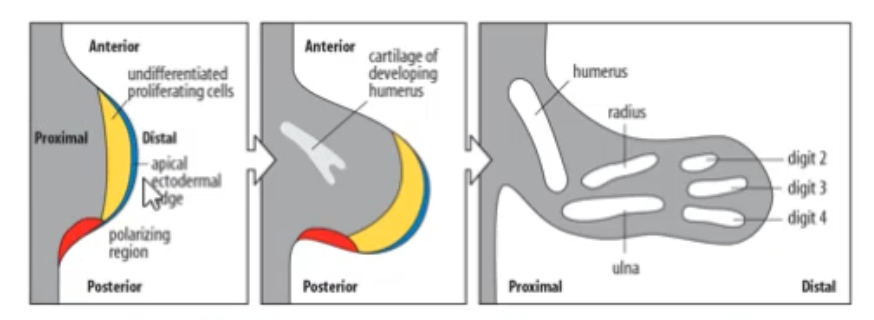
explain the development of limb buds
ectoderm cells thicken in area of limb → form the apical ectodermal ridge (stimulates outward growth of tissues)
mesoderm cells underneath proliferate
bones form
what is the order of systems that are built?
cardiovascular
skeletal
muscular
nervous
the way our limbs are built is from ______ to ______
proximal, distal

it takes about _ weeks to get to the stage where we have all our digits (fingers)
7

what is the very last thing to happen in the development of our limbs?
removing of the webbing b/w the fingers via apoptosis

apoptosis
also known as pre-programmed cell death
method to which the webbing b/w the fingers is removed
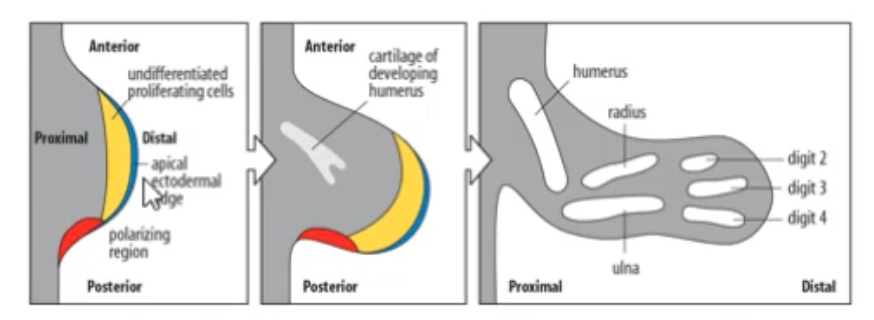
removal of the webbing b/w the fingers via apoptosis happens around week _
8

the development of organs and structures in the body is being stimulated by _____ signals from one cell to another
chemical
what is the name of one of the proteins that help stimulate limb bud development in humans?
sonic hedgehog protein
thalidomide was originally a drug developed in the 1950s as a ______. It was later prescribed to women who were pregnant to help reduce ______ _______.
sedative, morning sickness
what happened to children born to mothers who took thalidomide?
often born w/o limbs, many mothers also had miscarriages or children were underdeveloped in organ systems
what does thalidomide do?
inhibits the formation of blood vessels
depending on when women take _______ during their pregnancy, it can affect the development of very specific _____ _______.
thalidomide, organ systems
what happens if a limb bud doesn’t have a blood supply?
apical ectodermal ridge forms + starts to grow outwards
becomes stunted w/o blood supply
mothers stopped taking thalidomide (bc morning sickness had gone away) and so the limb buds resume growing
at this stage the middle portions of the arms have been skipped, so children end up with formed hands/feet very close to the body
the skeleton develops from what
mesoderm + neural crest cells
the skeleton forms as a ________ skeleton first before the bone
cartilage
muscle develops from what
myoblasts
myoblasts
differentiated from somites
early embryonic cells that develop into skeletal muscle fibers
migrate to wherever muscle needs to be built
once myoblasts reach their destination, they ____ together to form ____________ cells.
fuse, multi-nuclear
the nervous system develops from what
neural tube + neural crest cells

know this diagram
mnemonic to remember what the branchial arches form
Farmer Audie Tongs Threw Parsnips
Pharynx
Auditory tubes
Tonsils
Thymus
Parathyroid glands
mnemonic to remember what the gut tube forms
Ants Tire, Lungs Live, Pancakes Audibly
Anterior pituitary
Thyroid gland
Lungs
Liver
Pancreas
Auditory tubes