Perceptual Dysfunction After Right Stroke
 Call Kai
 Learn
 Practice Test
 Spaced Repetition
 Match
 Flashcards
 Knowt Play
1/61

There's no tags or description
Looks like no tags are added yet.
62 Terms
what is spatial neglect?
defined as a failure to report, response, or orient to stimuli in the contralesion space after brain injury. is also called hemispatial neglect, hemineglect, unilateral neglect, contralateral neglect, or hemi-inattention
what is the epidemiology of spatial neglect?
30% of patients with acute stroke
50% of right stroke survivors
10% of patients with acute neglect will experience symptoms in chronic phase
what part of the brain might be involved in spatial neglect?
primarily the right hemispheres, right posterior parietal cortex, particularly in the inferior parietal lobe or temporoparietal junction. may involve the cingulate gyrus, prefrontal cortex, premotor cortex. (not due to sensory or motor loss) Is not the cause of pusher syndrome, but highly correlated with pusher syndrome in people with right stroke
what are the signs and symptoms of spatial neglect?
unilateral lack of understanding of spatial relationships
spontaneous deviation of head and eyes ipsilateral to brain lesion
construction apraxia: inability to accurately copy or draw an image
body awareness problem
navigating problem
frequent falls
what are related impairments of spatial neglect?
anosognosia
somatoparaphrenia
allochiria
constructional apraxia
what is anosognosia?
unawareness of a specific deficit, patients may be unaware of neglect and also unaware of hemiplegia.
what is somatoparaphrenia?
a delusional belief relating to the contralateral limbs or side of the body, such that a patient does not believe that the limb/side belongs to them
what is allochiria?
a patient responds to a stimulus to one side of the body as if it had been to the other side. it can also be present in drawings where items from the CL side are transposed to the IL side
what is constructional apraxia?
the inability to draw or copy complex diagrams. often associated with R hemisphere damage and persists after rightward bias has resolved. it is not related to motor apraxia
what is visual extinction?
a failure to report CL stimulus in the presence of a competing IL stimulus when both stimuli are briefly presented simultaneously
what is neglect vs extinction?
Neglect refers to the lack of awareness or attention to stimuli on one side of space, typically the contralesional side, without competing stimuli. Extinction, on the other hand, occurs when a patient can perceive a contralesional stimulus if presented alone but fails to report it when accompanied by an ipsilesional stimulus.
what is hemianopia?
is a visual field loss on one side, commonly following damage to the visual pathways in the brain. It can result in loss of peripheral vision and affects awareness of stimuli on the affected side. Pts are often aware of this deficit and turn their head to counter the visual field loss
what is the behavioral inattention test?
used to assess for unilateral visual neglect, consists of the BIT conventional and BIT behavioral
what is included in the BIT conventional?
consists of 6 items including line crossing, letter cancellation, star cancellation, figure and shape copying, line bisection, representational drawing (max score 146)
What is included in the BIT behavioral?
consists of 9 items including pre-scanning, phone dialing, menu reading, article reading, telling and setting the time, coin sorting, address and sentence copying, map navigation, and card sorting (max 81)
which assessments can be used to assess spatial neglect?
line crossing, star cancellation, copying, spontaneous drawing
what are the cutoffs of the BIT that indicate spatial neglect?
BIT < 196/227
BITC < 129/146
BITB <67/81
what should interventions look like for spatial neglect?
treatment should target the perceptual representational processes (“where” interventions)
treatment targeting the premotor intentional components (directional aiming)
prismatic adaptation
optokinetic stimulation
transcranial magnetic stimulation or transcranial direct current stimulation
what is prismatic adaptation?
technique in which pt performs visuomotor tasks like reaching to an object with their hand while looking through prism glasses that displace the light path, by for instance 10 degrees to the R/L
what is optokinetic stimulation?
stimulation with large fields of stripes or dots moving right to left, induces smooth pursuit eye movements in the direction of the movement as well as illusionary rotation of the body
what is transcranial magnetic stimulation (TMS) or transcranial direct current stimulation (TDCS)?
non-invasive brain stimulation techniques that suppress activity of the left hemisphere or enhancing activity on the right side
how can eye patching be used to address spatial neglect?
can help reduce spatial neglect by occluding the unaffected visual field, thereby encouraging the patient to explore and attend to the neglected side. This technique promotes awareness of the neglected side and can facilitate recovery of spatial attention. often glasses with half field patching (on the same side of each lens) works better for spatial neglect
what side would you patch according to the interhemispheric balance theory?
patching the bilateral right half fields in individuals with left hemi-neglect and right hemisphere stroke stimulates the R hemisphere and reduces the stimulation of the left hemisphere, leading to interhemispheric re-balance
what is pusher’s syndrome?
a surprising behavior of pts with stroke who use their non-paretic extremities to push toward the paretic side
a clinical disorder following L or R brain damage in which pts actively push away from the non-hemiparetic side, leading to a loss of postural damage
what might pusher syndrome result from?
R or L hemisphere
posterior thalamus (most common), insular, postcentral gyrus
right stroke is highly correlated with spatial neglect
left stroke: not statistically significant with spatial neglect, but statistically related with aphasia
what did the study that evaluated the relationship between pusher syndrome and thalamic function find?
posterior thalamus appears to be significantly related to controlling upright body posture
what are the signs and symptoms of pusher syndrome ?
pushing away from the non-hemiparetic side toward the affected side
tilting the body contraversively or towards the affected side
no visual impairments
significant problems with sitting, standing, transfers, and walking
what is the mechanism of pusher syndrome?
pt has altered perceived postural vertical: subjective postural vertical error and range are significantly greater in the pusher group compared to other control groups.
what is the scale for contraversive pushing (SCP)?
measures spontaneous posture, extension of the nonparetic extremity, and resistance to passive correction of posture (sitting and standing). total score is 6.
what are the cutoff scores for the SCP?
> or equal to 1 in each section: presence of contraversive pushing
> 0 of each subscore in each section: high reliability
> 0 of total score: low reliability

what scale is shown in the image?
scale for contraversive pushing (SCP)
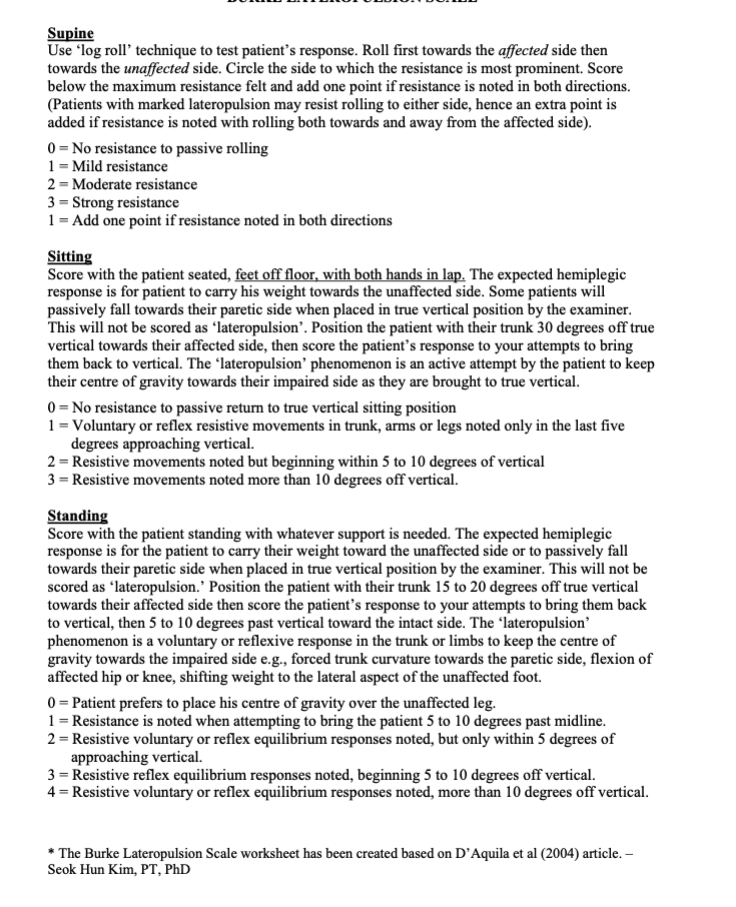
what is the burke lateropulsion scale (BLS)?
measures whether resistance is present when correcting tilted posture, the degree of resistance, and the stage at which resistance begins. the 5 items are rolling, sitting, transfers, and walking. total score is 17. (image shows supine, sitting, and standing items, though also includes transfers and walking)
what are the cutoff scores of the BLS?
> or equal to 2: presence of lateropulsion
what can BLS be used for during rehab?
can be used to monitor progress and recovery during rehab over time
which measure, the BLS or the SCP, is more appropriate for use with pusher syndrome?
BLS is more responsive to small changes and more sensitive in the classification of pusher behavior than SCP. BLS is especially useful to detect mild to resolving pusher behavior in standing and walking (since includes supine, sitting, standing, transfers, walking)
what is the prognosis of pusher syndrome?
can see relatively good prognosis with nearly complete recovery, but patients with motor, proprioceptive and vision deficits shows the worst prognosis regardless of the side of the lesion
do we ignore pusher syndrome?
no, you should use specific treatment of pusher syndrome that aims to shorten the period and enables earlier discharge. it still will take them longer to recovery post-stroke but start specific treatment early for best long term result. (pts with pusher need 3.6 week or 63% longer to reach teh same functional outcome level compared to hemiparetic pts without pusher)
what are the treatment strategies for pusher?
main purpose of PT is to enable the pt to transfer weight to the non-hemiparetic side, manipulations to automatically elicit the desired upright posture without the patient being dependent upon verbal cues
computer based training
mirror training
what is the order for the most effective intervention plan for pusher syndrome (IMPORTANT AND SHOULD BE IMPLEMENTED FOR INTERVENTIONS IE IN ROLLING SIDE TO SIDE, SITTING, STANDING, AND GAIT)?
realize the disturbed perception of erect body position
visually explore surroundings and body’s relation to the surroundings, ensure the pt SEES WHETHER he or she IS ORIENTED UPRIGHT (PT uses visual aids ie arm and works in room with many vertical structures)
learn the movements necessary to reach a vertical body position
maintain the vertical body position while performing other activities

what intervention is shown in the image?
computer based training
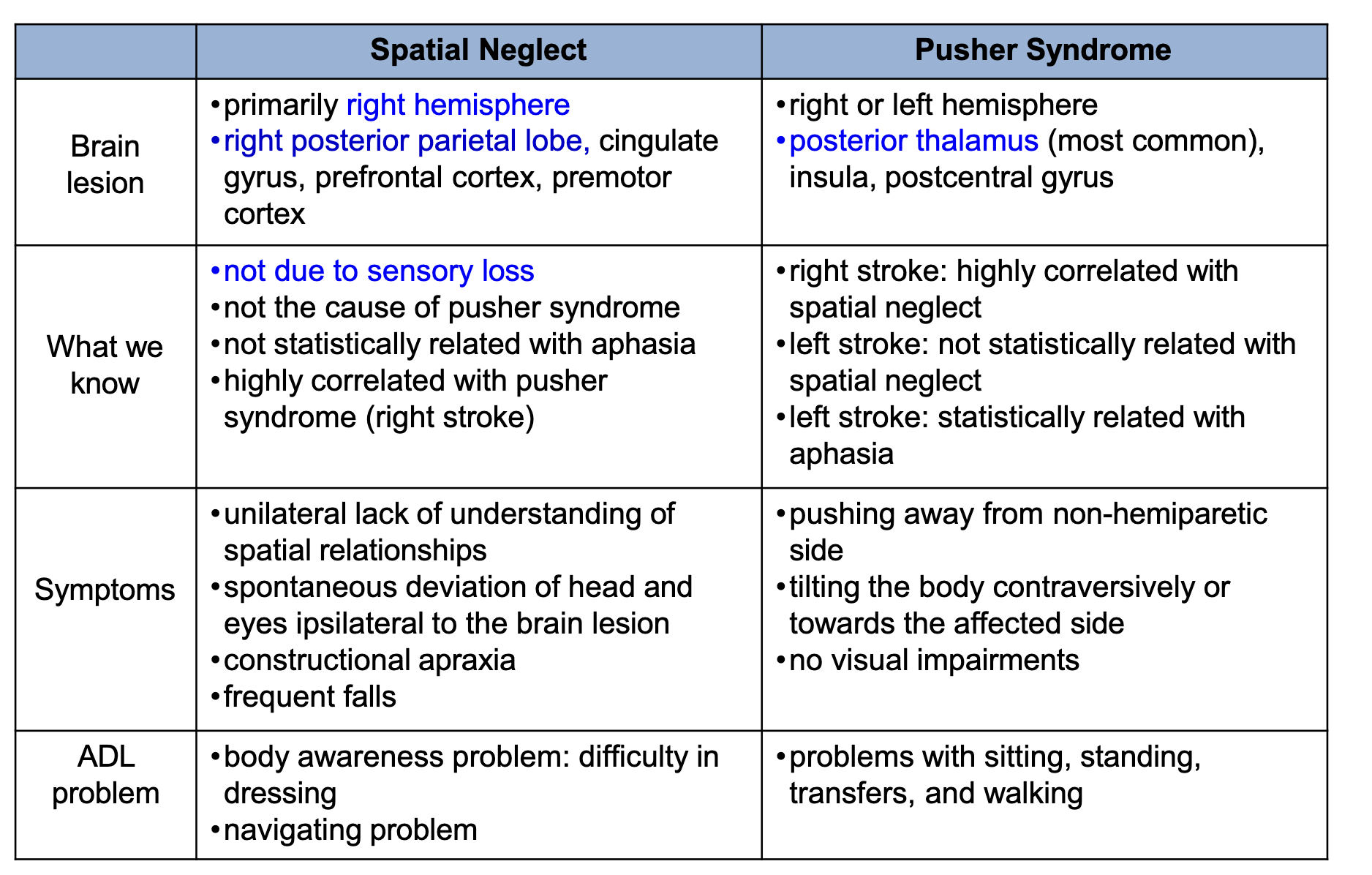
what is the difference between spatial neglect and pusher syndrome?
see table
what is sustained attention?
capacity to attend to relevant information during activity, maintain a consistent response during a continuous activity
what is selective attention?
capacity to attend to a task regardless of environmental, visual, or auditory stimuli
what is divided attention?
the capacity to respond simultaneously to two or more tasks or stimuli when all stimul are relevant
what is alternating attention?
capacity to move flexibly between tasks and respond appropriately to the demands of each task
what is the difference between immediate recall, short term memory, or long term memory?
Immediate recall refers to the ability to remember information shortly after it's presented (few seconds), short term memory stores information temporarily for a few minutes to a few days, while long term memory retains information over extended periods (years), potentially for a lifetime.
what is volition?
the capacity to determine what one needs and wants to do, encompasses a future realization of one’s needs and wants, goal planning, task initiation, self awareness, awareness of environment, and social awareness
what is purposive action?
includes productivity and self-regulation, encompasses the ability to initiate, maintain, switch, and stop complex action of sequences in an orderly manner to realize a goal
what is effective performance?
capacity for quality control, including the ability to self monitor and self-correct one’s behavior, may not perceive to take action against their mistakes
what is right-left discrimination ?
the inability to ID the R and L sides of one’s own body or the examiners body. inability execute movements in response to verbal commands that include the terms “right” and “left”
what is finger agnosia?
inability to ID the fingers of one’s own hands or the hands of the examiner
what is figure-ground discrimination?
the ability to distinguish a figure from the background in visual perception. is pt can’t locate buttons on a shirt, can tell where one step ends and another begins
what is form discrimination?
inability to perceive or attend to subtle differences in form and shape. pt may confuse a pen with a toothbrush
what is spatial relations?
inability to perceive the relationship of one object in space to another object or to oneself, problems crossing midline, ADL problems
what is position in space?
inability to perceive and to interpret special concepts such as up, down, under, over, in, out, in front of, and behind
what is topographical orientation?
difficulty in understanding and remembering the relationship of one location to another
what is visual object agnosia?
inability to recognize familiar objects despite normal functioning of the eyes and optic tracts (can recognize almost immediately when passed into hands
what is auditory agnosia?
inability to recognize nonspeech sounds or to discriminate between them (can’t tell diff between barking and thunder)
what is tactile agnosia?
inability to recognize forms by handling them, although tactile, proprioceptive, and thermal sensation may be intact
what is ideomotor apraxia?
the breakdown between concept and performance, disconnect between idea of a movement and its execution, can do task habitually but cannot perform it on command. (pt can blow a bubble when handed a wand but not if told to blow a bubble)
what is ideational apraxia?
failure in the conceptualization of a task, inability to perform purposeful motor act, either automatically or on command, bc the pt no longer understand the overall concept of the act, cannot retain the idea of the task, or cannot formulate the motor patterns required, may be able to do part of task but not whole (ex when pt asked to brush teeth, may put tooth paste directly into mouth)
what is buccofacial apraxia?
difficulties with performance of purposeful movement with the lips, tongue, cheeks, larynx, and pharynx on command. may do tasks automatically, but not on command- can’t blow out a candle, can make phenomes but can’t do them in formulaic order