EC - 3.3 Revenues, costs and profits
 Call Kai
 Learn
Learn Practice Test
 Spaced Repetition
 Match
Match Flashcards
 Knowt Play
1/60

There's no tags or description
Looks like no tags are added yet.
Name | Mastery | Learn | Test | Matching | Spaced | Call with Kai | Chat |
|---|
No analytics yet
Send a link to your students to track their progress
61 Terms
total revenue (TR) formula
price × quantity sold
average revenue (AR) formula
total revenue ÷ quantity sold
marginal revenue (MR) formula
change in revenue ÷ change in quantity sold
What is average revenue?
The price received per unit sold
What is marginal revenue?
The revenue from selling an additional unit
What happens to TR when MR is positive?
TR increases
What happens to TR when MR is zero?
TR is at its maximum
What happens to TR when MR is negative?
TR decreases
What is the relationship between AR and the demand curve?
AR is the price and therefore represents the demand curve
For a linear demand curve, how does MR compare with AR?
MR has the same y-intercept and is twice as steep
What is the relationship between MR, price and PED?
MR = P(1 + 1/PED)
What does PED measure?
The responsiveness of quantity demanded to a change in price
What happens to TR when demand is elastic and price falls?
TR increases
What happens to TR when demand is inelastic and price falls?
TR decreases
What happens to TR and MR when PED = 1?
TR is maximised and MR = 0 (dP offsets dQ, so TR same)

total cost (TC) formula
TFC + TVC
What are total fixed costs (TFC)?
Costs that do not vary with output (only applies SR)
What are total variable costs (TVC)?
Costs that vary with the level of output
average total cost (ATC) formula
total cost ÷ quantity of output
average fixed cost (AFC) formula
total fixed costs ÷ quantity of output
average variable cost (AVC) formula
total variable costs ÷ quantity of output
marginal cost (MC) formula
change in cost ÷ change in quantity
What is marginal cost?
The cost of producing an additional unit of output
What happens to AFC as output increases?
AFC falls
What is the law of diminishing marginal productivity?
As the input of a variable factor increases while another factor is fixed, the additional output from each extra unit of the variable factor eventually falls
Why is diminishing marginal productivity a short-run concept?
It assumes that at least one factor of production is fixed
What is the short run?
The period in which all FoP is fixed except labour
What is the long run?
The period in which all factors of production can vary
What is the relationship between LRAC and short-run average cost curves (SRAC)?
LRAC is the envelope of the SRAC curves

Why can LRAC be below SRAC?
The firm can adjust its capital stock in the long run to suit its output level
What happens when a firm moves away from its output level for which its capital stock is designed?
SRAC > possible LRAC
What are economies of scale?
Producing on a larger scale reduces AC
What are constant returns to scale?
Range where LRAC constant as Q increases

What are technical economies of scale?
Specialised equip
Equip that would be expensive/underused in small firms (economies from indivisibilities)
Container principle: Volume increases faster than length
What are economies from indivisibilities?
Lower AC from capital/prod processes only justified at large scales
Management EoS causes
Management team does not need to grow as quickly as Q
Different managers specialise in dpt.s
What are marketing economies of scale?
Marketing CoP rise less quickly than Q
What are financial economies of scale?
Large firms can raise finance on more favourable terms e.g. larger loans at lower IR as seen as lower risk of default
What are purchasing economies of scale?
Buying raw materials in bulk
Negotiating lower P
What can cause management diseconomies of scale?
Problems w/:
Coordination
Comms
Bureaucracy
Motivation
MES
Minimum Efficient Scale: Level of Q after which LRAC stops falling as Q rises

What is productive efficiency?
Minimising LRAC
What are internal economies of scale?
Economies of scale arising from the internal expansion of a firm
What are external economies of scale?
Economies of scale arising from the expansion of the industry
How are external economies of scale shown diagrammatically?
LRAC shift down

Example of industry expansion creating external EoS
More skilled labour → Lower training costs
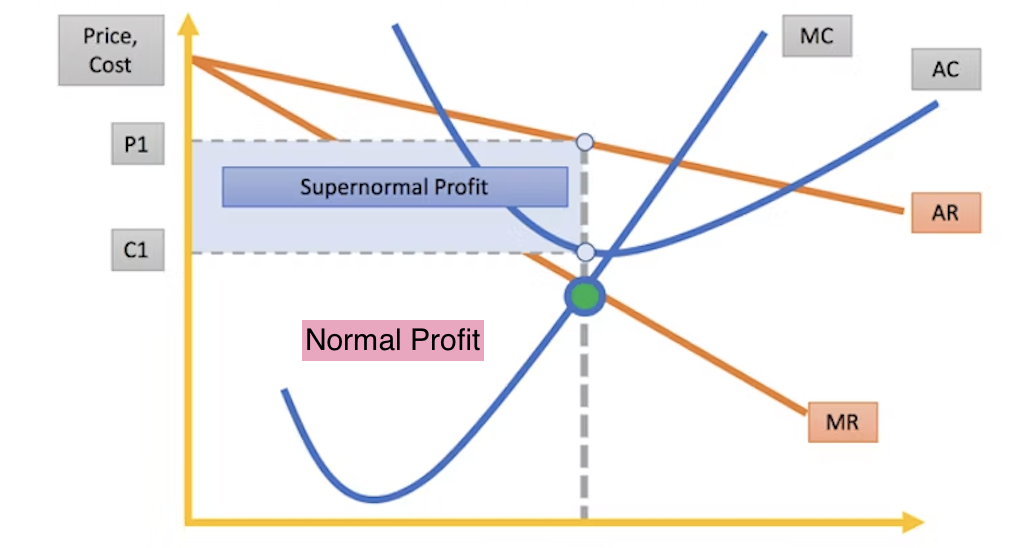
Normal profit
Min. profit needed to cover TC of being in business, incl OC
How is normal profit treated in economics?
As part of the firm's total costs
What are supernormal profits?
Profits above normal profit
What is a loss?
TR < TC
What is the condition for profit maximisation?
MC = MR, with MC cutting MR from below
What does MC = MR where MC cuts MR from above represent?
Maximising loss

What is the short-run shut-down point?
AR = AVC (continuing creates larger loss than shut down)
Note: Shut down PAST this, i.e. AR < AVC, not only AT this
When does a firm shut down in the short run?
AR < AVC
Why can a firm continue operating while making a short-run loss?
Covers VC and some/no FC
What happens to fixed costs in the short run if a firm shuts down?
They still have to be paid
What is the long-run shut-down condition?
AR < LRAC
Why is the long-run shut-down condition different?
LR: all FoP vary, so firm can make normal profit
overhead cost
CoP not directly involved in prod (can be fixed/variable)
risk-bearing EoS
Diversification of diff G+S/regions
→ Safety net prevents risk of revenue drops/bankruptcy
supernormal + normal profit on diagram