1 - Non-insulin Hypoglycemics
 Call Kai
 Learn
 Practice Test
 Spaced Repetition
 Match
 Flashcards
 Knowt Play
 Podcast
1/174

There's no tags or description
Looks like no tags are added yet.
175 Terms

GLUTs?
Glucose transporter
Are membrane proteins that have 12 helices that pass through the cell membrane
Can transport glucose either outside or inside the cell
How do GLUTs work?
Glucose binds to the transporter’s binding sites
This causes the transporter go through a → conformational change
That shape change causes glucose release to the other side of the membrane
Where are the GLUTs binding sites located?
In the transmembrane segments → 9, 10, and 11
What are the key characteristics of the GLUT family?
14 known GLUT isoforms
Divided into 3 subclasses based on sequence similarities
Each has a specific role based on tissue location, substrate specificity, transport kinetics, and regulation
GLUT1?
Provides low-level, basal/constant glucose uptake → in cells to maintain cellular respiration in all cells
What alters the expression of GLUT1 in cell membranes?
Increased by → reduced glucose levels
Decreased by → increased glucose levels
Where is GLUT1 found?
Erythrocytes
Endothelial cells of barrier tissues
The BBB and in astrocytes
GLUT2?
Is the main transporter for the transfer of glucose between the liver and blood
Also has a role in glucose reabsorption
Where is GLUT2 found?
Liver
Pancreatic beta cells
Small intestine
Renal tubular cells
Role of GLUT2 in the pancreatic beta cells?
High-capacity, low-affinity glucose transporter
Helps pancreatic β-cells sense blood glucose levels

When is GLUT2 upregulated?
At the brush border membrane of epithelial cells
To enhance glucose transport into the blood
GLUT3?
Transports glucose in neurons
Expressed mostly in the brain
GLUT4?
Is the insulin regulated glucose transporter
Found mostly in the adipose tissues / striated muscle
What happens to GLUT4 during low insulin levels?
It gets sequestered and stored in intracellular vesicles inside muscle and fat cells
What happens to GLUT4 during insulin signaling / high levels?
Insulin signals vesicles to move to and fuse with the cell membrane
Then GLUT4 transporters are inserted into the membrane → are become more available for transporting glucose
Increasing glucose absorption!!! and glycogen production
GLUT5?
Fructose transporter
Expressed on the apical border of enterocytes in the small intestine
Also is present in other tissues → skeletal muscle, testis, kidney, adipocytes, and brain
SGLTs?
Sodium glucose linked transporter
SGLT1?
A glucose transporter found mainly in the intestinal enterocytes of the small intestine and the proximal tubule of the nephron

SGLT2?
A glucose transporter located exclusively in the proximal portion of the renal tubule
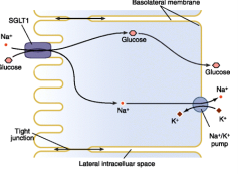
What does the Na⁺/K⁺ ATPase pump do?
Located on the basolateral membrane of proximal tubule cells
Pumps 3 Na⁺ out into the blood
Brings 2 K⁺ in to the cell
What does the Na⁺/K⁺ ATPase pump create for SGLTs?
A sodium gradient that allows Na⁺ to move from outside to inside the cell (downhill)
How do SGLT1 and SGLT2 transport glucose?
The Na⁺/K⁺ ATPase pump keeps sodium levels LOW inside the cell and HIGH outside
Na⁺ naturally wants to move back INTO the cell
SGLT allows Na⁺ to enter while bringing glucose along with it
Glucose gets pulled into the cell even when glucose concentration is already higher inside
Why are SGLT1 and SGLT2 called symporters?
They transport Na⁺ and glucose in the same direction across the membrane
They also both mediate renal glucose reabsorption
Functions of SGLT2?
A high affinity low capacity transporter
Moves glucose against a concentration gradient from the → tubular lumen using energy from Na+ flux via epithelial cells

How much glucose is reabsorbed by SGLT2?
80-90% of reabsorption

How much glucose is reabsorbed by SGLT1?
The remainder, about 10% reabsorption
So what do SGLT2 inhibitors do?
Reduce the rate of glucose reclamation in the proximal tubule
Shifting the renal threshold for glucose excretion from about 180 to 50mg/dL
What form of glucose is responsible for HbA1c formation?
Open-chain glucose form
Contains an aldehyde group at C1
How is the open chain form of glucose formed into HbA1c?
Glucose's C1 aldehyde group undergoes a glycation reaction with hemoglobin in RBCs
The C1 aldehyde reacts with the N-terminal valine of hemoglobin
→ Results in stable glycated hemoglobin (HbA1c)
What does HbA1c tell us?
A history of serum glucose concentrations → 8-12 week/2-3 month history of serum glucose
T1/2 → in blood is 120 days, same as RBCs
Diagnosis / Monitoring of T2D?
Fasting plasma glucose level of >126 mg/dL.
Glucose tolerance test of >200 mg/dL 2 hours after oral administration of 75 grams of glucose
Random plasma glucose of >200 mg/dL
HbA1c > 6.5%
Which glucose lowering agents act on the small intestine to decrease glucose absorption?
Metformin
DPP-4 inhibitors
Alpha-glucosidase inhibitors
Which glucose lowering agents act on beta cells in the pancreas to increase insulin secretion?
GLP-1 agonists
Sulfonylureas
Meglitinides
Which glucose lowering agents act on glucose uptake in adipose tissue?
TZDs
Which glucose lowering agents act on glucose re-absorption in the kidney?
SGLT2 inhibitors
Where does metformin act?
Small intestine to decrease glucose absorption
Liver to decrease glycogenolysis
Examples of sulfonylureas?
Glipizide
Glyburide
Glimepiride
Examples of Biguanides?
Metformin
Examples of Glycosidase inhibitors?
Acarbose
Miglitol
Examples of Meglitinides?
Natelinide
Repaglinide
Examples of Thiazolidinediones (TZDs)?
Pioglitazone
Rosiglitazone
How are sulfonylureas and meglitinides insulin secretagogues?
Both stimulate pancreatic β-cells to release more insulin
Increased insulin promotes glucose uptake into muscle cells
Why don't sulfonylureas and meglitinides work in Type 1 diabetes?
Pancreatic β-cells do not produce insulin → so there is no insulin to stimulate release
MOA of Sulfonylureas and Meglitinides?
Bind to SUR1 and inhibit KATP channels →
Cause β-cell depolarization →
Open calcium channels, triggering insulin secretion →
What enzyme senses rising glucose levels in pancreatic β-cells?
Glucokinase → which generates ATP
What happens when ATP levels increase in pancreatic β-cells?
ATP closes KATP channels
Causes depolarization, calcium influx, and insulin secretion
What are the potential adverse effects of prolonged sulfonylurea therapy?
β-cell overstimulation and exhaustion
SUR2A/SUR2B binding can cause cardiac side effects
May reduce cardiac myocyte survival during ischemia

What structural feature do all sulfonylureas share?
Sulfonylurea group

What are the R1 and R2 structural features of sulfonylureas?
R1: Aromatic ring with a single substitution
R2: Bulky group

What are the acid-base and binding properties of sulfonylureas?
Weak acids (pKa ~5)
Highly protein bound
Why can sulfonylureas cause drug interactions?
High protein binding can increase blood levels of other concurrently administered drugs
How do the three generations of sulfonylureas differ?
With →
Increasing potency
Shorter half-life
Longer duration of action
Which sulfonylureas belong to each generation?
Second: Glipizide, glyburide
Third: Glimepiride
How are sulfonylureas metabolized?
CYP450 metabolism produces active metabolites
What is a common side effect of sulfonylureas?
Weight gain
Which medications can potentiate the hypoglycemic effects of sulfonylureas?
NSAIDs (e.g., salicylates)
Sulfonamides (e.g., chloramphenicol)
Coumadin (warfarin)
Probenecid
Which medications can cause hyperglycemia when taken with sulfonylureas?
Thiazides
Phenothiazines
Thyroid products
Oral contraceptives
Phenytoin
Which drugs are non-sulfonylurea insulin secretagogues?
Nateglinide / Starlix
Repaglinide / Prandin
How do meglitinides stimulate insulin secretion?
Bind SUR1 on KATP channels at a different site than sulfonylureas
Otherwise share the same MOA
How do repaglinide and nateglinide differ in receptor selectivity?
Repaglinide: Binds SUR1, SUR2A, and SUR2B → cardiac side effects (~4%)
Nateglinide: Selective for SUR1
How are meglitinides metabolized?
CYP450 2C8 and 3A4
Produce inactive metabolites
When are meglitinides contraindicated?
Type 1 diabetes
Diabetic ketoacidosis (DKA)
What is the most common adverse effect of meglitinides?
Hypoglycemia (~31%)
What is metformin, and where was it originally derived from?
Biguanide derived from French lilac (goat's rue)
FDA-approved in the US in 1994
WHO List of Essential Medicines
Most widely prescribed diabetes medication
How does metformin affect intestinal glucose absorption?
Decreases glucose absorption by the intestines
How does metformin affect peripheral muscle glucose uptake?
Increases insulin sensitivity
Promotes glucose uptake into muscles
What is the overall effect of metformin on insulin use?
Helps the body use insulin more effectively
How does metformin enter cells?
Through OCT1 → organic cation transporter 1
What are metformin's effects in the intestine?
Decreases gluconeogenesis
Decreases lipid synthesis
Increases lactate production
How does metformin affect the liver?
Decreases gluconeogenesis → the conversion of lactate and glycerol to glucose
How does metformin affect muscle cells?
Increases glycogenesis → glycogen synthesis
How is metformin absorbed and eliminated?
Oral absorption → ~60%
Accumulates in the intestine
Eliminated through the kidneys
What are common side effects of metformin?
GI → nausea, vomiting, stomach upset, diarrhea, gas
Headache, muscle pain, weakness, metallic taste
Does metformin cause hypoglycemia or weight gain?
Does not cause hypoglycemia
Weight neutral
Which diabetes medications are available in combination formulations with metformin?
Sulfonylureas
Meglitinides
TZDs
SGLT2 inhibitors
DPP-4 inhibitors
What are TZDs and what do they do?
Enhance insulin action
Improve insulin sensitivity by decreasing insulin resistance
What transcription factor do TZDs activate?
PPARγ
What do PPARγ transcription factors do?
Bind DNA and regulate downstream gene expression
What processes does PPARγ activation regulate?
Lipid metabolism
Adipose differentiation
Insulin sensitivity in the liver, muscle, and adipose tissue
How do TZDs improve insulin sensitivity?
Bind PPARγ
Decrease insulin resistance in muscle and liver
Decrease gluconeogenesis in the liver
How do TZDs improve hyperglycemia?
Increase insulin sensitivity in muscle and liver
Decrease hepatic gluconeogenesis
Reduce lipid accumulation in tissues involved in glucose regulation (visceral fat, liver, muscle, and β-cells).
What metabolic effects does pioglitazone (TZD) have in insulin-resistant states?
Decreases hyperglycemia (high blood glucose)
Decreases hyperinsulinemia (high insulin)
Decreases hypertriglyceridemia (high triglycerides)

What structural feature do TZDs share?
Both drugs in the class, Pioglitazone and Rosiglitazone → contain a thiazolidine ring
How is pioglitazone metabolized?
Extensive hydroxylation and oxidation
CYP2C8 and CYP3A4 are involved
Also forms glucuronide and sulfate conjugates
What are the major active metabolites of pioglitazone?
M-3 and M-4
What liver-related warning is associated with pioglitazone?
Postmarketing reports of liver failure
Use caution in patients with liver disease
Which medications can be combined with pioglitazone?
Metformin
Sulfonylureas
Not used in combination with insulin
What is a common side effect of TZDs?
Weight gain
What are serious but rare side effects of TZDs?
Congestive heart failure → more serious with rosiglitazone
Hypoglycemia
Bladder cancer
What are α-glucosidase inhibitors, and how do they lower blood glucose?
Block intestinal enzymes that break down carbohydrates
Slow glucose absorption
Used to reduce blood glucose in Type 2 diabetes
What enzymes break down starch into glucose?
Salivary and pancreatic α-amylase
Intestinal α-glucosidase
What does pancreatic α-amylase do?
Breaks complex starches into oligosaccharides in the small intestine lumen
What do intestinal α-glucosidases do?
Break down oligosaccharides, trisaccharides, and disaccharides into glucose and other monosaccharides
Occurs at the small intestine brush border
What is acarbose (Precose), and where is it derived from?
Complex oligosaccharide derived from an actinomycete
Delays carbohydrate digestion
How does acarbose lower blood glucose?
Delays carbohydrate digestion and glucose absorption after meals
Reduces post-meal blood glucose
How does acarbose inhibit carbohydrate digestion?
Competitive, reversible inhibition of →
Pancreatic α-amylase
Intestinal α-glucosidase
What does the amino group of acarbose do?
Prevents protonation of the glycosidic linkage
How much acarbose is orally absorbed?
Only 2%
What are common GI side effects of acarbose?
Abdominal pain
Diarrhea
Flatulence
What is the indication for acarbose?
Adjunct to diet and exercise to improve glycemic control in adults with Type 2 diabetes