Pt Care 6: Exam 1 (Intro to Pain, Acute Pain)
 Call Kai
 Learn
 Practice Test
 Spaced Repetition
 Match
 Flashcards
 Knowt Play
1/99

There's no tags or description
Looks like no tags are added yet.
100 Terms
Unit 1.1: Introduction to Pain and Treatment Options
Unit 1.1: Introduction to Pain. and Treatment Options
Nociception
• Physical transduction of information that is perceived as pain by the brain
• Specialized sensory receptors
• "Pain receptors" that are found on peripheral endings of primary sensory neurons
• They are the least differentiated and exist as free nerve endings
• Transduction occurs when noxious insults causes depolarization to produce action potentials
• Four Classes of Specialized Nociceptors:
1. Thermal
2. Mechanical
3. Polymodal
4. Silent
Transduction
Noxious insults causes depolarization of sensory ending membranes to produce action potentials
What are the four classes of specialized nociceptors?
1. Thermal
• Activated by extremes in temperature (>45° C and
What kind of receptors do the nociceptor class of thermal receptors use?
Transient Receptor Potential (TRP)
→ Ex. TRPV1 activated by ~45° C temp AND capsaicin.
→ Ex. TRPM8 activated by cold < 20 C temp AND menthol.
NaV1.8
• Voltage-gated sodium ion channels that transduce action potentials from peripheral neurons into the spinal cord and finally to the brain
• Target of lidocaine
PTX3
• Ionotropic (a type of ligand-gated ion channel) purinergic receptor that is activated by ATP released from peripheral cells after tissue damage
Mas-related G protein-coupled receptor (Mrg) family
Activated by peptide ligands; sensitize nociceptors promoting the silent class.
Conduction
Sensation of pain modulated by the type of afferent fibers (neurons) carrying nociceptor data
Aδ fibers
• Small-diameter, thinly myelinated, fast (5-30 m/s):
• Activation associated with fast, sharp, pricking pain
• Small receptive field so the source of an injury is happening and can react accordingly
• Used by thermal or mechanical nociceptors
• FIRST PAIN
• Uses glutamate
C fibers
• Small-diameter, unmyelinated, slow (0.5-2 m/s)
• Large receptive fields mean less precise location of pain; individually malleable thresholds adds variability
• Associated with a variety of noxious stimuli: high-intensity mechanical, chemical, temperature
• Used by polymodal nociceptors
• SECOND PAIN
• Uses glutamate
Aα and Aβ
• Larger and faster, these carry non-pain, touch data
• They are both myelinated and have fast conduction
• Carry tactile info or sensation of environment
• Carry pain info in an abnormal state
•Aα senses movement, action and location
•Aβ senses touch
A__ senses movement, action, and location.
A__ senses touch/
α; β
Tissue damage and reduced pH sensitize nociceptors, enhancing the sensation of pain in response to stimuli by:
• Sensitizing nociceptors lowers threshold for action potential on nociceptor-bearing neurons
• Increasing frequency of action potentials, increasing magnitude of pain evoked by super threshold stimuli
• Sensitization results from the release of chemical mediators that produce EPSPs (Excitatory Post Synaptic Potentials)
→ Bradykinin
→ Histamine
→ Prostagraldnins and leukotrienes
• Sensitization results from the release of chemical mediators that produce EPSPs (Excitatory Post-Synaptic Potentials):
1. Bradykinin (activate nociceptive sensory neurons)
→ Released from damaged plasma
→ Activate directly OR act to decrease the threshold for nociceptive sensory neuron APs
2. Histamine (activate nociceptive sensory neurons)
→ Released from mast cells
→ Activate directly OR act to decrease the threshold for nociceptive sensory neuron APs (like bradyinin)
3. Prostaglandins and leukotrienes (Part of inflammation response from damaged cells)
→ Sensitizes nociceptors ("nociplastic")
Aδ fibers are _________ than C fibers because they are __________.
faster; myelinated
What neurotransmitters are released by sensory neurons to depolarize dorsal horn projection neurons?
• Glutamate
- Works at NMDA receptors; release triggers mild pain
- Used primarily by Aδ and C fibers for fast synaptic potentials
• Neuropeptides: Substance P (see below), calcitonin gene-related peptide (CGRP), somatostatin, galanin
- All: used by C fibers for slow synaptic potentials. Enhance and prolong action of glutamate.
• Substance P
- Peptide; works at Neurokinin receptors. When released with glutamate, triggers strong pain
- Concentrated in large, dense core vesicles in unmyelinated C-fibers
- Used by C fibers for slow synaptic potentials. Enhances and prolongs action of glutamate.
• Endorphins act at all three opioid receptors
- Enkephalin, β-endorphin, dynorphin
→ Hyperpolarize dorsal horn neurons, reduce pain signaling
- Located at key points in pain modulatory system
Glutamate
- Primary sensory neurotransmitter
- Works at NMDA receptors; release triggers mild pain
- Used primarily by BOTH Aδ and C fibers for fast synaptic potentials
- Stored in small clear vesicles that are quickly refilled
Substance P
- Peptide; works at Neurokinin receptors. When released with glutamate, triggers strong pain
- Concentrated in large, dense core vesicles in unmyelinated C-fibers
- Used by C fibers for slow synaptic potentials. Enhances and prolongs action of glutamate.
Nociceptive Inputs and Spinal Cord Structure
• Primary sensory neurons → Afferent Fibers of Dorsal Root Ganglia → Dorsal Horn Projection Neurons (Lamina I and V) & Projection neurons or Local excitatory interneurons (Lamina II) or Inhibitory interneurons (Lamina II)
Projection neurons
• In lamina I & V
• There is a high density in Lamina I
- They gather input from Aδ and C fibers and project directly up to midbrain and thalamus
• Lamina V neurons
- Direct input from Aδ and Aβ fibers, and through dendrites reaching to lamina II, C fibers. Wide variety of input. Project to brain stem and thalamus.
• Wide dynamic range neurons: some respond in graded fashion to both innocuous then noxious mechanical stimulus
Local Excitatory Interneurons
(Lamina II) relay data to projection neurons, enhancing nociceptive signaling
Local Inhibitory Interneurons
- (lamina II) regulate/suppress flow of nociceptive information to projection neurons through GABA release
- Target of descending inhibitory pathway regulating pain
Deafferentation
• Destruction of afferent (input) nerves may itself cause pain since it may result in hyperactive dorsal horn neurons
• Produces a burning pain called causalgia
Neuropathic pain
• Results from direct injury to nerves in the peripheral or central nervous system (neuropathy)
- Can result from loss of inhibitory control (loss or impairment of interneurons; injured Aβ "sprouting")
- May be exacerbated by activation of microglia (immune cells) and their release of inflammatory agents
• Symptoms range from tingling, pricking sensations (paresthesia), or muscle weakness
• May give sensation of dysesthesia (numbness; impairment of senses,
especially touch) or allodynia (feeling pain with non-painful stimulus)
• Often elicits a burning pain (causalgia), stabbing or electric sensation
Five Ascending Nociceptive pathways: Spinal Cord to Brain
1. Spinothalamic tract: Spine (projection neurons of laminae I, V - VII)→ lateral nuclear group of thalamus → Somatosensory cortex
- Includes axons of nociceptive projection neurons from laminae I and V through VII of dorsal horn » Discrete receptive fields of origin = localization of pain (distributes nociceptive info that is specific about location)
2. Spinoparabrachical tract: Spine (axons from projection neurons of laminae I + V) → parabrachical nucleus in hte pons
- Distributes nociceptive info widely and is less sensitive
3. Spinoreticular tract: Spine (projection neurons of laminae VII + VIII)→ Reticular Formation (Medulla + Pons) and Thalamus → Somatosensory Cortex
- Large bilateral receptive fields: implicated in diffuse, unlocalized pain
4. Spinohypothalmic tract: Spinal neurons (projection neurons of laminae I,V, VII + VIII)→ hypothalamic nuclei
- Influences autonomic (nausea, unsteadiness) control, triggers neuroendocrine & cardiovascular response to pain.
Spinothalamic tract
Spine (projection neurons of laminae I, V - VII)→ lateral nuclear group of thalamus → Somatosensory cortex
- Includes axons of nociceptive projection neurons from laminae I and V through VII of dorsal horn » Discrete receptive fields of origin = localization of pain (distributes nociceptive info that is specific about location)
Spinoparabrachial tract
Spine (axons from projection neurons of laminae I + V) → parabrachical nucleus in hte pons
- Distributes nociceptive info widely and is less sensitive
Spinoreticular tract
Spine (projection neurons of laminae VII + VIII)→ Reticular Formation (Medulla + Pons) and Thalamus → Somatosensory Cortex
- Large bilateral receptive fields: implicated in diffuse, unlocalized pain
Spinohypothalmic tract
Spinal neurons (projection neurons of laminae I,V, VII + VIII)→ hypothalamic nuclei
- Influences autonomic (nausea, unsteadiness) control, triggers neuroendocrine & cardiovascular response to pain.
Descending Inhibitory (Pain) Pathway
• Serotonin, along with norepinephrine, GABA and endorphins, are key components in the descending inhibitory pathway regulating pain.
1. Starts in the periaqueductal gray (PAG) in midbrain:
- Excitatory pathway synapses with the 5-HT neurons in the nucleus raphe magnus
‒5-HT neurons project to spinal cord, making inhibitory connections with neurons in laminae I, II and V of the dorsal horn, including neurons of the spinothalamic tract that carry noxious stimulation signals.
- Serotonin inhibits spinothalamic tract input, blocking pain.
2. PAG excitatory pathway is, itself, inhibited by short GABA interneuron (would increase pain):
- μ-opioid receptors on GABA interneurons in PAG, when activated, inhibit GABA signaling, releasing the excitatory pathways to activity.
3. Additional NE pathway originates in locus ceruleus and nuclei of pons and medulla
- Descending NE pathway blocks output of neurons in laminae I and V of spinal cord by direct and indirect (triggering enkephalin release, activating inhibitory interneurons) actions

Pain is...
....transduced (three classes of nociceptors), conducted (Aδ and fibers) and then transmitted (by projection neurons, and interneurons).
Three phases of Inflammation:
1. Acute- initial response to injury that precedes immune response; mediated by release of autacoids
- Autocoids have overlapping effects on vasodilation, vascular permeability, chemotaxis and pain
2. Immune - immune cells are activated and neutralize invading organisms; can be bad if it leads to chronic inflammation w/o resolving anything
3. Chronic - involves the release of cytokines (Interleukins, GM-CSF, TNF-α, Interferons, PDGF) that attach via a cell-surface receptors and have some kind of effect
Autocoids
• Biological factors (molecules) which act like local hormones, have a brief duration, and act near their site of synthesis (metabolized quickly)
• Include histamine, serotonin, bradykinin, prostaglandins, and leukotrienes

Cytokines
• Hormone-like chemicals facilitating communication between brain and immune system.
• Promote several functions:
1. Pain - TNF-α, IL-1β and IL-8 liberate prostaglandins and bradykinin to induce hyperalgesia by sensitizing system
2. Fever -TNF-α, IL-1β and IL-6 increase PGE2 levels, thereby causing the hypothalamus to elevate body temperature through increased heat generation and decreased heat loss
3. Increase sleepiness - Also thought to be IL-1β, acting through prostaglandin release.
4 Decrease energy levels, appetite and sex drive - Mechanism not yet clear; may be direct CNS effect
IL-1
Cytokine that is thought to be a principle mediator of the response to infection and endotoxins
• Two distinct polypeptides: IL-1α and IL-1β.
IL-1Ra
Naturally occurring IL-1 receptor antagonist. Some clinical trials indicate that IL-1Ra significantly improves septic shock survival rate and reverses rheumatoid arthritis.
Neurogenic Inflammation
• Connecting inflammation w/ pain which may translate to a neurological way and eventually a long-term chronified pain state
Steps:
1. C fibers at injury release:
(a) Substance P
(b) CGRP
2a. Substance P causes plasma extravasation and edema, it then acts on mast cells to evoke degranulation and histamine release
2b. CGRP causes vasodilation leads to further inflammation and additional bradykinin release
3. The histamine and bradykinin that is released by SP and CGRP respectively, spreads to nearby healthy tissues and contributes to secondary hyperalgesia and increased C fiber firing
4. This causes central sensitization via glutamate working on NMDA receptors to cause prolonged excitation of nociceptor signals
In neurogenic inflammation, C fibers release __________ which then causes histamine release AND _______ which then causes bradykinin release.
Supstance P; CGRP
Nerve Growth Factor (NGF) and brain-derived neurotrophic factor (BDNF)....
...upregulated in inflamed peripheral tissues may also contribute to persistent pain(blocked by growth factor inhibitors).
Neuropathy
The condition where nerves in the Somatosensory, PNS or CNS are diseased or damaged
Neuropathic pain
ARise fro
Neuropathic pains are characteristic of trauma or repetitive stress, but are also included in syndromes of:
• Complex Regional Pain Syndrome: Often the result of trauma or surgery, but syndrome of variable course and unknown cause characterized by pain, swelling, and vasomotor dysfunction of an extremity.
• Postherpetic neuralgia: Severe pain occurring in some patients after shingles, caused by herpes virus outbreak
• Phantom limb pain: May occur after traumatic or surgical amputation, leaving damaged neurons behind
• Metabolic and endocrine disorders: Diabetes mellitus: chronically high blood glucose levels. A leading cause of peripheral neuropathy in the U.S. ~60-70% diabetics have mild to severe nervous system damage
• Autoimmune diseases: Sjogren's syndrome, lupus, and rheumatoid arthritis; Guillain-Barré syndrome (acutely)
• Cancer: Direct nerve tumor, or more commonly, compression damages nerve fibers. May also occur from chemotherapeutic toxicity and radiation: ~30-40% of patients so treated develop neuropathy
• Anesthesia dolorosa: Pain in the absence of sensation; can arise from transection of sensory nerves
Treatment difficult; analgesic response poor. Must diagnose and treat underlying condition first, where possible.
Pain (2020 Revised IASP Definition of Pain)
• An unpleasant sensory and emotional experience associated with, or resembling that associated with, actual or potential tissue damage
• 6 Key Notes:
1. Pain is always a personal experience that is influenced to varying degrees by biological, psychological, and social factors.
2. Pain and nociception are different phenomena. Pain cannot be inferred solely from activity in sensory neurons.
3. Through their life experiences, individuals learn the concept of pain.
4. A person's report of an experience as pain should be respected.
5. Although pain usually serves an adaptive role, it may have adverse effects on function and social and psychological well-being.
6. Verbal description is only one of several behaviors to express pain, inability to communicate does not negate the possibility that a human or a nonhuman animal experiences pain
Nociceptive Pain
- Adaptive: Protective mechanism
- Occurs due to
• Trauma
• Chemical exposure
• Temperature extremes
- Immune system:• Inflammatory pain- Further sensitivity to allow for healing
Pathological Pain
- "Maladaptive": not protective
- Neuropathic pain
• Peripheral nerve injury
- Diabetic Peripheral Neuropathy (DPN)
- Postherpetic Neuralgia (PHN)
- Chemotherapy induced neuropathy
• Central nervous system
injury after having a....
- Ischemic stroke
- Multiple sclerosis
• Centralized (there's no identified nerve injury or inflammation, but there is a disturbance in the CNS resulting in pain hypersensitivity)
- Fibromyalgia
- Irritable bowel syndrome
- Myofascial pain syndrome
Pain is directly related to the extent of an injury, disease severity, or strength of the pain signal. (True/False)
False, the pain a person feels is not necessary related to the extent of the injury, disease severity, or the strength of the pain signal
General Initial Step-wise Approach to Chronic Pain Management
Step 1: Complete Pain Assessment
Step 2: Obtain full medical history
Step 3: Consider non-pharm options
Step 4: Risk mitigation
- Substance use/abuse
Step 5: Consider nonopioid and adjuvant options
Step 6: Select best treatment recommendation, monitor closely, CEs
Step 7: If all nonpharm/nonopioid treatment regimen has failed; make adjustments if needed. If indicated, screen pt to determine if an opioid trial ins indicated.
Return to Step 1 and continue to reassess and adjust
Acute Pain
• Pain with distinct onset and obvious cause
• Duration: Less than 3 months duration
• Pain subsides as healing occurs
• Examples: Trauma, Burns, Myocardial infarction
Subacute Pain
A subset of acute pain
• Duration: Pain that has been present for at least 6 weeks but less than 3 months
Chronic Pain
Pain signals remain active in the nervous system for weeks, months, years persisting beyond normal tissue healing time
• Duration: Pain lasting greater than 3 months**
• ****NOT A PROLONGED VERSION OF ACUTE PAIN****
Acute on Chronic Pain
• Acute pain superimposed on underlying chronic pain
• Examples:
- New injury (trauma) inpatient with chronic pain
- Sickle cell crisis
With chronic pain, are there always observable signs?
No
Nociceptive Pain (inflammatory)
Pain that arises from actual or threatened damage to non-neural tissue and is due to activation of nociceptors.
"pain caused from ongoing inflammation and damage of tissues"
• Osteoarthritis, Bone fracture, metastases, muscles, joints, skin, peptic ulcer, kidney stones, angina, cancer
• Can be somatic or visceral pain

Neuropathic Pain
Pain caused by a lesion or disease of the somatosensory nervous system.
• Can be peripheral or central
• Diabetic peripheral neuropathy, peripheral vascular disease, stroke, spinal cord injury, MS, infections, (HIV, shingles, herpes), carpal tunnel,
• ALWAYS MALADAPTIVE

Nociplastic Pain
• Pain that arises from altered nociception despite no clear evidence of actual or threatened tissue damage causing the activation of peripheral nociceptors or evidence for disease or lesion of the somatosensory system causing the pain.
• Comes from maladaptive changes that affect nociceptive processing and modulation without objective evidence of tissue or nerve damage
• Central sensitization, wind-up, glial and chronic immune system activation, disturbed response to psychosocial stressors, reduced central inhibition
• Common symptoms
- Widespread pain; Multiple regions of the body
- Common low impact activity causes pain
- Some report sensitivity to odors, sounds, light
- Associated with short term memory issues
- Associated with anxiety in some patients
• Main Characteristics associated with this type of pain:
1. Allodynia
2. Hyperalgesia
• Ex. fibromyalgia, IBS, bladder pain syndrome, functional visceral pain, regional somatic sensitization, non-specific back pain

List examples of factors that contribute to the pain sensation
• Physiological
• Affective
• Sociocultural
• Behavioral
• Cognitive
• Sensory

Allodynia
Pain due to a stimulus that does not normally provoke pain
Hyperalgesia
Increased pain from a stimulus that normally provides pain
Paresthesia
Abnormal sensation, whether spontaneous or evoked
• Per ISAP: use this to describe an abnormal sensation that is NOT unpleasant; use dysesthesia for abnormal sensations that are unpleasant
• Feeling of tingling numbness or "pins and needles"
Dysesthesia
Abnormal sensation, whether spontaneous or evoked
• Per ISAP: dysesthesia should always be unpleasant
- Examples: biting, burning, crawling, electric, itching, piercing
Common Pain Treatment Options
(See image)

Generalized Treatment Approach Based on Pain Presentation
Nociceptive:
• NSAIDs
• APAP
• Opioids
• SNRI's/TCAs -- Duloxetine for osteoarthritic pain
• Interventional injections
• Behavioral interventions
• Exercise (somatic*)
Neuropathic:
• Opioids (+/-) (3RD LINE)
• Anticonvulsants (eg. gabapentin and Lyrica)
• Analgesic antidepressants (TCAs, SNRIs)
• Behavioral interventions
• Exercise
Nociplastic:
• Anticonvulsants (eg. gabapentin and Lyrica)
• Analgesic antidepressants (TCAs, SNRIs)
• Behavioral interventions
• Exercise

Biopsychosocial Model of Pain
A model of pain that considers how psychological, social, biological, physiological, and behavioral factors contribute to pain.
• Biological
- Nociceptive injury
- Trauma
- Infection
- Illness
- Cancer
- Nerve damage
• Psychological
- Sleep
- Fear
- Anxiety
- Depression
- Coping skills
• Social
- Work
- Family
- Social network

L-DOC-SARA
• Location
• Duration
• Onset
• Characteristics
- Quality
- Radiation
- 24 hour pain pattern
• Severity and (realistic) pain goal
• Aggravating factors
• Relieving/remitting factors
• Associatie symptoms
5 A's
• Analgesia
- Pain Relief/Improved sleep
• Activities
- Sitting/Standing tolerance
- Ability to walk
- Activities of daily living
• Adverse Effects
- Side effects
• Aberrant Drug Behaviors
- Early refill requests
- Signs of drug or alcohol use
- Manipulative behaviors
• Affect
- Change in mood/signs of depression or anxiety
SUD (Substance Use Disorders) - 5 C's
• Control, loss of
• Compulsive use
• Craving drug
• Continued use
• Chronic problem/consequences
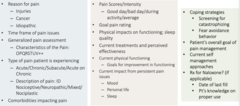
Full Pain Assessment
• Reason for pain
- Injuries
- Cancer
- Idiopathic
• Time frame of pain issues
• Generalized pain assessment
- Characteristics of the Pain: OPQRSTUV++
• Type of pain patient is experiencing
- Acute/ Chronic/ Subacute/ Acute on Chronic
- Description of pain: ID Nociceptive/Neuropathic/Mixed/ Nociplastic
• Comorbidities impacting pain
• Pain Scores/Intensity
- Good day/bad day/during activity/average
• Goal pain rating
• Physical impacts on functioning; sleep quality
• Current treatments and perceived effectiveness
• Current physical functioning
- Goals for improvement in functioning
• Current impact from persistent pain issues
- Mood
- Personal life
- Sleep
• Coping strategies
- Screening for catastrophizing
- Fear avoidance behavior
• Patient's overall goal ofpain management
• Current self management approaches
• Rx for Naloxone? (if applicable)
• Date of last fill
• Pt's knowledge onproper use
Assessment Questions for Pain and/or other Symptoms: OPQRSTUV
• O: Onset
- Where did it begin?
- How long does it last?
- How often does it occur?
• P: Provoking/Palliating
- What brings it on?
- What makes it better?
- What makes it worse?
• Q: Quality
- What does it feel like?
- What are some words that describe this pain?
• R: Region/Radiation
- Where is the pain?
- What areas do you feel the pain spreads?
• S: Severity
- How intense if your pain? (0-10) Now? At best? At worst? Average?
- How bothered are you by this pain?
- Are there any other symptoms that are occurring with this pain?
• T: Treatment
- What medications/treatments are you using?
- How effective are these?
- What side effects have you experienced?
- What medications/treatments have you used in the past?
• U: Understanding/Impact on You
- What do you believe is causing this symptom?
- How is this pain affecting you? (Consider assessing sleep quality here)
- How is this pain affecting your loved ones?
• V: Values
- What is your current goal in regard to your pain?
- What is your comfort goal or acceptable level for this pain?
- What would you like to do that you can't do now due to your pain?
- Are there any other feelings about this pain issue that are important to you or your family?
Unidimensional Scales
- Usually focused on pain intensity
- Easy and quick to use
- Limited training needed to administer
- Validated and Reliable
- Common examples:
• VAS: Visual Analogue Scale
• NRS: Numeric Rating Scale
• Faces Pain Scale (and revised FPS)

Multidimensional Pain Scales
- Usually focuses on multiple pain related issues
• Pain intensity
• Location
• Affect
• Sensations
• Impact on activities of daily living (ADLs)
- Validated and Reliable
- Some are longer than others
- Common examples:
• Brief Pain Inventory
• McGill Pain Questionnaire
• PEG Scale (Pain, Enjoyment, General)
• CAPA Tool (Clinically aligned Pain Assessment)
• DVPRS (Defense and Veterans Pain Rating Scale)

PAINAD Tool
Recommended for assessing pain in dementia patients.

Neonate and Infant Pain Assessment
• Numerical: older children
• FACES: younger children
• FLACC scale: 2 months to 7 yearsor individuals unable to communicate pain
• N-PASS
- Neonatal pain, agitation, and sedation scale
- Validation:
• Neonatal pain and sedation
• Pain and sedation for term and preterm infant
DN4
Neuropathic pain assessment tool completed in office to differentiate neuropathic from nociceptive pain
Alarm Symptoms
- Unrelenting pain not responding to treatment
- Unrelenting pain that is impairing daily activities or QOL (change in status)
- Worsening pain with hx of cancer or unintentional weight loss
- Worsening pain with new or increase in neurologic symptoms (weakness, numbness, tingling)
- Requests for early refills, unexpected UDS results, use of other prescribers, etc.
- Suicidal thoughts or behavior
Addiction
"Addiction is a treatable, chronic medical disease involving complex interactions among brain circuits, genetics, the environment, and an individual's life experiences. People with addiction use substances or engage in behaviors that become compulsive and often continue despite harmful consequences."
Physical Dependence
"A state of adaptation that is manifested by a drug class specific withdrawal syndrome that can be produced by abrupt cessation, rapid dose reduction, decreasing blood level of the drug, and/or administration of an antagonist."
Tolerance
"A state of adaptation in which exposure to a drug induces changes that result in a diminution of one or more of the drug's effects over time."
Misuse
"Taking a medication in a manner or dose other than prescribed."
Pain catastrophizing
"An exaggerated negative orientation toward actual or anticipated pain experiences"

Pain Catastrophizing Statements
1. Magnification: The tendency to magnify the threat of pain
- I wonder whether something serious may happen
- I become afraid that the pain will get worse
- I keep thinking of other painful events
2. Rumination: A relative inability to inhibit pain related thoughts in anticipation of, during, or following a painful encounter
- I anxiously want the pain to go away
- I can't seem to get it out of my mind
- I keep thinking about how much it hurts
- I keep thinking about how badly I want the pain to stop
3. Helplessness: Feeling helpless in the context of pain
- I feel I can't go on
- I feel I can't stand it anymore
- There's nothing I can do to reduce the intensity of the pain
- It's terrible and I think it's never going to get any better
- I worry all the time about whether it will end
- It's awful and I feel that it overwhelms me
List the two important broad goals of pain management
1. IMPROVE FUNCTION
2. Relieve pain
Describe Florida House Bill 451 including who is exempt
- "Prior to providing anesthesia, prescribing, ordering, dispensing, or administering Schedule II opioid: a patient must be informed of nonopioid alternatives"
- The patient must be provided an educational pamphlet on nonopioid alternatives
- Providers in the emergency services are exempt
Transcutaneous Electrical Nerve Stimulations (TENS) Unit
• Risk to patient: very small
• Contraindications
- Pregnancy
- Epilepsy
- Pacemaker
• Use only as directed.
- Do not place on eyes, head, front of neck, broken skin or lesions, on tumors, directly over the spine
List 2 fundamental goals of CBT and provide tools commonly used in CBT
Goals are:
1. Acceptance
2. Embrace Change
Tools include:
- Journaling
- Nightmare exposure and rescripting
- Relaxed breathing
- Unraveling cognitive distortions
- Progressive muscle relaxation
- Cognitive restructuring
- 3C's: Catch it, Check it, Change It
List the main goals of ACT and describe the 6 core treatment processes
• ACE stands for Acceptance and Commitment Therapy (ACT)
Main Goals
➢ Notice, accept and embrace
➢ Shift primary focus from reducing or eliminating pain to fully engaging in their lives
➢ Change how the patient relates to internal experiences
➢ FOCUS ON LIVING BETTE
- Suffer less
- Become involved
6 core treatment processes
1. Being present - focus on here and now
2. Values - discover what is truly important to you
3. Commitment - take action to pursue the important things in your life
4. Self as context - see yourself as unchanged by time and experience
5. Defusion- observe your thoughts without being ruled by them
6. Acceptance - be willing to experience difficult thoughts
List examples of nonpharm treatment and pharmacological treatment recommended for chronic low back pain based on 2022 VA guidelines:
• Acute (
NSAIDs MOA
inhibit prostaglandin synthesis by inhibiting COX-1 (constitutively expressed) and COX-2
NSAID Adverse Effects
- Central nervous system: Headaches, tinnitus, dizziness and (rarely) aseptic meningitis
- Cardiovascular: Fluid retention, hypertension, edema and (rarely) myocardial infarction and congestive HF
- Gastrointestinal: Abdominal pain, dysplasia, nausea, vomiting and (rarely) ulcers or bleeding
- Hematologic: Inhibits platelet formation; (Rarely) Thrombocytopenia, neutropenia, aplastic anemia
- Hepatic: Abnormal liver function test results and (rarely) liver failure
- Pulmonary: Asthma (due to increased leukotriene production). Use contraindicated in asthmatics
- Skin: Prolonged use increases incidence of rashes of all types, pruritus and photosensitivity
- Renal: ↓ sodium excretion, causing renal insufficiency, renal failure, hyperkalemia and proteinuria These effects grow more prevalent/worse over increased exposure (i.e., high doses or prolonged administration)
NSAID Drug Interactions
- ACE Inhibitors and Angiotensin II receptor blockers: Predictable decrease in antihypertensive response
- Furosemide and thiazide diuretics: Predictably ↓ diuretic, natriuretic and antihypertensive response
- Anticoagulants: ↑ inhibition of platelets; may increase hypothrombinemic response, gastric erosions
- Selective serotonin reuptake inhibitors (SSRIs): ↑ platelet inhibition increases risk of bleeding
NSAIDs should be avoided in...
- Kidney/liver problems
- Asthmatics
- Patients on blood thinners
- History of ulcers of GI problems
- Pregnant mothers 20 weeks of later
Should aspirin be used for pain?
NO! The dose needed to reach analgesia is almost toxic
Aspirin
• First in class, needs higher doses for analgesia, but this leads to increased side effects so NO LONGER RECOMMMENDED TO TREAT PAIN!
• Pharmacokinetics: A acetylsalicylic acid ASA with ½ life = 15 min
• MOA: Non-selectively irreversibly inhibits COX 1/2 and lasts 8 - 10 days (the half-life of a platelet), also indirectly decreases thromboxane
• Clinical Use: Decreases ischemic attacks, angina
- No longer recommended for pain
• Adverse Effects: In addition to common effects, causes gastric upset and ulcers
- CI in hemophiliacs
Med Chem: Aspirin
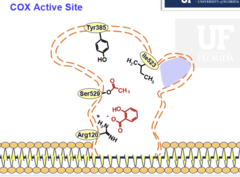
• Irreversible inhibition occurs due to one of the two interactions
1. Aspirin's carboxylate engages the gatekeeper arginine's amine + to make an ionic bond so aspirin is anchored close to the gate
2. The active site serine's hydroxyl does a nucleophilic attack on the aspirin's ester group and cleave it off (irreversible)
Sodium Salicylate, salicyl salicyate
• Nonacetylated salicylates.
• Less effective, nonspecific COX inhibitors.
• Effective anti-inflammatories, but may be less effective analgesics than aspirin.
• Less effective inhibition of platelet aggregation may make these more useful in hemophiliacs, asthmatic
SAR - Arylalkanoic Acids
• Optimal separation of the carboxyl group from the aromatic ring is one methylene unit
• Also simple substitution (NOT BRANCHED) at alpha position increased potency
• Forms stereoisomers and S(+) usually most effective
• Ex. Ibuprofen, naproxen

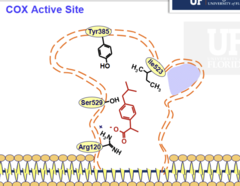
Med Chem: Ibuprofen @ COX Site
1. Ionic interaction between ionized COOH group and amine of the gatekeeper Arginine
2. Hydrophobic interaction with the rest of the molecule
Med Chem: Oxicams
1. Sulfone to mimic carboxylate group
2. 4-Hydroxyl group is critical
3. 2-methyl group contributes to anti-inflammatory activity
4. 3-carboxyamide contributes to anti-inflammatory activity
5. The N-Heterocyclic carboxamides possess: extended plasma t1/2, enhanced acidity and high potency due to the stabilization of the enolate anion
- Piroxicam has a pyridine N-heterocyclic group while meloxicam has a thiazole

Med Chem: COX-2 Inhibitor
- The sulfonamide confers COX-2 selectivity since it binds to an area remote from the site of the carboxylate of the NSAIDs
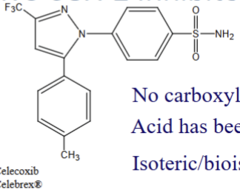
What are the COX-2 selective inhibitors?
Celecoxib and Meloxicam (chemical class of -oxicam tho)