METR 322 - Exam 3
 Call Kai
 Learn
 Practice Test
 Spaced Repetition
 Match
 Flashcards
 Knowt Play
1/231

There's no tags or description
Looks like no tags are added yet.
232 Terms
What is random variability?
Random variability are fluctuations that do not appear to be caused systematically. The fluctuations do not repeat at a distinct interval and are considered unimportant.

What is periodic variability?
Periodic Variability is an abnormality that recurs with some relative regularity.

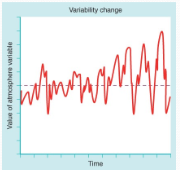
What are variability changes?
Variability changes do not see a change in the mean but a temporal drift to larger or smaller variability about the mean.
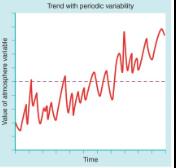
What are temporal trends?
A slow, temporal drift of the mean (decrease or increase)
What is a step change?
A step change is a sudden shift to a different mean.

Why are variabilities in climate data complicated?
Anomalies may obscure the pattern, and several different forms of change and variability may exist simultaneously.
What may have caused the first global ice age?
An increase in vegetation led to a higher increase of O2 being in the atmosphere, which lead to a severe decrease in methanogens a nearly 2.5 billion years ago.
What lead to the second ice age?
The dislocation of the Rodinia supercontinent created fresh basaltic provinces, which increased the weatherability of the surface. Atmospheric CO2 consumption was enhanced, leading to a long-term climatic cooling around 800-600 million years ago.
What was the effects of the third ice age?
The third ice take took place 460-430 million years ago, and it resulted in a massive extinction event.
When did the fourth ice age take place?
The Gondwanan Ice Age, named for the large southern hemisphere that resulted from the break-up of Pangea, occurred 320-250 million years ago, followed by a warm period.
What is the K-T extinction event?
The Cretaceous-Tertiary or Cretaceous-Palogene Extinction event occured 65 million years ago. It was the mass extinction event of most plants and animals on Earth, including the dinosaurs.
How are we in an ice age today?
There is still “permanent” ice that exists on Earth’s surface in the form of ice sheets and mountain glaciers. This is the final, major, known ice ag
How are ice ages subdivided?
They are divided into glacial (cold) and interglacial (relatively warm) periods.
When was the last glacial phase?
Wisconsin Glacial in Pleistocene Epoch
What occurred 8,000-5,000 years before present?
Warm period know as Hypsithermal, which was 2C warmer than today’s levels.
What occurred c. 500 A.D.?
Dark ages in Europe, which were cold and stormy
What occurred c. 900 A.D.?
A warm interval known as the Little Climatic Optimum (LCO) or Medieval Warm Period (MWP) began.
What occurred c. 1450-1850 A.D.?
The Little Ice Age took place. Streams in Europe that don’t freeze today froze back then. 1816 was known as the year without summer, and there was frost every single month in New England.
What are the recent temperature trends?
The ten warmest years of in instrumental record all occurred since 1990.
What are the recent sea level trends?
An estimated global sea level rise of approximately 15 cm or 6 in has accompanied the warming of the 20th century.
What is an interglacial period?
A relatively warm interval between two glacial periods.
What are glacial erratics?
Large rocks transported by glaciers and deposited in locations where their rock types differ from the local bedrock.
What is paleoclimatology?
The study of Earth's past climates using geological, biological, and other historical evidence.
Which statement best describes random climate variability?
It represents fluctuations that do not exhibit a clear, regular periodic pattern.
Which statement best describes the geological evidence associated with continental glaciation?
Glacial erratics, moraines, and striations provide evidence of past glacier extent and movement.
What are glacial striations?
Grooves or scratches carved into bedrock by rocks embedded in moving glaciers.
Following a period of cooling, an expanding snow and ice cover can reinforce the initial temperature decrease. Which process explains this feedback?
Snow and ice increase surface albedo, reflecting more incoming solar radiation and promoting further cooling.
How did the use of the term “climatic change” evolve in the scientific literature, according to its historical development?
It initially referred to climate variability and anomalies, and later increasingly emphasized human influence on climate.
Which statement best describes the faint young Sun paradox?
The early Sun was less luminous than today, yet geological evidence suggests that warm temperature supported life on Earth.
Why was global sea level significantly lower during major glacial periods?
Large volumes of water were stored on land in continental ice sheets and glaciers.
What is the principle of uniformitarianism in geology?
Geological processes operating today can help explain geological features and processes in the past.
How can continental drift influence Earth's long-term climate?
It changes the distribution of continents and oceans, influencing ocean circulation and the global distribution of heat and moisture.
A fossil assemblage found in sedimentary rocks contains organisms known to have lived in warm, shallow marine environments. What can this evidence most reasonably suggest about the past environment?
The area was likely covered by a warm, shallow sea when the sediments were deposited.
What do glacial striations provide evidence of?
The direction of glacier movement across bedrock.
What are moraines?
Accumulations of sediment deposited by glaciers.
Which statement best distinguishes climate change from climate variability?
Climate change involves long-term shifts in climate characteristics, while climate variability describes fluctuations around typical climate conditions.
Scientists reconstruct past climate using tree rings, ice cores, pollen, fossils, and geological evidence. Why is combining multiple types of proxies particularly valuable?
It provides independent, complementary evidence that can be cross-checked to strengthen the reconstruction.
Scientists find different types of pollen preserved in lake sediments from different depths. How can this information help reconstruct past climates?
Pollen provides information about past vegetation, which can be used to infer environmental and climatic conditions.
Which statement correctly describes the three major components of Earth's Milankovitch cycles and their approximate periods?
Eccentricity: 95,000 years; axial tilt: 44,000 years; precession: 23,000 years.
What is the main difference between relative dating and radiometric dating?
Relative dating establishes the sequence of geological events, while radiometric dating estimates numerical ages using radioactive decay.
Proxy evidence examples?
Ice cores, old trees, lake/ocean sediments, pollen, caves, etc.
Catastrophism
Catastrophic changes do not occur uniformly, but from one equilibrium to a drastically different equilibrium in only a short time geologically
What is half-life of radiometric dating?
Time for one-half of the radioactive nuclei to decay
What are the three common types of radioactive decay?
Alpha, Beta, and Gamma
What is the advantage of using radiometric dating?
It is the only absolute dating techniques that go back farther in geologic history than a few hundred years
Principle of Superposition
Older evidence will be found successively lower in sedimentary rock layers
Cross-cutting relationships
Many regions exhibit igneous rock formations that cross-cut pre- existing sedimentary rock layers
Inclusion relationships
Older material will be surrounded by the newer.
How do ice cores provide proxy evidence?
When drilling into ice sheets, the air preserved inside bubbles located in the ice core contain air from when the ice was formed. If global temperature were more cold, 18O isotopes will contain less in the air and more in the ocean. If temperatures were warmed, more 18O is in the air.
How do fossils provide proxy evidence?
Fossilized rock allows paleoscientists to infer the climatic conditions that must have existed at the time and place that the fossil was formed
What is foraminifera?
Foraminifera are single-celled organisms that create complex shells from seawater minerals.
How do foraminifera provide proxy evidence?
They can provide clues about the salinity of the oceans during their existence because salinity is related to the energy and water budgets of the atmosphere; foraminifera abundant in warm periods
What is palynology?
The scientific study of pollen and spores
How does palynology provide proxy evidence?
Coring and radiocarbon dating can identify a temporal sequence of pollen/spore types. It can also provide important information about the paleoclimatic conditions, including circulation especially when used in conjunction with other types of paleoclimate evidence
What is dendroclimatology?
The science of using annual tree rings to infer paleoclimates
How can dendroclimatology provide proxy evidence?
Can provide climatic evidence dating back hundreds or even thousands of years before present
Offers the advantage of an annual and even a sub- annual record
Especially useful in precipitation and streamflow reconstructions
How do mountains affect climate change variability?
The positions of mountainous regions can cause climatic change:
Highland climate after orogeny (cold top)
Mountain uplift can affect the synoptic- scale atmospheric circulation:
e.g., long wave of ridge/trough pattern
What is eccentricity?
The earth's orbit around the sun gradually changes from more circular to more elliptical orbit with periodicity of approximately 95,000 years.
Low eccentricity - likely to coincide with glacial periods within ice ages
High eccentricity - interglacial phases (longer summer/winter)
Summer determined if the ice will stay (ice age) or me
How does Earth’s tilt affect climate change variability?
The smaller the tilt, the closer to the equator the sun’s direct rays remain throughout the year --- smaller seasonal change --- glacial periods
Periods of high tilt allow the sun’s direct rays to penetrate farther poleward than average causes very warm summers and very cold winters --- interglacial periods
What would an extreme warm summer look like with the Milankovitch Cycles?
An extremely warm summer would consist of high eccentricity, large tilt, and perihelion occurring on the summer solstice.
How might volcanic activity be explained through climate change variability?
Periods of active volcanism may enhance the greenhouse effect by contributing CO2 to the atmosphere, leading the earth into an ice-free period. The slow removal of that CO2 may allow for the onset of an ice age. The addition of matter to the atmosphere from volcanism can disrupt the global atmospheric circulation resulting in unusual and/or extreme weather events
How might variations in solar output affect climate change variability.
Increased amounts of insolation, leads to more latitudinal temperature differences leading to:
Stronger circulation with more vigorous contrast between tropical and polar air masses.
Increased air mass contrast, along with the additional evaporation from a warmer tropical ocean, could create more precipitation. causing
More snow and ice in the high-latitudes which would
Increase the albedo of the surface, providing
A greater percentage of the sun’s energy reflected from the surface
More energy reflection would cause colder polar conditions even with greater input of solar energy.
What happens to monsoon circulation during El Nino?
It weakens.
What happens to Atlantic tropical cyclone activity during El Nino?
It is suppressed.
What is the Quasi-biennial Oscillation?
Quasi-biennial Oscillation (QBO) is a periodic reversal of the equatorial stratospheric winds between westerly and easterly
Cycle length of QBO?
26 months
What is the QBO related to?
Atlantic tropical cyclone frequency, the Asian monsoon, and winter temperature variability in the northern hemisphere
What does “global dimming” describe?
A decrease in sunlight reaching Earth’s surface, partly associated with aerosols and clouds.
How can an atmospheric inversion affect air pollution near the ground?
It limits vertical mixing and can allow pollutants to build up near the surface.
Pollution levels are high in a valley during calm, stable conditions. A stronger wind begins to mix the air. What is a likely local effect?
Concentrations may fall as wind disperses pollutants downwind.
Which example best describes a process that removes carbon dioxide from the atmosphere?
Plants take up carbon dioxide during photosynthesis.
Scientists combine tree rings, ice cores, pollen, fossils, and geological evidence to reconstruct past climate. Why is this useful?
The evidence can be compared across sources to strengthen the reconstruction.
What does the label PM2.5 refer to?
Particles with an aerodynamic diameter of 2.5 micrometers or less.
Why can rising carbon dioxide have a large influence on climate despite being less abundant than water vapor?
A portion of added CO₂ persists for centuries, while water vapor cycles out in days.
What was one role of the 1970 Clean Air Act amendments in the United States?
They strengthened federal air-quality regulation and EPA responsibilities.
How can sulfur dioxide and nitrogen oxides contribute to acid precipitation?
They react in the atmosphere to form sulfuric and nitric acids.
What is a secondary air pollutant?
A substance formed through reactions involving pollutants or atmospheric components.
Which statement best describes the greenhouse effect?
Greenhouse gases absorb some surface emitted infrared radiation and re-emit longwave radiation.
A city establishes heat-warning systems and cooling centers as heat waves become more common. Which response category best fits these actions?
Adaptation, because they help people cope with climate impacts.
Which combination contributes to an urban heat island?
Less vegetation and greater heat storage in built surfaces.
Which conditions favor the formation of photochemical smog?
Nitrogen oxides, hydrocarbons, and sunlight driving chemical reactions.
A city remains warmer than nearby rural areas late into a clear, calm night. Which explanation best fits this pattern?
Built surfaces release stored heat while limited vegetation reduces evaporative cooling.
A region reports sulfur dioxide emissions from fuel combustion and increased acidic deposition downwind. Which sequence best explains the observations?
Primary sulfur dioxide is emitted, then atmospheric reactions form sulfuric acid or sulfate that can be deposited downwind.
What is a primary air pollutant?
A pollutant emitted directly from a source into the air.
Researchers compare climate-model projections with long-term temperature records to evaluate future risks. Which response category best describes this work?
Continued research, because it tests projections against observations.
Aerosol pollution declines while greenhouse gas concentrations continue to rise. What temperature effect may follow?
More sunlight reaches the surface, revealing some warming previously masked by aerosols.
A city replaces fossil-fuel electricity with renewable power to reduce future greenhouse gas emissions. Which type of response does this represent?
Prevention, because the city is reducing a potential climate threat.
What gas is the most abundant greenhouse gas?
Water vapor is the most abundant and important greenhouse gas. Little concern in terms of global warming. 5-8 um wavelength
What is the second most abundant greenhouse gas?
CO2
What gas has the greatest greenhouse gas effect?
CO2. Wavelength of 4-5 um
What is the projection of CO2 estimated to keep growing by?
Projected to keep growing to .060% by 2050. This would cause temperatures to rise by 1.5 to 3.5C
Why is wood combustion and other organic materials not considered a major source of CO2?
The combustion of wood and other organic materials is not considered a major source of atmospheric CO2 since the storage and removal of the carbon occurs over relatively short time periods.
What are CO2 sinks?
mechanisms that remove more CO2 from the atmosphere than is emitted to it
List the CO2 sinks.
Sedimentary rock formation (Major but long time period)
Oceans by actions of phytoplankton (major over shorter time)
Soils (minor but has potential to be improved)
Vegetation use for photosynthesis (Minor due to surface coverage)
Concentration of Methane in the atmosphere?
1.85 ppm
What are some of the ways methane has increased over the last 200 years?
Released from anaerobic decomposition of bogs, tundra, swamps
Released from the stomachs of ruminants
Termites
The flooding of rice fields
Other: biomass burning, landfill, oceanic biological process, methane hydrates
Other important greenhouse gases?
N2O, Fluorocarbons, CO, Nitrous Oxides
What percent of greenhouse gases does the U.S. produce?
16%
How do increasing temperatures from greenhouse gases affect the cryosphere?
Increased temperatures » additional cryospheric melting, which would then endanger coastal cities as sea level rises