3.3: Meteorology (Weather, Climate, Water Cycle)
 Call Kai
 Learn
 Practice Test
 Spaced Repetition
 Match
 Flashcards
 Knowt Play
1/62

Earn XP
Description and Tags
63 Terms
Meteorology
The science of atmosphere and weather
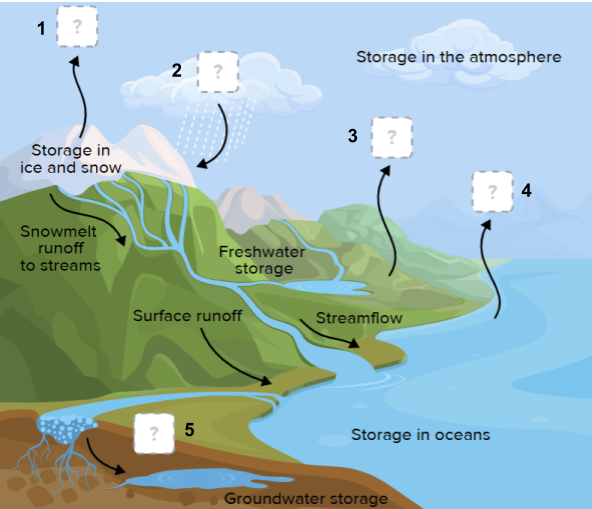
Name process 1 in the water cycle diagram. Describe the process.
Sublimation: The state change where a solid (ice or snow) changes directly to a gas (water vapor).
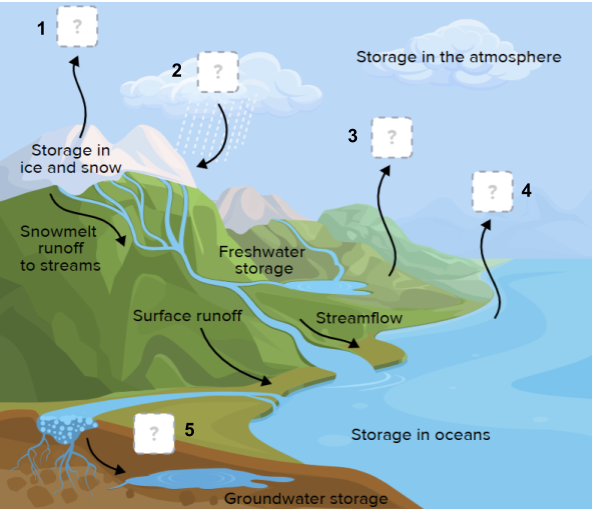
Name process 2 in the water cycle diagram. Describe the process.
Condensation: the process in which water vapor changes to tiny droplets of liquid water.
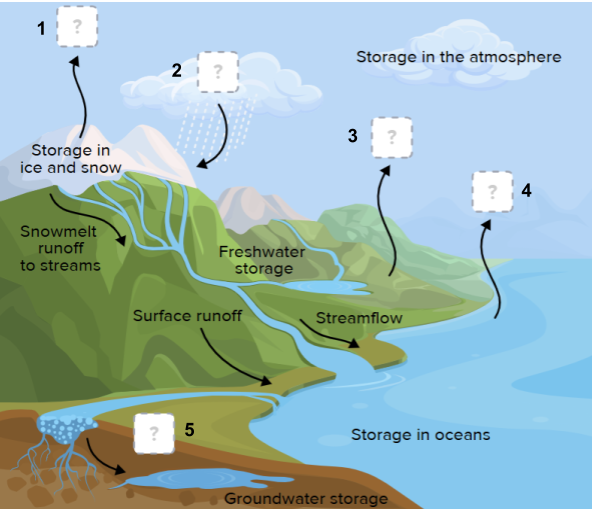
Name process 3 in the water cycle diagram. Describe the process.
Evapotranspiration: The evaporation that occurs from the land surface along with transpiration
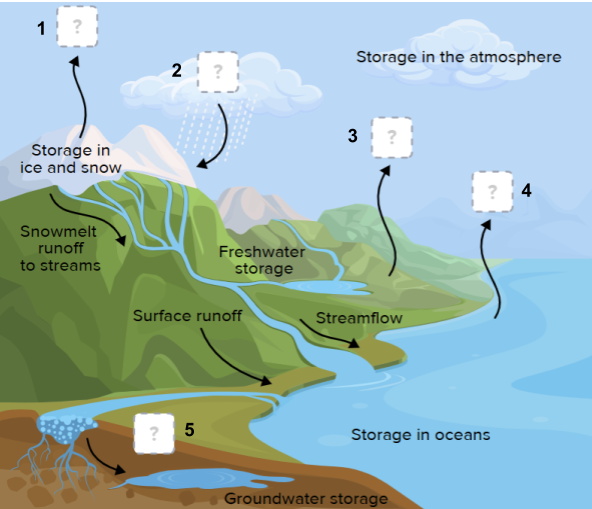
Name process 4 in the water cycle diagram. Describe the process.
Evaporation: The transformation of water from liquid to gas phases as it moves from the ground or bodies of water into the overlying atmosphere. The source of energy for evaporation is primarily solar radiation.
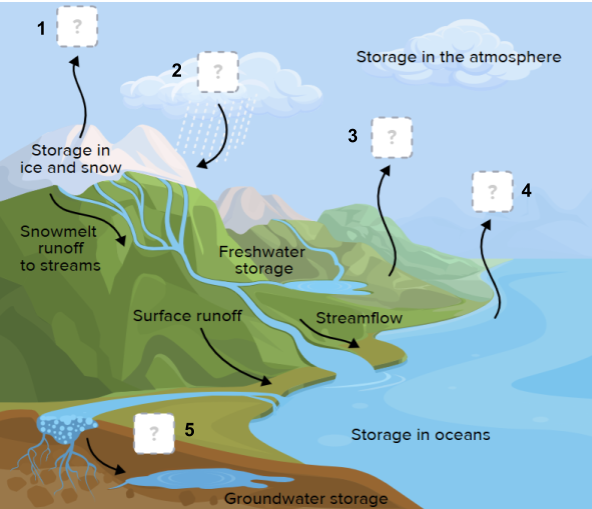
Name process 5 in the water cycle diagram. Describe the process.
Infiltration: The process in which water seeps into the ground, becoming groundwater.
Exchange pool
Part of a biogeochemical cycle that holds an element or water for a short period of time.
For example, the atmosphere for water - it usually holds water (in the form of water vapor) for just a few days.
Reservoir
Part of a biogeochemical cycle that holds an element or water for a long period of time
For example, the atmosphere for carbon dioxide.
Runoff
Water that flows over the land from precipitation or melting of snow or ice.
Canopy interception
The precipitation that is intercepted by plant foliage and eventually evaporates back to the atmosphere rather than falling to the ground.
Percolation
The movement of rainwater as it filters through soil and rocks into the ground, becoming groundwater.
How does the ocean influence coastal temperatures?
The ocean stores and slowly releases heat, keeping coastal areas warmer in winter and cooler in summer.
How does the ocean drive the water cycle?
The ocean provides most of the water vapor for clouds and precipitation through evaporation.
What do ocean currents do for global climate?
They move warm and cold water around the planet, redistributing heat and affecting weather patterns.
How do hurricanes form?
Hurricanes get their energy from warm ocean water.
Where in the atmosphere do most familiar weather phenomena occur in?
Troposphere (lower part of the atmosphere)
Difference between weather and climate
Weather: conditions of the atmosphere at a given time and place
Climate: the AVERAGE of weather over a long time
How does weather occur?
Density (temperature and moisture) differences between one location and another
What causes weather?
Unequal heating (of the Sun) on the atmosphere
Oceans and landforms receive sunlight → release (redistribution) or store it (storage)
Basically, how oceans and landforms interact with the energy released by the sun will determine what kind of weather we have.
Factor influencing the weather within the water
Currents - flow within the ocean caused by temperature and changes in salinity
Factor influencing the weather within the atmosphere
Wind - caused by unequal heating of the sun and the spinning of the earth
What do characteristics that influence weather all directly relate to?
Amount of energy that is in the system and where that energy is
Source: Sun
Gases in the air based on highest to lowest percentage
Nitrogen
Oxygen
Argon
Carbon dioxide
Water vapor
What happens to air density as we go higher?
At higher altitudes, the density of air decreases
Why is the density of air decreasing as we go higher in the atmosphere?
At higher altitudes, there is less air pushing down from above
Gravity is weaker farther from earth’s center
→ At higher altitudes, air molecules can spread out more → decreasing air density
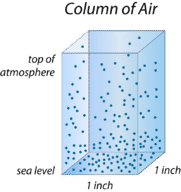
What happens to air pressure as we go higher?
At higher altitudes, the pressure of air decreases
Explain the properties of warm air
When air is warm, gas molecules are able to move freely and move more often → take up more space → lowering air density and air pressure
More buoyant (lighter), allowing it to rise
Explain the properties of cool air
When air is cool, gas molecules are sluggish, take up less space → increasing air density and air pressure (bc we have same number of molecules in less space, it’s packed more tightly)
Denser → sinks down
Name the layers of the atmosphere from lowest to highest
🌴 Troposphere (tropical: closest to the ground = warmest)
☁ Stratosphere (straggler clouds: clouds that are up in the sky but still slow)
⭕ Mesosphere (middle: middle)
🩲 Thermosphere (thermal underwear: 2nd to last layer of clothing)
💀 Exosphere (exoskeleton: outermost layer)
Describe the air temperature changes in troposphere
Temperature decreases 🥶 as we go higher ⬆️
Describe the air temperature changes in mesosphere
Temperature decreases 🥶 as we go higher ⬆
Describe the air temperature changes in stratosphere
Temperature increases 🥵 as we go higher ⬆
Why does air temperature in stratosphere increases with altitude?
Stratosphere absorbs a lot of energy from the sun at its upper layer → warmest at its highest point
Air at bottom strato = cold = dense = doesn’t rise
Describe the air temperature changes in thermosphere
Temperature increases 🥵 as we go higher ⬆
Troposphere
Lowest layer of the atmosphere
Goes from hot to cold as we go higher
Heat source:
Sunlight absorbed by earth and radiated to become heat
Gases pulled by gravity at surface (more gas = higher density = raises temp)
Warm air under cool air (still want to rise bc it has lower density); rising and sinking of air = weather
Temperature inversion
A situation in which warm air lies above cold air.
Cool air is dense → stays near the ground
Can trap air pollution near the surface
More common in the winter
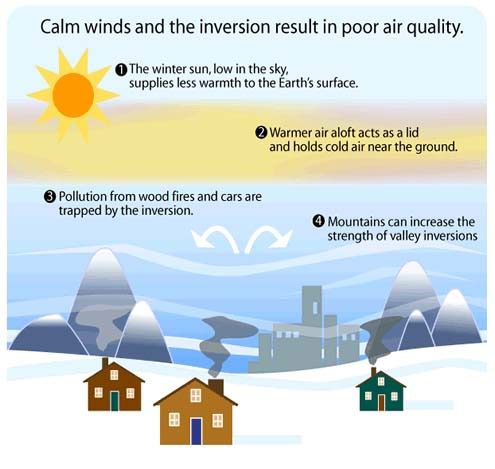
Temperature inversion and air pollution: how temperature inversion affect air quality
In winter, sun is low in the sky → less warmth supplied to Earth’s surface
Temp inversion - Warmer air aloft acts as a lid and holds cold air near the ground
Pollution from wood fires and cars = trapped by inversion
Mountains can increase strength of valley inversions
Tropopause
Thin layer of air at the top of troposphere, acting as a barrier that prevents cool air in troposphere from mixing with warm air in stratosphere
Stratosphere
Above troposphere
Goes from cold to hot as we go higher
Heat source: the sun
Warm air sits ABOVE cool air → stable, little turbulence (ideal zone for planes) ✈
Contains ozone layer
Ozone layer and UV radiation
The ozone layer has a higher concentration of ozone than other spots in the atmosphere.
UV radiation splits an O₂ molecule into two. Each atom combines with another oxygen molecule to create ozone, O₃.
Ozone reflects harmful UV light—radiation that has the ability to penetrate cells and DNA.
Mesosphere
Above stratosphere
Goes from hot to cold as we go higher
Heat source: stratosphere (this layer has too few gas molecules to absorb radiation)
Thermosphere
Above mesosphere
Where ionosphere (electric currents) and magnetosphere (auroras) are found
Ionosphere
Solar radiation ionizes gas to create positively and negatively charged ions, which form electric currents here.
Magnetosphere
Above the thermosphere.
Particles from solar flares are trapped in the Earth’s magnetic fields
An overload of particles can ionize oxygen and nitrogen, causing them to light up and form auroras.
Exosphere
Above thermosphere - outermost layer
Beyond the atmosphere = solar wind
Solar wind
High-speed particles traveling outward from the Sun
How does the Sun influence weather?
The Sun heats different parts of Earth unevenly, causing air movement (wind), temperature changes, and weather events.
What role do oceans play in weather and climate?
Oceans store and move heat around the planet, affecting temperatures, weather patterns, and climate.
How do oceans affect coastal climates?
Oceans keep coastal areas warmer in winter and cooler in summer compared to inland areas.
How does the water cycle influence weather?
The water cycle moves water and heat through the atmosphere, creating clouds, rain, snow, and other weather events.
Differential heating
The combined property of how land and water handle heat differently that explains land and sea breezes as well as thunderstorm and monsoons.
How do land and water differ in how they handle heat?
Land = metal spoon (heats up and cools down fast); has low specific heat = temp changes quickly
Water = thick soup (takes forever to get hot, stays warm for a long time); has high specific heat = temp changes slowly
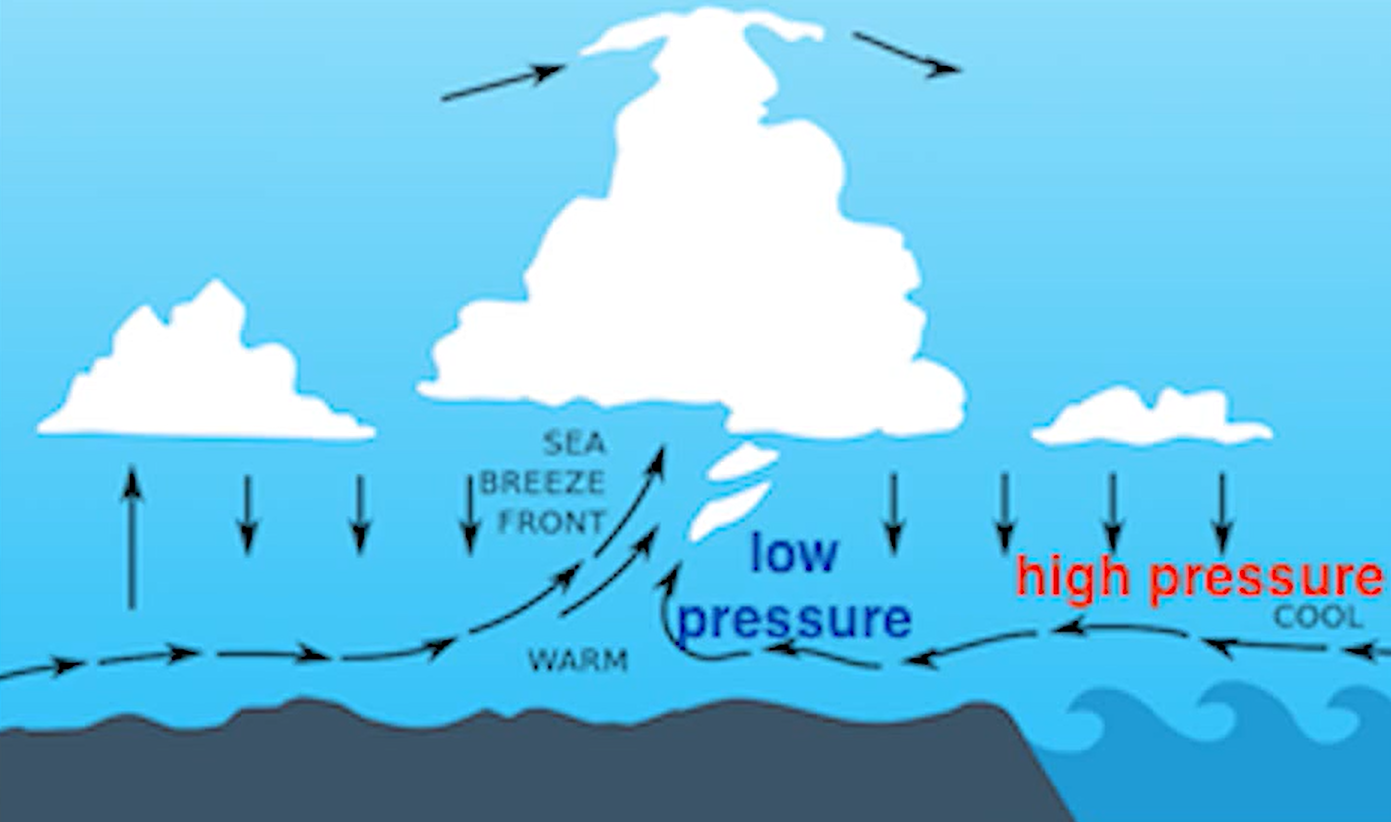
Differential heating in daytime (sea breeze)
During the day, the sun heats up the land and ocean
Land heats up faster
♨ Hot air rises off the land, acting like a vacuum that pulls cool air in from the ocean
Resulting in sea breeze, where ocean wind blows toward land
Differential heating in nighttime (land breeze)
At night, the sun is no longer heating land and ocean
Land cools down fast
BUT water stays warm
♨🌊 Hot air rises off the water → pulling cool air from the land out toward the sea
When does a Valley Breeze occur, and which way does the wind move?
During the day; wind moves upslope (from the valley up to the peaks).
When does a Mountain Breeze occur, and which way does the wind move?
At night/evening; wind moves downslope (from the peaks down into the valley).
Why do mountain slopes get warmer than valleys in the morning?
Because of geometry and first light; the peaks and slopes are higher up and catch the sun's rays earlier and more directly than the deep valley floor.
Which two forces combine to create a Mountain Breeze (downslope wind) at night?
Convection and gravity
What is the specific requirement for a sea surface temperature change to be defined as El Niño or La Niña?
A sustained temperature anomaly (change) of greater than 0.5°C in the central tropical Pacific.
What kind of water replaces the coast of South America during El Niño?
Warm, nutrient-poor tropical water.
During El Niño, what specific cold, nutrient-rich current is replaced/blocked?
The Humboldt Current (also known as the Peru Current).
How are ocean temperatures characterized during a La Niña event?
Unusually cold ocean temperatures in the eastern equatorial Pacific.
How does La Niña affect Atlantic tropical cyclones (hurricanes)?
Activity is generally enhanced (increased).