Metals in Synthesis
 Call Kai
 Learn
 Practice Test
 Spaced Repetition
 Match
 Flashcards
 Knowt Play
1/88

There's no tags or description
Looks like no tags are added yet.
89 Terms
How does π back bonding act on CO ligands? (2)
polarity: The empty antibonding π* orbitals of CO accept electron density from the metal t2g orbitals making Cδ+ and Oδ-
bond strength: weakening the carbonyl bond and strengthening the metal bond

How many valence electrons do class 1/2/3 octahedral complexes have?
12-22
≤18
18
What ligands are found in class 1/2/3 octahedral complexes?
weak field
strong field
strong field
What Oh complex class do a) 3d, b) 4d, c) 5d metals belong to?
a) 1
b) 2
c) 2
Electron counting (4 steps)
Treat metal and ligand as neutral
Count all valence electrons (4s, 3d) of the metal
Classify the ligands and include all electrons donated. Consider M-M bonding (nbonds=nelectrons to each metal) and bridging ligands
Adjust for the overall charge on the complex
Why are 18 electron Oh compounds stable?
all bonding molecular orbitals are filled, and antibonding unoccupied
What complexes deviate from the 18 electron rule? (2)
d8 square planar organometallics: dx2-y2 orbital is very high in energy (16 electron configuration)
Early transition metal compounds: low number of metal valence electrons and difficulty avoiding steric conflicts
How can a complex incapable of achieving the 18 electron rule be stabilized?
Very sterically demanding ligands can be used to stabilise them
What are the two types of ligand electron donors (neutral configurations)?
L type: 2 electron/neutral donor
X type: 1 electron/radical donor
What is the oxidation state of a) L and b) X type ligands (for calculating metal oxidation state)?
a) 0
b) -1; also applies to LnXn
TRUE OR FALSE: π back bonding is a characteristic unique to CO ligands
FALSE: ligands such as η2-Alkene/alkyne, NO, R3P can also participate

Agostic bonding
The C–H bonds of alkyl ligands can coordinate to electron deficient metals; α/β/γ-agostic based on position of carbon to metaé

Oxidative Addition
where X and Y must have an electronegativity greater than the metal
π-backdonation from electron rich complex breaks X-Y bond

What changes to a metal does oxidative addition result in? (3)
+2 coordination number
Mn+ to M(n+2)+
n+2 electrons; usually tending to 18 → increased stabilisation
What is the mechanism and therefore stereochemical outcome of an oxidative addition if X-Y is non polar (eg. H2)?
concerted; X and Y cis to one another

What is the mechanism and therefore stereochemical outcome of an oxidative addition if X-Y is polar/ has a leaving group?
stepwise; X and Y trans to one another

a) What is the mechanism (including intermediate) for reductive elimination and b) what structural feature does it require?
a) exact opposite to concerted oxidative addition
b) eliminated molecules cis to one another

Metathesis
A process formally involving the exchange of a bond (or bonds) between similar chemical species

1,1-migratory insertion
primarily with CO ligands when another ligand is added

1,2- migratory Insertion
primarily with η2 -coordinated alkenes or alkynes

TRUE OR FALSE: 18e compounds have a smaller barrier to β-hydrogen elimination
FALSE: Larger barrier
β-Hydride elimination

What effect does increasing electronegativity of the R groups of phosphine (PR3) have?
increases the size of the σ* lobe that points toward M making it more accessible for back donation therefore a better π acceptor
Tolman electronic parameter determination of electron donation for ligands
Stronger donor PR3 on (R3P)Ni(CO)3 increase the electron density on Ni, increasing back donation to CO and lowering v(CO) which means CO bond has been weakened
What complex is used for the Tolman electronic parameter of chelating ligands?
(L–L)Mo(CO)4
carbene

Describe the a) electron distribution, b) spin state, c) reactivity of singlet carbenes
a) in same p orbital
b) opposite; ↓↑
c) electrophile

Describe the a) electron distribution, b) spin state, c) reactivity of triplet carbenes
a) in different p orbital
b) same; ↑↑
c) nucleophile

What type of carbons do a) Schrock and b) Fischer ligands have?
a) triplet carbene
b) singlet carbene
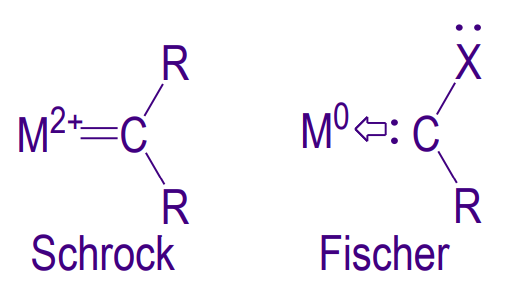
In Ln-M-CR2 where C belongs to a Fischer carbene, what kinds of a) R, b) M, c) L are preferred?
a) heteroatom with lone pair (eg. NR or OR)
b) mid-transition metals
c) good π-acceptor (strong field) co-ligands
Resonance structures for Fischer carbene
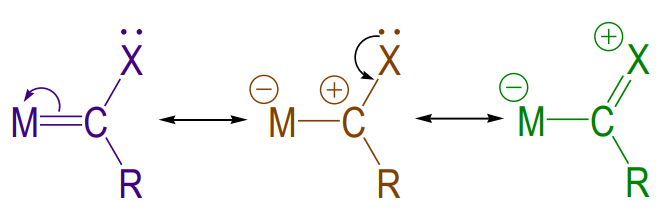
What type of ligands (in electron counting) are a) Fischer and b) Schrock carbenes?
a) L
b) X2
Resonance structures of M-CO
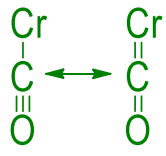
Preparation of Fischer carbenes (3 steps)
where R-= alkyl lithium and Me+= alkyl halide

In Ln-M-CR2 where C belongs to a Schrock alkylidene, what kinds of a) R, b) M are preferred?
a) alkyl or H
b) early transition metal in a high oxidation state
Resonance structures for Schrock alkylidene

Preparation of Schrock carbenes (2 paths)

Orbital diagram for Schrock carbene

Orbital diagram for Fischer carbene

N-heterocyclic carbenes a) structure and b) how they are made
a) see image
b) deprotonation of imidazolium salts (see image)
What are the steric effects of heterocyclic carbenes compared to regular carbenes?
the steric bulk of the R groups is directed toward the metal as opposed to cone angle
TRUE OR FALSE: N-heterocyclic carbenes dissociate easier than linear carbenes from the metal on the basis of steric crowding
FALSE (very strongly bound, in fact)
Grubb’s catalyst
N-heterocyclic carbene based
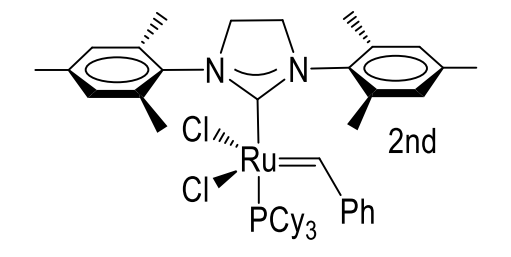
Homogenous catalysts a) advantages (4) and b) disadvantages (2)
a)
Selectivity
Heat dissipation
Greater activity
More accessible mechanistic insight
b)
Separation
Lack of stability
Heterogenous catalysts a) advantages (2) and b) disadvantages (3)
a)
Separation
Stability
b)
Stability depends on condition
Harder to gain mechanistic insight
Harder to optimize
How can transition metals act as catalysts? (4)
facilitates proximity of reactants
Coordination activates a reaction partner
Coordination of the substrate can facilitate nucleophilic attack
chiral catalysts can allow enantioselective synthesis
What is a necessity for transition metal catalysts? (2)
presence of vacant coordination sites or the ability to generate them
Stable in multiple coordination numbers and with ligand sets
Metal catalysts are typically…
Late TMs with d8 and d10 coordination electron counts

Water-gas shift reaction
inputs
outputs

What are challenges associated with using a) CH4 and b) CO2 feedstocks?
a) CH bonds are strong and cannot be selectively activated leading to overoxidation
b) very thermodynamically stable
C-H Activation (2 steps)
irradiation (photolysis)/ heat (thermolysis)→ reductive elimination of H2; 16 electron complex
oxidative addition of C-H; 18 electron complex
TRUE OR FALSE: f orbitals are able to more efficiently π back-bond than d orbitals because they are more extended
FALSE: unable to efficiently back bond
What ligands do lanthanides/ f orbitals bond with?
Charged and chelating ligands
What kind of complexes do lanthanides form with a) non-sterically and b) sterically hindered ligands?
a) if also carbanionic, polymers
b) monomers
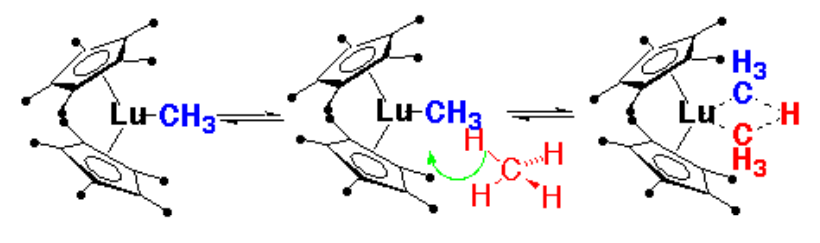
C-H bond activation with lanthanide catalyst
Wilkinson’s catalyst a) formula and b) reaction
a) [RhCl(PPh3)3]
b) convert alkenes to alkanes
η2-Alkene/alkyne complexes that π back bond effectively have carbons with δ(+/-) character making them susceptible to …
η2-Alkene/alkyne complexes that π back bond effectively have carbons with δ+ character making them susceptible to nucleophilic attack

What are the catalysts and their functions in Wacker oxidation?
Pd(II): C2H4 + H2O→ CH3CHO + H+
Cu(II): Pd(0) + 2Cu(II)→ Pd(II) + 2Cu(I)
Alkene metathesis

Ring-opening metathesis polymerisation
termination occurs only when a capping unit is added

Ring closing metathesis

Polymerisation via Cossee-Arlman mechanism

Preparation/ structure of a Ziegler-Natta Catalyst (3 steps)

What mechanism do Ziegler Natta catalysts polymerize by?
1,2 insertion
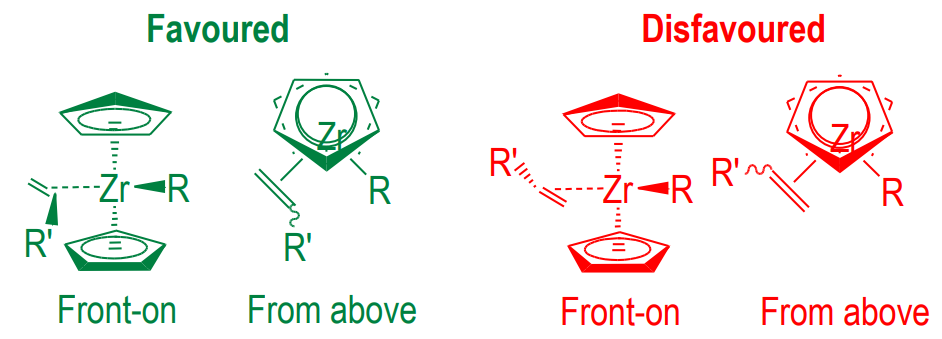
a) What are the two pathways to regiospecifically joining alkenes and b) which is preferred for Zirconocene catalysts and why?
a) head to head, head to tail
b) head to tail because it minimizes steric clash with ring
where head refers to the end of the alkene with most hindering substituent and tail to the opposite end
How is Ziegler-Natta catalysis terminated?
naturally occurring β-hydride elimination

What are the terms given to the relative orientation of neighbouring substituents on stereogenic carbon centres generated by polymerisation of substituted alkenes?


What tacticity of polymers will this catalyst give?
atactic

What tacticity of polymers will this catalyst give?
isotactic
How can catalytic activity of zirconocene catalysts be increased and what is the basis behind it?
tether rings together:
increase angle of alkene approach site → increase ability to coordination
reduce ring distance → improve selectivity by increasing steric effects


What tacticity of polymers will this catalyst give?
syntactic
Common mechanism for Pd catalysts for C-C bond formation
Where L= 1-3 L-type ligands

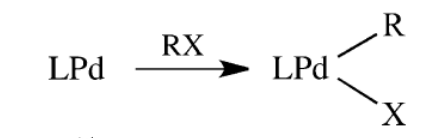
What is R in the Pd(0) catalyst complex and why?
typically aryl or vinyl to avoid β-hydride elimination.

What L is favoured in the Pd complexes and why?
Basic, bulky phosphines; favour/facilitate the oxidative addition

What is this palladium catalysed C-C bond forming reaction?
Mizoroki-Heck
Mizoroki-Heck catalytic cycle

a) What temperature do Mizoroki-Heck Pd catalysts decompose and b) what does this give; c) what is the effect?
a) above 120oC
b) Pd nanoparticles
c) bad selectivity
What are the two products potentially given by the Mizoroki-Heck reaction that immediately precede the 1,2-insertion?
non-polar (L) and polar (P)

What favours a) polar and b) non-polar Mizoroki-Heck pathways?
a) polar solvent, chelating ligands
b) strongly binding X-
Which type of Mizoroki-Heck pathway gives better enantioselectivity?
polar
In the pictured reagents, what is E in a) Stille and b) Suzuki reaction?
a) SnR3
b) B(OH)3
Stille OR Suzuki catalytic cycle

What cofactor is needed for a Suzuki reaction and why?
Base to form boronium ion; B-R4
Where R= 2x OH, 1x R group, 1x conjugate acid equivalent

Rank from most to least reactive the Suzuki halide containing reaction partners R-X if X= Cl/ Br/ I/ OTf (pictured)
I
OTf
Br
Cl
For coupling to occur, the partner groups must be in a) what configuration and b) how can this be promoted?
a) cis
b) chelating phosphine ligands
in Stille coupling, which reagents can/ cannot have β-H and why?
RX cannot (eg. Ph-C2H4-Br) because β-hydride elimination would occur when coordinated to the Pd
R2SnBu3 can have β-hydrogens because reductive elimination happens the quickest
Sonogashira coupling

Buchwald-Hartwig reaction
