Biology - lungs, heart, blood, metabolism
 Call Kai
 Learn
 Practice Test
 Spaced Repetition
 Match
 Flashcards
 Knowt Play
1/114

There's no tags or description
Looks like no tags are added yet.
115 Terms
Describe the path of air into the lung
(Nostrils)/(mouth->past epiglottis) → pharynx -> trachea -> bronchus -> broni=chiole, alveoli
What it the larynx
Voice box
Where is the epiglottis and what does it do
Back of your throat, it is a flap that opens when you breathe and closes when you swallow to stop things going down the wrong hole
What is the pleural cavity
Membrane that goes around each lung. It contains fluid that prevents friction
Why does the trachea produce mucus
To catch pathogens and particles as they move down in the trachea before they get into the lungs (there is no system to get it out of the lungs)
Why does the trachea have cilia
Helps to move the mucus back up into the mouth to get rid of pathogens and particles
Describe the bell jar model
Bell jar with a cork on the top, with a tube going through a hole in the cork. The tube splits into two, from which two balloons hang. Sheath at the bottom of the jar. When you pull down on the sheath, the balloons expand. When you let go they shrink
Evaluate the bell jar model
Ribs are supposed to expand, the jar doesn't
No smaller structures shown
Pleural cavity is too big, and there is not fluid in the model
Impact of the creation of a pressure gradient shown well
Simple and easily recognisable as the lungs
Describe what happens when you breathe in
Diaphragm contacts, going down and flat _ + intercostal muscles contract, moving the ribs up and out → volume of thorax increases → pressure falls in lung → pressure gradient created: higher pressure outside the lung than inside → air moves into the lung down the concentration gradient
Describe what happens when you breathe out
Diaphragm relaxes, moving upwards n + intercostal muscles relax, moving the ribs down and in → volume of thorax decreases → pressure in lung increases → pressure gradient created: higher pressure inside the lung than outside → air moves out of the lung down the concentration gradient
How are alveoli adapted for gas exchange
Walls are 1 cell thick -> short diffusion distance
Enormous surface area
Moist lining -> gases can dissolve into the moisture and diffuse faster
Excellent blood supply -> high maintained concentration gradient as oxygenated blood is always replaced with deoxygenated blood
How does a moist lining help the lung in a way other than diffusion
Reduces friction and prevents alveolus from sticking together
When blood moves away from the lungs it is …
Oxygenated
When blood moves towards the lungs it is
Deoxygenated
Oxygenated blood moves into the heart through the…
Pulmonary vein
From the pulmonary vein, blood goes to (not including valve)…
The left atrium
From the left atrium, blood goes to…
The left ventricle
What does the left ventricle do to push blood out
Pumps (muscles contract)
How do valves react to the left ventricle contracting
The bicuspid valve closes to prevent blood flowing back into the left atrium. Semilunar valve opens to allow blood out of the left ventricle
From the left ventricle, blood goes to (not valve)
aorta
When blood leaves the aorta, where does it go?
To the rest of the body
Deoxygenated blood moves into the heart through the…
Vena cava
From the vena cava blood goes to (not valve) 2 steps av
Right atrium —> right ventricle
From the right ventricle blood goes to
The pulmonary artery
When blood leaves the pulmonary artery, where does it go
To the lung to get oxygenated
What valve is between the right atrium and the right ventricle
Tricuspid
What valve is between the right ventricle and the pulmonary arteries
Semilunar (same as on the left side)
When looking at a diagram of the heart, your left is actually…
On the right
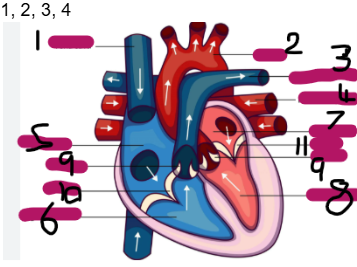
1, 2, 3, 4
Vena cava
Aorta
Pulmonary artery
Pulmonary vein

5, 6, 7, 8
Right atrium
Right ventricle
Left atrium
Left ventricle
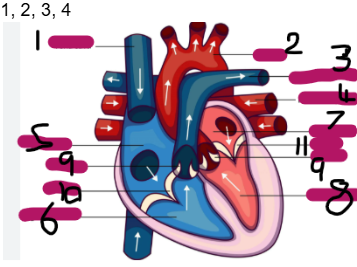
9, 10, 11
Semi lunar valves
Tricuspid valve
Bicsupid valve
Arteries move…
Away from the heart (aorta is an artery)
Veins move …
Towards the heart (vena cava is a vein)
Artery blood pressure
Very high - it has just come from the ventricles
Artery wall structure + how does this aid its function
Thick (=strong and able to cope with high blood pressure) and elasticated (=is able to stretch when blood surges)
Artery Lumen diametre
narrow
Artery oxygenated or deoxygenated blood?
Normally oxygenated (except for the pulmonary artery which travels from the heart to the lungs)
Capillary blood pressure
Usually low pressure as they are far from the heart
Capillary wall structure (+how does this relate to its function)
Capillary walls are 1 cell thick. This helps to allow faster diffusion of substances, as the role of the capillary is to transport glucose and oxygen to the cells, and to transport carbon dioxide and urea away from them
Capillary Lumen diametre
tiny
Capillary Oxygenated or deoxygenated blood
Both - oxygenated, but it then gives this oxygen to the cells and becomes deoxygenated
Vein blood pressure
Low, as they are travelling back to the heart
Vein wall structure + how does this relate to its function
Thinner elasticated muscle tissue (lower pressure means it does not need to be as thick and strong as artery walls)
Wide lumen = allows as much blood to flow as possible
Valves prevent the backflow of blood, ensuring it only flows in 1 direction
Vein lumen diametre
wide
Vein oxygenated or deoxygenated blood
Usually deoxygenated except for the pulmonary vein which comes from the lungs to the heart
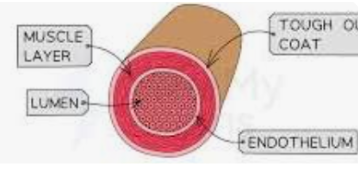
Artery, vein, or capillary?
artery

Artery, vein, or capillary?
vein
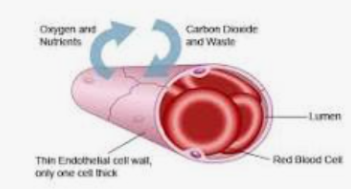
Artery, vein, or capillary?
capillary
What are the 4 components of blood
Plasma, platelets, red blood cells, white blood cells
What is the role of red blood cell
To deliver oxygen from the lungs around the body, and to receive carbon dioxide from cells by diffusion
Adaptations of a red blood cell and how this affects its function
No nucleus = more room for haemoglobin (haemoglobin contains a protein which carries oxygen)
Biconcave shape = it is flexible and can squeeze through narrow blood vessels like capillaries + it has a greater surface area, allowing for faster diffusion
General features of white blood cells
Much larger than red blood cells, can change shape, contains a nucleus
What is the role of white blood cells? What 3 ways can they achieve this
Defend the body against infections.
Produce antibodies - bind to a specific antigen to destroy the pathogen
Produce antitoxins - destroy toxins released into the body (e.g. in a snakebite)
Phagocytosis - engulfing and digesting pathogens
Where are white blood cells and red blood cells produced? From what?
Stem cells in the bone marrow
What is plasma? What does it contain? What does it do?
Straw coloured, yellow fluid. It is mostly water with substances like glucose, amino acids, hormones, urea, carbon dioxide. It allows substances to diffuse, and allows the blood to flow around the body
What are platelets? What is their role?
Fragments of cells (mostly from the cytoplasm of larger cells). They have no nucleus. Their role is to clot blood, creating a temporary fix with the skin is cut, preventing both internal and external bleeding.

Plasma
Red blood cell
Platelets
White blood cell
Aerobic respiration word and symbol equation
Glucose + oxygen -> carbon dioxide + water + energy released
C6H12O6+6O2 -> 6CO2 + 6H2O
Anaerobic respiration in MUSCLES word equation
Glucose -> lactic acid + energy released
Anaerobic respiration in YEAST CELLS word equation
Glucose -> ethanol + carbon dioxide + energy released
Anaerobic or aerobic respiration: glucose is oxidised to release energy
aerobic
Anaerobic or aerobic respiration: occurs in both the cytoplasm and the mitochondria
aerobic
Anaerobic or aerobic respiration: used most of the time by most organisms
aerobic
Anaerobic or aerobic respiration: less efficient
anaerobic
Anaerobic or aerobic respiration only in cytoplasm
anaerobic
Anaerobic or aerobic respiration: only for short times, like running a race
anaerobic
What is anaerobic respiration in yeast cells called
Fermentation
How are yeast cells used to make bread
Dough contains yeast cells and glucose -> anaerobic respiration produces carbon dioxide. Bubbles of gas cause the dough to rise as it cooks (these bubbles expand) -> making bread
*the ethanol is burnt off
How are yeast cells used to make alcohol
Yeast cells are rapidly reproducing in alcohol production -> oxygen runs out -> forces them to switch to anaerobic respiration ->producing ethanol
Respiration is exo/endothermic. How does this help
Exothermic -> heat produced circulates throughout the body through blood
Organisms need energy produced in respiration for
Movement
Chemical reactions to produce molecules (e.g. amino acids -> proteins, glucose -> starch)
Cell division
Active transport
Transmission of nerve impulses
Keeping warm
Draw a labelled heart

This is referred to as oxygen debt as you anaerobically respire because you do not have enough oxygen, but the cells in the liver require oxygen to break down the lactic acid produced
If LDLs deposit too much cholesterol here, it can build up
This can form a plaque over time, making the artery more and more blocked
Blood flow to the heart is reduced (+pressure increases which can lead to a burst)
Blood clots often form in the blood, and, if one flows through this artery, it may get stuck as the tube is narrowed
If it is trapped, all blood flow to the heart is stopped
Muscle tissue in the heart will die because the cells have no oxygen to respire
This leads to a myocardial infarction
Faster heart rate → high blood pressure → damage to artery walls
Nicotine makes platelets stickier → clump together to form larger blood clots → arteries blocked more easily
Carbon monoxide combines with haemoglobin irreversibly → less oxygen carried by red blood cells
High salt diet → water moved out of cells through osmosis → blood pressure increases → potentially damaging artery walls
High vitamin diet → repairs damage to artery walls
High levels of obesity → increased blood pressure → damage to artery walls
High levels → decreased levels of cholesterol → less deposited by LDLs → arteries not blocked
Low levels → heart is inefficient, artery walls are less elastic (so cannot deal with high blood pressure), heart rate increases
Increases blood pressure → vessels damaged
Calorie rich → increased cholesterol, blood pressure
Effects the rhythm of the heart
Adrenaline also constricts the artery walls → more likely to get blocked