Comp Math P1 A(1) Guide
 Call Kai
 Learn
 Practice Test
 Spaced Repetition
 Match
 Flashcards
 Knowt Play
1/25

There's no tags or description
Looks like no tags are added yet.
26 Terms
Laws of Indices (Negative & Zero Index)
a^(m-n) * b^p.
TRAP: Forget to apply the negative index to all terms inside a bracket, e.g., (2x)^-1 = 1/(2x), NOT 2/x. Anything to the power of 0 is 1 (a^0 = 1).

Profit and Loss Percentage
S = C * (1 + Profit%) OR S = C * (1 - Loss%).
TRAP: Do NOT calculate profit percentage based on selling price! Profit% = (S - C)/C * 100%.
Discount and Marked Price
S = M * (1 - Discount%).
TRAP: Confusing Marked Price with Cost. Discount is ALWAYS applied to Marked Price, not Cost! Discount% = (M - S)/M * 100%.
Compound Interest Formula
TRAP: Forgetting to subtract Principal (P) when asked for "Interest" only! Interest = Amount - P. If compounded half-yearly, k=2; quarterly, k=4; monthly, k=12.

Base Conversion (Binary to Denary)
12^4 + 12^3 + 12^2 + 02^1 + 1*2^0 = 16 + 8 + 4 + 0 + 1 = 29. TRAP: Counting powers of 2 from left to right instead of right to left. The rightmost digit is always 2^0. MC Shortcut: Use Calculator BASE mode (BIN -> DEC).

Base Conversion (Expanded form to Binary)
Convert 2^16 + 2^11 + 2^7 + 2 to binary: 10000100010000010_2. REQUIRED MARKING STEP: Ensure every missing power of 2 from 16 down to 0 is represented by a '0'. 2 is 2^1, so 2^0 is 0. TRAP: Forgetting the final zero for 2^0 if there is no constant term.

Compound Inequalities (AND)
Solve x > -2 AND x <= 3: Result is -2 < x <= 3. (Overlapping range).
TRAP: Reversing inequality signs when multiplying/dividing by a negative number is the #1 mistake!

Compound Inequalities (OR)
Solve x < -2 OR x >= 3: Result is x < -2 or x >= 3. (Take all ranges). TRAP: Writing "-2 > x >= 3" is mathematically invalid. Keep them separated by "or". If it was "x > -2 or x <= 3", the answer is "All real numbers". [IMAGE NEEDED: Number line showing arrows pointing outwards from -2 and 3 | Source: Unit 8 Inequalities]

Subject of Formula (Factorization Trap)
Make x the subject of y = (ax + b) / (cx + d): y(cx + d) = ax + b => cyx + dy = ax + b => cyx - ax = b - dy => x(cy - a) = b - dy => x = (b - dy) / (cy - a).
REQUIRED MARKING STEP: Group all 'x' terms on one side, factorize 'x' out, then divide. TRAP: Dividing by a variable before factorizing.

Ratio and Proportion (Continuous Ratio)
If a:b = 3:4 and b:c = 6:7, find a:b:c: Make the 'b' values equal. LCM of 4 and 6 is 12. a:b = 9:12. b:c = 12:14. Result: a:b:c = 9:12:14. TRAP: Adding ratios directly or assuming a=3 and c=7 without unifying b.

Variations (Partial / Joint)
"z partly varies directly as x, and partly varies inversely as y". Equation: z = k1x + k2/y. REQUIRED MARKING STEP: Must explicitly write "where k1, k2 are non-zero constants" for full marks in Paper 1. TRAP: Writing z = k1x + 1/y (forgetting the second constant).

Mensuration (Cylinder & Sphere Volume)
Cylinder V = pi * r^2 * h. Sphere V = (4/3) * pi * r^3. TRAP: Using diameter instead of radius. Premature rounding of pi in intermediate steps (always keep EX ACT pi or use calculator memory).

Mensuration (Cone & Sphere Surface Area)
Cone TSA = pirl + pir^2 (where l = slant height = sqrt(r^2 + h^2)). Sphere SA = 4pir^2. TRAP: Forgetting to add the base area (pir^2) for a SOLID cone when calculating Total Surface Area.

Polygons (Interior & Exterior Angles)
Interior Sum = (n - 2) * 180 degrees. Exterior Sum = 360 degrees. REQUIRED WORKING PHRASES: "(sum of polygon)", "(sum of ext. angles of polygon)". TRAP: Confusing sum of interior angles with ONE interior angle of a regular polygon (which is (n-2)*180/n).

Geometry (Angles & Parallel Lines)
Corresponding: a = b (corr. angles, AB // CD). 2. Alternate: c = d (alt. angles, AB // CD). 3. Interior: e + f = 180 degrees (int. angles, AB // CD). TRAP: Missing the "// CD" condition in the reason bracket loses the step mark! [IMAGE NEEDED: Parallel lines cut by transversal showing alt, corr, and int angles | Source: Unit 10 Geometry]

Statistics (Mean, Median, Mode from Table)
Mean = Sum of (Class Mark * Frequency) / Total Frequency. Median = Middle value(s) of the ordered dataset. TRAP: Finding the median of the frequencies instead of the data values.

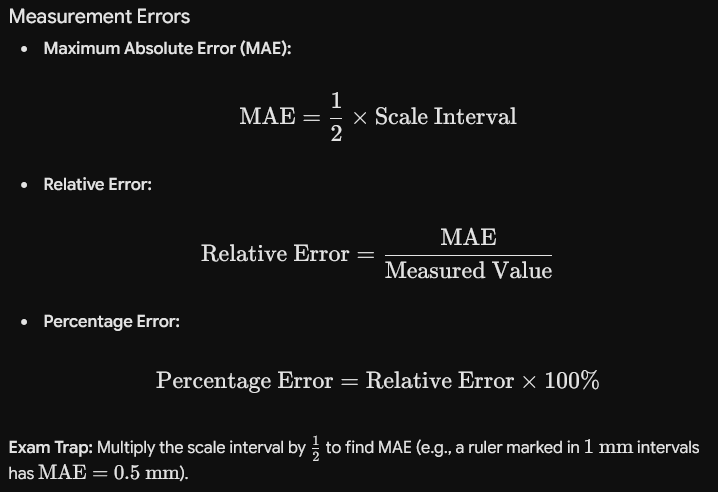
Errors (Max Absolute Error)
Max Abs Error = (1/2) * Scale interval. Relative Error = Max Abs Error / Measured value. Percentage Error = Relative Error * 100%. TRAP: Forgetting the (1/2) for Max Abs Error. A ruler with 1mm markings has a Max Abs Error of 0.5mm.
Map Scale and Area
If Scale is 1:k, Actual Length = Map Length * k. Actual Area = Map Area * k^2. TRAP: Forgetting to square the scale factor for area calculations! Example: 1:1000 means 1 cm^2 on map = 1000^2 cm^2 in reality.
Sector Area and Arc Length
Arc Length = 2 * pi * r * (θ/360). Sector Area = pi * r^2 * (θ/360). Perimeter of Sector = Arc Length + 2r. TRAP: Forgetting to add the two radii (2r) when asked for the PERIMETER of a sector.

Coordinate Transformations (Rotation about Origin)
90 deg anticlockwise: (x, y) -> (-y, x). 90 deg clockwise: (x, y) -> (y, -x). 180 deg: (x, y) -> (-x, -y). TRAP: Confusing clockwise and anticlockwise rules, or forgetting to swap the x and y coordinates during 90-degree turns.
Coordinate Transformations (Reflection)
Reflect across x-axis: (x, y) -> (x, -y). Reflect across y-axis: (x, y) -> (-x, y). Reflect across line y=x: (x, y) -> (y, x). TRAP: Reflecting across the x-axis changes the Y-sign, NOT the x-sign!

Algebraic Identities Difference of Two Squares
Exam Trap: Always place brackets around composite terms when expanding or subtracting. Missing sign distribution in the second bracket (writing x−y+1 instead of x−y−1) is a primary loss of marks.

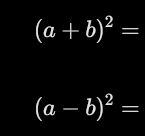
Perfect Squares
ssssssssssss

Remainder Theorem & Division Algorithm
sssssssssss

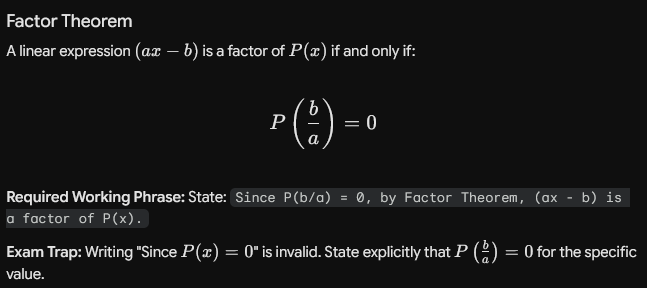
Factor Theorem
wwwwwwwwwwwww
Equations & Formulas