Patho Exam 1 block 3
 Call Kai
 Learn
Learn Practice Test
 Spaced Repetition
 Match
Match Flashcards
 Knowt Play
1/133

Earn XP
Description and Tags
Name | Mastery | Learn | Test | Matching | Spaced | Call with Kai | Chat |
|---|
No analytics yet
Send a link to your students to track their progress
134 Terms
Genome Mutations
involve loss or gain of an entire chromosome
Chromosomal Mutations
which involve alterations in one or more chromosomes
Gene mutations
which are partial or complete deletion of the gene or
alteration of the nitrogenous base - usually lead to death of fetus or during start of life.
What is pleiotropy
Pleiotropy is when one gene influences multiple different traits or characteristics in an organism.
What is polygenic inheritance?
A pattern of inheritance in which multiple genes contribute to one trait or condition. ie skin color
What does multifactorial inheritance mean?
A trait or disease is influenced by multiple genetic factors and often environmental factors.
Name four diseases that may have a genetic component and follow a multifactorial inheritance pattern.
Coronary artery disease, hypertension, gout, and diabetes mellitus.
What is the difference between polygenic inheritance and pleiotropy?
Polygenic inheritance: multiple genes influence one trait. Pleiotropy: one gene influences multiple traits.
Hereditary or familial
A condition derived from parents (i.e., transmitted in the germ line)
Congenital
A condition that is present at birth
Are all hereditary conditions congenital?
No, not all hereditary conditions are congenital; some may manifest later in life.
Are all congenital conditions hereditary?
No, not all congenital conditions are hereditary; some arise from environmental factors.
When looking at chromosome 12 which arm is 12p3?
Short arm band 3
When looking at chromosome 12 which arm is 12q5?
Long arm band 5
What is an autosomal dominant disorder?
A genetic disorder caused by a disease-associated allele on an autosome, where one copy of the allele can be sufficient to produce the phenotype.
What does reduced penetrance mean?
Not everyone who carries a disease-associated genotype expresses the associated phenotype.
Do autosomal dominant disorders usually encode enzymes?
No, they often involve structural proteins or regulatory molecules. (a loss of 50% of an enzyme’s activity can be compensated for by activity of the enzyme encoded by the normal allele
Familial Hypercholesterolemia Mutation
Low-density lipoprotein receptor gene (LDLR); there are more than 900 known mutations.
Familial Hypercholesterolemia Mechanism
The LDL receptor recognizes apolipoprotein B100 (ApoB100) or apolipoprotein E (ApoE); therefore, a mutation of the receptor results in impaired uptake of cholesterol into cells.
Familial Hypercholesterolemia Manifestations
Elevated cholesterol level; Heterozygotes have half the normal amount of LDL receptors and two or three times the normal level of cholesterol; homozygotes have five or more times the normal level of cholesterol.
– Early atherosclerosis and its consequences; homozygotes usually die of cardiovascular disease before the age of 30 years
What is the function of the PCSK9 gene
The PCSK9 gene provides instructions for making a protein that helps regulate the amount of cholesterol in the bloodstream.
What does the PCSK9 protein do to LDL receptors (LDLR)?
PCSK9 binds to and promotes the breakdown of LDL receptors before they reach the cell surface.
What is the effect of a gain-of-function mutation in PCSK9?
It enhances PCSK9 activity, leading to increased breakdown of LDL receptors and fewer LDL receptors on the cell surface.
What phenotype can result from a gain-of-function mutation in PCSK9?
Familial hypercholesterolemia, characterized by elevated LDL cholesterol levels.
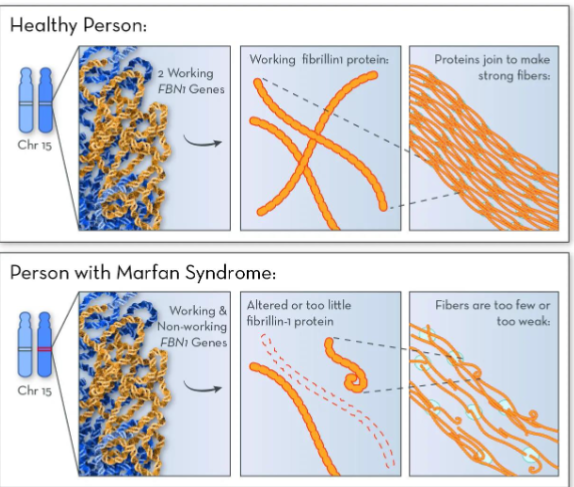
Marfan Syndrome
is an autosomal dominant disorder of connective tissues, manifested principally by changes in the skeleton, eyes and cardiovascular system.
Marfan Syndrome Mutation
Fibrillin-1 (FBN1) gene on chromosome 15q21.
Marfan Syndrome Machanism
The extracellular glycoprotein, fibrillin, is secreted by fibroblasts, provides support for deposition of tropoelastin and the production of elastic fibers (loss of microfibrils increases TGF-β)
Marfan Syndrome Manifestations
Skeletal: long arms and legs and long fingers.
Eye: Bilateral dislocation of the lens (ectopia lentis).
Cardiovascular: Aortic root dilation, floppy valve syndrome, congestive heart

Cystic Fibrosis Mutation
Cystic fibrosis transmembrane conductance regulator (CFTR) gene on chromosome 7; (CFTR is expressed in the exocrine glands and the epithelial linings of the respiratory, GI and reproductive tracts).
Cystic Fibrosis Mechanism
Impaired resorption of chloride from the lumen of the sweat ducts, with resultant impaired absorption of sodium; impaired secretion of chloride into the airways, pancreatic ducts, and the GI tract, resulting in less secretion of sodium and water and, therefore, viscid (sticky) secretions.

Cystic Fibrosis Manifestations
Fibrosis of the pancreas, recurrent pulmonary infections (Psuedonomas aeruginosa), chronic bronchitis, pancreatitis, diabetes, biliary cirrhosis (impaired absorption of Vitamins A,D,E and K), and infertility in males (bilateral obstruction of the vas deferens).
Phenylketonuria (PKU) Mutation
Gene for phenylalanine hydroxylase (PAH).
PKU Mechanism
Hyperphenylalaninemia (inability to convert phenylalanine to
tyrosine).
PKU Manifestations
Untreated PKU can cause severe intellectual disability, seizures, and decreased skin pigmentation.
These complications can largely be prevented by restricting phenylalanine in the diet.
Pregnancy: If a woman with PKU stops dietary treatment, high phenylalanine levels can cross the placenta and increase the risk of birth defects and neurological problems in the baby.
What are the two most common forms of lysosomal storage disorders?
Gaucher disease and Tay-Sachs disease
What is the primary cause of most lysosomal storage disorders?
The absence or deficiency of a lysosomal enzyme.
What happens when a lysosomal enzyme is absent?
Its substrate cannot be properly degraded, so it builds up and accumulates inside lysosomes.
Which type of cell commonly accumulates substrate in lysosomal storage disorders?
Macrophages
Why are the liver and spleen often enlarged in lysosomal storage disorders?
Macrophages in these organs accumulate undegraded substrate, contributing to organ enlargement.
Which organs are commonly enlarged in lysosomal storage disorders?
The spleen and liver. Lymph nodes may also be enlarge
What is the inheritance pattern of lysosomal storage diseases
Autosomal recessive
What does autosomal recessive inheritance mean?
An individual generally needs two disease-associated alleles, one inherited from each parent, to develop the recessive disorder.
True or False: Lysosomal storage disorders usually result from excessive enzyme activity.
False. Most are due to the absence or deficiency of a lysosomal enzyme.
Complete the pathway: Enzyme deficiency → ______ → accumulation in lysosomes.
Impaired substrate degradation.
Do all lysosomal storage disorders have the exact same clinical presentation?
No. Different enzyme deficiencies cause accumulation of different substrates and can lead to different clinical features.
Gaucher Disease Mutation
Gene for β-glucocerebrosidase (GBA).
Gaucher Disease Mechanism
A mutation in the GBA gene leads to a deficiency of the enzyme β-glucocerebrosidase, resulting in the accumulation of glucocerebroside in lysosomes.
Accumulation of glucocerebroside occurs in organs with a high concentration of phagocytic cells (e.g., spleen, liver, lymph nodes).
Type I (3 total): Chronic non-neuropathic form represent 99% of cases of Gaucher disease. Presents later in childhood or early adulthood.
Gaucher Manifestations
Symptoms include splenomegaly, hepatomegaly, bone pain, and anemia. Type I is characterized by a non-neuropathic presentation.
Affected phagocytes become enlarged and accumulate in the liver, spleen and bone marrow causing hepatosplenomegaly and bone erosion.
Tay Sachs Disease Mutation
Deficiency of one of the genes encoding for lysosomal enzymes that catabolize gangliosides (glycolipid), hexosaminidase (HEXA)
Tay Sachs Disease Manifestations
Ballooned neurons leading to progressive neurological deterioration (motor and mental) and involvement of ganglion cells in the retina causing a cherry-red spot. Signs and symptoms develop by the age of 6 months; death usually occurs by the age of 2 to 3 years.
What is X-linked recessive inheritance?
A pattern of inheritance involving mutations in genes located on the X chromosome.
Why is a male carrying an X-linked recessive mutation generally affected?
Males typically have one X chromosome (XY). If that X chromosome carries the disease-associated mutation, they do not have a second X chromosome with a corresponding normal copy to compensate.
Why is a female carrying one X-linked recessive mutation generally unaffected?
Females typically have two X chromosomes (XX). A normal copy of the gene on the other X chromosome often provides sufficient function, so the female is generally unaffected but may be a carrier.
What is a carrier in X-linked recessive inheritance?
A female who has one mutated X chromosome and one normal X chromosome, which may pass the mutation to offspring but typically does not express the associated condition.
True or False: A male can be an unaffected carrier of a typical x-linked recessive condition
False
What is the difference between autosomal recessive and X-linked recessive inheritance?
Autosomal recessive conditions involve genes on autosomes and generally require two disease-associated alleles. X-linked recessive conditions involve genes on the X chromosome, and males with one disease-associated allele are generally affected.
Duchenne Muscular Dystrophy Mutation
Dystrophin (DMD) gene at Xp21.
Duchenne Muscular Dystrophy Mechanism
In skeletal and cardiac muscles, dystrophin is part of a protein complex that strengthen muscle fibers and protects them from injury as muscles contract and relax. In dystrophin deficiency, the cell membrane of the muscle fiber is damaged when the muscle contracts.
Duchenne Muscular Dystrophy Clinical Presentations
Disease manifests by age 5. Associated muscular weakness leads to immobility by the early teens and usually death by early twenties. Cardiomyopathy and nonprogressive cognitive abnormalities are common.
Duchenne Muscular Dystrophy Signs and Symptoms
Weakness of pelvis first, with delayed ability to walk; pseudohypertrophy (calf muscles enlarge due to fat replacement), and muscle atrophy.

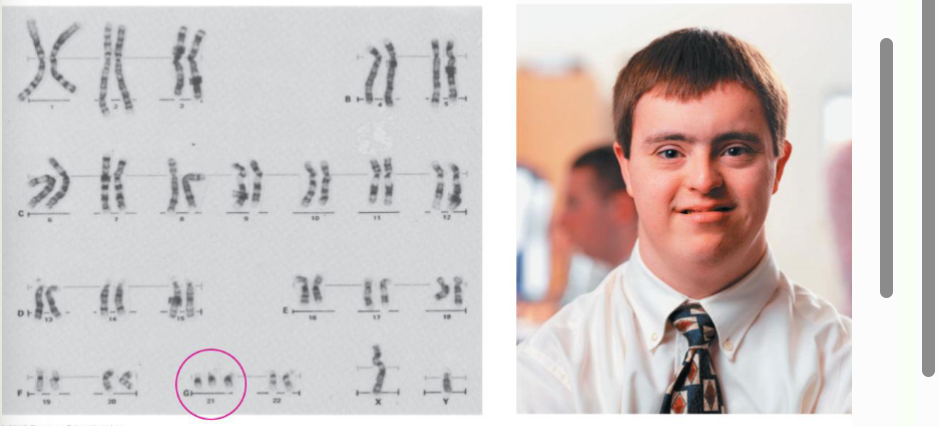
What is Trisomy 21?
Down Syndrome
What is the most common cause of Down syndrome?
Maternal meiotic nondisjunction, accounting for approximately 95% of cases
What is meiotic nondisjunction?
Failure of chromosomes to separate properly during meiosis, resulting in gametes with an abnormal number of chromosomes.
During which stages of meiosis can nondisjunction occur?
Anaphase I, when homologous chromosomes fail to separate, or anaphase II, when sister chromatids fail to separate.
What is a Robertsonian translocation?
A chromosomal rearrangement involving the long arms of acrocentric chromosomes, in which chromosome material becomes joined to another chromosome.
Approximately what percentage of Down syndrome cases are due to a Robertsonian translocation
Approximately 4%.
Which chromosomes are mentioned as possible partners in a Robertsonian translocation involving chromosome 21?
Chromosomal piece from the long arm (q) of chromosome 21 to the q arm of another acrocentric chromosome, such as 14 or 22)
What is an acrocentric chromosome?
A chromosome with its centromere near one end, giving it a very short p arm and a long q arm. Chromosomes 13, 14, 15, 21, and 22 are human acrocentric chromosomes.

Manifestation of Trisomy 21
Intellectual disability, flat facial profile and epicanthal folds; congenital heart defects, early development of Alzheimer's, increased risk of leukemia.
What is Trisomy 18 also called
Edward Syndrome
What is the incidence of Trisomy 18
Approximately 1 in 8,000 live births.
What is a prominent occiput?
A noticeably prominent or projecting back portion of the skull.
What ear abnormality is associated with Trisomy 18?
Low set ears
What jaw abnormality is associated with Trisomy 18?
A small jaw (micrognathia)
What neurological manifestations are associated with Trisomy 18?
Intellectual disabilities, cerebellar abnormalities, and brainstem abnormalities.
What cardiac manifestation is associated with Trisomy 18?
Congenital heart disease.
What foot abnormality is characteristic of Trisomy 18?
Rocker-bottom feet with a prominent heel and a convex sole.
What is the prognosis for patients with Trisomy 18?
Almost all patients die during the first year of life, with apnea listed as a cause.
What is trisomy 13 also called
Patau Syndrome
What are the incidence rates of Trisomy 13
1 in 15,000 live births.
What are the manifestations of Trisomy 13
Microphthalmia (Abnormally small eye(s)), holoprosencephaly (how the brain develops), intellectual disability, polydactyly (Extra fingers or toes), cleft lip and palate, congenital heart disease, and rocker-bottom feet.

True or false: almost all patients with Trisomy 13 die within the first year of life
True
What is Klinefelter Syndrome?
A chromosomal condition affecting males, typically involving one or more extra X chromosomes along with a Y chromosome. It is associated with hypogonadism.
What is the most common karyotype associated with Klinefelter syndrome?
47, XXY in 82% of cases
What is the incidence of Klinefelter syndrome
Approximately 1 in 500 live births
What hormonal changes occur in Klinefelter syndrome?
Increased follicle-stimulating hormone (FSH) and decreased testosterone
What is hypogonadism?
Reduced function of the gonads, resulting in impaired sex hormone production and/or reproductive function.
What testicular abnormality is associated with Klinefelter syndrome?
Atrophic (small or underdeveloped) testes. Microphallus (small penis).
What reproductive consequence is associated with Klinefelter syndrome?
Sterility or infertility, commonly related to impaired sperm production.
Why can individuals with Klinefelter syndrome have tall stature?
increased length between the sole of the foot and the pubic bone, resulting in long legs.
What happens to body hair in Klinefelter syndrome?
It is reduced
If you have Klinefelter syndrome, how much of an increased risk do you have of getting breast carcinoma?
20x
What is a Barr body? (Klinefelter)
An inactive X chromosome found in the nucleus of a cell
What is turner syndrome
A chromosomal condition associated with female hypogonadism and the absence of all or part of one X chromosome.
What is the classic karyotype associated with Turner syndrome?
45, XO (also written 45, X).
What percentage of Turner syndrome cases are XO
57%
What percentage of Turner syndrome cases have structural abnormalities of the X chromosome
14%
What percentage of Turner syndrome cases are mosaics
29%
What does mosaicism mean?
The presence of two or more genetically different cell populations within the same individual, resulting from changes during development.
What type of reproductive or endocrine condition is associated with Turner syndrome?
Female hypogonadism, involving reduced ovarian function.