Enzyme Kinetics
 Call Kai
 Learn
 Practice Test
 Spaced Repetition
 Match
 Flashcards
 Knowt Play
1/56

There's no tags or description
Looks like no tags are added yet.
57 Terms
define enzyme kinetics
study of the enzymatic rct rate

define the Ks.
k1 = formation of ES (enzyme-substrate complex)
k-1 = breakdown of ES (enzyme-substrate complex)
k2 = formation of P (product)
k-2 = breakdown of P (product)
what is the steady state assumption
ES formation rate = ES breakdown rate
define this [ET] = [ES] + [E]
total amount of enzyme = enzyme binded to the substrate and the free enzyme

when Ks is small, what does it mean for the affinity of E to S? When Ks is large, what does it mean for the affinity of E to S?
Ks is small » good affinity of the E to S
Ks is large » less affinity of the E to S
define rate constant (k)
expresses the relationship btwn the chem rct rate and the concentration of the reactants
k1([ET]-[ES])[S] = k-1[ES] + k2[ES]
formation of ES rate
breakdown of ES rate
define KM
the [S] at which the rct rate is at half-max
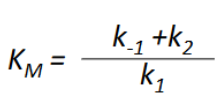
define the top term and bottom term
top: breakdown of ES
bottom: formation of ES
define Vmax
when [S] is high and the enzyme is saturated / or no more available enzyme for the substrate to bind to
define Ks
dissociation constant of the Michaelis complex
when the KM and Ks goes down, how does that affect the enzyme’s affinity for the substrate?
makes the affinity stronger or increases it
define kcat
catalytic constant aka turnover #: # of rct process that the enzyme catalyzes per unit time
what is an inhibitor
substances that reduce an enzyme’s activity by influencing the binding of substrate and enzyme’s turnover #, and structurally resembles the substrate
what is an inactivator
inhibitor, but the process of inhibition is irreversible
is the process of inhibition by a inhibitor reversible?
yes, it is common
what are the types of E inhibition?
competitive, uncompetitive, and noncompetitive/mixed
what does comp. inhibition do?
the inhibitor competes w the S for the enzyme’s binding site and reduces the [ ] of free E avail. for substrate binding

what kind of inhibition is this?
comp. inhibition

what kind of inhibition is this?
competitive inhibition

what inhibition is this
comp inhibition
what does the uncomp inhibition do
the inhibitor binds to the enzyme-substrate complex and distorts the active site thereby rendering the E catalytically inactive
T/F - adding more substrate does reverse the effect of an uncomp inhibitor b/c S binding does interfere w uncomp inhibitor binding
F - adding more S doesnt interfere w the process of uncomp inhibition
what is noncomp./mixed inhibition
inhibitor binds to the enzyme site whether or not it has substrate bind to it

what inhibition is this
noncomp/mixed
when there is comp inhibition what is the effect of it on the michaelis-menten rxn?
increases KM
when there is uncomp inhibition what is the effect of it on the michaelis-menten rxn?
decreases KM and VMax
when there is noncomp/mixed inhibition what is the effect of it on the michaelis-menten rxn?
decreases Vmax and may increase or decrease KM

what inhibition is this
comp inhibit

what inhibition is this
uncomp inhibit
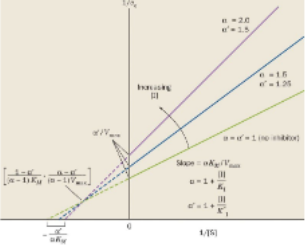
what inhibition is this
noncomp/mixed inhibition
T/F - Organisms need to control their catalytic activities to coordinate metabolism, respond to environmental changes, grow and differentiate.
True
what are ways to control enzyme’s activity?
1) feedback or product inhibition
2) substrate availability
3) amount of enzymes
4) covalent modifications
5) allosteric interactions
6) specialized control
7) modulators
what is covalent mod?
changes configuration; some common ones are phosphorylation/dephosphorylation
what is allosteric interactions
a modulator binds to another site besides the active site and changes the E conformation
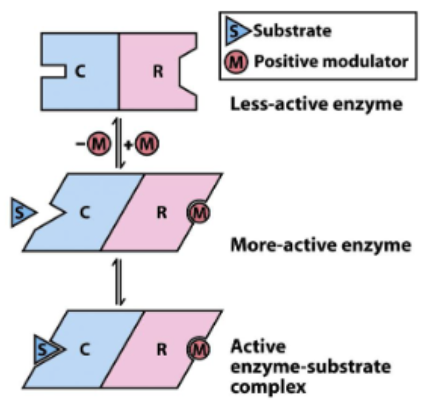
what is feedback inhibition
when a product of metabolism inhibits its own synthetic pathway in an earlier step
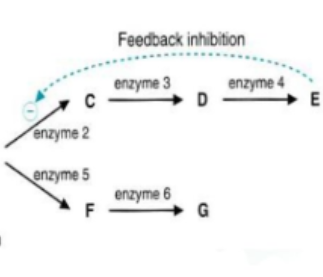

what type of way of controlling enzyme activity is this
feedback inhibition
what is product inhibition
the product of the enzyme reaction inhibits the activity of the enzyme that produced it

what are some kinds of specialized controls
zymogens, isozymes, and modulators
what are zymogens
inactive enzymes that need to be activated
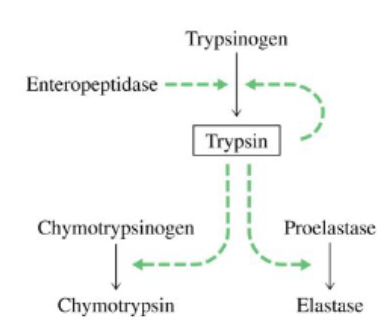
what kind of specialized control is this
zymogens
what is isozymes
made up of more than 1 peptide subunit
what are modulators
bound proteins on enzymes added or removed to affect E activity

what kind of specialized control is this
modulator
what is homoallostery
cooperative substrate binding and inhibition
what is heteroallostery regulated by
regulated by heterotropic allosteric effector molecules
T/F - An E’s activity can be affected by the binding of a molecule at a site other than the active site
T
what is ATCase (aspartate carbamoyltransferase), the enzyme, inhibited by? is it on the active site or allosteric site?
CTP (cytidine triphosphate), a pyrimidine nucleotide at the allosteric site
what is ATCase (aspartate carbamoyltransferase), the enzyme, activated by? is it on the active site or allosteric site?
ATP (adenosine triphosphate), a purine nucleotide at the allosteric site
what does ligand binding-induce in allosteric regulation
conformational changes by the rapid association or dissociation of the ligand and the [ligand] acting as a signal that cell needs more or less product
what does allosteric activator do in terms of activity
higher activity
what does allosteric inhibitor do in terms of activity
lower activity
who is the homotropic effector when there is allosteric activation
substrate itself
who is the heterotropic effector in allosteric activation
metabolite in pathway (feed ahead activation) or other ligand indicating need
who is the heterotropic effector in allosteric inhibition
product of pathway (feedback inhibition) or some other ligand indicating a need for less pathway product
what does R state indicate about the binding, affinity, and kind of allosteric regulation
prefers to bind to enzyme’s active site, high affinity, and it is a heterotrophic activator
what does T state indicate about the binding, affinity, and kind of allosteric regulation
prefers to bind to enzyme’s inactive site, low affinity, and it is a heterotrophic inhibitor