Ch 17 Adaptive Immunity: Specific Defenses of The Host
 Call Kai
 Learn
Learn Practice Test
 Spaced Repetition
 Match
Match Flashcards
 Knowt Play
1/144

Earn XP
Description and Tags
35m run
Name | Mastery | Learn | Test | Matching | Spaced | Call with Kai | Chat |
|---|
No analytics yet
Send a link to your students to track their progress
145 Terms
What is adaptive immunity?
Host defenses that develop later (you're not born with them) to handle a specific microbe.
What are the 2 ways adaptive immunity is acquired?
Infection (exposure to the pathogen).
Vaccination.
Adaptive immunity is also known as what?
"Specific" defenses of the host.
What does adaptive immunity specifically recognize and respond to?
A specific microbe.
What does it mean that adaptive immunity has immunological memory?
The immune system has encountered the same pathogen before.
How does the speed of the adaptive immune response compare to innate immunity?
It's slower.
Adaptive immunity makes up which line of host defenses?
The 3rd line.
What are the 2 components of the 3rd line of defense?
Humoral immunity.
Cell-mediated immunity (CMI).

delete
delete
What is immunology?
The study of host defenses (immunity) against foreign substances (antigens).
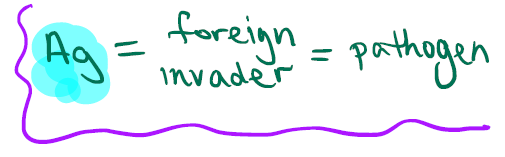
What does Ag stand for, and what does it represent?
Antigen; a foreign invader, i.e., a pathogen.
What is an antigen (Ag)?
Something that doesn't belong to you; a substance that stimulates an immune response in the form of antibody production.
What are 3 examples of antigens?
Pathogens.
Foreign substances.
Vaccines.
How does a vaccine act as an antigen?
It injects something that tricks the immune system into turning on and making antibodies.
What is an antibody (Ab)?
A protective protein made by the host in response to certain antigens.
Antibodies are also known as what?
Immunoglobulins (Ig).
What do the two parts of the word "immunoglobulin" refer to?
Immuno = immune system.
Globulin = globular-shaped protein.
In the "us vs. them" idea, which is the antigen and which is the antibody?
Antigen = "them."
Antibody = "us."
Which 2 lymphocytes are involved in adaptive immunity?
B cells and T cells.
Lymphocytes belong to which group of leukocytes?
Agranulocytes.
What are the 3 types of lymphocytes?
B cells - Adaptive.
T cells - Adaptive.
NK cells - Innate.

What type of antigens does humoral immunity fight?
Extracellular Ag's (invaders present outside the cell).

What are 2 examples of extracellular antigens?
Extracellular pathogens.
Toxins.
What type of antigens does cell-mediated immunity attack?
Intracellular Ag's (antigens that have entered the cell).

What is an example of an intracellular antigen?
An animal virus present inside a host cell.
A pathogen outside the cell turns on which type of immunity?
Humoral immunity.

A pathogen inside the cell turns on which type of immunity?
Cell-mediated immunity (CMI).

What type of cells are associated with humoral immunity?
B cells.
What do B cells "indirectly" make?
Antibodies (Ab).
What is the pathway from a B cell to an antibody?
B cell → plasma cell → antibody (Ab).

What role do antibodies play in destroying antigens?
They only "help" destroy antigens; they don't destroy them directly.
What type of cells are the basis of cell-mediated immunity?
T cells.
What do T cells recognize?
Parts of antigens that have been processed by phagocytes.
What do T cells do to the antigen once they recognize it?
They destroy it.
Where do pluripotent stem cells develop?
In the red bone marrow or fetal liver.

What happens to the stem cell during B and T cell development?
It diverges into 2 cell lines: B cells and T cells.

Where do B cells mature?
In the red bone marrow (of adults).
Where do T cells mature?
In the thymus.
After maturing, where do B and T cells migrate?
To lymphoid tissue, such as the spleen, but especially the lymph nodes.
Antigens turn on which type of immunity to make antibodies?
Humoral immunity.
Most antigens have what feature that antibodies interact with?
External components.
What specific part of an antigen do antibodies bind to?
Antigenic determinants on the surface of the Ag.
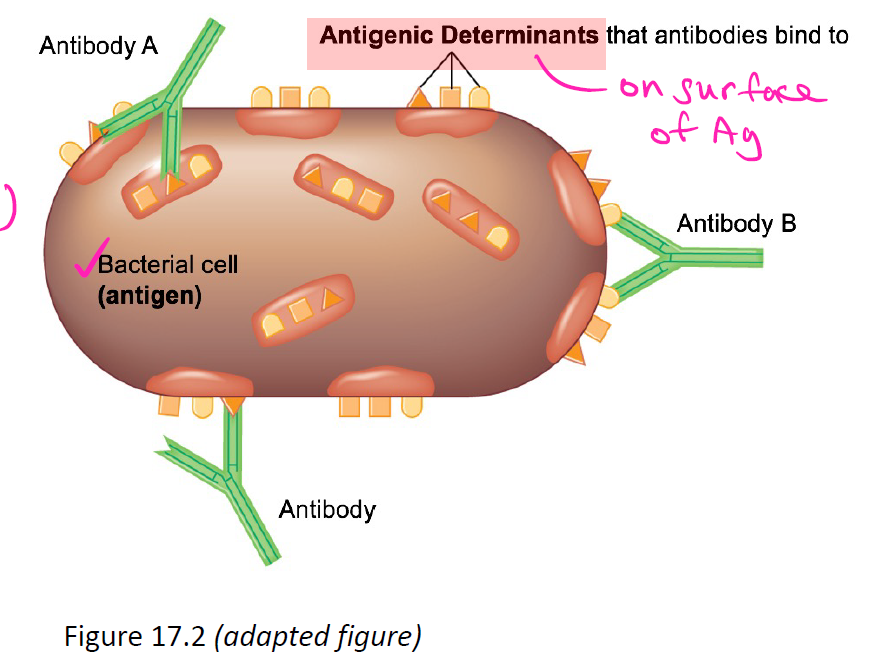
What happens when an antigen and an antibody meet?
They bind to each other.
Humoral immunity involves which cells and molecules?
B lymphocytes and antibodies (Ab).
What forms when antibodies bind to antigens?
An Ag-Ab complex.

If antibodies don't destroy antigens, what do they do?
They "mark" the Ag for destruction.
What shape does an antibody form?
A "Y-shape."
How many protein chains make up an antibody?
(form a Y shape)
Four.
What level of protein structure is an antibody, and why?
Quaternary (4°) structure, because it's made of multiple subunits (chains).
What are the 4 protein chains of an antibody?
2 identical light chains.
2 identical heavy chains.
What are the 2 main parts of an antibody's Y-shape?
Arms.
Stem.

Where are the variable regions of an antibody located?
At the ends (tips) of the arms.

What do the variable regions bind to?
Antigenic determinants.
Why are they called "variable" regions?
Because the tips of the arms vary from antibody to antibody.
Which part of the antibody is the constant region?
The stem (Fc region).

What are the 5 classes of immunoglobulins/antibodies?
IgG.
IgM.
IgA.
IgD.
IgE.

Describe IgG (structure, abundance, location, function, misc).
Structure:
Monomer (1 unit).
Abundance:
Most abundant Ig in the blood serum (80%).
Location:
Blood, lymph, and intestine.
Function:
Enhances phagocytosis (by coating the Ag surface with IgG)
Neutralizes toxins and viruses
Protects the fetus and newborn.
Misc:
Long-lived (23 days) and provides long-term protection
Crosses the placenta (transplacental passage).

Describe IgM (structure, abundance, location, function, misc).
Structure:
Pentamer (5 units).
Abundance:
6% of serum antibodies.
Location:
Remains in blood vessels.
Function:
Causes clumping (agglutination) of pathogens, so phagocytes can engulf several pathogens at one time.
Misc:
Largest Ab; primary response to infection; short-lived (lasts a few days).
High IgM (and low IgG) means a recent/new infection.

Describe IgA (structure, abundance, location, function).
Structure:
Mostly a dimer (2 units) in secretions; exists as a monomer on mucous membrane surfaces (mucosal lining).
Abundance:
13% of serum antibodies (in the blood); most abundant Ig in the body, because of mucous membranes.
Location:
Common on mucous membrane surfaces and in secretions (tears, saliva, breast milk).
Function:
Prevents attachment of pathogens to mucous membranes.
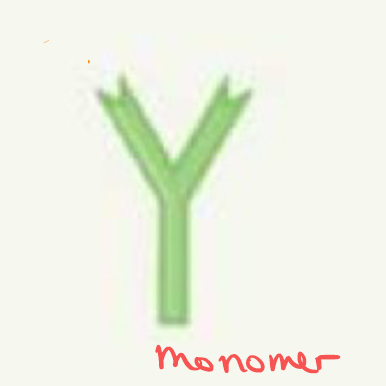
Describe IgD (structure, abundance, location, function).
Structure:
Monomer.
Abundance:
0.02% of serum antibodies.
Location:
In blood, in lymph, and on B cells.
Function:
May be involved in self-tolerance (the ability to tolerate yourself so you won't attack yourself), vs. loss of self-tolerance.

Describe IgE (structure, abundance, location, function).
Structure:
Monomer.
Abundance:
0.002% of serum antibodies.
Location:
On mast cells, on basophils, and in blood.
Function:
Causes the release of histamines from mast cells/basophils, which leads to allergies; destroys parasitic worm infections (by ADCC).
What is the order of Ig abundance in the body (most → least)?
A, G, M, D, E.
What is the order of Ig abundance in the blood (most → least)?
G, A, M, D, E.
In simple terms, what does clonal selection mean?
Choosing the correct class of Ab to make.
In simple terms, what does clonal expansion mean?
Making many copies of the Ab you selected.
What is clonal selection?
The process of B cell activation.
How does clonal selection happen?
Surface Ig on a B cell recognizes a specific Ag (a specific antigenic determinant), and that B cell gets "selected."

What happens during clonal expansion?
The "selected" B cell proliferates into a clone of activated B cells.
The clone of activated B cells differentiates into which 2 cell types?
Memory B cells.
Plasma cells.
What do memory B cells provide?
Immunological memory, which gives a faster immune response if the same Ag is seen a 2nd time.
What happens to memory B cells after the pathogen is gone?
They remain in the body in case the same pathogen returns.
What do memory B cells become when the same Ag returns?
Plasma cells, which then make antibodies.
What does each mature B cell carry on its surface?
Surface immunoglobulins (Ig) against a specific antigen.
In Figure 17.6, why is B cell II "selected" instead of B cell I?
Its "triangular" variable region matches the antigen's "triangular" antigenic determinants.

Which cells made during clonal expansion are long-lived?
Memory B cells.
What do plasma cells do with the antibodies they make?
They secrete (shed) them into circulation (the blood).
What is the end result of clonal selection and clonal expansion?
The correct class of Ab's is made and released.
What is another name for an Ag-Ab complex? Do they destroy Ags?
Immune complex.
Recall: Antibodies do NOT destroy Antigens, they just tag/mark them for destruction.
What is the overall goal after an immune complex forms?
To get rid of the Ag.
What are the 5 results of immune complex formation?
(What happens after mark complex is formed, what’s the goal?)
Agglutination.
Opsonization. (present in Innate immunity)
Neutralization.
Activation of complement. (present in Innate immunity)
Antibody-dependent cell-mediated cytotoxicity (ADCC).
Goal is to get rid of the Ag.
Which 2 results of immune complex formation are also present in innate immunity?
Opsonization.
Activation of complement proteins.
What does ADCC stand for?
Antibody-dependent cell-mediated cytotoxicity.
Which Ig is involved in agglutination, and how does it help get rid of the Ag?
IgM; it "clumps" Ag's together, which reduces the number of infectious units to be dealt with.

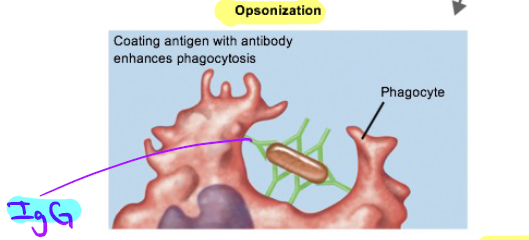
Which Ig is involved in opsonization, and how does it help get rid of the Ag?
IgG; coating the Ag with antibody enhances phagocytosis.
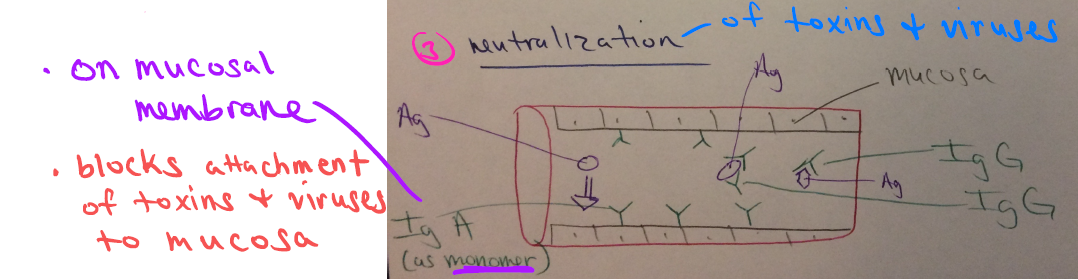
Which Ig is involved in neutralization, and how does it help get rid of the Ag?
IgG or IgA; it blocks adhesion of bacteria and viruses to the mucosa and blocks attachment of toxins.

Which Ig is involved in activation of complement, and how does it help get rid of the Ag?
IgG or IgM; it causes inflammation and cell lysis.

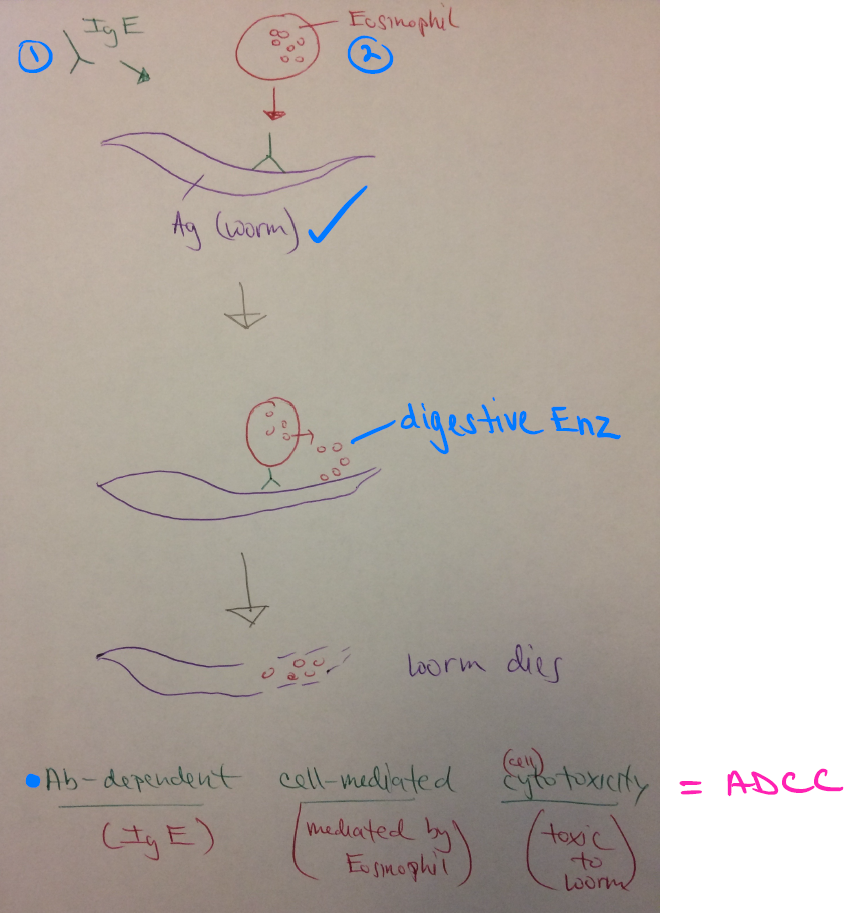
Which Ig is involved in ADCC, and how does it help get rid of the Ag?
IgE; Ab's attached to the target cell (parasite) cause its destruction by macrophages, eosinophils, and NK cells, which release perforin and lytic enzymes.

Describe the process of agglutination.
IgM clumps several Ag's in 1 place, so a phagocyte can engulf them together.

Describe the process of opsonization.
IgG coats the Ag surface, making it more "appetizing" to the phagocyte (enhances phagocytosis); this is analogous to opsonization in the complement system.

Describe the process of neutralization.
IgA (as a monomer on the mucosal membrane) and IgG block the attachment of toxins and viruses to the mucosa.
Describe the steps of activation of complement.

Describe the steps of ADCC.
Ab (IgE) attaches to the worm, forming an immune complex.
An eosinophil, macrophage, or NK cell attaches to the Ab stem region.
It releases enzymes on the worm.
The worm dies.
What are 2 examples of intracellular antigens?
Animal virus.
Phagocytosed Ag.
How can a T cell recognize an Ag that's inside a cell?
The Ag gets processed (fragmented into pieces), and the pieces are placed on the infected cell's surface, where the T cell can now recognize them.
What are the 3 steps of how an intracellular Ag gets presented to a T cell?
The Ag gets processed/fragmented into small pieces.
The Ag fragment migrates to the cell surface.
The fragment is presented to the T cell.
In Figure 17.13, what does the T_H cell do after recognizing the presented Ag?
It activates the T_C cell (via cytokines).
What are the 5 types of T cells?
TH.
TC.
TR.
TD.
Memory T cell.
What are the 2 functions of T_H cells?
Activate T_C cells involved in cell-mediated immunity.
Activate certain B cells (memory B cells) to produce Ab's.
B cells that need T_H cells to be activated are called what?
"T-dependent" B cells.
T_C cells are also known as what?
"Killer" T cells.