chapter 5 chem
 Call Kai
 Learn
Learn Practice Test
 Spaced Repetition
 Match
Match Flashcards
 Knowt Play
1/53

There's no tags or description
Looks like no tags are added yet.
Name | Mastery | Learn | Test | Matching | Spaced | Call with Kai | Chat |
|---|
No analytics yet
Send a link to your students to track their progress
54 Terms
Linus Pauling and others (1930s) developed the
valance bond theory
of covalent bonding.
Electrons reside in
orbitals
.Covalent bonds form when electrons are
shared by the overlapping
of singly occupied orbitals.
Electrons in these overlapping orbitals must have
opposite spins.
to form a covalent bond, an atom must have
an unpaired electron.
Number of bonds formed by an atom is determined by the?
number of
unpaired electrons
This theory works well for explaining the
bonding in diatomic
molecules with only single bonds
VSPER theory explains
This theory also works well for explaining the lack of bonding
experienced by the noble gases, but it does not work well for other
elements or molecules.
valence bond theory must be modified to explain ?
covalent bonds
formed in other molecules
The basic principle of Valence Bond Theory is that?
a covalent bond is
formed when the atomic orbitals of two atoms overlap, and the
overlapping orbitals each contain one unpaired electron.
More overlap=
stronger bond
This sharing of electrons lowers the energy of the system, thus
stabilizing the
atoms when bonded
Lower energy=
happy molecules can exist
Overlapping or orbitals form covalent bonds. The shared space has two electrons with opposite spins, thus demonstrating what princple?
pauli exclusion
The overlap of two p orbitals is greatest when the orbitals are directed end to end. (b) Any
other arrangement results in
less overlap. The dots indicate the locations of the nucle

how many pi and sigmas
one sigma bond no pi bonds

how many sigma and pi bonds?
one sigma bond one pi bond

how many bonds and sigmas
one sigma bond two pi bonds
Single bonds are formed by the direct overlap of two hybrid orbitals,
p orbitals, or s orbitals.
• These are called
sigma (sigma) bonds.
The additional electrons shared in a multi bond are not a result of
directly overlapping hybrid orbitals, but are a result of
ide-by-side
overlap of two regular “p” atomic orbitals.
• These are called pi () bonds

Identify the number
of σ and π bonds contained in this molecule.
There are six σ C–H bonds and one σ C–C bond, for a total of seven
from the single bonds. There are two double bonds that each have a
π bond in addition to the σ bond. This gives a total nine σ and two π
bonds overall.
sigma bonds have head on overlap. This could include
s-orbitals overlapping s-orbitals
s-orbitals overlapping p-orbitals
p-orbitals overlapping p-orbitals if aligned correctly
sp, sp2, or sp3 hybrid orbitals overlapping each other or an s or p-orbital

pi-bonds have side by side overlap and is represented by the pi symbol. They form between two unhybridized parallel p orbitals
“side by side” pi overlap
look
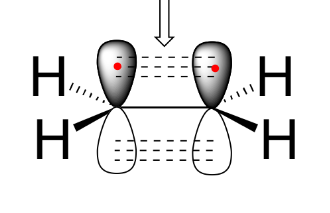
dentify each illustration as depicting a σ or π bond:
(a) is a π bond with a node along the axis connecting the nuclei while (b) and (c) are σ
bonds that overlap along the axis.

hybridization
Mixing of the native atomic orbitals to form special orbitals for bonding.
Bonding in many molecules is best explained with
hybrid orbitals.
Hybrid orbitals only exist in covalent bonded atoms.
Keep in mind when working with hybrid orbitals.
• The number of hybrid orbitals formed always equals the?
number of atomic
orbitals that are combined.
H2O, The hypothetical overlap of two of the 2p orbitals on an oxygen atom (red) with the 1s orbitals of two?
hydrogen atoms (blue) would produce a bond angle of 90°. This is not consistent with experimental evidence. In reality it is 140°. (Note that orbitals may sometimes be drawn in an elongated “balloon” shape rather than in a more realistic “plump” shape in order to make the geometry easier to visualize.
A water molecule has four regions of electron density, so VSEPR theory predicts a?
tetrahedral arrangement of hybrid orbitals. Two of the hybrid orbitals on oxygen contain lone pairs, and the other two overlap with the 1s orbitals of hydrogen atoms to form the O–H bonds in H2O. This description is more consistent with the experimental structure.

two atomic orbitals can hybridize to produce two hybrid orbitals, what does that look like?
one s orbital + one p orbital two sp hybrid orbitals
All orbitals that are in a set of hybrid orbitals will have the same energy
and shape. VESPR Theory will
predict the type of orbital formed based on its
electron-pair geometry.
hybridization of an s orbital (blue) and a p orbital (red) of the same atom produces two
sp hybrid orbitals (yellow). Each hybrid orbital is oriented primarily in just one direction. Note that each sp orbital contains one lobe that is significantly larger than the other. The set of two sp orbitals are oriented at 180°, which is consistent with the geometry for two domains.
sp Hybrid Orbitals
Occurs when a central atom is surrounded by two regions of electron
density.
• Has 2 areas of electron density
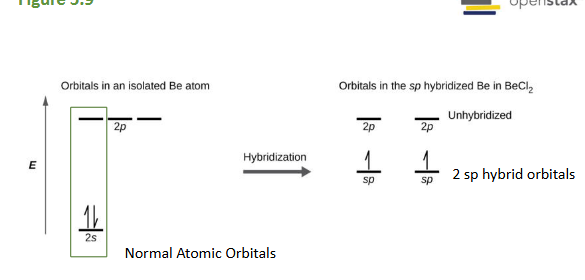
This orbital energy-level diagram shows the sp hybridized orbitals on Be in the linear BeCl2 molecule. Each of the two sp hybrid orbitals holds one electron and is thus?
half filled and
available for bonding via overlap with a Cl 3p orbital.
Three atomic orbitals can hybridize to produce three hybrid orbitals.
one s orbital + two p orbitals three sp2 hybrid orbitals
Occurs when a central atom is surrounded by three regions of electron density.
The hybridization of an s orbital (blue) and two p orbitals (red) produces three equivalent sp2 hybridized orbitals (yellow) oriented at 120° with
respect to each other. The remaining unhybridized p orbital is not shown here, but is located along the z axis.
sp2 Hybridization
Combination of one s and two p orbitals.
• Gives a trigonal planar arrangement of atomic
orbitals.
• One p orbital is not used.
–Oriented perpendicular to the plane of the sp2
orbitals.
–Has 3 areas of electron density
This alternate way of drawing the trigonal planar sp2 hybrid orbitals is sometimes used in
more crowded figures.
look

H3 is an electron-deficient molecule with a trigonal planar structure. draw it and mark the angle
look


In an isolated B atom, there are one 2s and three 2p valence orbitals. When boron is in a molecule with three regions of electron density, three of the orbitals hybridize and create a
set of three sp2 orbitals and one unhybridized 2p orbital. The three half-filled hybrid orbitals each overlap with an orbital from a hydrogen atom to form three σ bonds in BH3

look
These all show sp2 hybridization because they have 3 regions of electron density. The central atom(s) in each of the structures shown contain three regions of electron density and are sp2 hybridized. As we know from the discussion of VSEPR theory, a region of electron density contains all of the electrons that point in one direction. A lone pair, an unpaired electron, a single bond, or a multiple bond would each count as one region of electron density.
Four atomic orbitals can hybridize to produce four hybrid orbitals.
one s orbital + three p orbitals four sp3 hybrid orbitals
Occurs when a central atom is surrounded by four regions of electron
density.
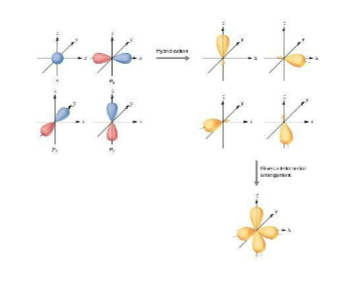
the hybridization of an s orbital (blue) and three p orbitals (red) produces
four equivalent sp3 hybridized orbitals (yellow) oriented at 109.5° with respect to each other.

in the ethane molecule, C2H6, each carbon has?
four sp3 orbitals. (b) These four orbitals overlap to form seven σ bonds.
Five atomic orbitals can hybridize to produce five hybrid orbitals
one s orbital + three p orbitals + one d orbital five sp3d hybrid
orbitals
Occurs when a central atom is surrounded by five regions of electron
density.
sp3d Hybridization
Combination of one d, one s, and three p
orbitals.
•Gives a trigonal bipyramidal arrangement of
five equivalent hybrid orbitals.
•Has 4 areas of electron density
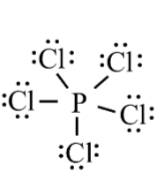
Draw the Lewis structure for PCl5
What is the shape of a phosphorus pentachloride
molecule?
What are the bond angles?
trigonal bipyramidal
90° and 120

These have 5 areas of electron density so they are sp3d. The three compounds pictured exhibit
sp3d hybridization in the central atom and a trigonal bipyramidal form. SF4 and ClF4+ have one lone pair of electrons on the central atom, and ClF3 has two lone pairs giving it the T-shape shown.
The five regions of electron density around phosphorus in PCl5 require?
five hybrid sp3d orbitals. (b) These orbitals combine to form a trigonal bipyramidal structure with each large lobe of the hybrid orbital pointing at a vertex. As before, there are also small lobes pointing in the opposite direction for each orbital (not shown for clarity).
sp3d2 Hybrid Orbitals
Six atomic orbitals can hybridize to produce six hybrid orbitals.
one s orbital + three p orbitals + two d orbitals six sp3d2 hybrid
orbitals
• Occurs when a central atom is surrounded by six regions of electron
density.
sp3d2 Hybridization
Combination of two d, one s, and three p
orbitals.
•Gives an octahedral arrangement of six
equivalent hybrid orbitals.
•Has 6 areas of electron density
Draw the Lewis structure for XeF4.’
What is the shape of a xenon tetrafluoride molecule?
What are the bond angles?
octahedral
90° and 180°


look
Sulfur hexafluoride, SF6, has an octahedral structure that requires sp3d2 hybridization. (b) The six sp3d2 orbitals form an octahedral structure around sulfur. Again, the minor lobe of each orbital is not shown for clarity.
summary of electron geometry
VSEPR theory predicts the shapes of molecules, and hybrid orbital theory provides an explanation for how
those shapes are formed.
To find hybridization of the central atom:
1. Determine the Lewis structure of the molecule.
2. Determine the number of regions of electron density around an atom using VSEPR theory, in which
single bonds, multiple bonds, radicals, and lone pairs each count as one region.
3. Assign the set of hybridized orbitals from the table that corresponds to this geometry.
