Speech sound disorder knowledge Review #2
 Call Kai
 Learn
 Practice Test
 Spaced Repetition
 Match
 Flashcards
 Knowt Play
1/49

There's no tags or description
Looks like no tags are added yet.
50 Terms
Locating the breakdown in The speech processing chain
-Sensory input (HL)
-Perception (APD)
-Linguistic formulation (Phonological disorder)
-Motor planning/ programming (CAS)
-Retrieval of motor plan
- Motor execution (Dysarthria, Ataxia)
what is CAS (childhood apraxia of speech)
- Neurologic speech sound disorder
- It is a problem with planning and programming
- It is NOT a problem with weakness
- SEVERE PERMANENT LIFELONG DISORDER
- The breakdown is in turning the plan into a precise, consistent movement sequence.
what do they call is childhood and not developmental
When the term “developmental” is used, people assume they will grow out of it
CAS is a deficit of
Planning/Programming, NOT EXECUTION
CAS diagnostic features (3 core features)
1. Inconsistency: Inconsistent consonant and vowel errors
2. Disrupted transitions: Lengthened and disrupted coarticulatory transitions
3. Prosodic errors: Inappropriate prosody
Mayo Clinic "10+1" features (NEED TO KNOW THIS)
You need at least 4 of these across at least 3 tasks
- vowel errors
- consonant distortions
- stress errors
- syllable segregation
- groping
- intrusive schwas
- voicing errors
- slow rate
- resonance disturbances
- transitional difficulty
+1 multisyllabic words
Assessing for CAS: current protocol
Diagnosis rests on expert judgment of features across several tasks:
-Dynamic motor speech exam
-Repeated and multisyllabic words
-Connected speech on video
-Diagnostic rule
Causes of CAS
- Mostly unknown (Idiopathic)
- Genetic Heterogeneity
- Co-occurrence
What is an internal model
stimulates how the sensorimotor system will behave
CAS treatment implications
1. Infants later diagnosed with CAS are thought to skip vocal play, so they begin therapy without an internal model of vocal-tract function.
2. Auditory feedback drives early learning: first establish a stable auditory target; repeated practice then builds somatosensory awareness.
3. Aim for dynamic stability in reaching an acoustic-phonetic target, not rigid motor consistency: the same target has several articulatory routes.
4. Expect frustration when replacing a well-learned (even inaccurate) pattern; plan pacing and expectations accordingly.
*** Speech therapy is all about movement
Phoneme to phoneme and syllable to syllable
what is a cleft
An abnormal congenital opening in a structure that is normally closed
Types of palates
- Primary palate (the lip and the portion of the hard palate anterior to the incisive foramen)
- Secondary palate (the hard and soft palate posterior to the incisive foramen)

Palate Severity Types
-Incomplete or complete
-Unilateral or bilateral
Primary palate (types)
Unilateral incomplete, unilateral complete and bilateral complete
Palate (types)
Incomplete and complete cleft palate; unilateral and bilateral complete cleft lip and palate
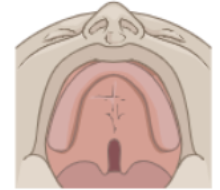
incomplete cleft palate
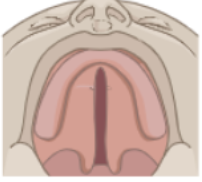
complete cleft palate
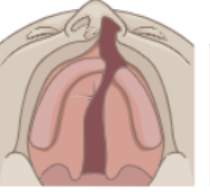
unilateral complete cleft lip and cleft palate

bilateral complete cleft lip and cleft palate

unilateral incomplete

unilateral complete
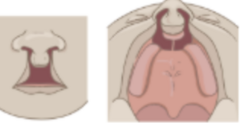
bilateral complete
The more structures involved ....
the greater the functional impact for:
- feeding
-Dentition (growth of teeth)
-Speech
Functional Impact

Dysmorphogenesis
errors in morphogenesis (tissue and organ formation) that produce dysmorphic features
Malformation
This structure was built atypically from the start
Deformation
The structure formed typical, then was physically altered
Craniosynotosis
Premature fusion of one or more cranial sutures

purpose of an evaluation
-Identification
-Severity rating
-Dx
-Tx planning
Steps and planning of an assessment
-Referral
-Case history
-Present development & reason for eval
-Clinical decisions
-Implementation
Components of a speech sound assessment
- Speech Production
-Related Domains
Speech Production
- Norm referenced single-word articulation/ phonology test
- Informal measures
- Continuous speech sample
- Inconsistency and variabilty assessment
Related Domains
- Phonological processing: Speech perception, phonological awareness, phonological memory
- language measure
Functional intelligibility
Intelligibility in context scale
Multilingual children
Assess every language the child uses, judge errors against each language and dialect, and work with the family
Dynamic assessment
Measure response to cues, not only static accuracy, The GDAP uses a standardized 15-point cueing hierarchy and is sensitive to change
what is a connected sample
shows errors intelligibility and prosody in real communication.
what are the four ways to analyze a connected sample
- phonetic inventory
- phonological processes
- syllable structures
- PCC-R
PCC-R - Collecting and transcribing samples
- Obtain a connected speech sample of 3-4 minutes: about 100 words and 180 constants
-Transcribe every word phonetically, and write the intended target word for each
PCC-R - Transcription rules
-Unintelligible words
-Repeated consonants
-Repeated words
PCC-R - what are scored as errors
-deletions
-substituions
-additions
PCC-R - Not scored as errors
- Distortions
- Dialect features
- vowel errors
PCC-R - scoring severity
-0-49% severe
- 50-64% moderate-severe
- 65-84% mild-moderate
-85-100% typical development
PCC-R ( for scoring and severity)
Consonants correct (divided by) total constants x 100
Stimulability testing
-Done after there single word assessment and speech sample
-Get sense of what they are stimulable for and what they are not stimulable for
Articulation disorder
A motor-based difficulty producing speech sounds correctly.
Phonological disorder
-A knowledge-based difficulty with the language rules underlying speech.
- The child can often physically produce the sound, but has not learned the rules for using it in particular word positions or contexts.
Pediatric dysarthria
-A neuromuscular disorder of motor execution resulting from abnormalities to the strength, range of motion, tone, or precision of movements
why is pediatric dysarthria harder to study?
It's harder to diagnose because their neural pathways have not been fully developed
informal measures
- inconsistency & variability
- intelligibility
- probes and stimulability