Thrombosis, Emboli, and Infarction
 Call Kai
 Learn
 Practice Test
 Spaced Repetition
 Match
 Flashcards
 Knowt Play
1/89

There's no tags or description
Looks like no tags are added yet.
90 Terms
Post mortem clots: attached to vessel wall?
no!
Post mortem clots: appearance
shiny and wet
Post mortem clots: structure within vessel
forms perfect cast of vessel lumina
Ante mortem clots: attached to vessel wall?
yes!
Ante mortem clots: appearance
dull, dry, and laminated
Ante mortem clots: structure within vessel
tail of clot extends downstream
Ante mortem clots are called...
thrombi
Thrombosis
the formation of a blood clot (thrombi), attached to a vessel wall during life
What is a thrombus made out of? (3)
-fibrin
-platelets
-other elements of the blood
What vessels does thrombosis usually occur?
usually in veins, but more serious in arteries
Why do thrombi usually form in veins?
vein have low pressure and low blood flow, so a clot is more likely to form
Virchow's Triad of Thrombosis
describes the three major factors that promote thrombus (blood clot) formation

Three components of Virchow's Triad of Thrombosis:
1.) Endothelial injury
2.) Abnormal blood flow
3.) Hypercoagulability
Endothelial injury
Damage to the vessel lining exposes pro-clotting substances and activates platelets
Endothelial injury is the _______ cause of most thrombi
primary
Pathogenesis of endothelial injury
1.) damage to the endothelial cells occurs and subendothelial collagen is exposed
2.) subendothelial collagen releases platelet-activating factor (PAF)
3.) Platelets adhere to the damaged vessel wall
4.) Platelets become activated and aggregate, recruiting and activating additional platelets
5.) coagulation cascade is activated simultaneously
6.) A platelet-fibrin thrombus forms
7.) Fibrin-platelet clot releases additional thromboplastin to recruit more platelets
8.) Circulating erythrocytes and leukocytes become entrapped in the fibrin
meshwork, parallel to the direction of blood flow
Four causes for endothelial injury/damage
1.) inflammation of the vessel wall
2.) deposition of mineral
3.) physical trauma
4.) parasite migration
Abnormal blood flow
Stasis or turbulence disrupts normal blood flow and promotes clot formation
Stasis
slow flow rate that causes accumulation of activated clotting factors and platelets with endothelium
What vessel type is stasis most common in?
veins
Turbulence
disruption in laminar blood flow; mixes blood (interaction w/ coagulation factors) and physically injures the endothelium
Where does turbulence typically occur?
where vessels branch, narrow, or sites of venous/lymphatic valves
Normal blood flows by the process of...
axial plasmatic streaming
axial plasmatic streaming
normal blood flow where the fluid component of plasma (containing anticoagulants) flows close to the vessel walls, and the cellular portions flows down the center

Hypercoagulability
An increased tendency of the blood to clot due to changes in coagulation factors
Hypercoagulability involves a ________ in prothrombotic factors and _______ in inhibitory factors
increase; decrease
Examples of things that can increase coagulation factors
-inflammation
-stress
-neoplasia
-surgery
-renal disease
What is the most common cause of hypercoagulability?
inflammation
Which of Virchow's Triad of Thrombosis is most important? Why?
Endothelial injury; damage to the endothelium exposes procoagulant substances (like collagen and tissue factor), causing platelet adhesion/activation and activation of the coagulation cascade, which directly promotes thrombus formation
**also can affect the other two factors of Virchow's Triad
Six descriptive words for thrombi:
1.) mural
2.) vegetative
3.) occlusive
4.) obturating
5.) saddle
6.) septic
mural
walls of a vessel; a thrombus attached to a large vessel or endocardium of heart chambers by a very wide base

vegetative
on heart, thrombus located on great vessel valves

Valvular (Vegetative) Endocarditis
Infection and inflammation of a heart valve that causes formation of friable thrombotic vegetations on the heart valves
Vegetations
septic thrombi with very high numbers of bacteria
Pathogenesis of Valvular (Vegetative) Endocarditis
1.) Valve endocardium is injured, exposing the underlying tissue
2.) A platelet-fibrin mesh covers the damaged surface
3.) The mesh becomes colonized by bacteria (or rarely fungi)
4.) Plaque fragments may break off, sending septic emboli to capillaries in other organs
occlusive
vascular obstruction
obturating
tail extends in the direction of blood flow and partially occludes vessel
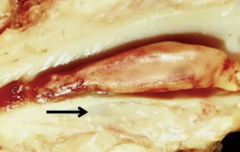
saddle
thrombus at the bifurcation of vessels
septic
thrombus that involves an infectious agent
Verminous thrombi
thrombus due to parasites or their fragments within cores of thrombi (such as heartworm)
Venous vs arterial thrombi:
venous thrombi are the most _______ site of thrombus formation
arterial thrombi are the most _______ site of thrombus formation
common
serious
Venous vs arterial thrombi:
venous thrombi are ________ occlusive
arterial thrombi are ________ occlusive
fully
partially
Venous vs arterial thrombi:
venous thrombi ________ yield infarction
arterial thrombi ________ yield infarction
seldom
often
infarction
complete obstruction of blood flow so that the tissue dies
Ischemia
reduced blood flow to tissue
Venous vs arterial thrombi:
venous thrombi have ________ RBCs
arterial thrombi have ________ RBCs
many ("red")
few ("white")
Venous vs arterial thrombi:
venous thrombi _________ have lamination
arterial thrombi ___________ have lamination
won't
will
Will venous or arterial thrombi readily embolize?
venous
Do venous or arterial thrombi have "Lines of Zahn"?
arterial
"Lines of Zahn"
Laminations- alternating layers platelets, fibrin, RBC's, and Leukocytes

Three outcomes of thrombus formation:
1.) resolution
2.) organization/recanalization
3.) embolism
thrombus resolution
involves small thrombi; thrombi are removed from the vessel wall via thrombolysis
organization
involves larger thrombi; thrombi are removed through phagocytosis and form a scar on the vessel wall
recanalization
new vascular channels are formed within the thrombus to resume blood flow; organized by fibroblasts
embolism
aka thromboembolism; parts of a thrombus dislodge and form obstruction at distant location
Embolus
Detached intravascular solid/liquid/gaseous mass that is carried by blood to a distant site
Emboli often occlude ________ vessels
small
When emboli occlude small vessels, what can this lead to?
complete obstruction and ischemic necrosis (infarction)
Emboli usually originate from _________, but may have other origins
thrombi
examples of other things that can form emboli
-bacteria
-cartilage
-neoplasm
-parasites
Infarcts
A localized area of ischemic necrosis from blockage or occlusion of arterial supply or venous drainage
What type of necrosis is most common with infarcts?
coagulative necrosis
Are infarcts most common in arteries or veins?
arteries
What type of organs are infarcts most common in?
those with limited collateral blood supply (such as the brain or kidney)
Two mechanisms that produce infarcts
1.) obstruction
2.) compression
obstruction
something that blocks the flow of blood from inside the vessel (such as thrombi, emboli)
compression
something that blocks the flow of blood from outside the vessel (such as mases, torsion, tourniquets)
arterial obstruction
usually secondary to emboli; blood supply is interrupted
For an arterial infarct, blood can't enter or leave?
blood can't enter!
gross appearance of arterial obstruction
pale

venous obstruction
caused by blockage of veins leading away from an organ
For a venous infarct, blood can't enter or leave?
blood can't leave!
gross appearance of venous obstruction
dark red/black

Disseminated intravascular coagulation (DIC): Syndrome
widespread endothelial injury resulting in platelets adhering and activation of the coagulation cascade at numerous sites and activation fibrinolytic system (dissolves clots as form)
Causes of DIC
Complication of sepsis, endotoxemia, neoplasia, burns, heat stroke, shock, and endotheliotropic viral infections
Gross appearance of DIC
-numerous petechiae
-poor blood clotting
-systemic microthrombosis

Venous thrombi are characterized by?
A Few RBC's (white)
B Laminated
C Readily embolize
D Often yield infarction
C Readily embolize
Thrombi are caused by which of the following?
A Intact endothelium
B Hypercoagulability
C Normal blood flow
D Axial plasmatic streaming of blood
B Hypercoagulability
A species and tissue specific manifestation of DIC that causes generalized renal cortical necrosis in the horse is called?
A Axial plasmatic streaming
B Vegetative endocarditis
C Schwartzman Reaction
D Lines of Zahn
C Schwartzman Reaction
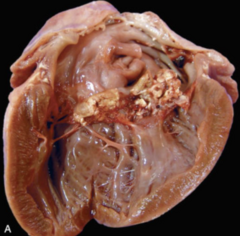
Which type of thrombus is
represented in this image?
What type of emboli is most
likely associated with it?
Thrombus: Vegetative
Emboli: bacterial
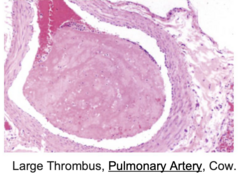
Which process is going on after
formation of this thrombus?
A. Recanalization
B. Organization and fibrosis
C. Little to no resolution
D. Complete resolution
C. Little to no resolution
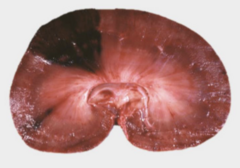
What pathology is associated with the local
wedge-shaped area of necrosis in this kidney?
A. Infarction
B. Ischemic necrosis
C. Emboli
D. Coagulative necrosis
E. All of above
E. All of above
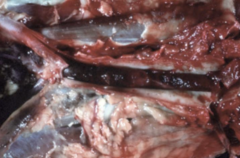
Which type of thrombus is
represented in this image?
What would be the likely
outcome of this thrombus?
Saddle thrombus
Emboli forms
In which tissue/organs occlusion of nearly any sized vessel typically results in infarction of the dependent tissue?
A. Liver
B. Gastrointestinal tract
C. kidney, and spleen
D. Skeletal muscle
C. kidney, and spleen
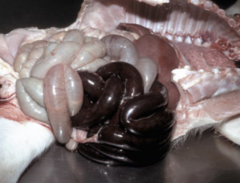
Which abnormal altered blood flow is usually associated with a
venous infarction?
A. Hyperemia
B. Congestion
C. Edema
D. Ascites
E. B and D
B. Congestion

Which type of thrombus is represented in this image?
A. Mural
B. Vegetative
C. Saddle
D. Verminous Thrombi
A. Mural

Which pathologic process is associated with this disease?
What type of emboli is most likely associated with it?
Endothelial injury and hypercoagulability
Parasitic or verminous emboli
In what species a generalized renal cortical necrosis can be an organ-specific manifestation of (DIC)?
A. Horses and Rabbits
B. Ruminants
C. Canine
D. Feline
A. Horses and Rabbits

Which abnormal altered blood flow can cause this gross morphology?
Congestion and right sided heart failures (Nutmeg liver)

Which abnormal altered blood flow can cause this gross morphology?
A. Ascites, congestion
B. Edema, congestion
C. Edema, hyperemia
D. A and B
A. Ascites, congestion