AI generated
 Call Kai
 Learn
 Practice Test
 Spaced Repetition
 Match
 Flashcards
 Knowt Play
1/46

Earn XP
Description and Tags
Vocabulary practice flashcards covering fundamental concepts, architecture, implementation lifecycles, risk management, and supporting technologies from the FIT3138 Real Time Enterprise Systems revision notes.
47 Terms
Enterprise System
An enterprise-wide, modular, integrated, real-time information system responsible for transaction processing across all business areas of the organisation.
Real-Time Enterprise (RTE)
Companies that respond instantly to internal and external events by utilizing real-time information systems to improve agility, responsiveness, and competitiveness.
Sense-Analyse-Respond Framework
A real-time framework consisting of three continuous steps: Sense (capture real-time data), Analyse (use analytics to generate insights), and Respond (take action immediately based on those insights).
Business Process
A logical sequence of activities or tasks driven by a transaction that takes an input and creates an output of value to the customer to achieve a defined business outcome.
Functional Silos
Isolated departments (such as sales, production, and finance) operating with separated systems, which prevents data sharing and creates organizational inefficiencies.
Information System (IS)
Computers, people, procedures, and software that store, organize, and deliver information.
Integrated Information Systems
Systems that enable business processes to integrate functional areas (such as sales, accounting, and production) by sharing data.
Service-Oriented Architecture (SOA)
An architecture that enables ERP systems to be more flexible by using web services to allow disparate systems to communicate and share data.
Cloud ERP
ERP systems hosted on cloud platforms that offer scalability, lower infrastructure costs, and accessible system operations from multiple locations.
Sarbanes-Oxley Act
A regulatory compliance act that pushed companies toward adopting integrated systems to maintain stricter control over financial reporting.
Inquiry
A customer's request to a company for information or a quotation regarding products or services without an obligation to purchase.
Quotation
A legally binding offer presented to a customer to deliver specific products or a selection of products within a specified timeframe at a pre-defined price.
Sales Order Processing
A series of activities that must take place to record a sales order.
Customer Relationship Management (CRM)
A system focused on managing customer-facing operations, customer data, acquisition, retention, and sales forecasting.
Supply Chain Management (SCM)
A system focused on managing the flow of goods from suppliers to customers, including production scheduling, raw material procurement, inventory, and logistics.
Credit Management in ERP
The practice of maintaining credit limits and reviewing real-time accounts receivable balances to balance customer credit with sales objectives and minimize financial risk.
Make-to-Stock
A production type where products and inventory are manufactured based on anticipated customer demand.
Make-to-Order
A production type where items are produced only after an actual customer order has been received.
Assemble-to-Order
A production type where end products are assembled using components that were pre-produced based on forecasts.
Financial Accounting
An accounting discipline that tracks all transactions and provides external reports, such as balance sheets, income statements, and financial statements.
Managerial Accounting
An accounting discipline focused on cost control, profitability analysis, and budgeting to support internal managers in making operational decisions.
XBRL (eXtensible Business Reporting Language)
A standardized language used for efficient digital reporting and regulatory financial compliance.
Business Process Reengineering (BPR)
The fundamental redesign of workflows to improve process efficiency, eliminate non-value-added tasks, reduce operational costs, and enhance service quality.
Business Process Management (BPM)
A management discipline that treats processes as assets that directly contribute to enterprise performance by driving operational excellence and business process agility.
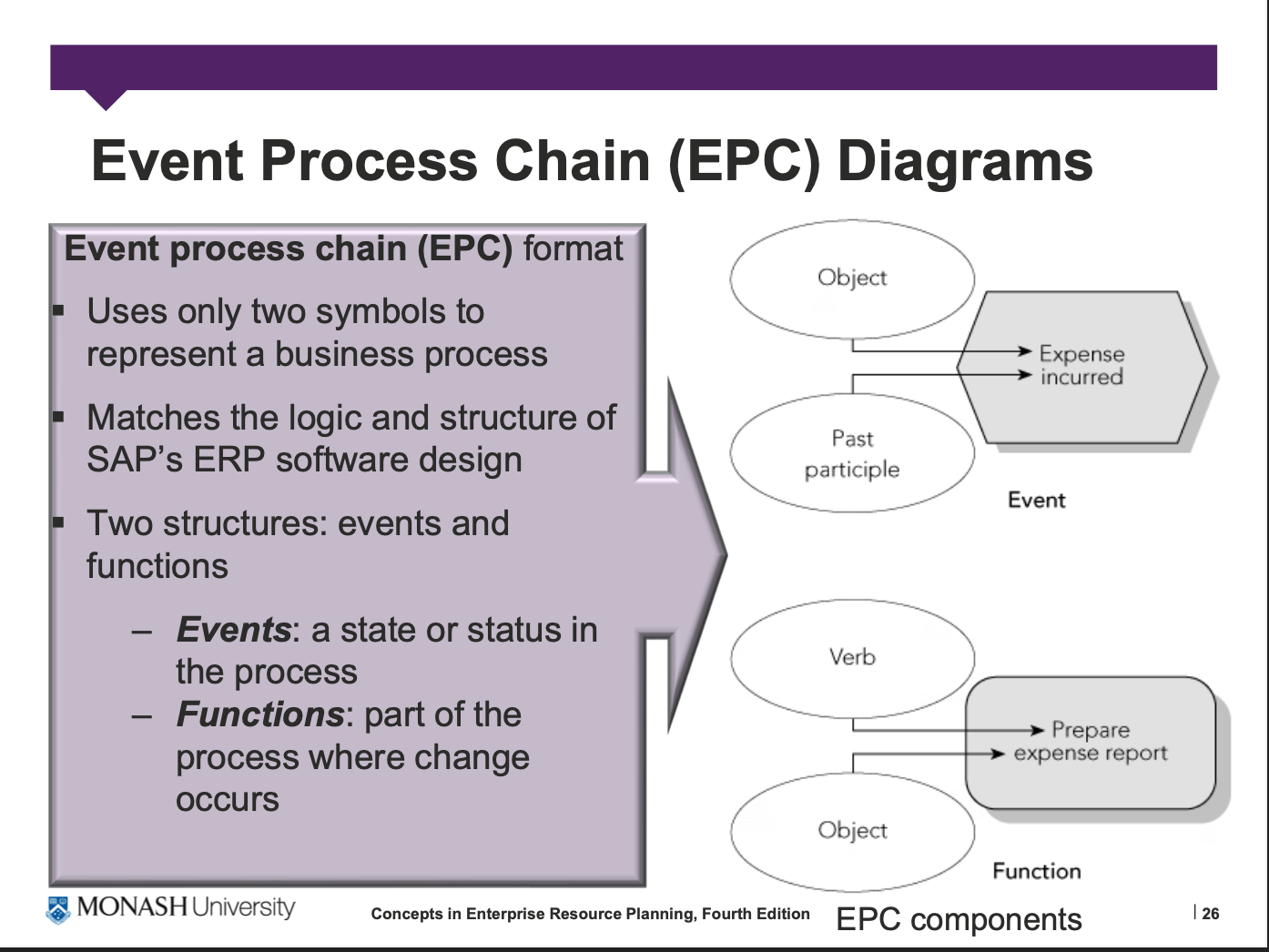
Event Process Chain (EPC)
A business process modelling format matching SAP ERP software design that uses two primary structures: events (a state or status) and functions (part of the process where change occurs).
Train-the-Trainer Approach
A change management training method where experienced internal staff members are trained first and subsequently train other employees.
ASAP Roadmap
A detailed project plan by SAP describing all implementation activities across five phases: Project Preparation, Business Blueprint, Realization, Final Preparation, and Go-Live and Support.
Project
The achievement of a specific objective involving a number of tasks and activities that consume resources, to be completed to a set specification and within a finite timescale.
Project Management
The process of controlling the achievement of project objectives by defining requirements and scope, allocating resources, monitoring progress, and managing deviations when necessary.
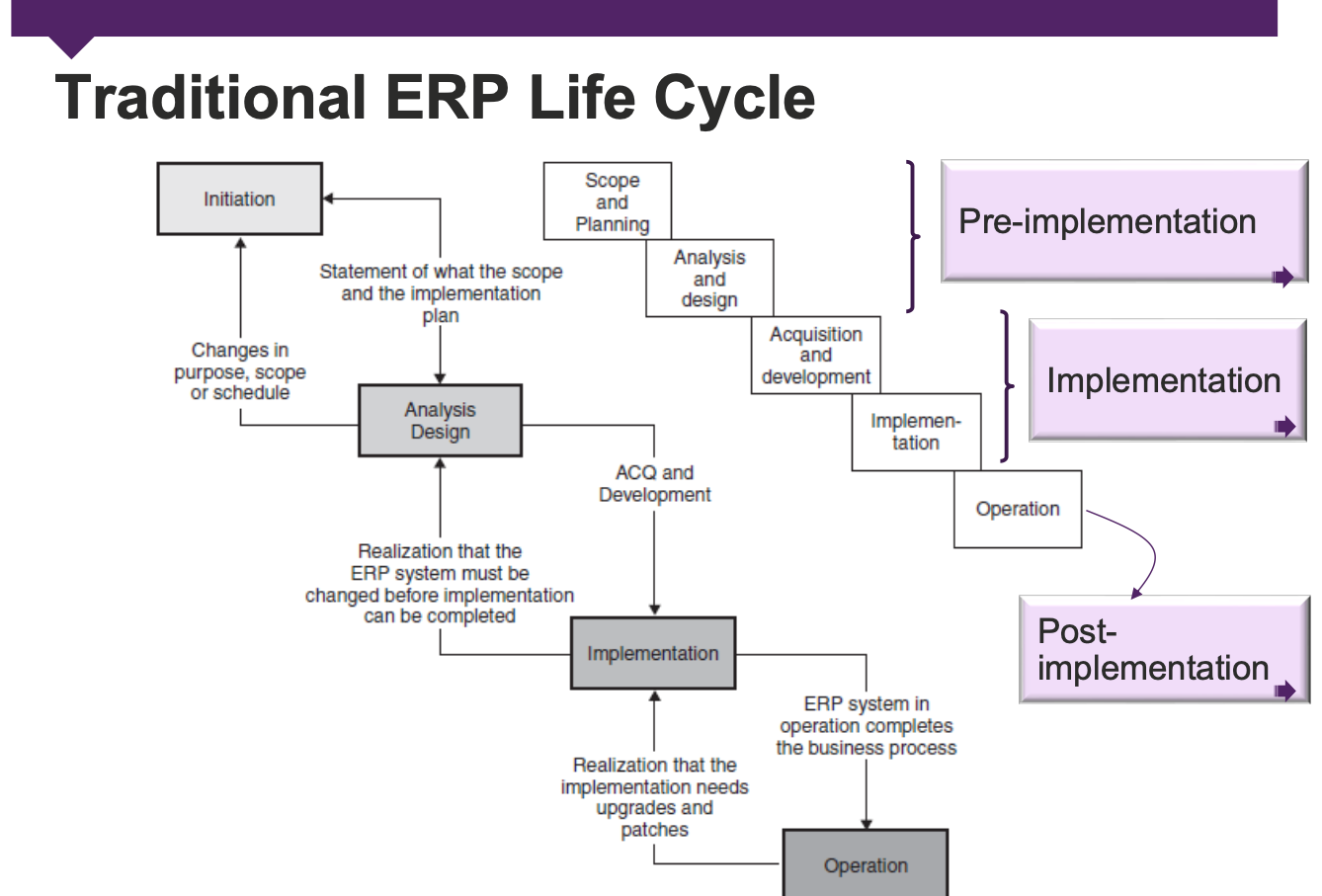
Traditional ERP Life Cycle
A structured ERP project model organized across Pre-implementation, Implementation, and Post-implementation phases.
Enterprise Risk Management (ERM)
A process, effected by an entity's board of directors, management, and personnel, applied across strategy setting to identify potential events and manage risk within the entity's risk appetite.
Risk Register
A document containing the results of various risk management processes, commonly presented in a tabular format.
Canary in a Coal Mine (ERP)
Early warning indicators signaling that an ERP implementation is in trouble, including the absence of a dedicated project team, lack of training scheduled before go-live, and absence of a contingency budget.
Systems Integration
The process of linking together different computing systems and software applications physically or functionally to act as a coordinated whole.
Master Data
Core organizational data that is created centrally, contains key relationship definitions, and is shared across all applications to execute business processes.
Document (ERP)
A data record generated within an ERP system whenever a business transaction is carried out.
Master Data Management (MDM)
Centralized governance of critical business entities (e.g., customer and product information) to guarantee data accuracy and consistency across different platforms.
ETL (Extract, Transform, Load)
A data integration process that extracts data from disparate source systems, transforms it into an appropriate format, and loads it into a central repository.
Kotter's 8-Step Process
A structured change management methodology: create urgency, form a guiding coalition, develop a vision, communicate the vision, empower action, create short-term wins, consolidate gains, and anchor new approaches in the culture.
Business Intelligence (BI)
A range of technologies and analytical applications (including data-mining and querying tools) used to extract and analyze large volumes of structured and unstructured data for decision-making.
Digital Transformation
The application of digital technologies—such as cloud computing, IoT, and big data—to reshape business processes and enhance organizational competitiveness.
Software as a Service (SaaS)
A deployment model where software applications are hosted externally by a vendor and delivered to end users over the internet.
Hybrid IT
An IT infrastructure strategy combining on-premises systems, off-premises public and private clouds, and traditional non-cloud clusters.
Radio Frequency Identification (RFID)
A wireless tracking technology that captures inventory and asset data in real time to increase supply chain transparency.
Net Present Value (NPV)
A financial calculation that determines the profitability of an investment by converting future inflows and outflows into an equivalent amount in present time.
Internet of Things (IoT)
A network of physical devices and sensors linked to ERP systems that continuously feeds real-time operational data for improved inventory and asset management.
Artificial Intelligence (AI)
The branch of computer science focused on developing intelligent machines capable of thinking and working like humans.