Intro to Bac. Lec 1
 Call Kai
 Learn
Learn Practice Test
 Spaced Repetition
 Match
Match Flashcards
 Knowt Play
1/78

Earn XP
Description and Tags
Gain an appreciation for the diversity of the microbial world - Recognize basic features and structures of the bacteria cell - Understand differences between Gram-negative and Gram-positive bacteria -Understand what virulence factors are
Name | Mastery | Learn | Test | Matching | Spaced | Call with Kai | Chat |
|---|
No analytics yet
Send a link to your students to track their progress
79 Terms
What is the size of bacteria?
micrometer
How common is it for bacteria to actually cause disease?
There is very few bacteria that actually cause human disease (Mostly harmless)
What are 3 domains of life? Which are prokaryotes?
Bacteria, Archaea, Eukaryotes
Bacteria and Archaea are prokaryotes
Does archaea cause disease
we don’t know of any of archaea that causes bacteria

What are we missing on the diagram?
Missing viruses on the tree of life diagram
What is the key definition of prokaryotes
lack nucleus and complex organelles
What is the simplest, smallest and most abundant cell on Earth
Prokaryotes

What does this diagram explain
We think life evolved 3.5 to 4 billion years ago
Basically microbes have been around from much longer than humans
How does bacteria reproduce and at what speed
reproduces by binary fission
at a very fast speed
What are the four phases of growth
Lag phase
Log phase (exponential)
Stationary phase
Death
Lag phase
no cell division
there is cell growth
cell repair
Log phase
exponential division
peak metabolic activity
reaches max population
Stationary phase
population growth flattens out
nutrients deplete
Death phase
nutrients exhaust
T or F: All species grow at the same speed
FALSE
some grow fast some grow slow
In what shapes are bacteria classified in?
Coccus — sphere like shape
Rod shape — rod shape
Spirillum — spiral shape

What are the 5 ways bacteria utilizes O2
Obligate aerobe — Need o2 to live
Obligate anaerobe — O2 is toxic for growth
Facultative anaerobe — Use 02 but dont need
Aerotolerant anaerobe — Dont use O2 but its not toxic
Microaerophile — Grow best in low o2 levels

What slide show two e.coli
Sequence of genome of these might only be 60% identical between the both
So 40% is different

What is a gram strain
a rapid laboratory test that checks for bacteria or fungi in samples

What happens to the gram bacteria after the test
if bacteria is gram negative, the purple washes out and become clear
If not positive, purple will not wash out

Why does gram bacteria stain differently
gram + bacteria has thick layer of peptidoglycan
So the thickness of the cell wall results in how they dye sticks
Which gram has an outer membrane? What is the outer-membrane called?
Gram negative
liposaccharides
What is another name for bacterial cell wall
called peptidoglycan
What is bacterial cell wall made of and its purpose?
rigid structure
prevents osmotic lysis
What linkages go between acetylglucosamine? What does it do?
Peptide linkages
holds the bacterial cell wall together
What is the naming convention for bacteria?
[Genus] [Species] [Strain]
genus is always capitalized
species in not capitalized
both are italicized

What are the three components of the lipopolysaccharide
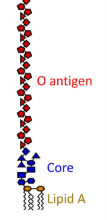
What is the O antigen and its function?
Outermost chain that makes up lipolysacc.
primary shield
Why is the O antigen antigenic?
antigen = substance that causes the immune system to produce antibodies against it
O antigen is a prime target for the immune system
Why is the O antigen highly variable?
Within a single species like E. coli, there are over 180 different O antigen types (serotypes)
Where is the lipid A located? What is the role of the lipid A (what is it recognized by)?
sticks into membrane
Lipid A is recognized by the innate immune system which is why its important
Recognizes lipid A by TLR 4 and initiates immune system
What happens if we detect too much lipid A
body can go into septic bunch
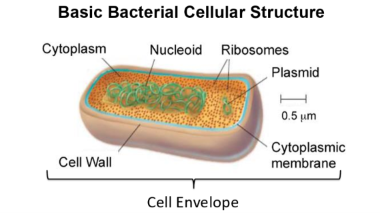
Describe the nucleoid
Not the nucleus
No surrounding membrane
Single, circular chromosome
Haploid genome
Why is MOST bacteria a singular circular molecule
an advantage for bacteria b/c it can mutate its genes faster
Describe plasmids
Extrachromosomal DNA (Physically separate from the main bacterial chromosome)
Not required for bacterial growth
Encode for “fitness” factors
Can be transferred from bacteria to bacteria
Are our internal organs colonized by microbes?
No. Internal organs are usually sterile.
Which tissues have extensive microbial populations?
"Surface" tissues, such as skin, mouth, nose and the GI and reproductive tracts.
How does the microbiota's collective genome compare to the human genome?
It easily contains ≥100 times as many genes.
Is the microbial composition the same at every body site?
Different body sites have different microbiomes
Commensalism def
(host-microbe relationship)
one benefits without hurting the other
Mutualism def
(host-microbe relationship)
both benefit
Parasitism def
(host-microbe relationship)
One benefits (usually microbe) at expense of the other (usually host)
What are the four things that make a bacterial pathogen successful?
Colonization, invasion/toxicity, immune evasion, transmission.
What is a virulence factor?
A molecule produced by the pathogen that contributes to disease.
Does every bacterial pathogen do all four steps?
No. A good pathogen can do all four, but not all bacteria do.
What are the two groups of virulence factors?
Surface and Secreted
List the five surface virulence factors
LPS (endotoxin)
Flagella
Pili and adhesins
Capsules
Secretion systems
What is the secreted virulence factor
Exotoxins
What are flagella used for?
They allow some bacteria to be motile.
Do all bacteria have flagella?
No. Only some bacteria do
What is chemotaxis?
Directed bacterial movement in response to chemicals in the environment (moving toward an attractant).
Which direction of flagellar rotation produces a run?
Counterclockwise.
Which direction of flagellar rotation produces a tumble?
Clockwise.
How does bacterial movement look when no attractant is present?
Random movement.
What are pili?
Surface structures that allow bacteria to attach.
What three things can pili attach to?
Surfaces, host tissue, and other bacteria.
What are capsules usually made of?
(Exo)polysaccharides (sugars).
Where are capsules located?
On the outside of the bacterium, as part of the cell envelope.
What three functions of capsules are listed on the slide?
Attachment to host tissues
protection from the host immune system
formation of biofilms.
Can capsules be used in vaccines?
Sometimes, in some cases.
What is a biofilm?
A community of bacteria attached to a surface and surrounded by a slimy protective matrix that they produce themselves.
What are the four biofilm stages listed on the slide?
Attachment
microcolony development
biofilm development
maturation.
What is the key takeaway about how bacteria grow?
Bacteria grow in colonies, not alone.
What is an endospore?
A highly differentiated, dormant cell formed within the parent cell.
Which bacteria can form endospores?
Only some Gram-positive bacteria
What are endospores resistant to?
Heat, harsh chemicals and radiation.
Why are endospores described as "dormant"?
They are an inactive stage of the bacterial life cycle.
Why do we autoclave?
Because of endospores, which don't die easily.
What are exotoxins?
Toxins secreted from bacteria.
List the 4 types of exotoxins
Hemolysins
toxins that function inside host cells
extracellular enzymes
superantigens
Can exotoxins be used in vaccines?
Yes, some (inactivated) exotoxins can be used as vaccines.
What do superantigens do?
They falsely activate T cells
What is an intracellular pathogen?
A bacterium that can live inside host cells.
Do all bacteria live inside cells?
No. Only some bacteria are intracellular pathogens.
What happens to intracellular bacteria taken up by phagocytic cells?
They survive within the cells instead of being destroyed.
How do some bacteria get into epithelial cells?
They "force" their own uptake.
Why is living inside cells an advantage for bacteria?
It lets them hide from different components of the immune system.
Why are antibodies less effective against intracellular bacteria?
Antibodies mostly act outside cells, so bacteria hidden inside are out of reach