Botany exam 2
 Call Kai
 Learn
Learn Practice Test
 Spaced Repetition
 Match
Match Flashcards
 Knowt Play
1/133

There's no tags or description
Looks like no tags are added yet.
Name | Mastery | Learn | Test | Matching | Spaced | Call with Kai | Chat |
|---|
No analytics yet
Send a link to your students to track their progress
134 Terms
Basic parts of leaves
Blade, petiole, and stipule
Blade
Site of photosynthesis on a leaf
Petiole
Leaf part that can be absent, connects to stem
Stipule
Joins at stem, modified to defensive structures
Blade ( picture ans.)
What is 1?

Stipules (picture ans.)
What is 3?

Stipules (picture ans.)
What is 3?

Node
Place of leaf attachment (where leaves emerge)
Internode (picture)
What is 1?

Node (picture)
What is 2?

Internode
Distance between modes
Leaf axils
Contain axillary buds
Axillary bud
A small, embryonic shoot found in the angle between a plant's leaf and the main stem
Axillary bud (picture)
What is 3?

Florigan
Flowering hormone
Alternate, opposite, whorled
3 types of leaf arrangement
Phyllotaxy
The arrangement of leaves on a stem
Alternate leaf arrangement
One leaf per node
Opposite leaf arrangement
2 leaf per node
Whorled leaf arrangement
3 or more leaves per node
Alternate (picture)
What type of arrangement is 1?

Opposite (picture)
What type of arrangement is 2?

Whorled (picture)
What type of arrangement is 3?

Pinnately compound leaf
Feather-like
divided into leaflets
No Axillary buds
Palmately compound leaf
Leaflets stemming from a single point
Palmately (picture)
What type of compound leaf is 1?

Pinnately (picture)
What type of compound leaf is 2?

Monocot leaves
Can be thought of as sessile on the stem, with sheaths and parallel venation
Blade (monocot pic)
What is 1?

Stem (monocot pic)
What is 2?

Sheath (monocot pic)
What is 3?

Parallel venation
What is 4?

Leaf absition
Leaves fall down
Leaf modifications
Leaves DONT always (only) photosynthesize
can be modified into a wide variety of plant structures
Bud scales
winter buds
Cold resistant

Cotyledons
embryonic leaves
Two types of
Gives plants ahead start before germination
Stuffed carbohydrates to sugar

Flowers
all modified leaves
Florine
Originate as the same thing
Spines
defensive structure
Cactaceae
Stem photosynthesize (not thorns)

Tendrils
Thismotrophism- growth from a touch stimulus

Water storage
succulent plants
Analogous trait

Floatation
Waterlily

Insectivory
eats insects
Carnivorous
Convergent (analogous)
Common environmental pressure
Enzymes breaks down exoskeleton of prey to gain nitrogen

Stems
structural support
Occasional site of photosynthesis
Conduction of fluids between roots and leaves
Primary growth
growth in length
A plant growing taller, a branch growing longer, etc.
Occurs at the apical meristem
Tunica-corpus model
outer layer
Two-layered tunica cells divide “anticlinally”
Multiple layers in corpus divide “perclinally”.
Anticlinally
two-layered tunica cells do side to side divisions
Maintains volume of cells internally
Periclinally
multiple layers in corpus divide “up and down” to maintain volume of cells internally
Ground meristem
Origin of most of the pith and cortex
Tunica
generates
Epidermis
Surface internal tissues (auxiliary buds, etc.)
Corpus
Generates
vascular tissue
Internal parenchyma
Secondary growth
Yearly or seasonal growth in width
Heartwood
Darker part of wood (center typically) because of metabolic waste and defensive chemicals (protects from fungi)
antifungal properties
Dendrochronology
Individuals tress can be aged by their rings
as well as local conditions at the time
Lenticels
has dots
Modified stomata when it was alive
Guard cells die
Underside of stoma packed with lignified fluff
Regulates gas exchange

Cycads
early type of wood
Well formed cortex and pith
Manoxylic
Pynoxylic
all other woody gymnosperms and angiosperms have this type of wood
Cortex and pith are highly reduced
Xylem is dominant - tightly packed rings
Monocot stems
xylem, phloem, sclerenchyma
No true woody
Thick lignified skin
Orchids, grasses, corn
Xerophytes
desert adaptive
Does all photosynthesis
Modified structures- spines
Minimization of surface area pleated for water storage
Expands for water collection

Rhizomes
a form of underground stem
Auxiliary buds
Asexual reproduction
Can be broken off by nature ,

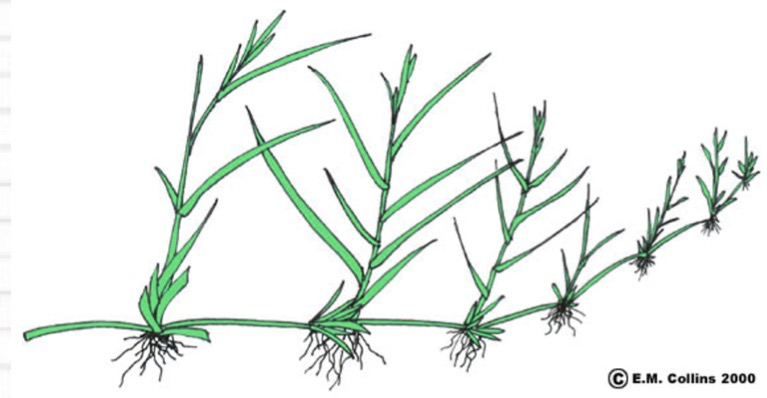
Stolon
Run up top of ground (stems)
Lawn grass, centipede grass
Rooting at the node
Tubers
starch (carbohydrate) storage
Eyes are auxiliary buds
Eyes arranged in spiral
Opposite leaf arrangement

Bulbs
actual part of the team
Have modified leaves

Tendrils
originates from the auxiliary bud
Leaf tissue

Thorns
started it as an auxillary bud
Protects from animals

Stem modification
Examples: Thorns, bulbs, tendrils, corms, tubers, stolon, xerophytes, rhizomes
Flowers
flower parts are modified leaves (developed from a bud)
Reproductive organs
Anther (pic)
What is 1?

Filament (pic)
What is 2?

Stamen (pic)
1 & 2 makes up what part (3)?

Petal (pic)
What is 4 (also known as corolla)?

Ovule with embryo sac (pic)
What is 5?

Sepal (pic)
What is 6 (also known as calyx)?

Receptacle (pic)
What is 7?

Peduncle (pic)
What is 8?

Stigma (pic)
What is 9?

Style (pic)
What is 10?

Pistil (pic)
9, 10, and 11 makes up what flower part?

Perianth
the corolla and calyx referred to collectively
(Petal and sepal)
Tepals
if the corolla and calyx look the same they are referred to as
Monocot part of flower
Petals in front of sepals
Peduncle
entire inflorescence
Pedicel
Individual flower
Whorls
Nectaries
Androecium
stamen
Made up of anther & filament
Stock attached to the recepical
Anther
Part of the stamen that produces the pollen grain
1 pollen grain
Produce 2 sperm
Gyneciums
Pistils
collective noun for all carpels
Made up of stigma, style, and one to several carpals
Can be fused to one pistil or unfused into more
Ovary
Swollen part at the base
Ovules
Ovary contains a structure that produces the eggs
Style
Above the ovary is a stock that supports a platform
Stigma
swollen area at the top is the ____
Landing place for pollen
Carpel
made of ovule plus locule ( the chamber in which the ovule sits
Placentation
Pattern of attachment of the ovule (what will become a seed) to the ovary
Ovule
What is 1?

Carpel
What is 2?

Placenta
What is 3?

Ovules
What is 4?

Locule
What is 5?

Axile placentation
ovules attached to the center, with carpels divided by walls (septa)
Converts Gyneciums to fruit

Parietal placentation
ovules attached to outer wall of ovary, usually divided by septa
Has an ovary
Placenta on the outside edges
Sometimes separated by walls
