MATMOD: 1.1 - Nature of Mathematics
 Call Kai
 Learn
Learn Practice Test
 Spaced Repetition
 Match
Match Flashcards
 Knowt Play
1/28

There's no tags or description
Looks like no tags are added yet.
Name | Mastery | Learn | Test | Matching | Spaced | Call with Kai | Chat |
|---|
No analytics yet
Send a link to your students to track their progress
29 Terms
Numbers
the foundation language of mathematics.
Galileo Galilei
who said this in the 1623 work “The Assayer (Il Saggiatore)”:
“Mathematics is the language with which God has written the universe.”
Ian Stewart
who said this in the 1995 work Nature’s Numbers:
“And it is mathematics that reveals the simplicities of nature and permits us to generalize from simple examples to the complexities of the real world.”
Patterns
a repeated or changing arrangement governed by mathematical rules from numbers, shapes, or objects; visible regularities.
Symmetry
this type of pattern refers to the balanced arrangement of parts such that one part corresponds to another according to a geometric transformation. it also refers to a sense of harmonious and beautiful proportion and balance.
Reflection Symmetry / Bilateral Symmetry / Line Symmetry (flip)
this type of symmetry has a line of reflection or mirror line where the distance between the image and the mirror line is the same as that between the original figure and the mirror line.
Line of Symmetry
refers to any line that divides the figure into two congruent parts; the line is unmoved by reflection.
Translation Symmetry (slide)
this type of symmetry occurs when an object moves the same distance in the same direction without changing its orientation.
Rotation Symmetry / Radial Symmetry (turn)
this type of symmetry occurs when an object can be rotated about a center and still appears unchanged before completing one full revolution (360 degrees).
Angle of Rotation
refers to the smallest angle that a figure can be rotated while still preserving the original formation.
Dilation
this type of pattern refers to a transformation that changes the size of an object while preserving its shape.
Fractals
this type of pattern refers to a self-similar, repeating shape where the same basic shape is seen again and again in the shape itself.
Fractals: Self-similarity
this fractal characteristic refers to the smaller sections found inside the shape that resemble the entire figure.
Fractals: Iterative Formation
this fractal characteristic means that a fractal is generated through repeated of a simple rule.
Fractals: Fractional Dimension
this fractal characteristic refers to the non-integer exponents that describe how complex and self-similar objects scale and fill space.
(ex: the Sierpinski Triangle has a [answer] of approximately 1.585.
Tessellation
this type of pattern refers to the repeating arrangement of shapes that completely covers a surface without gaps or overlaps using one or more geometric shape called tiles.
Tessellation: Regular
this type of tessellation is made by repeating one regular and congruent polygon with common vertices.
Schläfli symbols
refers to the notation symbols used to define a tessellation in the form of {p, q}, where p = number of sides, and q = number of polygons at each vertex.
Tessellation: Semi-regular (Archimedean tessallations)
this type of tessellation is made up of two or more regular polygons where the pattern at each vertex must be the same.
Concentric circles
this type of pattern is composed of circles that all share the same center but have different radii.
Annulus
refers to the region between two concentric circles of different radii.
Sequence
this type of pattern refers to an enumerated collection of objects with a governing rule; order matters.
Sequence: Arithmetic
this type of sequence has a common difference.
Sequence: Geometric
this type of sequence has a common ratio.
Sequence: Harmonic
this type of sequence is a list whose reciprocals form an arithmetic sequence.
Fibonacci numbers
A sequence where each number is obtained by adding the two previous numbers.
Leonardo Pisano Bigollo (Leonardo Fibonacci)
this sequence list is named after this Italian mathematician in the book Liber Abaci containing a problem concerning rabbit birth rates.(1202).
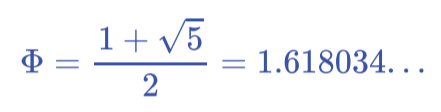
Binet’s formula
What is the value of the golden ratio?

What is the general formula of the Fibonacci sequence?