Paper 3: Further Mechanics
 Call Kai
 Learn
 Practice Test
 Spaced Repetition
 Match
 Flashcards
 Knowt Play
1/19

There's no tags or description
Looks like no tags are added yet.
20 Terms
Particle model of projectile motion and limitations
The particle model of projectile motion assumes the following:
The projectile is a particle: its dimensions, shape, and rotation are ignored.
After projection, only the gravitational force is acting on the particle, so air resistance is negligible.
Vertical acceleration is constant, downwards, and has a magnitude of 9.8 ms-2: ay = -g
There is no horizontal acceleration: ax = 0
Limitations of the model include the following:
The projectile’s size and shape may affect its motion.
The presence of air resistance results in a changing resultant vertical acceleration and results in horizontal deceleration.
g varies with altitude.
Rotation can result in additional forces.
Calculating the magnitude of the velocity of a projectile at a given time or position

Calculating the direction of the velocity of a projectile at a given time or position

Calculating the range of a projectile on a horizontal plane
The range of a projectile on a horizontal plane is the horizontal distance travelled from the point of projection to the point of landing. On a horizontal plane, the vertical displacement is 0.
A projectile has initial velocity u at an angle α above the horizontal.
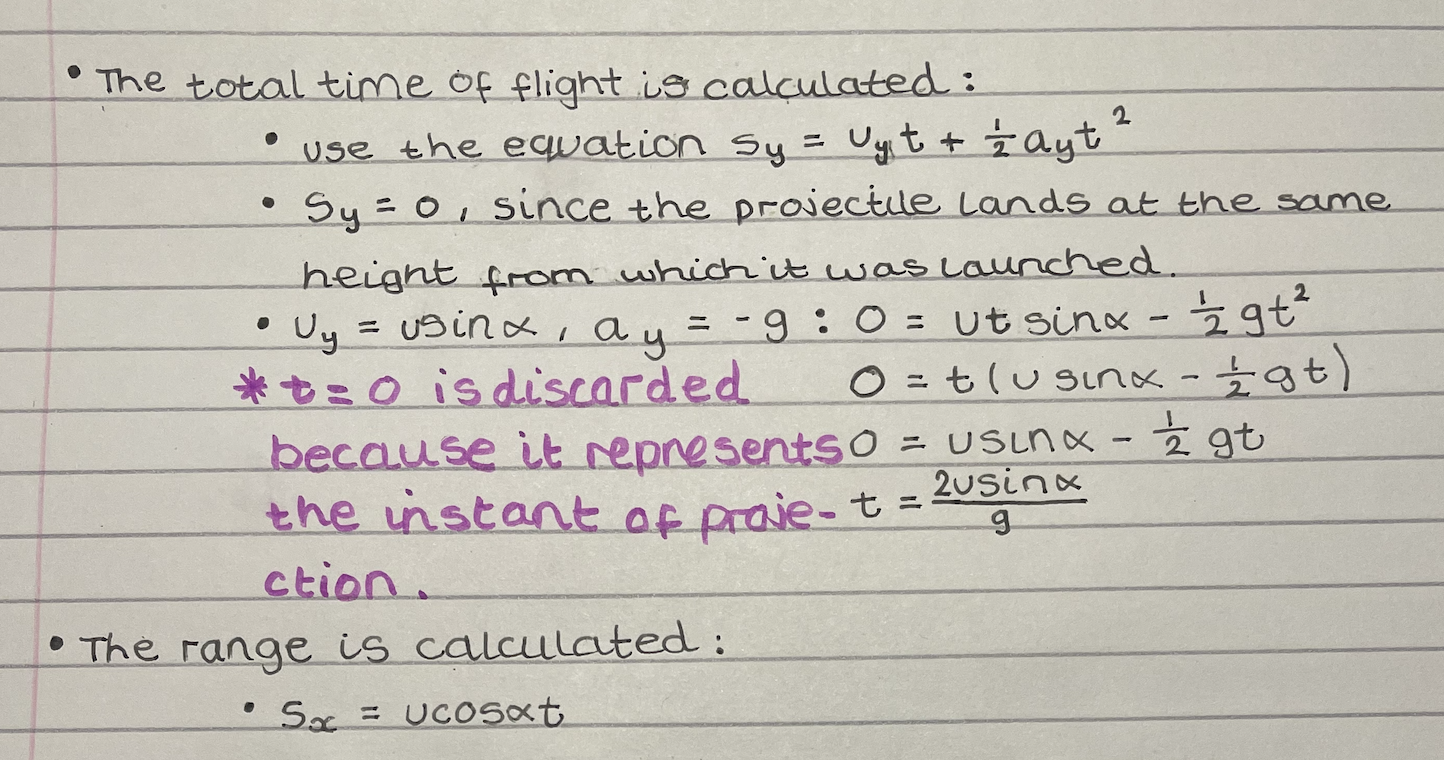
Calculating the greatest height reached by a projectile
A projectile has initial velocity u at an angle α above the horizontal.

Cartesian equation of the trajectory of a projectile and derivation
The Cartesian equation of the trajectory of a projectile describes the projectile’s vertical displacement y in terms of its horizontal displacement x, without involving time.
A projectile has initial velocity u at an angle α above the horizontal.

Finding unknown initial speed from Cartesian equation of trajectory of projectile

Finding unknown angle of projection from Cartesian equation of trajectory of projectile

Finding unknown initial speed and angle of projection from Cartesian equation of trajectory of projectile
If given two points the projectile passes through, two simultaneous equations are created and solved for u and α.
Moment of a force
The moment of a force about a point is the turning effect of that force about the point.
Moment of force (N m) = Fd
F = magnitude of the force
d = perpendicular distance from the pivot to the force’s line of action
Anticlockwise moments are positive, and clockwise moments are negative.
Centre of mass
In a uniform gravitational field, the effect of gravity on a rigid body is equivalent to a single vertically downward force equal to the total weight of the body, acting through its centre of mass.
W = mg
W = weight (N)
m = mass (kg)
g = 9.8 ms-2
Uniform body
A uniform body has a constant mass per unit length, area, or volume.
Identifying the position of centre of mass of a uniform body
The centre of mass of a uniform body lies on every axis or plane of symmetry.
To identify the position of centre of mass of a uniform body, use the following method:
Identify the body’s axes or planes of symmetry.
Determine their intersection.
If the intersections identify a point, this is the centre of mass.
If symmetry only identifies a line or a plane, additional information is needed to locate where on the line or plane the centre of mass lies.
Centre of mass of a triangular lamina
A triangular lamina is a uniform body that is a triangular sheet.
Its centre of mass is 2/3 along any median measured from a vertex.
A median joins a vertex to the midpoint of the opposite side.
Centre of mass of a solid hemisphere
A solid hemisphere is a uniform body that is half of a solid sphere.
Its centre of mass