fundamentals of radiobiology, biological effects of radiation - part 2
 Call Kai
 Learn
 Practice Test
 Spaced Repetition
 Match
 Flashcards
 Knowt Play
1/32

There's no tags or description
Looks like no tags are added yet.
33 Terms
deterministic effects occur when:
enough cells in an organ and tissue are killed or prevented from functioning normally
the threshold for deterministic effects is..
the level where symptoms will appear in 1% of those exposed
above the threshold, the severity of the effect increases with dose. the curve will plateau when the effect is so severe that the organ/tissue is no longer viable
the threshold dose varies with:
organ affected
confounding factors such as:
health
age
smoking
threshold doses for deterministic effects

systemic effects may be…
morphological and/or functional

according to radiosensitivity laws (bergonie and tribondeau), the most radiosensitive cells are…
from the basal stratum of the epidermis

skin reactions

hair loss
temporary hair loss can occur approx. 3 weeks after exposure of 2-5 Gy, with regrowth beginning approx. 2 months later (complete regrowth in 6-12 months)
the [1] of the eye is very radiosensitive and surrounded by [2]
1- lens
2- highly radiosensitive cuboid cells
there are 2 basic effects from radiation damage to the eye:
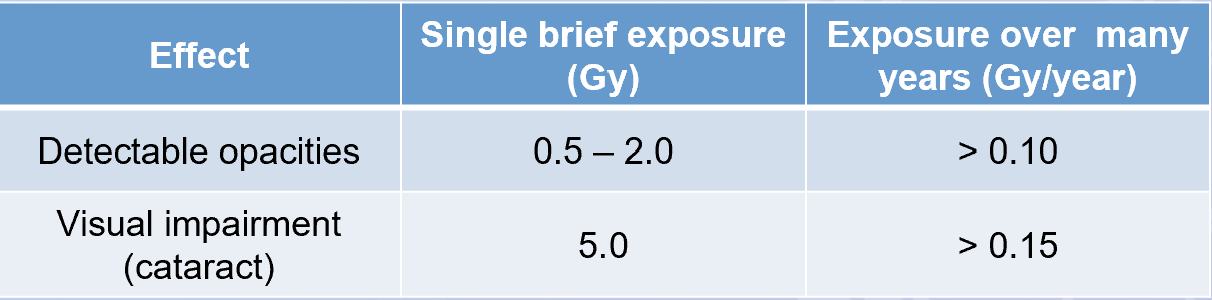
cataractogenic radiation damage starts at…
the anterior surface
(lens of the eye) radiation damage results in
aberrant crystalline protein folding and dysregulation of lens cell morphology
[1] was thought to be the only typical lesion related to radiation damage to the lens but recent data suggest that radiation induced opacities can be found in the [2] as well
1- posterior subcapsular (PSC) opacification
2- the lens cortex

reproductive organs - testes. the testes contain both radiosensitive cell populations [1] and radioresistant cell populations [2]
1- spermatogonia
2- mature spermatozoa
the primary effect on the male is temporary [1] or permanent sterility [2]
1- acute doses of 2.5 Gy
2- 6 Gy
reproductive organs - ovaries. the [1] within ovarian follicles are radiosensitive. the [2] are the most radiosensitive, then [3], with the [4] being the least radiosensitive
1- ova
2- intermediate follicles
3- mature follicles
4- small follicles
reduces fertility can occur after exposure to ionizing radiation [1]. permanent sterility can occur after doses of greater than [2]
1- 1.5 Gy
2- 3 Gy
the [1] is one of the main organs affected by irradiation injury
1- hematopoietic system
exposure to radiation can cause [1] and [2] due to the [3] that can self-renew and differentiate into all types of blood cells
1- acute myelosuppression
2- long-term hematopoietic injury
3- direct or indirect damage of hematopoietic stem cells (HSCs)
there are 3 kinds of effects from antenatal exposure:
1- lethality
2- congenital anomalies
3- large delay effects (cancer and hereditary effects)

lethal effects can be induced by [1] before or immediately after [2]
1- 0.1 Gy or less
2- implantation of the embryo into the uterine wall
an embryo is a few non-specialized cells:
[1] if a few cells are killed…
[2] if too many cells are damaged
1- the remaining embryonic cells replace the cells lost (within a few cell divisions) with no adverse effects
2- the embryo fails to implant and is resorbed
it is likely a potential pregnancy would not be identified
effects of antenatal exposure - congenital anomalies
intellectual disability
ICRP notes that intellectual disability can be induced by radiation (iq score < 100)
can occur during the most radiosensitive period (8-25 weeks)
reduction in iq of 25 points per Gy
there is no known link with down syndrome
effects of antenatal exposure - congenital anomalies
8-15 weeks vs 15-25 weeks
8-15 → severe intellectual disability with a risk factor of 0.4/Sv
15-25 → severe intellectual disability with a risk factor of 0.1/Sv
effects of antenatal exposure - large delay effects
both somatic effects and genetic effects can occur as a result of antenatal exposure
acute radiation syndrome (radiation poisoning) is..
a combination of clinical syndromes occurring in stages, hours to weeks after exposure as injury to various tissues and organs is expressed
ARS occurs if the exposure:
1- is acute
2- involves the whole body or a large portion of it
whole body response (to acute radiation syndrome). steps:
1- prodromic (onset of disease)
2- latency
3- manifestation
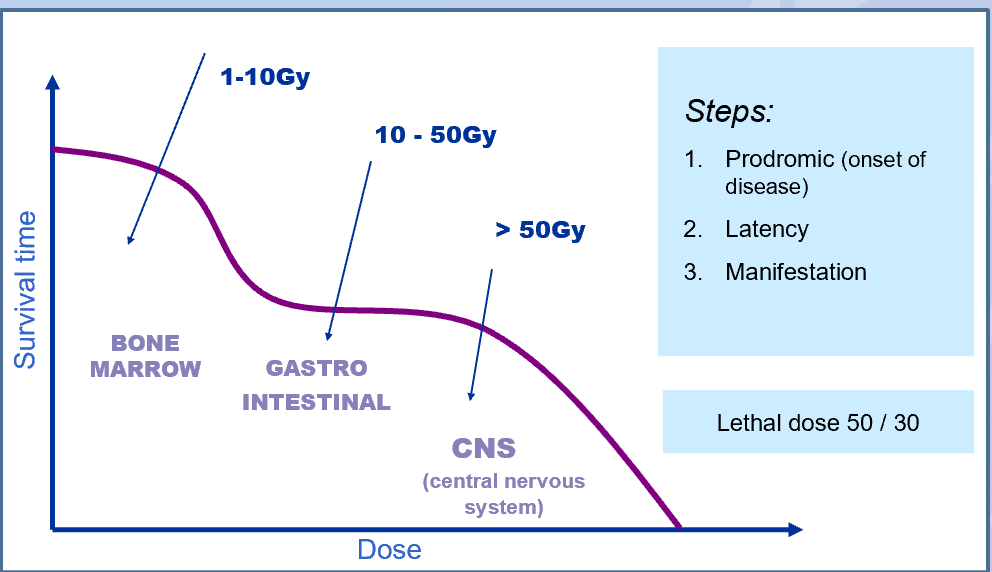
what is the lethal dose 50/30?
the dose which would cause the death of 50% of the population in 30 days
its value is about 2-3 Gy for humans for whole body radiation
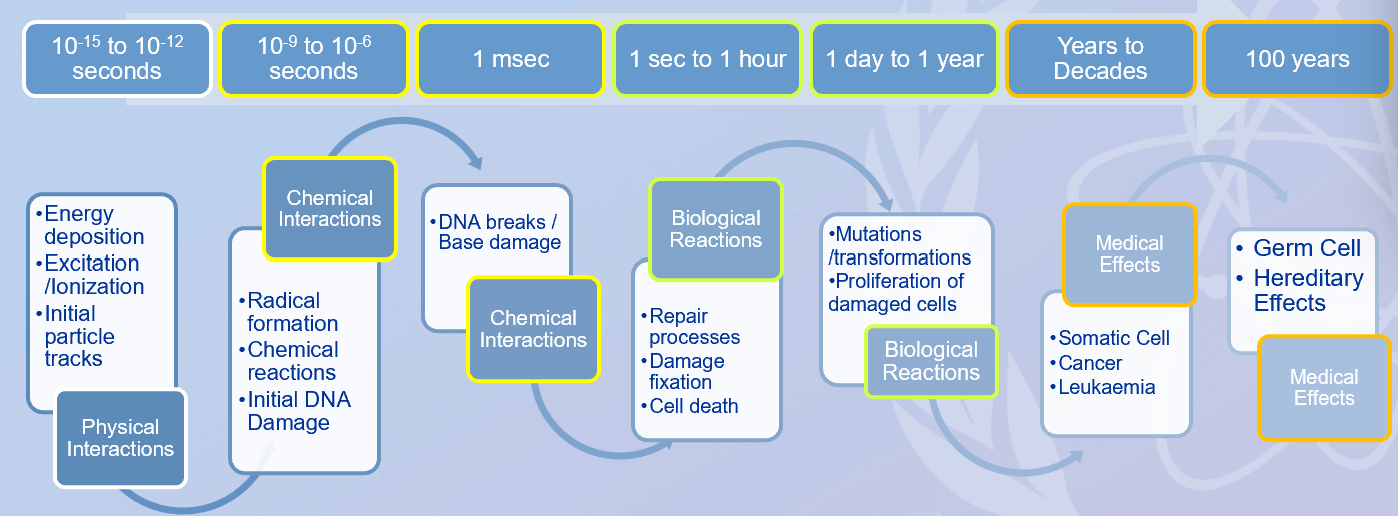
timescale of radiation damage
1- delayed tissue reactions from exposure are seen within:
weeks, e.g. skin erythema
years, e.g. cataracts
decades, e.g. cardiovascular disease
2- cancer induction is a late effect:
occurs years or decades after mutation
3- heritable effects is also a late effect:
have not been seen in children of irradiated parents
have been observed in plant/animal studies
will require further research using sensitive dna based methods
time of events leading up to radiation effects