Organic Compounds and Enzymes
 Call Kai
 Learn
 Practice Test
 Spaced Repetition
 Match
 Flashcards
 Knowt Play
1/87

There's no tags or description
Looks like no tags are added yet.
88 Terms
Catalyst
A substance that speeds up a chemical reaction without being consumed
What is the difference between a catalyst and an enzyme?
Catalysts can be inorganic while enzymes are biological organic catalysts which are made of proteins
What are enzymes made of? What are those bio-molecules made of?
Proteins which are made of amino acids.
Why are enzymes only needed in small quantities?
Enzymes are not consumed or altered during a chemical reaction. They can be reused over and over again to catalyze new reactions.
Substrate
Reactant molecule that an enzyme binds to and acts upon during a chemical reaction.
Intermediary molecule in an enzyme substrate reaction
Enzyme-substrate complex

Lock and key model
The model of the enzyme that shows the substrate fitting perfectly into the active site
Active site
The part of an enzyme or antibody where the chemical reaction occurs. Region on enzyme where substrate binds.

Induced fit model
Change in the shape of an enzyme's active site that enhances the fit between the active site and its substrate(s)

Significance about lock and key model
Foundational scientific concept explaining how enzymes recognize and bind to specific substrates
Catalysis
The acceleration of a chemical reaction by a catalyst
Cofactors
Any nonprotein molecule or ion that is required for the proper functioning of an enzyme. Cofactors can be permanently bound to the active site or may bind loosely with the substrate during catalysis. Nonprotein enzyme helpers.
pH
Hydrogen cation concentration
pH Scale
0-7 is acidic
7 is neutral
7-14 is basic
Coenzymes
Organic cofactors
The affect of substrate concentration on enzyme action
Increases reaction rate
The affect of substrate concentration on reaction rate
Increases reaction rate
Saturation
The state or process that occurs when no more of something can be absorbed, combined with, or added.
Competitive inhibition
Substance that resembles the normal substrate competes with the substrate for the active site

Non-competitive inhibition
The inhibitor binds elsewhere, altering enzyme function.

Functional groups
The components of organic molecules that are most commonly involved in chemical reactions

Hydroxyl group
-OH (alcohol)

Carboxyl group
-COOH (found in organic acids)

Carbonyl group/Aldehyde group
C=O (polar)

Amino group
NH2

Phosphate group
PO4

Methyl group
CH3

Exergonic/Exothermic
Spontaneous, net release of free energy
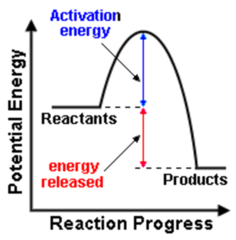
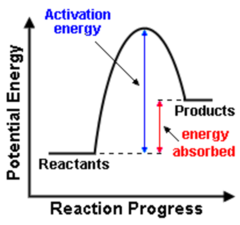
Endergonic/Endothermic
Spontaneous, energy absorbed
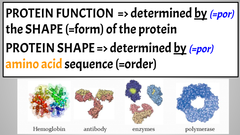
Protein shape determines
Protein function
Levels of protein structure
primary, secondary, tertiary, quaternary

Primary structure
The first level of protein structure; the specific sequence of amino acids making up a polypeptide chain.

Secondary structure
The second level of protein structure; the regular local patterns of coils or folds of a polypeptide chain.

Tertiary structure
The third level of protein structure; the overall, three-dimensional shape of a polypeptide due to interactions of the R groups of the amino acids making up the chain.

Quaternary structure
The fourth level of protein structure; the shape resulting from the association of two or more polypeptide subunits.

Alpha-helix (α-helix)
A spiral shape constituting one form of the secondary structure of proteins, arising from a specific hydrogen-bonding structure.

Beta sheet (β sheet)
Folding pattern found in many proteins in which neighboring regions of the polypeptide chain associate side by side with each other through hydrogen bonds to give a rigid, flattened structure.

Denaturation
Loss of normal shape of a protein due to heat or other factor (pH, chemicals, salt)
Triglycerides
An energy-rich compound made up of a single molecule of glycerol and three molecules of fatty acid.

Why is all life based on carbon?
Carbon can form bonds with up to 4 other atoms, and can therefore be built into more complex molecules than any other biologically important element.
Carbon backbones
Carbon atoms readily bond with each other and can form long chains, branched molecules, and rings

Organic compounds
Compounds that contain carbon
Structure of a molecule
The three-dimensional arrangement of atoms and chemical bonds within a molecule
4 most important organic molecules to all life
Carbs, Proteins, Lipids, Nucleic Acids
What do living things use carbs as
Their main source of energy. Plants and some animals use them for structural purposes.
Starch
A storage polysaccharide in plants consisting entirely of glucose.

Isomers
Compounds with the same formula but different structures.

Sucrose
glucose + fructose (Found in plants)

Maltose
glucose + glucose (found in barley)
Dehydration synthesis
A chemical reaction in which two molecules covalently bond to each other with the removal of a water molecule.

Macromolecules
Giant molecules (hundreds of thousands of smaller molecules)

Monomers
building blocks of polymers
Polymers
large compound formed from combinations of many monomers
The formation of polymers from monomers occurs as a result of ___________ reactions, and the breakdown of polymers into monomers occurs as a result of ___________ reactions.
Dehydration synthesis and hydrolysis
Lactose
Galactose + glucose

Glycogen
storage form of glucose in animals liver

Cellulose
Carbohydrate component of plant cell walls.

Chitin
A structural polysaccharide, consisting of amino sugar monomers, found in many fungal cell walls and in the exoskeletons of all arthropods.

Plants turn most glucose and fructose into starch
True
Hydrolysis
Splitting bonds between monomers
Carbohydrates
The starches and sugars present in foods
Proteins
Nutrients the body uses to build and maintain its cells and tissues
Lipids
Energy-rich organic compounds, such as fats, oils, and waxes, that are made of carbon, hydrogen, and oxygen.
Nucleic acids
macromolecules containing hydrogen, oxygen, nitrogen, carbon, and phosphorus. DNA/RNA, transmits genetic info.
DNA vs RNA
DNA - Blueprint
RNA - Turns blueprint into proteins
Amino acids all have
an amino group and a carboxyl group (Carboxyl group makes it an acid)
Coils, helixes and globules
Proteins are like coils when denatured. Helixes are the secondary structure. Globules are the tertiary structure
3 main types of lipids
triglycerides, phospholipids, steroids (cholestrol)
HDL vs LDL
High density lipoproteins flow through your bloodstream. Low density lipoproteins also flow but can clog. That's why they are bad. Both flow through your bloodstream with cholestrol.
Steroids
Lipids characterized by a carbon skeleton consisting of four fused rings
Cholestrol
Made in liver. Steroids
Fat
A large lipid molecule made from an alcohol called glycerol and three fatty acids; a triglyceride. Most fats function as energy-storage molecules.
Fatty acids have a hydrophilic end and a hydrophobic end
True
Hydrophilic
Polar
Hydrophobic
Non polar
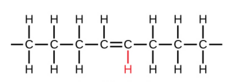
Saturated fat
A lipid made from fatty acids that have no double bonds between carbon atoms

Unsaturated fat
A lipid made from fatty acids that have at least one double bond between carbon atoms.

Trans fat
An unsaturated fat, formed artificially during hydrogenation of oils, containing one or more trans double bonds.
atherosclerosis
hardening of the arteries due to plaque buildup
Examples of unsaturated fats
Most oils, nuts, salmons, seeds, avacado
Examples of saturated fats
Animal fats, coconut oil, butter, beef fat, palm oil, lard, and chicken fat
Examples of trans fats
Baked goods, deep fried foods, margerine, shortening
Hydrogenation
The process of converting unsaturated fats to saturated fats by adding hydrogen (Trans fats, they're trans)
Phospholipids
Fats but they have 2 fatty acids. Part of cell membranes

Anabolic steroids
Synthetic variants of the male hormone testosterone.
Nucleotides
A type of monomer with ribose a phosphate group and a nitrogenous base
Proteins (Polymers) are made of ____ types of ______ (monomers)
20 amino acids
DNA is built from just four kinds of monomers called ____.
nucleotides