Lecture 2 - Pressure Flow
 Call Kai
 Learn
Learn Practice Test
 Spaced Repetition
 Match
Match Flashcards
 Knowt Play
1/42

There's no tags or description
Looks like no tags are added yet.
Name | Mastery | Learn | Test | Matching | Spaced | Call with Kai | Chat |
|---|
No analytics yet
Send a link to your students to track their progress
43 Terms
What are blood flow to tissues regulated by under normal conditions?
tissue needs
cardiac output
total volume of blood your heart pumps/minute
sum of all local tissue blood flow
CO = Heart rate (HR) x stroke volume (SV)
is arterial pressure related to CO and blood flow?
no, it is highly regulated and not affected by changes in CO and local tissue blood flow
flow
movement of substances from different points driven by energy gradients
what is the gradient that drives substances
energy gradients
what is the gradient that drives molecules
conc. gradient
what is the gradient that drives heat
temp gradient
what is the gradient that drives gases
pressure gradient
what is the gradient that drives fluids
hydrostatic pressure
How is rate of flow/mag of flow related to mag of gradient
directly proportional
multiple gradients can determine mag of flow
ex. E gradient for ions is conc. gradient and voltage gradient
what is inversely proportional to flow?
resistance
there’s always some resistances to flow, but some can be controlled
pressure gradient
difference between p1 and p2 at two different points

how is resistance created?
when blood moves continuously through the circulatory system, primarily caused by friction between blood and the inner walls of blood vessels

blood pressure
force caused by blood against wall of arteries
hydrostatic pressure (ex. mmHg, kPa)
reflects force exerted by blood against a unit area of a vessel wall
what are the methods of measuring blood flow and pressure?
ultrasonic doppler flowmeter = uses ultrasound to measure flow rate
intravascular pressure transducer
BP sphygmomanometer
How to calculate resistance?
cannot be measured directly
must be calculated once bp and p are known
Blood flow (F) equation
F = delta P / R
delta P = P1 - P2
difference in mean BP between aorta and right atrium (drives flow during circulation)
R = resistance
expressed as volume/time
resistance
impediment to flow due to friction
both external (vessel wall) and internal (due to blood viscosity)
conductance
opposite of resistance
1/R
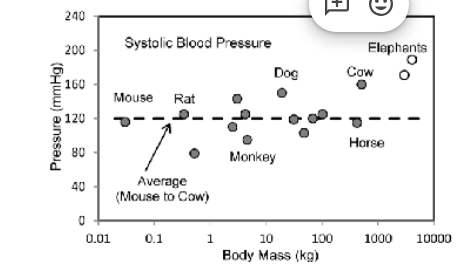
describe the graph

Total peripheral resistance (TPR)
resistance of an entire systems circulation
or total amt of force/resistance blood must overcome to flow through the circulatory system
how does CO and delta P relate to mass/body size
CO proportional to body size
P scales with mass fluctuations
How does TPR relate to size/mass?
TPR dec. with larger animals
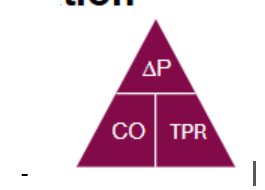
How doe delta P, CO and TPR relate?
delta P/CO = TPR
CO x TPR = delta P
delta P/TPR = CO
how do biological structures facilitate and constrain function?
arrangement of elements within a tissue/organ (ex. arrangement of vessels can affect blood flow)
physical dimensions of a structure (ex. shape and size of vessel can affect blood flow)
factors affecting resistance
vascular arrangement: networks arranged in series or parallel
patterns of blood flow: laminar or turbulent flow
vascular dimension: changes in length and diameter of vessels
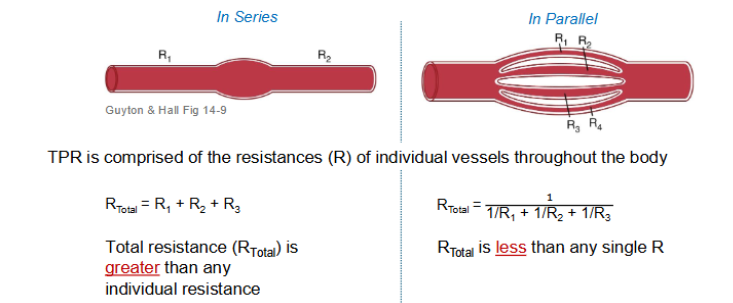
How do vessel networks arranged in a series affect resistance?
series: one vessel next to the other, individual resistances (of each segment) are summed → total resistance increases
Rtotal = R1 + R2 + R3
Rtotal > any individual resistance
TPR is comprised of the resistances (R) of individual vessels throughout the body

How do vessel networks arranged in parallel affect resistance?
parallel: vessels are arranged in parallel, has multiple different resistances
Rtotal < any single R
Rtotal = 1/ (1/R1) + (1/R2) + (1/R3)
TPR is comprised of the resistances (R) of individual vessels throughout the body
how are capillary networks arranged?
usually in parallel
blood flows via capillary beds of different systemic tissues in parallel
based on diagram,
several capillary resistances are included
a larger body mass, more capillary vessels and more capillary beds (bigger animals) will decrease TPR
*recall TPR equation for parallel networks

How does laminar flow affect resistance?
blood flows smoothly in streamline through vessels
via relatively little mixing in radial direction
creates lower and more stable resistance as fluid moves in smooth, parallel layers, without mixing

How does turbulent flow affect resistance?
flow can become disorderly, whirling in a radial (crosswire) direction to form “eddy currents”
occurs in largest vessels, with highest flowrates and around obstacles/occlusions
increases resistance to blood flow

how does vascular dimension affect resistance?
resistance changes directly with physical dimension of vessels
vessel radius
how does vessel length affect resistance?
vessel length
inc. vessel length = inc. resistance to blood flow = dec. blood flow
longer vessels create more friction as blood travels across larger SA
blood flow dec. with inc. resistance
How does vessel radius affect resistance?
small changes in r affect resistance (r is to the power of 4 according to poiseuille’s law)
Vessel length and (internal) viscosity do not vary much over short periods
External vessel radius can change acutely and is thus the most important factor regulating resistance

how does vessel radius (lumin of a rat) differ between a normal and hypertensive rat?
normal: lumin diameter is smaller → more resistance to blood flow
hypertensive rat: pink smooth muscle is thicker, diameter increases → less resistance
recall: F = delta P/R
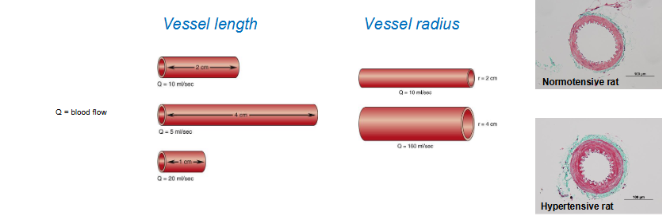
During laminar flow at a set pressure, how does vessel diameter affect blood flow?
small changes in vessel diameter have large effects on blood flow (recall r is to the power of 4)
Friction against vessel walls makes blood flow slower
In larger vessels, fewer streamlines of blood are near the vessel wall
In smaller vessels, greater proportion of blood along vessel walls so blood flows slower
Longer vessel = more resistance → P and I are inversely proportional
vascular conductance x resistance as radius increase graph
Bp is lower and gradually increases as vessel radius increases
Resistance will decrease as vessel radius increases
Both are exponential curves
How is resistance regulated?
Increased diameter = vasodilation
Decreased diameter = vasoconstriction
Decrease in diameter (ex. Using a pharmacological vasoconstrictor) reduces blood flow at given pressure gradient
Vasoconstrictor = noreepi, epi
Decrease vasoconstriction, blood flow decreases, p increases
See downward shift in curve with vasoconstrictor
What is a major site where resistance is rapidly regulated?
Arterials are a major site where diameter, thus resistance, is regulated rapidly to meet blood flow demands

How does blood viscosity relate to resistance?
blood viscosity is proportional to resistance
changes in hematocrit (% of blood that’s RBC) can alter blood viscosity and resistance
more RBC’s are suspended in blood, increases friction between adjacent cells and against vessel walls
How does anemia affect blood viscosity?
anemic can occur during the menustral cycle in response to blood loss
blood viscosity decreases because a low red blood cell count makes the blood thinner and causes less resistance to flow
How does polycythemia (aka. excessive erythrocytosis) affect blood viscosity?
occurs at high elevation, in response to sleep apnea, in pulmonary diseases, etc., more resistance to blood flow
Orange bar shows that non EE individuals have less percentage of hematocrit
After putting everyone through exercise in graph 2, it found that co-increases in non-ee group highlanders have higher blood cell count and are more likely to have mor resistance to blood flow
Look more into graphs!
Decreases in hematocrit, TPR, and blood cells can cause lower blood viscosity and less resistance which increases CO

What would be the effect of experimentally correcting haematocrit by “isovolumic hemodilution” (removing
blood and replacing it with saline)?