PPL Written Exam
 Call Kai
 Learn
 Practice Test
 Spaced Repetition
 Match
 Flashcards
 Knowt Play
1/112

There's no tags or description
Looks like no tags are added yet.
113 Terms
PPL Minimum Requirements
17 years old (solo at 16)
Read, speak, write, & understand english
Pass the knowledge & practical exams
written, oral, flight
3rd class medical
3 hrs of flight time in the preceding 2 calendar months
Flight time requirements for PPL
40 hours
20 from CFI
3 hrs XC in single engine plane
10 solo
5 hours solo XC
1 solo XC 150NM+ with full stop landings at 3 points and one segment being 50NM+
3hrs night flight
1XC over 100NM+
10 T/O & L/As to full stop
3 hours with sole reference to instruments
3 hours within 2 months of practical test with a CFI
Medical Certificates
Required to be PIC
3 types
1st class: Airline Transport pilot privileges
2nd class: Commercial pilot privileges
3rd class: Private pilot privileges
other option: Basic med
How does validity & expiration work for medical certificates
Calendar months
the validity of the certificate extends to the end of the month, not the exact date
Trickle down
doesn’t expire, but loses the class privileges
How does age & validity work for medical certificates
3rd class
under 40: 60 calendar months
over 40: 24 calendar months
2nd class
all ages: 12 calendar months
after it expires, reverts to 3rd class
1st class
under 40: 12 calendar months
over 40: 6 calendar months
What is basicmed
Alternate medical qualification, without an FAA medical
must have held a FAA medical after July 14, 2006
to maintain
complete a medical exam checklist with a physician every 48 months
online course every 25 months
limits
no more than 6 passengers (7 including the pilot)
plane weight of 12,500lbs MAX
VFR/IFR
lower than 18k
less than 250kts
no operation for compensation or hire
Required documents to be PIC
Pilot cert
gov-issued ID
driver’s license, passport, or military ID
medical certificate
logbook with endorsements if required
when do you need all the required documents by
your solo
to be PIC you need student pilot cert & valid 3rd class medical
PPL privileges
act as PIC
carry passengers
not for compensation
share operating expenses
pro rate share
fuel, oil, and rental fees
must split equally
can be reimbursed for expenses for search and rescue operations
if authorized by a government agency
Tow glider
with endorsement & training
can demonstrate an aircraft to buyer
200hrs of flight logged
must be an aircraft salesperson and employed by a dealer
flights for charity
501C nonprofit
500hrs total time
within 25NM
day VFR
Preventative mx
Limits of private pilot
no compensation of hire
how do you stay legal to fly
To act as PIC
have a bi-annual flight review
to carry passengers
meet the landing requirements
must keep records to show proof of currency
what records do you need to show you are legal?
must log any time required to obtain a certificate/rating
currency flights
flight reviews
Bi-annual flight reviews
who can do it
a CFI or checkpilot
what’s required
1hr of ground + 1 hr of flight
focuses on what type of flying you’re doing
passing
there is no “pass” or “fail”
you just don’t get re-endorsed until the examiner thinks you’re up to standards
not needed if you
get a new certificate/rating
taking a WINGs FAA class
what is passenger currency?
must meet requirements
preceding 90 days
3 takeoffs/landing as the sole manipulator of controls in an aircraft
same category of class
night time currency
same concept, but must be done to a full stop
there are different kinds of nighttime
PIC vs Sole Manipulator
PIC
final command of operations and safety
can log PIC time when
acting as the sole manipulator of the controls when rated for the aircraft
Sole manipulator
the one actually flying the plane
currency vs proficiency
currency
meeting regulatory requirements to operate the aircraft and fly passengers
proficiency
a proficient pilot is practiced and competent to fly safely and comfortably
its about how familiar you feel flying the plane
what are the different kinds of night
sunset to sunrise
aircraft are required to display position (nav) lights
end of evening civil twilight to beginning of morning civil twilight
pilots may log flight time during this period as night flight time
you can look up this time online
one hour after sunset to one hour before sunrise
night landings for currency
What is airworthiness and the 3 pillars
means that the aircraft is fit and safe for operation to fly
3 pillars
meets the approved type design
in condition for safe flight
all maintenance, required inspections, & directives are done
Who’s responsibility is airworthiness determination
owner
responsible for maintaining airworthiness, inspections, etc.
PIC
final authority of determining if the plane is safe to fly that day
what is category, class, and type
category
the “type” of flying
airplane
gliders
helicopters
class
what groups it together…engines, sea or land, etc.
single-engine land
single-engine sea
multi-engine land
etc.
type
an aircraft 12,500lbs or greater, requires specific rating
types of certifications
standard
can carry passengers and cargo, commercial operations
special
doesn’t fully meet normal airworthiness, but is safe for specific operations
standard certification types
normal
no aerobatic flight
utility
limited aerobatics
aerobatic
commuter
multi-engine
19 passengers
transport
jet engine
10+ seats
special certification types
experimental
can’t carry passengers for hire
restricted
limited to the required crew members
special
can’t carry passengers
sometimes cargo is allowed
what are the required inspections
AVIATE
Annual
12 months
VOR
30 days - IFR only
100 hour
for hire only
Altimeter
24 months
Transponder
24 months
ELT
12 months, 1hr consecutive use, 50% battery life
Annual vs 100hr inspections
Annuals
all aircraft pt 91. every 12 calendar months, more detailed
A&P mechanic with inspection authorization (IA)
100hr
required for “hire” operations
flight instruction aircraft, or planes used to carry passengers
identical to annual BUT any A&P mechanic can do it
Progressive/Phase checks
breaks down a larger inspection into shorter phases
prop, engine, etc.
minimizes downtime to help at high-usage schools
what happens if you miss an inspection?
you can get an extension called a special flight permit
at the local FSDO
allows you another 10hrs to fly to get the inspection
the hours flown over the limits count towards the next inspection
if its due at 2100hrs & inspection is done at 2105, next 100 hour is still due at 2200
what are the required documents you need to have for the plane
ARROW
Airworthiness certificate
cabin/cockpit
must be visible to passengers
Registration certificate
not required to be visible
Radio station license
operation limitations (POH)
weight and balance
done before the flight & brought on board
do plane documents expire?
airworthiness doesn’t as long as you keep inspections & alterations maintained
registrations certificate lasts 7 years (as of jan 2023)
POH doesn’t expire, but can be updated
what are airworthiness directives & service bulletins
they are sent out to the plane when there is something that needs to be fixed (like car recall)
airworthiness directive
legally enforced regulation issued by the FAA to correct an unsafe condition
AD compliance is mandatory and the aircraft isn’t airworthy until fixed
service bulletin
is issued by the aircraft manufacturer and is a recommendation
how can you make sure the aircraft is compliant with airworthiness directives and service bulletins (ADs and SBs)
look at MX records
check FAA database
FAA’s regulatory & guidance library
dynamic regulatory system (DRS)
check if the aircraft has an AD compliance sheet
where can you find the list of preventative maintenance a pilot can do
14 CFR Part 43, Appendix A
what are the required equipment references
minimum equipment list (MEL)
Type Certificate Data Sheet
Kinds of Equipment list (POH)
91.205 (ATOMATOFLAMES)
Any ADs
what is a MEL, minimum equipment list
airplane specific for make/model/serial number/registration what can be inoperative
developed by the operator
more flexible
what is a type certificate
an official document that defines the design and airworthiness standard
specific aircraft, engine, or prop
operating limits
dimensions
required placards
defines requirements to conform to its type design
what are kind of equipment lists
typically POH chapter 2 or 9
developed by an airplane manufacturer
all aircraft of the same make/model
less flexible
what do I do if some equipment is broken
check for an MEL
if none, comply with 91.213(d)
what to do if there is an inoperative equipment
if required, repair before flight or obtain special flight permit
if non required, deactivate/remove and mark as inoperative
what are the 2 types of weather
forecasted and observed
what is observation weather
what the weather has been doing
METAR, PIREP, Surface Analysis Chart, CVA, GFA
What is forecasted weather
what we think the weather will do
TAF, GFA, Winds Aloft Charts, Convective Outlook
AIRMETS & SIGMETS
what are the categories of weather
VFR (visual flight rules, green)
MVFR (marginal flight rules, blue)
IFR (instrument flight rules, red)
LIFR (low instrument flight rules, magenta)
what is a METAR
standard report, issues every hour, provides current weather
what is SPECI
unscheduled when significant and rapid changes occur in weather
what is ATIS
every hour, most comprehensive, only towered airports
what is ASOS
every min, more comprehensive, towered/non towered
what is AWOS
every min, least comprehensive, towered/non towered

read this METAR
type of report
station identifier
date and time of report
modifier
wind
visibility
weather
sky condition
temp and dew point
altimeter setting
remarks
what do these descriptors mean
MI
BC
PR
DR
BL
SH
TS
FZ
MI: shallow
BC: patches
PR: partial
DR: low drifting
BL: blowing
SH: showers
TS: thunderstorm
FZ: freezing
what do these precipitation weather phenomena mean
DZ
RA
SN
SG
PL
GR
GS
UP
DZ: drizzle
RA: rain
SN: snow
SG: snow grains
PL: ice pellets
GR: hail
GS: small hail and/or snow pellets
UP: unknown precipitation
what do these obscuration weather phenomena mean
BR
FG
FU
VA
DU
SA
HZ
BR: mist
FG: fog
FU: smoke
VA: volcanic ash
DU: widespread dust
SA: sand
HZ:haze
what do these other weather phenomena mean
PO
SQ
FC
SS
DS
PO: dust/sand whirls
SQ: squalls
FC: funnel clouds
SS: sandstorm
DS: duststorm
what is a TAF
terminal aerodrome forecast
5SM radius of airport runway
issued every 6 hours, 4 times a day
valid for 24-30hrs
what does FM mean pertaining to weather changes
“from” indicates a rapid significant change in conditions expected to occur within an hour
what does TEMPO mean pertaining to weather changes
forecasts temporary fluctuations expected to last less than an hour at a time and occur less than half the time period
what does PROB mean pertaining to weather changes
indicates a probability of that weather
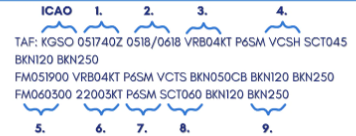
read this TAF
forecast time: 5th day of the month, 1740Z
valid date and time: (DDHH/DDHH)
wind: variable 4kts
precip: VC (vicinity) SH (showers)
time: FM(from) 06(date) 0300(hours & min)
wind: 220 degrees at 3kts
visibility: P(plus) 6+SM
Sky condition: scattered 6000ft
ceilings: broken 25,000ft
what is a PIREP
last “coded” report
most accurate and currect
pilot report, only real time report
access during flight through ATC, FSS, ATIS might include
2 types:
UA: regular
UUA: urgent
what do these identifiers mean in a PIREP
XXX
UA or UUA
/OV
/TM
/FL
/TP
/SK
/WX
/TA
/WV
/TB
/IC
/RM
XXX: 3 letter station identifier
UA or UUA: report type
/OV: location, in relation to VOR
/TM: time, zulu
/FL: altitude, for turbulence & icing reports
/TP: type aircraft, for turbulence & icing reports
/SK: sky cover
/WX: weather
/TA: temperature
/WV: wind, direction in degrees, speed in knots
/TB: turbulence
/IC: icing
/RM: remarks
what are headwinds
wind is pushing against you
increases fuel consumption and flight time
what are tailwinds
wind is pushing you
decrease fuel consumption and flight time
how does altitude effect winds aloft
strong wind gradients can cause turbulence and winds might be stronger or weaker at certain altitudes
what is winds aloft chart
based on a 6hr forecast, 4x a day
for winds aloft, how do you decode winds above 100kts
codes starting with 6/7/8/9
add 100 to the wind speed
subtract 50 from the wind direction
what is a GFA
graphical forecast chart
interactive, web based
up to 18hrs in the future
real-time weather
forecasts in 1hr increments up to 15hrs ahead
select flight levels, forecast times, weather layers, and flight categories
what are ceiling and visibility charts
real time graph of current ceiling and visibility conditions
updates every 5 minutes
gives you an idea of the category of weather
shows you weather trends
if its going VFR to MVFR showing getting worse
what are cloud layer charts
tells you the bottom and top altitudes of the cloud layers
coverage amount stated
what are freezing level charts
the level at which freezing can occur
compare with cloud layers to get an idea of where icing could be
up to 12hrs in the future
real time forecast
what are icing severity charts
5 categories: none, trace, light, moderate, and heavy
based on the accretion rate of ice on a airplane
what is convective outlook
forecast product for severe convective weather within 25NM of a point
thunderstorms, tornadoes, large hail, damaging wind gusts
shows in probability graphics
provides a 3 day outlook, each day covers 24hrs from that point
day 1: 5x daily
day 2: 2x daily
day 3: 1x daily
when do you use convective outlook
identify hazardous weather and determine alternate routes
risk mitigation through understanding the severity levels
what is an AIRMET
for all aircraft, but emphasis on smaller
issued every 6 hours, valid for 6hrs
what does Sierra, Tango, and Zulu mean on AIRMET
Sierra
IFR conditions widespread, mountain obscuration
Tango
moderate turbulence, sustained surface winds of 30kts+
non-convective low-level wind shear
Zulu
moderate icing, freezing level information
what are SIGMETS & its hazards
significant hazardous weather for all planes
issues as needed, valid for up to 4 hours
6 for volcanic ash
hazards
severe icing not associated with thunderstorms
severe/extreme turbulence
dust/sand storms
volcanic ash
what is convective SIGMET & types of thunderstorms
issued hourly, valid for 2hrs
severe thunderstorms
surface winds 50kts+, hail 3/4in diameter, tornadoes
embedded thunderstorms, line of thunderstorms
60miles long, affecting at least 40% of its length
widespread thunderstorms
area of 3,000+sq miles with coverage of over 40%
atmospheric composition
standard atmosphere
15 C & 29.92 HG at seal level
atmosphere is made up of gases
permanent gases
78% nitrogen, 21% oxygen 1% trace gases
variable
0-4% water vapor
these amounts stay the same at all altitudes
they move further apart as density altitude increased
pressure decreases
what are the atmosphere layers
troposphere: 0-36k
all weather is here
tropopause: between troposphere & stratosphere
jetstreams typically
stratosphere: 36,000-160,000ft
smooth air, ideal for airlines
atmospheric stability
indicator to the type of weather you can expect
stability refers to the atmosphere’s tendency to resist vertical motion
stable is little movement
stable vs unstable atmosphere
stable
resisting movement and because it’s descending, it’s pushing contaminants down
smooth air, poor viz, steady precip, temp inversions
stratiform clouds, layered, fog, overcast
unstable
cumuliform clouds, thunderstorms, convective activity
turbulent, good viz, showery precip
temp changes with altitude
standard lapse rate: -2 C per 1000ft
what are lapse rates
the rate at which the air temp decreases as altitude increases
what is adiabatic cooling
the process of the air parcel temp decreasing
as it rises
the parcel expands due to lower pressure
cooling as it expands
adiabatic lapse rate
dry
unsaturated air approx. 1.5-3C per 1000ft
wet
saturated air 3C per 1000ft
the condensation of water slows the loss of heat
what are temperature inversions
when the temp increases with altitude
temp increases with height for a layer
acts like a lid
smooth weather below
bumpy above
poor viz, fog, smooth flying, suppression of convection
at the inversion boundary, expect wind shear, freezing rain
how does heat move
temp determines
stability, density alt., clouds, turbulence, etc.
heat moves 3 ways
radiation
energy travels in waves
conduction
molecule to molecule contact
convection/advection
responsible for most of our weather
vertical movement: convection
horizontal movement: advection
heat & how it affects weather
sun heats the ground, not the air
solar energy is absorbed by the land and water, then radiated upwards
air is ALWAYS heated from below
heat transfers via radiation, conduction, convection/advection
how it affects weather
heat makes water evaporate, creating steam
air cools, steam condenses, creates clouds
heat is released and creates updrafts
which can create towering cumulonimbus
temp differences can create
friction, windshear, turbulence, air masses & fronts
humidity
the amount of water vapor in the air
higher humidity = increased likelihood of air reaching saturation, especially when combined with cooling processes
as the air cools to the dew point, clouds form
overcast skies, rain & drizzle, poor viz, thunderstorms, dew, icing
fog is likely to form when the temp and dew point are within 2C of eachother
what are temp cycles
morning
ground cooled overnight by radiation
air is stable, smooth, haze & fog possible
midday
the sun is heating the ground, thermals are starting
surface heats faster than air aloft
unstable and bumpy
late afternoon
peak surface temp, strongest thermals and turbulence
if enough moisture = thunderstorms
evening
sun angle drops, surface stops heating
air calms, new inversions for smooth flights
what are pressure systems
region where the air pressure is higher or lower than that of the surrounding areas
pressure systems control movement
fronts are where 2 pressure systems meet
how is a front formed
high sends out the air masses
low pulls them together
high pressure systems always want to go to low pressure
high chases low
what are high pressure systems
high pressure sinks and spreads out
like a warm blanket falling on the land
Descending air
pushing the contaminants down, called ridges
anticyclonic
airflow is outward, descending, and clockwise
flight conditions
stable, light winds, smooth flying
light reduced viz
light precip
what are low pressure systems
low pressure air comes inward and rises
unstable, called troughs, pushing contaminants into the air
cyclonic
rising and counter-clockwise
flight conditions
cloudy, lots of vertical development
precipitation and storms
what are weather fronts
boundary between 2 air masses that have different temps, moisture levels, and densities
when they meet, weather happens
clouds, wind, turbulence, precipitation
what is a cold front
leading edge of a colder air mass is replacing warmer air
rapid weather changes
showery precip, turbulence, cumulus, thunderstorms, gusty winds
what is a warm front
leading edge of a warmer air mass replacing colder air
gradual weather changes
extended cloudiness, low ceilings, precip
what is a stationary front
a boundary between air masses that isn’t moving significantly
prolonged unsettled weather, stable but changing
what are occluded fronts
occurs when a cold front overtakes a warm front
warm air lifts off the surface
what to expect
widespread mixed weather
IFR
steady precip
how are clouds formed
visible moisture and cooling component
air rises and cools, reaches dew point, condensation occurs, cloud is formed
what are the 3 levels of clouds
low clouds
up to 6,500ft
middle clouds
6,500-20,000ft
high clouds 20k+
what are the main types of clouds
stratiform
cumuliform
cirrus
cumulonimbus
what is a stratiform cloud
layered, sheet-like clouds covering large areas horizontally
smooth air, steady precip, poor viz
what is a cirrus cloud
high altitude
can be an early indicator of storms on the way
fair and calm weather
typically products of light precip that never reaches the clouds