Horizontal Gene Transfer
 Call Kai
 Learn
Learn Practice Test
 Spaced Repetition
 Match
Match Flashcards
 Knowt Play
1/12

There's no tags or description
Looks like no tags are added yet.
Name | Mastery | Learn | Test | Matching | Spaced | Call with Kai | Chat |
|---|
No analytics yet
Send a link to your students to track their progress
13 Terms
Horizontal Gene Transfer
gene movement between cells that are not direct descendants
allows quick acquisition of new characteristics
fuels metabolic diversity
Three Mechanisms of HGT
Transformation
Transduction
Conjugation
Three fates of HGT
Degradation (no change)
Replication by itself
Recombination with host genome
Transformation
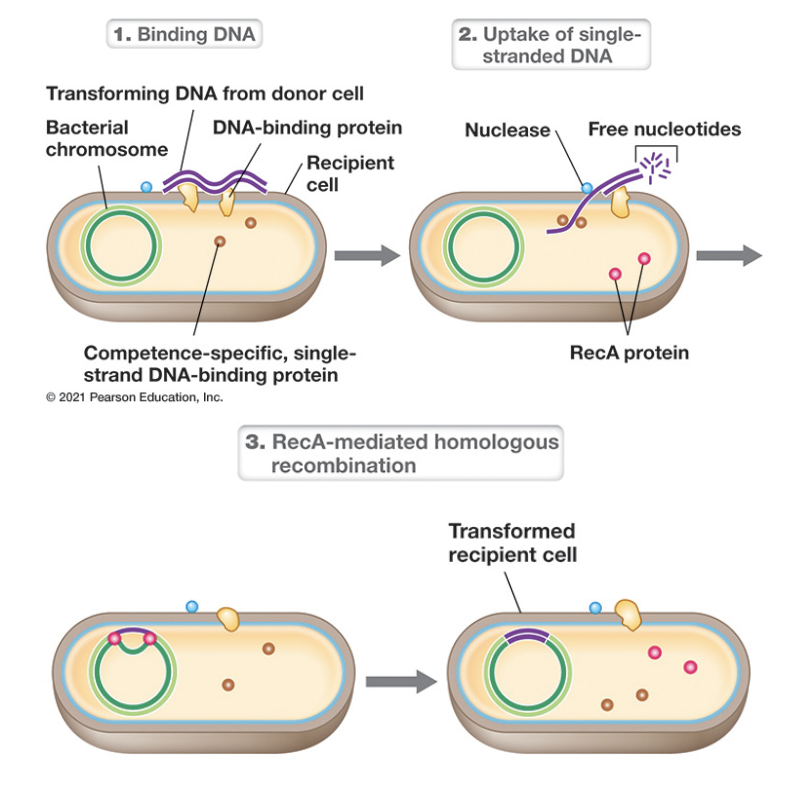
Free DNA is incorporated into a recipient cell and brings about genetic change
Competent cells can take up DNA
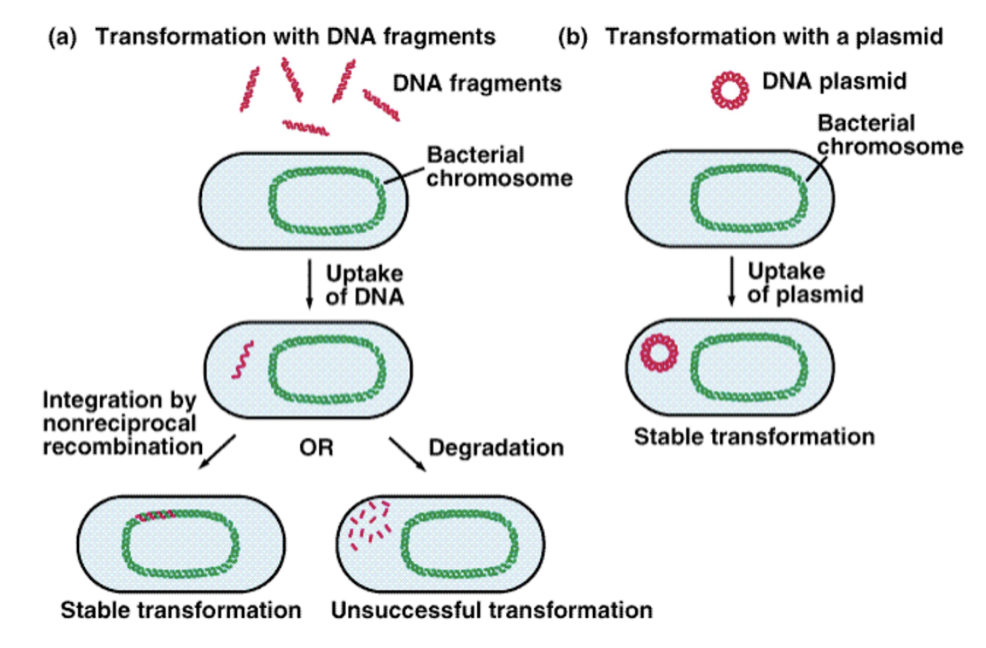
DNA can be added to the chromosome using RecA or a plasmid can be replicated in the cytoplasm without recombination
Can lead to a stable transformation or the DNA can degrade, which leads to an unsuccessful transformation.
Transduction
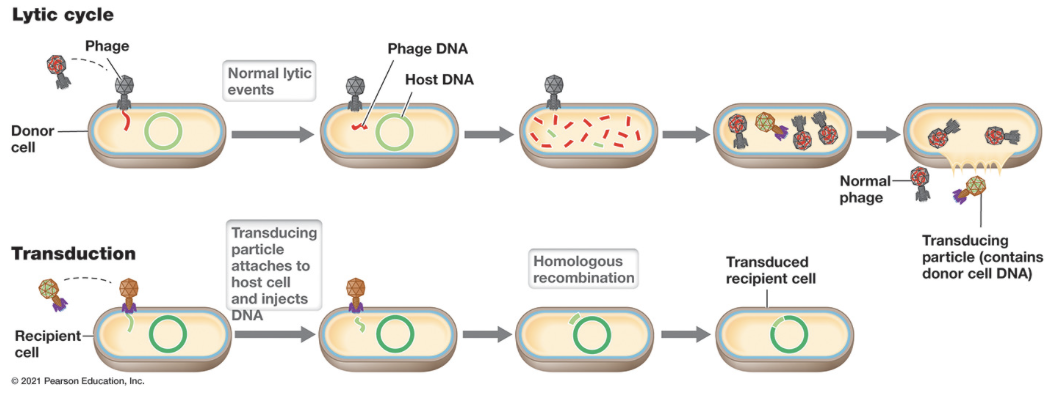
Transfer of DNA from one cell to another by a bacteriophage (virus that infects bacteria)
Low efficiency: 1/10^6 to 1/10^8 are transduced
Can be generalized or specialized
Generalized transduction
Non-specific DNA from the host genome is packaged inside the virion
Donor genes will be lost without homologous recombination
Caused by the lytic cycle
Lytic: A virus is going to infect, replicate, and leave. Lytic cycle leads to the death of the host.
A bacteriophage is going to infect a bacterium carrying out its normal viral replication cycle, which we'll talk about more specifically. Typically, that involves breaking up all of the host DNA because it doesn't need it, and then replicating its own DNA. And then packaging of this new virus typically occurs just randomly, the virus structure is going to form around pieces of DNA.
Sometimes these viruses mistakenly package around bacterial DNA. When that new bacteria phage leaves it carries bacterial DNA, it can bind to and begin to infect a new host. And when it inserts DNA, it's the donor DNA and not viral DNA, thereby inserting linear DNA into a host. That linear DNA can then be incorporated into the chromosome by homologous recombination. So now you have successful transduction.
Specialized transduction
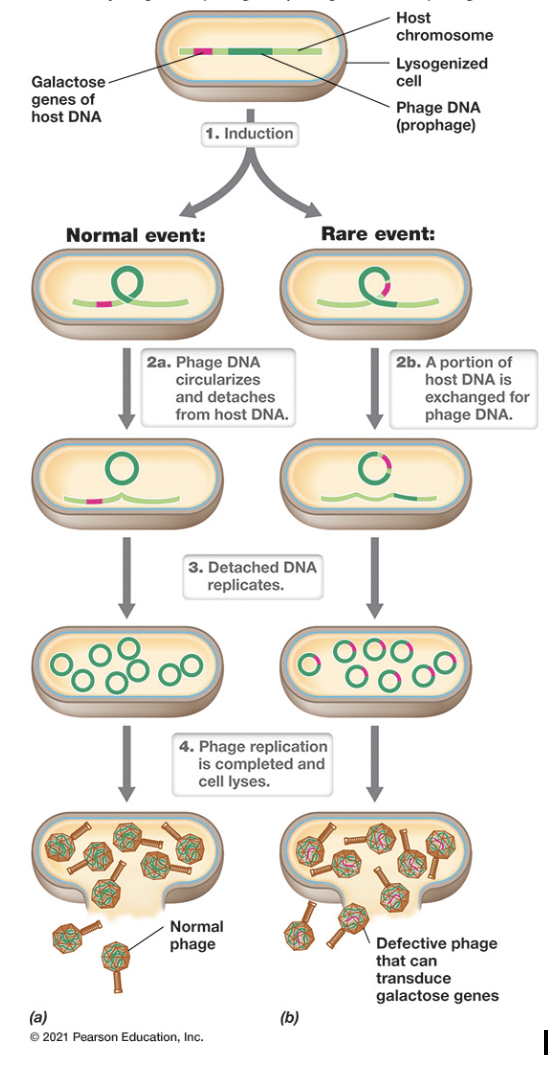
DNA from a specific region of the host chromosome is integrated directly into the virus genome
Donor genes inserted by homologous recombination or during viral replication
Starts with lysogenic cycle
Lysogenic phages (integration of phage into the host genome)
Normal:
Starts with induction. The phage DNA (prophage) circularizes and detaches from the host DNA
The detached DNA then replicates and once finished, the cell lyses and normal phages are released
Rare:
Starts with induction. A portion of the host DNA is exchanged for phage DNA.
Detached DNA then replicates and once finished, the cell lyses and defective phages are released which can transduce the host DNA within.
Conjugation
Mating
Horizontal gene transfer that requires cell-to-cell contact
Plasmid-encoded (F-plasmid)
Requires relatedness
Transfer DNA through pilus
Donor cell: Contains conjugative plasmid (F+)
Recipient cell: Does not contain plasmid (F-)
F+ always mates with F-
F+ and F+ don’t mate
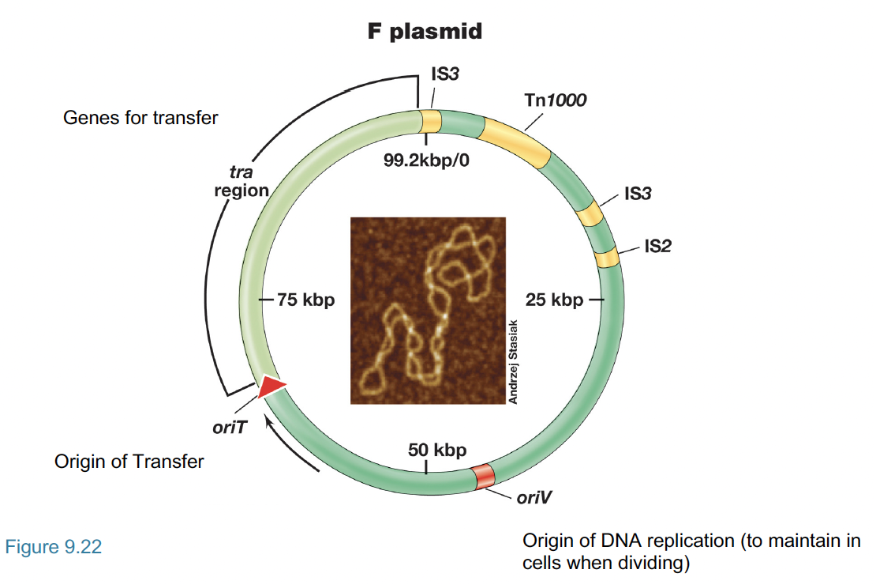
Genetic Map of the F (Fertility) Plasmid of Escherichia coli
oriV: Vertical gene transfer
oriT: Horizontal gene transfer
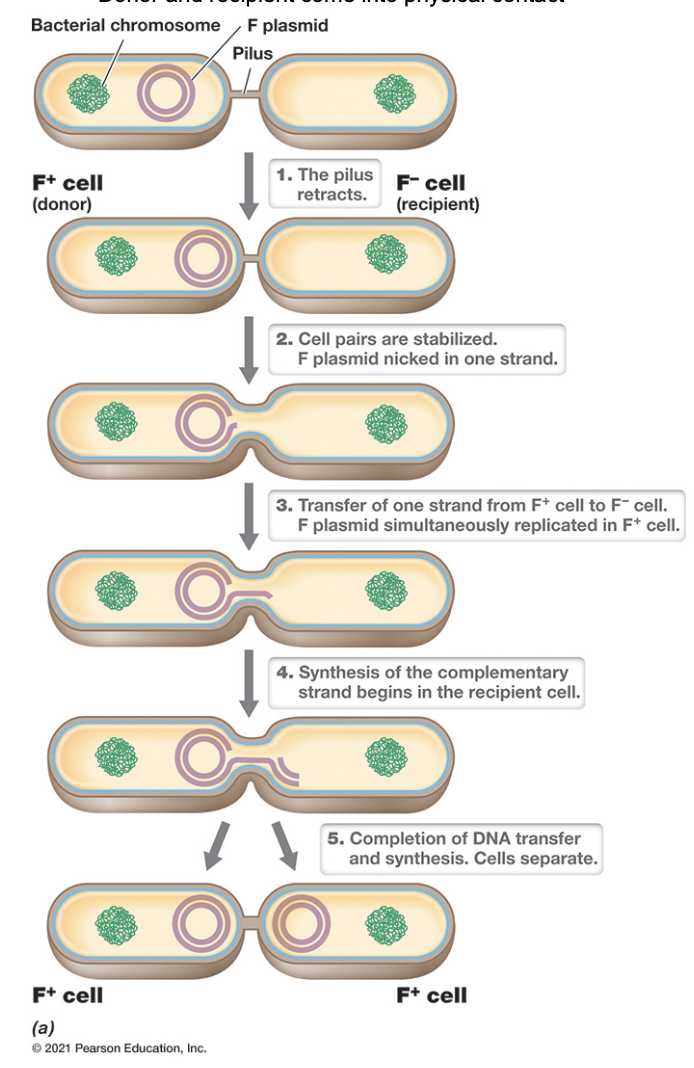
F Plasmid DNA Conjugation
Takes five minutes
Beings with F+ and F-
Ends with F+ and F+
Donor and recipient come into physical contact
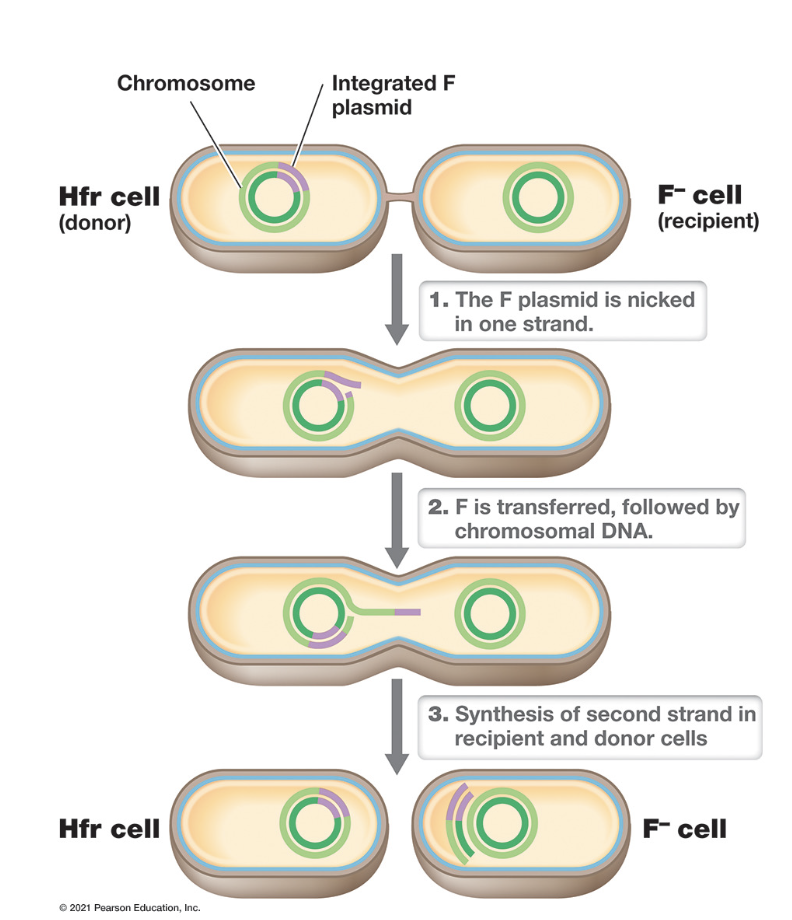
Hfr Strains
F+: Cells possessing a nonintegrated F plasmid
Hfr (high frequency of recombination): Cells possessing an integrated F plasmid
High rates of genetic recombination between genes on the donor (Hfr) and recipient (F-) chromosomes
Integration provides mechanism for mobilizing a genome
Cannot accept f plasmid from F+
Only mates with F- and allows F- to remain negative
F- cell does not receive entire copy of the F plasmid instructions but products are still genetically different
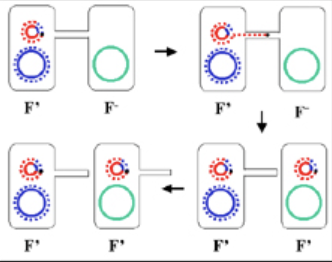
F’ Conjugation
F’ (F-prime) plasmids are F plasmids containing chromosomal genes
F’ plasmids transfer chromosomal genes to recipients at high frequency
Allows pair with F- cells
Deinococcus radiodurans
Withstand a 1000x more radiation than a person can
Humans die from 500-1000 rads
Deinococcus radiodurans can survive up to a 1.5 million rads
Most radiation resistant organism on the planet
Can repair mutations in ss (single stranded) and dsDNA (double stranded)
Cleans up toxic waste