Anatomy - lower leg and foot oia/function/injuries/
 Call Kai
 Learn
 Practice Test
 Spaced Repetition
 Match
 Flashcards
 Knowt Play
1/92

There's no tags or description
Looks like no tags are added yet.
93 Terms
20
normal dorsiflexion
45
normal plantarflexion
30
normal inversion
20
normal eversion
inversion
lateral ligaments resist excessive _________
eversion
medial ligaments resit excessive _________
femur
origin
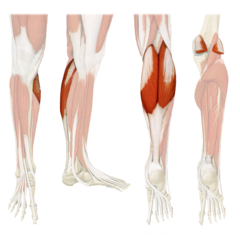
calcaneous
insertion

gastrocnemius action
plantar flexes foot and flexes knee
flexes knee, plantar flexes foot
action

fibula
origin

calcaneous
insertion

plantarflexion with bent knee
action

tibial shaft
origin
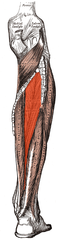
medial malleous
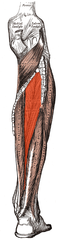
inversion
action

midway tibia
origin (flexor digitorum longus)

3-5 phalanges
insertion

fibula
origin

distal phalanx first toe
insertion

calcaneous
origin

middle phalanx 2-5
insertion

flexion of PIP 2-5
flexor digitorum brevis action
flexion of DIP 1
flexor hallucis longus action
flexion DIP 2-5
flexor digitorum longus action
midfoot
origin
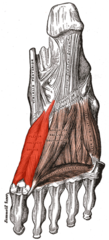
proximal phalanx 1
insertion

flexion of mtp 1
flexor hallucis brevis action
Abduct toes
abductor halucis, abductor digiti minimi ACTION:
calcaneous
origin

proximal phalanges 1-5
insertion

maintain arch
plantar fascia action:
tibia
origin

medial metatarsal 1
insertion
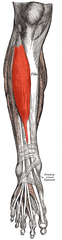
dorsiflexion
tibialis anterior action
fibula head
origin

distal phalanges 2-5
insertion

middle of fibula
origin

disal phalanx 1
insertion

extend dip 1
extensor hallucis longus action
midfoot
origin

middle phalanx 2-4
insertion

extend pip 2-4
action of extensor digitorum brevis
midfoot
origin

proximal phalanx 1
insertion

extend mtp 1
extensor hallucis brevis action
fibula head
origin

base of mtp 1
insertion

crosses over
fibularis longus laterally _______ the base of the first mtp
eversion
fibularis longus action
middle fibula
origin

base of mtp 5
insertion

eversion
fibularis brevis action
fibula
origin

base of mtp 5
insertion

eversion
fibularis tertius action
planatar fasciitis
inflammation of plantar fascia (heel to toes)
-mechanisms: arch problems, obesity, bad shoes
worsens
in plantar fasciitis, pain _______ in the morning
heel spur
a calcium deposit in the plantar fascia nears its attachment to the calcaneus bone that can be one of the causes of plantar fasciitis
pes planus
flat foot
tibialis posterior
strengthen the. ______ _________ to help with pes planus
pes cavus
Abnormally high arch of the foot
hammer toe
Proximal phalanx permanently dorsiflexed at the PIP joint
A callosity or callus often develops where the dorsal surface of the toe repeatedly rubs on the shoe
claw toe
PIP and DIP fixed in flexion
arch strain
refers to an inflammation and/or burning sensation at the arch of the foot
valgus
position of a body part that is bent outward
hallux valgus

tailors bunion

turf toe
Hyperextension of the great toe

lisfranc injury
an injury of the foot in which one or more of the metatarsal bones are displaced from the tarsus

jones fracture
avulsion fracture of the base of the fifth metatarsal

plantars neuroma
pinching of interdigital nerve
lateral sprain
85% of ankle sprains
anterior talofibular ligament is most commonly sprained
tibiotalar
what joint is affected in lateral sprains?
talar tilt
CF ligament, tilt talus to see if its loose
greater than 10 deg is significant;

anterior drawer
more than 3 mm of movement indicates ATF sprain

medial ankle sprain
injury to the deltoid ligament
longer to heal than lateral
-excessive eversion
kleigers
test to externally rotate ankle to stress medial structure
tibialis posterior
strengthening the ______ _______ is important for medial sprain rehabilitation
high ankle sprain
tibiofibular joint sprain; AiTFL PiTFL
- foot pushed inter external rotation with interanl lower leg rotation
- affects talus
squeeze test
squeeze bones to form gap at distal TF spaice
positive test with pain
peroneal tendon subluxation
Partial displacement of peroneal tendon (usually longus);
rupturing retinaculum
medial tibial stress syndrome
Pain that occurs below the knee either on the front outside portion of the leg or on the inside of the leg; SHIN SPLINTS
compartment syndrom
Swelling in a confined space that produces dangerous pressure; may cut off blood flow or damage sensitive tissue.
- chronic and acute (acute is due to trauma)
ischemia
Lack of blood supply
overlength or overload
muscle strains are cause by _________ ___ ________
achilles tendonitis
inflammation of the Achilles tendon causing severe pain
- heel lift in shoe can relive stress
tendonosis
breakdown of a tendon without inflammation
chronic inflammation
thompson test
compression of the calf muscle while observing for plantar flexion to assess the stability of the Achilles tendon
retrocalcaneal bursitis
Inflammation of the bursa between the Achilles tendon and the calcaneus.
achilles tendon reflex
S1-S2
a stretch reflex; tapping this tendon in the heel normally causes plantar flexion of the foot; also called the ankle-jerk reflex
kleigers

talar tilt
