12, 13, 14 Mutation & evolution, mechanisms, & effects
 Call Kai
 Learn
 Practice Test
 Spaced Repetition
 Match
 Flashcards
 Knowt Play
1/34

There's no tags or description
Looks like no tags are added yet.
35 Terms
Are mutations good or bad?
It is extremely dependent on the situation. For example if E. coli mutates more maltodextrin pores (LamB) in a maltodextrin rich environment then it is a positive. However, LamB is also a Lamda Phage binding site, so if there is the phage present then it is detrimental to the bacteria.
What did the MEGA plate experiment display?
It showed the evolution of antibiotic bacteria over the course of time.

What are 3 targets for antibiotics to target?
Enters and accumulates
Interacts with targets within cell
Death or growth inhibition
What are 3 ways bacteria deal with the targets?
Decreased entry / increased efflux
target overpopulation/target modification
antibiotic modification/destruction or target bypass
(She also wants you to think about how these modifications would come about; what would the phenotype look like?)

How do you know if resistance is spontaneous or induced by antibiotics?
Spontaneous - random mutation was present in the population prior to selection. The number of mutants would fluctuate
Induced - mutation occurred in response to selection; the number of mutants would be constant
What did the Luria-Delbruck experiment show?
It showed that the resistance was due to a heritable change of the baterial cell which occurs independently of the action of the virus
What is a worry with antibiotic resistance?
Some selecting agents can induce mutations, subleathal levels of antibiotics can induce highly resistant bacteria.
Are mutations all random?
No, there are differences in mutations between essential genes and non-essential genes. Some organisms show associations between mutation frequencies and features of the genome have been shown.
What are reasons why all bateria resistant to antibiotics?
if bacteria is in an environment that doesn’t have antibiotics, that machinary could be a waste of resources
bacteria simply wasn’t exposed
What are the base pair change mutations?
Transition:
Purine —> Purine T<-—>C
Pyrimidine —> Pyrimidine A < —- > G
Transversion:
Purine —> pyrimidine
Pyrimidine —> Purine G or A < —- > C or T
What are some causes for base pair changes?
chemical changes in bases —> bases can pair differently
chimcal alteration in bases are induced by mutagens —> bases can pair differently
mutagens can be base analogs —> analog base mispair during replication
errors in replication —> wrong nucleotide is added —> mispairing
What happens if a base alteration happens prior to incorporation into DNA?
DNA only has 1 mismatched base in the pair, the mutation doesn’t happen until AFTER replication when that mismathced base is paired with the mutant base.

What happens if base alteration happens on the DNA
A chemically altered wtDNA base is replicated, leading to a mismatch, THEN the SECOND generation has the mutated DNA

How can mutations occur spontaneously?
Keto-enol tautomerization and amine-imine tautomerization. The equilibrium favors the correct version, however, they can randomly mutate to enol/imine versions.

What can enol and imine forms allow?
Enols - G or T allow them to form G-T pairs
Imine - A or C allows for A-C pairs
How do cells know there is a mismatch?
A mismatch will typically create a bend in the DNA. Furthermore, there can be helix width changes due to mutations that can be noticed.

How do cells know which strand to fix?
Methyl-directed mismatch repair
Parent-strand As are methylated by Dam methyltransferase (prior to breaking) , and the new strand is temporarily unmethylated (<2 min).
The two strands can be distinguished by the MutS homodimer, which binds to mismatches, changing its conformation to hydrolyze ATP and recruit MutL homodimer.
MutS/L move to the hemimethylated site, recruit MutH and nick the unmethylated strand.
Exonucleases degrade the nicked strand towards the mismatch
DNA pol III fills gaps, ligase seals nicks
Dam methylase methylates new DNA
Each step increases DNA replication fidelity

How can addition/deletion of 1 or a few bp happen?
DNAP falls off DNA misaligns at repeates. Either a the new strand loops, adding 1 bp, or the template strand loops, deleting a bp.

What is recombination?
Breaking and rejoining DNA in new combinaitons
this can happen to 1 strand of DNA, removing apart of a strand
Requires enzymes that recognize a variety of substrate structures in DNA, process them, and rejoin them
Involved in
repairing DNA double-strand breaks and stalled DNA replication forks at strand breaks
genetic exchange
transposition
genomic rearrangements
Inversion can occur through recombination
Be sure to understand how to draw recombinations.

What ar ethe two types of recombination?
Homologous - large deletions and insertions inversions (the loops previously known)
Nonholologous - transposition (cut and paste and copy and paste)

What are transposons?
Aka transposable element, IS element, Tn - mobile DNA element that can direct its insertion into a target DNA using a transposase, marked by inverted repeats so the transposase can recognize it
It can be replicative and non-replicative

What is transposition?
movement that is catalyzed by a transposase enezyme encoded by a gene located within the transposons
How does tranposases function
It recognizes inverted repeats, binding to them, and breaking the dsDNA. From there it locates target, inserts the transposon to match with direct repeats, and the host repairs the dsDNA.
How can transposon lead to spread of antibiotic resistance?
Transposons can jump to conjugative plasmids, spreading through conjugation. They can also be uptaken through transformation.
What are the 3 types of mutations?
base pair change
Change in the number of DNA bp
Addition/deletion of 1 or a few bp - similar effect to 1
transposition
Large insertions/deletions
inversions
What are the consequences of bp (I/D of few bp) mutation in regulatory/promoter/SD site
Transcription or translation could be altered, leading to changes in when and/or how much RNA/proteins are made.
Mutations can change binding efficiency to activators and repressors too
Also, be able to recognize what effect would happen if different portions of regulatory pathways were to change
What aer activators and repressors?
Activator - stimulates transcription (postivie control)
Repressor - inhibits transcription (negtaive control)

What are the consequences of a bp (I/D of a few bp) mutation in a gene that encodes an untranslated RNA?
RNA can be affected at the level of:
stability
changes in structure/folding changes
function
changes in the anticodons
OR no effect
What are the consequences of a bp (I/D of a few bp) mutation in a gene that encodes a protein.
Synthesis - more or less produced
Stability - folding process/structure
Function
What are the consequences of a bp change in the Open Reading Frame?
silent - aa is not changed (synonymous substitution)
missense - aa is changed to another aa
nonsense - aa is changed to a stop codon
UAG - amber
UAA - ochre
UGA - opal
Mutations DON’T always cause a change in the phenotype of the protein

What are the 3 types of codons?
wild type codons - produces native DNA/RNA
Fast (optimized, common) and Slow (rare) codons - produces native, misfolded, degraded, and aggregated proteins.
*keep in mind that slow codons can allow time for correct folding, while fast CAN the opposite (ofc 1 doesn’t always mean 1 outcome, just what typically happens)
Can silent mutations still have an affect?
Yes, despite the AA not being changed, it could still affect the amount made or even the folding (changes binding affinity)
What could happen with transposition and large insertions/deletions
genes disruption, gene loss/gain, changes in expression, chromomal rearrangements
What are the consequences of inversions?
It prevents the transcription of a gene. Some cells use this as a mechanism to turn on and off the gene (as a regulatory technique). `

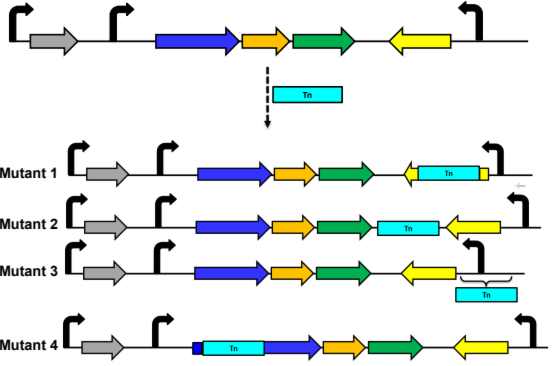
What are some consequnces of Tn insertions?
It can render a gene useless, it can encorperate itself into a gene, it can affect the promotor and it can ismply be inbetween genes.