PSYCH Exam 2
 Call Kai
 Learn
 Practice Test
 Spaced Repetition
 Match
 Flashcards
 Knowt Play
1/142

There's no tags or description
Looks like no tags are added yet.
143 Terms
Is classical conditioning voluntary or involuntary?
Involuntary
What is CS
Conditioned Stimulus
What is CR
Conditioned Response
What is US
Unconditioned Stimulus
What is UR
Unconditioned Response
What is habituation? (CC)
Getting the subject accustomed to the CS so they don’t respond to it
Ex - Repeatedly ring bell (CS) until the dog doesn’t notice it
What’s the difference between the CR and UR?
UR - Natural, just happens
CR - Trained, happens due to association of CS with US
TRUE or FALSE — The CR and UR are always the same
FALSE !!
When a rat is shocked electrically, its heart rate increases. A flashing light is
introduced right before the rat is shocked. Eventually, the rat’s heart rate increases at
just the sight of the flashing light.
Identify US, UR, CS, and CR
US - Shock
UR - Heart rate increase
CS - Light
CR - Heart rate increase
When a rabbit is shocked electrically, its heart rate increases. A beeping noise is
introduced right before the rabbit is shocked. Eventually, the rabbit’s heart rate decreases to counteract the shock at the beep.
Identify US, UR, CS, and CR
US - Shock
UR - Heart rate increase
CS - Beep
CR - Heart rate decrease
What are the three measurements of a conditioned response?
Amplitude, Probability, and Latency
What is Amplitude? (CC)
The strength of the conditioned response (CR)
Ex - Amount of salivation
What is Probability? (CC)
How often the CR occurs when paired with the CS
Ex - Dog only salivates 1/10 of the time
What is Latency? (CC)
Period of time before CR occurs
Ex - Dog salivates after 10 seconds of hearing the bell
What are four terms used to describe how Classical Conditioning works?
Acquisition, Extinction, Spontaneous recovery, and Rapid reacquisition
What is Acquisition? (CC)
The amount of time it takes for the subject to learn the CR
What is presented to the subject during Acquisition? (CC)
US and CS
TRUE or FALSE — Longer the periods of acquisition yields stronger amplitude of the CR
TRUE !
What is Extinction? (CC)
The concept that providing the CS without the US diminished CR strength
What is presented to the subject during Extinction? (CC)
Just CS (no US)
What is a Reinforced Trial? (CC)
A trial during the acquisition period
US is given to the subject alongside the CS
What is the opposite of a reinforced trial? (CC)?
An extinction trial
CS without US
Why does Exctinction occur? (CC) - Buildup of Inhibition (long answer)
Buildup of Inhibition
If CS no longer leads to US, then CR will no longer occur
If bell no longer means food, then bell no longer leads to salivation
What is Spontaneous Recovery? (CC)
24 hours after the last experiment, CR is recovered without any further training!
What is presented to the subject during Spontaneous Recovery? (CC)
24 hours after the last trial, just the CS is presented and the CR is obtained
TRUE or FALSE — During Spontaneous Recovery, the CR has higher amplitude (CC)
FALSE !!
TRUE or FALSE — Repeated Spontaneous Recovery experiments may lead to extinction quicker than reinforced trials (CC)
TRUE !
What is Rapid Reacquisition? (CC)
If the subject undergoes extinction and stops producing the CR, they will learn the CR even faster is the experiment is repeated again!
What is presented to the subject during Rapid Reacquisition? (CC)
US and CS
Why does Exctinction occur? (CC) - What is Learned
Inhibitory associations are learned
Ex - Learns that bell does not equal food
When inhibition is as strong as excitation . . .
Extinction (CC) has occurred
When an excitatory association is permanent . . .
Acquisition (CC) has occurred
:: Excitatory association is permanent, inhibitory association is temporary (CC)
:: Why Spontaneous Recovery occurs after 24h
What are some experimental aspects of Classical Conditioning?
Contiguity and Optimal Time Interval
What is Contiguity ? (CC)
Closeness in time between presenting CS and US
What is the Optimal Time Interval? (CC)
The best time between presenting the CS and US to yield the strongest CR
TRUE or FALSE — The Optimal Time Interval is the same for every experiment? (CC)
FALSE !!
TRUE or FALSE — Stronger CS yields the same CR
FALSE !! — Ex - Louder bell = More salivation
How does Second Order Conditioning work? (CC)
Train subject on US + CS 1 until acquisition is complete
Train subject on CS 1 + CS 2 until acquisition is complete (remove US)
Subject will now yield CR to CS 2 OR CS 1 only (both, independently)
Why can’t we continue onto even higher levels of conditioning? (CC)
Extinction prevents this
If CS 2 no longer leads to US, it won’t be long until inhibition is learned
Why does higher order conditioning work? (CC)
The first CS presented acts as a US if conditioning is thorough enough
CS 1 = Secondary reinforcer
What is generalization? (CC)
Similar stimuli yield similar responses
Ex - Red/Pink flashing both lend to the same response
What is Discrimination? (CC)
Different stimuli yield different responses
Ex - Blue/Yellow flashing lend to different responses
How can Discrimination be achieved? (CC)
Over-training: Repeatedly use the same stimuli to produce a response
Learns inhibition for different stimuli and excitation for correct CS
Example of CR not being the same as UR
Rabbit hears a beep (CS) and is shocked (US)
Rabbit lowers heart rate (CR) when it hears the beep to avoid a spike in heart rate (UR)
What did Pavlov believe about the relationship between the CS and US?
The dog began to think of the CS (bell) as though it were the US (food)
What did Rescorla believe about the relationship between the CS and US?
The dog learned that the US (receiving food) was contingent upon the CS (bell)
What is a Preparatory CS/US association? (CC)
The CS prepares the body for the US, causing the body to compensate for the event (shocked rabbit example)
What is Contingency? (CC)
Receiving the US is contingent upon (dependent) the presence of the CS
Who is Ivan Pavlov?
Dog experiment psychologist studying classical conditioning
Who is B.F. Skinner?
Behaviorist, developed the Skinner Box, operant conditioning
Who is Edward Thorndike
Psychologist, Cats in a puzzle box, Operant conditioning
Is operant conditioning voluntary or involuntary?
Voluntary - Under the subject’s control
What can we learn from operant conditioning?
Learning is gradual, happens bit by bit
Trial/Error
There’s no sudden insight happening that happens
What Operant Conditioning experiments did Edward Thorndike do?
He put hungry cats in puzzle boxes
What is Reinforcement? (OC)
Positive reward for completing an action
What is Behavior? (OC)
The action we want the subject to produce
What is the mechanism of Operant Conditioning?
The Law of Effect
What is the Law of Effect? (OC)
Responses are strengthened when followed by reinforcement and diminished when followed by punishment
TRUE or FALSE — Reinforcement is contingent on a response
TRUE !
What is Delay (of Reinforcement)? (OC) (long answer)
The longer the time between the behavior and the reward, the weaker the association
Have to present reinforcement close after the behavior
What is reinforcement? (OC)
Anything that increases the rate of response, even if it’s not necessarily positive
What is Positive Reinforcement? (OC)
Adding something to the experiment to increase the rate of response
What is Negative Reinforcement? (OC)
Removing something from the experiment to increase the rate of response
What is Punishment? (OC)
Anything that decreases the rate of response
What is Positive Punishment? (OC)
Adding something to the experiment to reduce the rate of response
What is Negative Punishment?
Removing something from the experiment to reduce the rate of response
What is a Discriminative Stimulus? (OC)
A certain stimuli tells an individual what to do in a particular situation

What is a Skinner box?
Operant conditioning box that basically runs its own experiment. The box can be used to collect its own data/see how many responses were made in a specific time
What did B.F. Skinner do?
Invent a way to record many responses with little time/effort
Ex: A rat presses a bar and only when the light is on, the rat receives reinforcement of food. When the light is off, and the bar is pressed, the rat DOES NOT receive reinforcement
Label Reinforcement (+type), what the light and pushing the bar are?
Positive Reinforcement = Food
Light = Discriminative Stimulus
Pushing the Bar = Behavior (operant response)
Classical : Operant, CR :
Operant response
Classical : Operant, US :
Reinforcement
Classical : Operant, CS :
Discriminative stimulus
Ordering of a classical conditioning experiment:
CS, US, CR
Ordering of an operant conditioning experiment:
(discriminative) Stimulus, Response, Reinforcement
What are the four timings of reinforcement in Operant Conditioning?
Fixed interval, and Variable interval
Fixed rate, and Variable rate
What is Continuous reinforcement? (OC)
Reinforcing the subject after every operant response
What is Partial reinforcement? (OC)
Reinforcing the rat sometimes
Benefits of partial reinforcement (OC)
Extinction takes longer to happen
What is an Interval? (OC)
The period of time after which a response is reinforced

What is a Fixed Interval? (OC)
The same duration of time passes before the reward
scalloped shape - rat knows reward is coming, presses only once
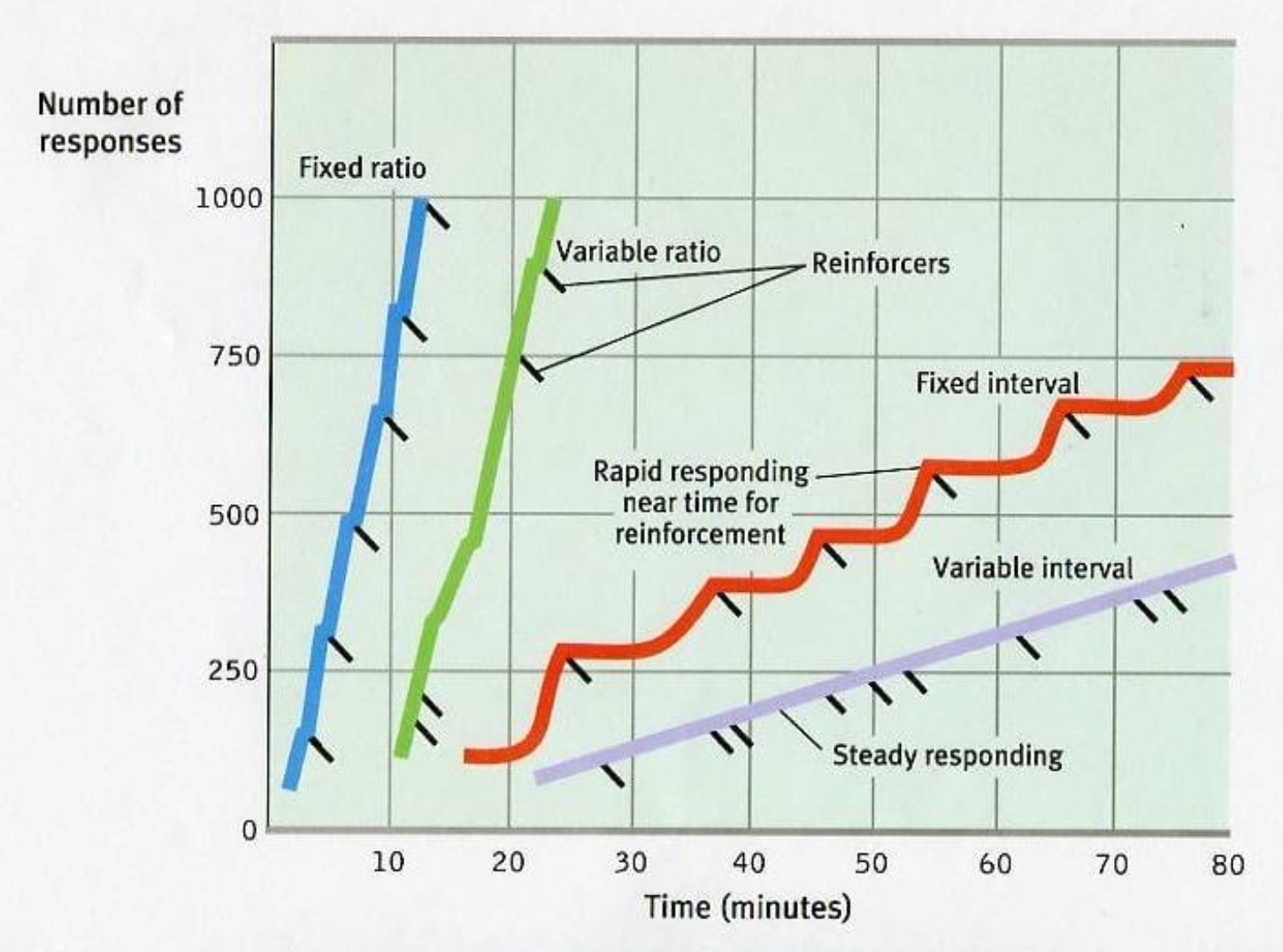
What is a Variable Interval? (OC)
Average duration of time prior to reward (uncertain wait time)
PURPLE LINE - rat doesn’t know when reward is coming
What is a Ratio? (OC)
Reinforcement after a certain number of responses

What is a Fixed Ratio? (OC)
Ratio of responses and rewards will always be the same
Ex - 10 button presses = 1 reward
BLUE LINE

What is a Variable Ratio? (OC)
Average ratio of responses prior to reward
GREEN LINE - Rat doesn’t know if reward is coming, continually presses
What is Shaping? (OC)
Trying to get the subject to do one behavior
What are the benefits of shaping? (OC)
Gets the animal to produce a response that it may not naturally do
How does shaping work? (OC)
Reward the animal for every little step it takes in direction of the operant behavior
What is Chaining? (OC)
Trying to get the subject to do a sequence of behaviors
What are the benefits of Chaining? (OC)
Links together responses that the animal would typically give into a chain of actions
How does Chaining work? (OC)
Start backwards in the chain, getting the subject to do response 10, proceeded by response 9, proceeded by response 8, . . .
Which matters more in classical conditioning? Contingency or Contiguity?
Contingency
What did Robert Rescorla do?
Rat fear experiment, Contingency > Contiguity, Classical Conditioning
Rescorla’s experiment to test Contiguity (overview)
3 groups of rats are shocked for the same amount of time (contiguity) after hearing a beeping noise
All rats have the same amount of fear of the beeping noise
Rescorla’s experiment to test Contingency
Group 1 is shocked 40% of the time, shock is not contingent on the beeping, so they’re not scared of the beeping
Group 2 is shocked 20% of the time, minor fear response
Group 3 is shocked 10% of the time, usually accompanied by beeping. They have the strongest fear response to the beeping
What is Belongingness? (CC)
A US and CS may belong together (in nature)
Example - Buzzing noise = Wasp, both generate fear
What did John Garcia do?
Rat and Quail, taste experiments, Classical Conditioning, Belongingness
Garcia’s rat experiment
(Rats associate taste with sickness) - Same rats used
Blue water = Sour/Sick ; Clear water = Normal → Avoid blue
Blue water = Normal ; Clear water = Sour/Sick → Avoid clear
Garcia’s Quail Experiment
(Quail associate color with sickness)
Blue Water = Sour/Sick ; Clear water = Normal → Avoid blue
Blue water = Normal ; Clear water = Sour/Sick → Avoid blue