Period Trends
 Call Kai
 Learn
 Practice Test
 Spaced Repetition
 Match
 Flashcards
 Knowt Play
1/13

There's no tags or description
Looks like no tags are added yet.
14 Terms
Coulomb’s law
Coulomb’s Law relates the strength of the force between two charged particles to the magnitude of the charge of the particles and the distance between the particles.
It states there is a direct relationship between the force of attraction and the distance between the particles.
Using Coulomb’s Law, what does it mean when the charges go up? *more protons
This mean the force of attraction increases, and as the distance between the particles(the distance from the nucleus to the valence electrons) increases, the force of attraction decreases.

How does Coulomb’s law apply to a subatomic level?
It applies to a subatomic level because protons and electrons are oppositely charged particles.
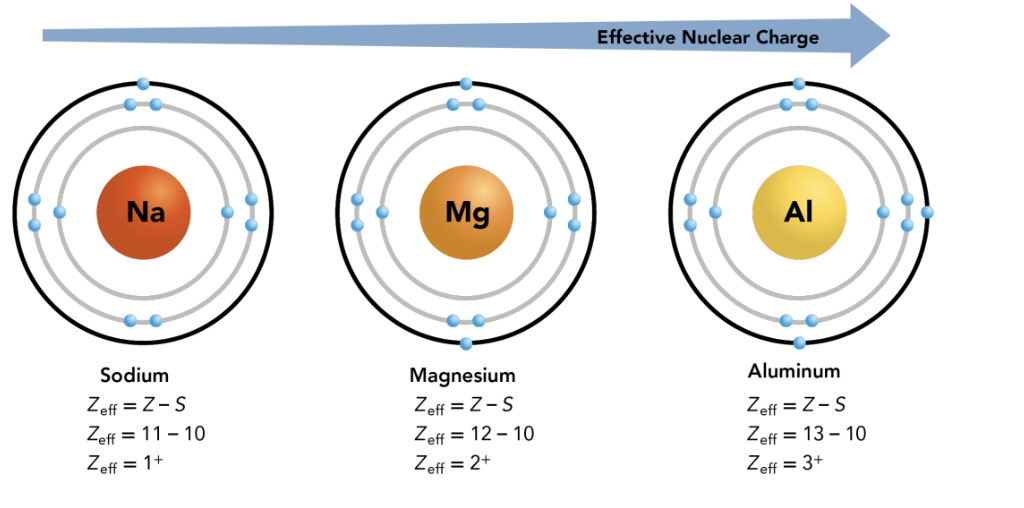
What does the term effective nuclear charge mean?
This describes the amount of nuclear attractive force that the valence electrons will experience.
Shielding effect
This explains how the repulsive forces from the core electrons(the electrons not in the outer shells) will shield the valence electrons from the full attractive forces of the nucleus.
IMPORTANT:Shielding increases going top to bottom down a group and doesn’t change going across a period
Why is effective nuclear charge and the shielding effect important?
They are used to explain the trends in the chemical and physical properties on the periodic table. *The bohr model is helpful to use when visualizing these concepts even though it is not the most accurate
Valence Electrons
Electrons in the outer shell of an atom
*Red electron in the image
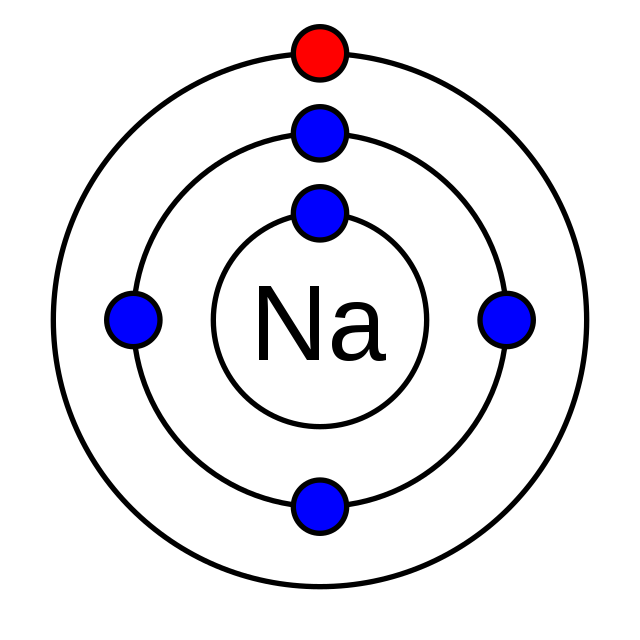
Core electrons
the electrons occupying the inner shells of an atom (if there are three shells, these electrons will be in the first and second shells surrounding the nucleus)
*Blue electrons in image

True or false: Since the sumber of energy levels doesn’t change from left to right across a period, shielding is NOT the reason why a property varies in a period.
TRUE
Periods
The row of horizontal elements from left to right
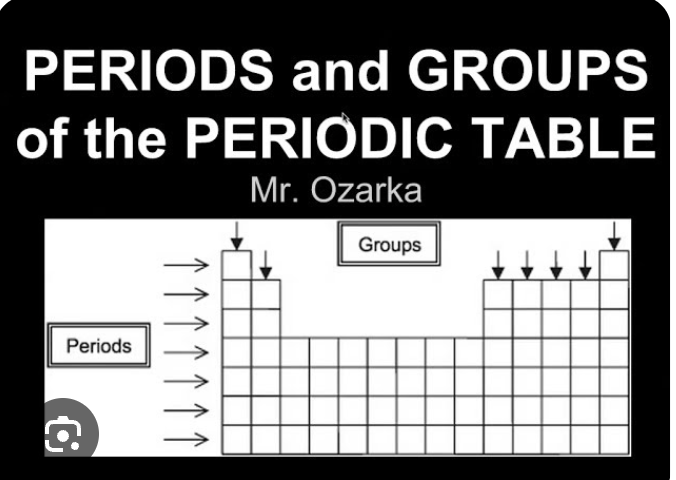
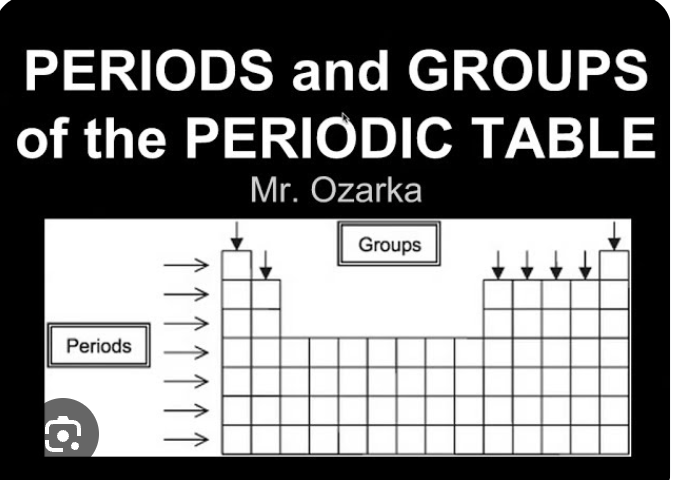
Groups/families
The vertical columns of elements in the periodic table
According to Coulomb’s law, as we move from left to right across a period, the number of protons in the nucleus increases, which means. . . .
the attractive force of the nucleus also increases. At the same time, the valence electrons are being added, but they are being added to the SAME PRINCIPAL ENERGY LEVEL. So, all the valence electrons are similar distances away meaning that distance has no effect on the attractive forces between the nucleus and valence electrons.
First Ionization Energy