Calculus Unit 2
 Call Kai
 Learn
 Practice Test
 Spaced Repetition
 Match
 Flashcards
 Knowt Play
1/19

There's no tags or description
Looks like no tags are added yet.
20 Terms
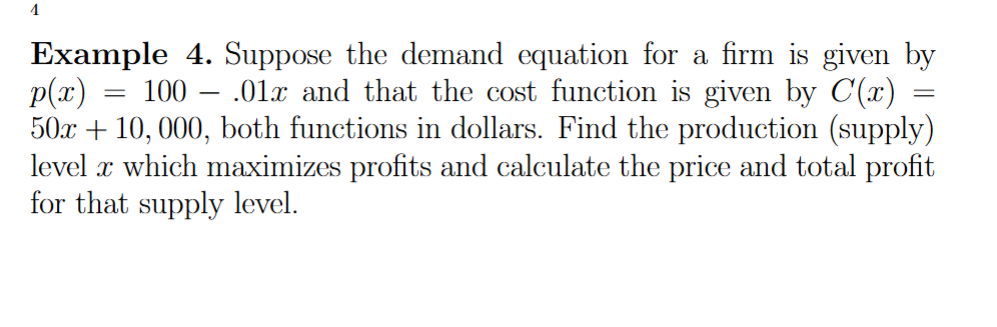
How do we find the total revenue function R(x)?
x times p(x) (the price function)

What does p(x) stand for
the price function
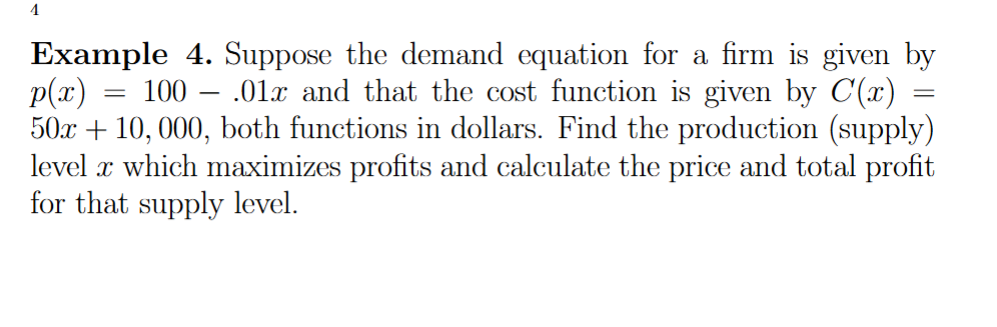
How do we find the total profit function P(x)?
subtracting total cost from total revenue: P(x)= R(x) - C(x)

How do we find the maximum profit?
take the first derivative of the profit function P'(x) (also known as marginal profit) and set it equal to 0
Find the critical values and critical points by ???
setting f prime of x to 0 and solving for x

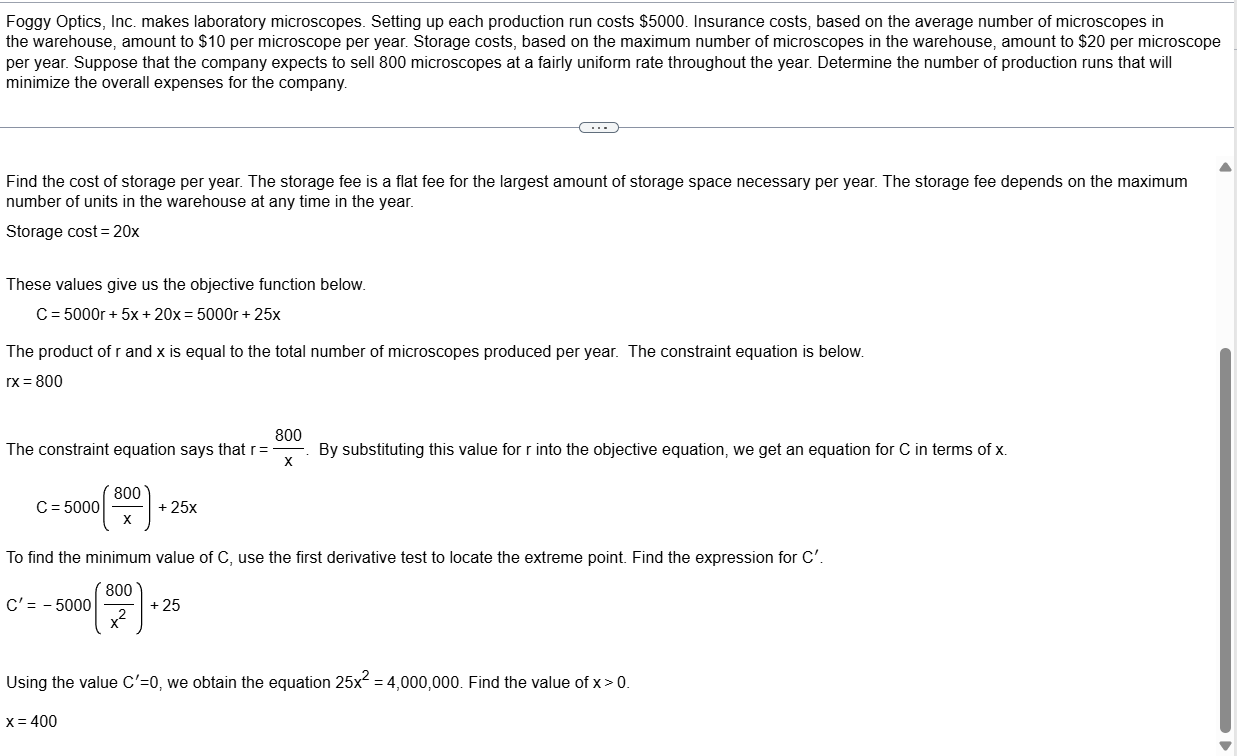
Let r be the number of production runs per year and let x be the number of microscopes produced per run. The overall expenses are equal to…???
the sum of the set-up cost, the insurance cost and the storage cost.

What do we do first in this problem? Why do we do this
Find the yearly cost of setting up production runs, the cost of insurance per year, and the cost of storage per year so we can set up the cost function C = set up cost + insurance cost + storage cost

What is the constraint equation for this problem? How do you know?
rx = 4000 because the product of r (# of production runs per year and x (# of microscopes produced per run) is equal to the total number of microscopes produced per year
What is a constraint equation?
an equation that derives from the original cost function. its the equation for the fixed, non-negotiable value given in a problem

What two equations do we have to find first to solve this?
the objective function and perimeter expression

What is the objective function and how do you know?
A = (x+140)w or A= xw +140w because A represents the area, when one side of the enclosure has length w and that the other side has length x + 140

What is the perimeter function and how do you know?
2(x+140) + 2w because the enclosure has dimensions of w feet by x + 140 feet and perimeter equals all the sides added together

What is the constraint equation and how do you find it?
2x + 2w + 140 = 840 , find it using the amount of perimeter that needs fencing expression and setting it equal to the amount of fencing in feet that is being added

How do we find the part of the enclosure which needs fencing? (constraint equation)
if perimeter equals 2x + 2w + 280 , then the part of the enclosure that needs fencing is 2x + 2w +140 = 840 and solve for w

What do we do after we’ve solved the constraint equation for w?
plug it back into the objective equation and solve for x so that we can take the first and second derivatives of the equation

what do we do to determine the enclosure with the largest possible area (the max of A)
use the first and second derivatives of A, determine the critical values by setting the first derivative equal to 0 and solving for x, use the second derivative to determine if that critical value corresponds to a maximum (if it’s negative then it has a maximum)
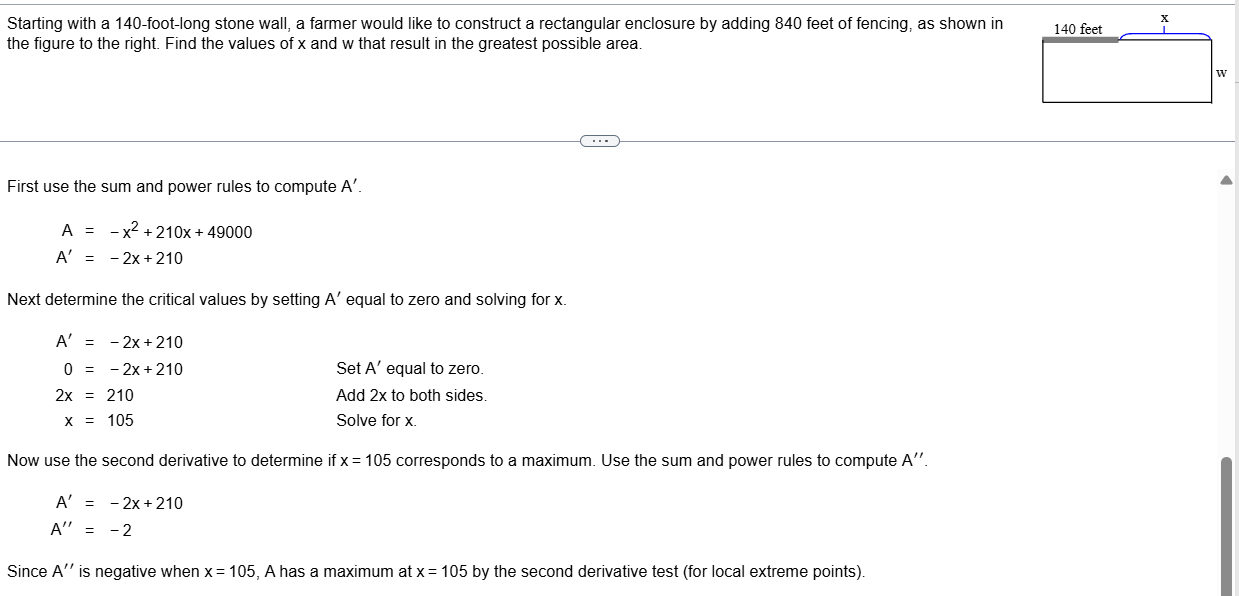
What is the final step in this problem once we have all this info?
substitute this value of x into the constraint equation and solve to find w giving us both the x and w values

What do we do first in this problem?
find an equation for the volume V of the package in terms of x, the square-end edge length, and z, the package length. The volume of a rectangular box is equal to the product of its dimensions so V=x²z

What is the equation for the sum of the dimensions and how do you know?
x+x+z = 210 or 2x+z = 210 because